The Ultimate Guide to Microbead Hair Extensions for Different Hair Types
Microbead hair extensions can feel confusing when you want more length and volume but worry about damage, slipping, or an unnatural finish. The wrong method can stress the roots and disappoint clients. The right match, however, can create a flexible, natural-looking result for many hair types.
Microbead hair extensions are semi-permanent hair extensions attached with small metal or silicone-lined beads instead of heat, glue, or sewing. They can suit fine, medium, thick, straight, wavy, and curly hair when the bead size, strand weight, hair quality, and installation method are selected correctly by a trained professional.

Microbeads are popular because they balance comfort, movement, and styling freedom. Still, they are not one-size-fits-all. I always recommend looking at the client’s hair density, scalp condition, lifestyle, and maintenance habits before choosing this method.
What Are Microbead Hair Extensions?
Choosing a hair extension method can be stressful because each option uses a different attachment system. Heat bonds may feel too permanent, tape-ins may not suit every scalp, and sew-ins may feel heavy. Microbead hair extensions offer another route with no glue, no heat, and no braiding[^1].
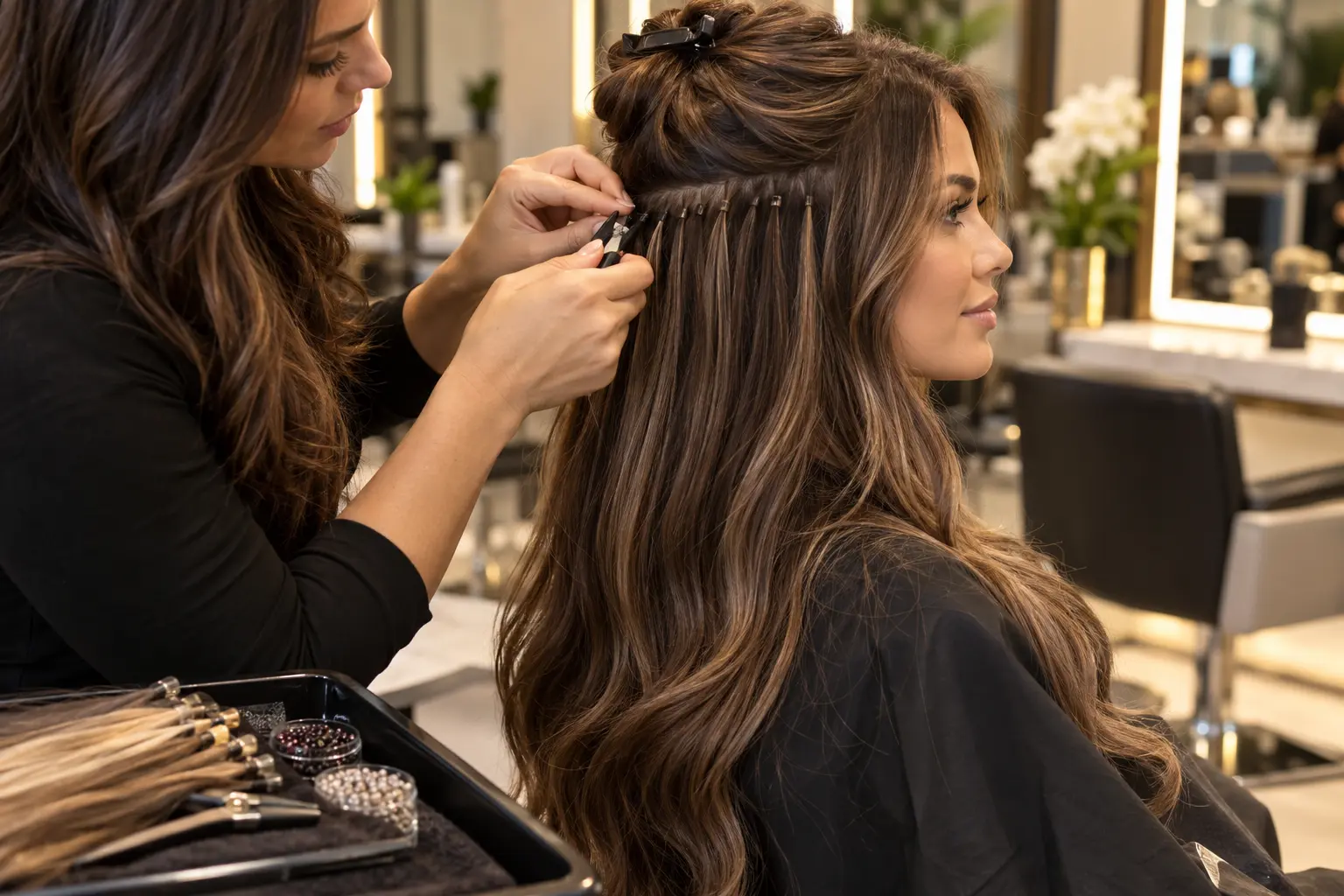
Microbead hair extensions are individual or small-section extensions secured to natural hair with tiny beads. A stylist pulls a small section of natural hair through a bead, inserts the extension strand, and clamps the bead to hold it in place. The result can look natural when the placement and weight are correct.
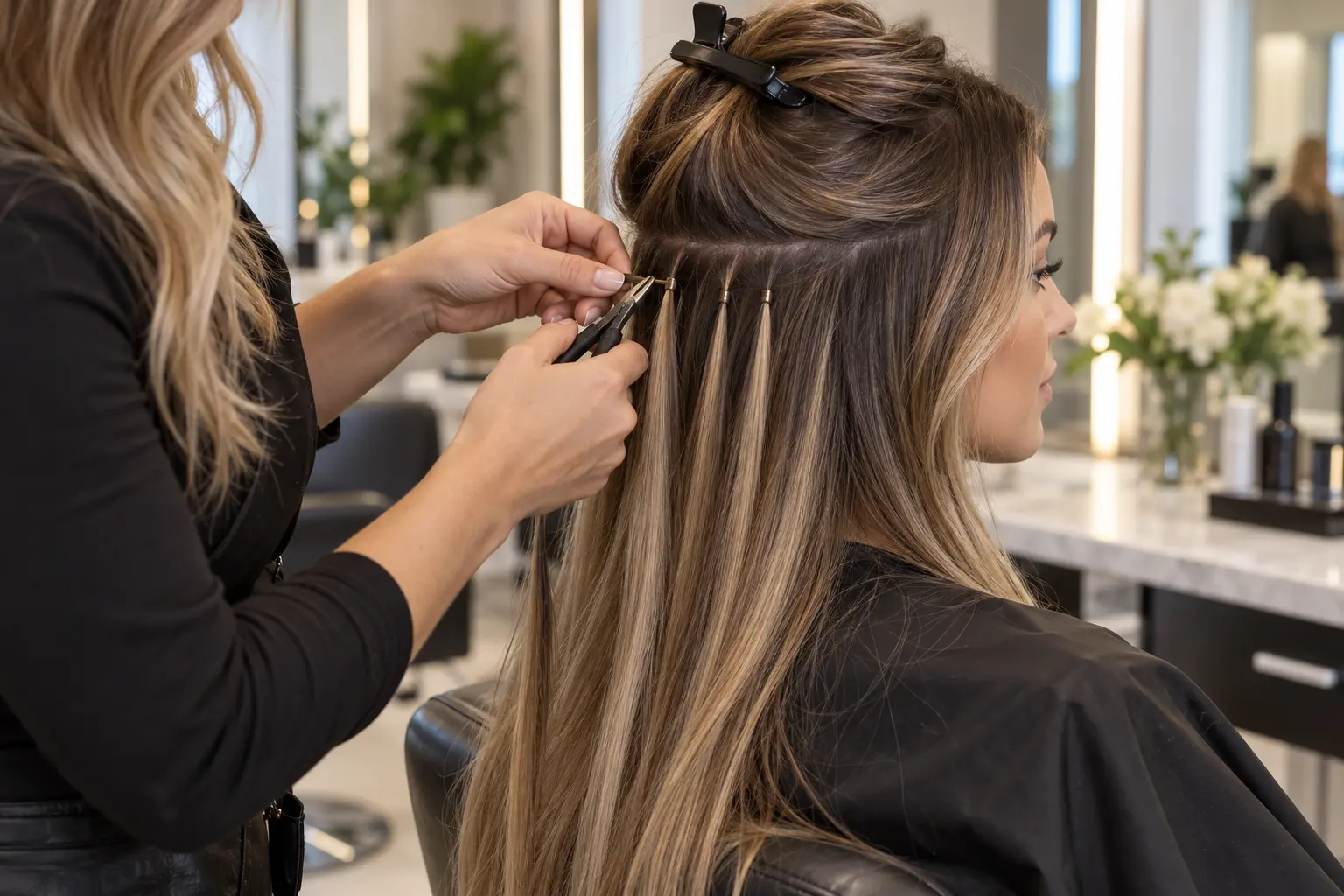
Microbead extensions are often called micro-link extensions, I-tip extensions, bead extensions, or cold fusion hair extensions. The names vary by market, but the core idea is similar. The stylist uses a small bead as the connection point between the client’s hair and the extension hair.
How the attachment works
A typical installation includes these steps:
-
Hair assessment
The stylist checks density, strand strength, scalp health, and desired result. -
Sectioning
The hair is divided into clean rows to keep the placement controlled. -
Bead application
A small amount of natural hair is pulled through a bead. -
Extension insertion
The extension strand is positioned inside or near the bead. -
Clamping
The bead is pressed flat enough to secure the hair, but not so tight that it damages the strand. -
Blending and cutting
The stylist trims and layers the extensions to match the natural hair.
Common bead and hair options
The bead itself matters more than many buyers realize. A poorly coated bead can slip, expose metal, or create discomfort. In B2B purchasing, I suggest buyers request details about bead material, inner lining, color options, and size consistency.
| Component | Common Options | Buyer Evaluation Point |
|---|---|---|
| Bead type | Metal bead, silicone-lined bead | Silicone lining may improve grip and comfort[^2] |
| Extension type | I-tip human hair, stick-tip hair | Tip consistency affects installation speed |
| Hair quality | Remy hair[^3], cuticle intact hair[^4], processed human hair | Buyers should verify claims with samples |
| Color range | Natural shades, balayage, piano, fashion colors | Shade consistency matters for salons |
| Length | 14–24 inches common | Longer lengths require stronger hair and careful aftercare |
In my experience, salons and wholesalers often focus first on color and length. That is understandable because clients see the final look. However, the connection system controls comfort and wearability. If the bead slips or the I-tip sheds, the client will not care how beautiful the shade looks.
For brands and distributors, sample testing is essential. I recommend checking:
- Tip firmness after washing
- Shedding rate during combing
- Color stability after shampoo testing
- Bead grip on different hair textures
- Tangle performance after air drying
- Root comfort during movement
Microbeads can be a strong category for salons because they allow strand-by-strand customization. A stylist can add fullness to the sides, fill sparse areas, or create length without covering large scalp sections. Still, the method requires skill. Poor sectioning, oversized strands, or too much tension can lead to breakage.
That is why I always treat microbeads as both a product and a service. The product must be consistent, but the stylist must also apply it correctly.
Are Microbead Hair Extensions Good for Fine Hair?
Fine hair creates a common problem. Clients want fullness, but heavy extensions can pull on delicate strands. If the attachment is too bulky, it may show through the top layers. Microbead hair extensions can work for fine hair, but the installation must be lighter, smaller, and more carefully placed.
Microbead hair extensions can be good for fine hair when the stylist uses lightweight strands, small silicone-lined beads, and low-tension placement. Fine-haired clients usually need fewer grams, smaller sections, and careful blending. A professional consultation is important because weak or thinning hair may not support bead extensions safely.
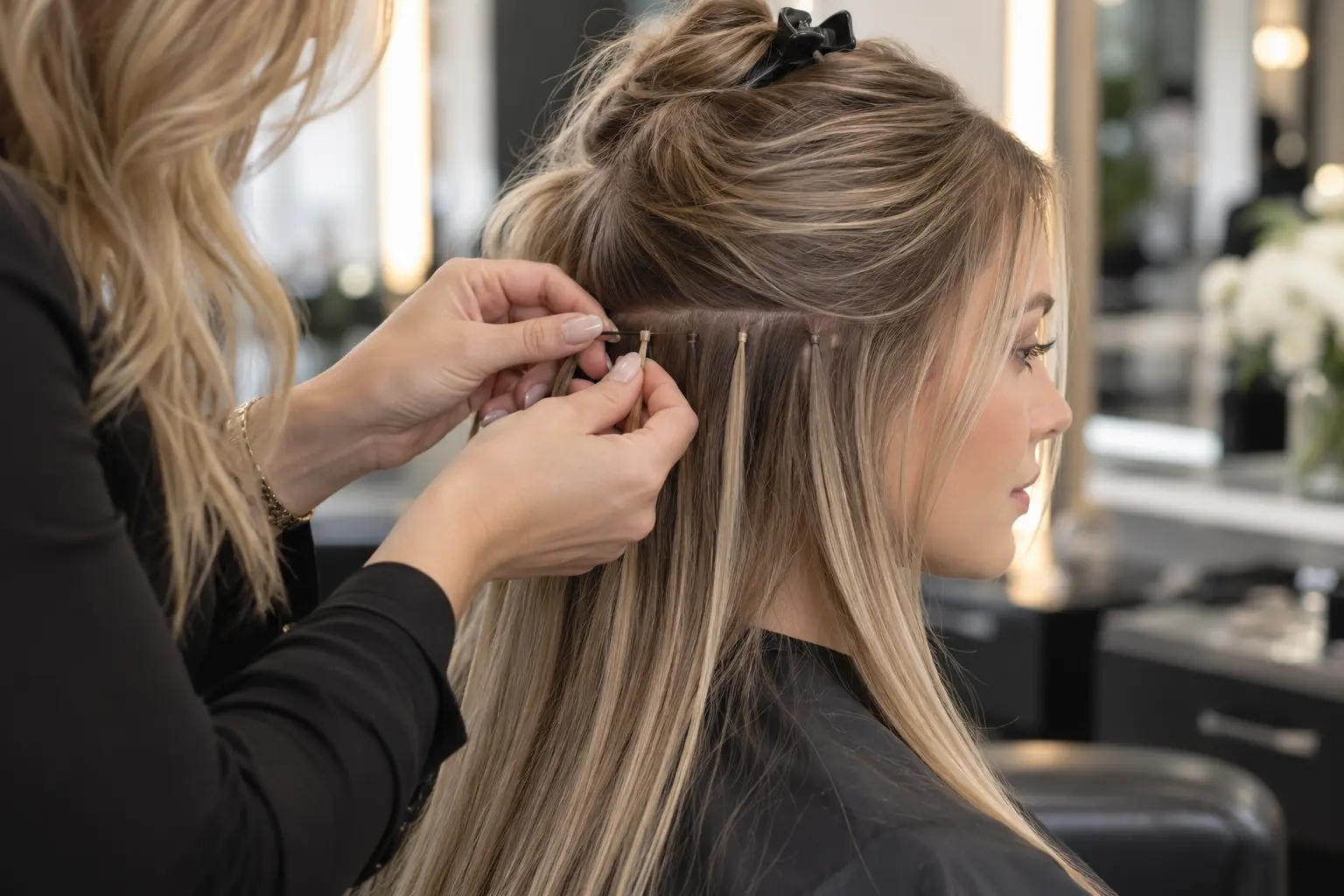
Fine hair is not always thin hair. A client may have fine individual strands but a lot of total hair. Another client may have both fine strands and low density. These differences change the extension plan. I have seen buyers make better product decisions when they separate strand diameter from overall density.
What fine hair needs
Fine hair usually needs:
- Smaller beads
- Lighter extension strands
- Soft color blending
- Careful row placement
- Less total weight
- Regular maintenance appointments
The goal is not to add the maximum amount of hair. The goal is to create a natural improvement without overloading the root.
Suggested approach for fine hair
| Fine Hair Concern | Recommended Choice | Why It Helps |
|---|---|---|
| Beads may show | Use smaller beads in matching color | Better concealment |
| Roots may feel tension | Use lighter strands | Reduces pull |
| Hair may break | Avoid oversized sections | Keeps weight balanced |
| Ends may look sparse | Add moderate volume first | Creates realistic fullness |
| Client may skip aftercare | Provide clear care card | Reduces matting and slippage |
For fine-haired clients, I usually suggest starting with a conservative installation. A stylist can add more later if the hair responds well. This is better than installing too much hair and creating stress at the roots.
Product quality matters more for fine hair
Fine hair exposes quality issues quickly. If the extension hair is coarse, dry, or too dense at the tip, it may not blend with the client’s natural hair. For this reason, B2B buyers should evaluate the fiber feel, tip size, and density distribution before placing bulk orders.
When sourcing from a manufacturer, buyers can request:
- Small sample bundles in key colors
- Different gram weights for comparison
- Tip pull tests to check bond strength
- Wash tests to observe texture after shampooing
- Color matching under natural light
At RENAI HAIR, for example, we focus on human hair categories such as Remy hair and cuticle intact hair, but buyers should still verify each specification against their market needs. A salon brand serving fine-haired clients may prefer softer, lighter I-tip hair. A wholesale customer serving high-volume salons may need a broader color card and stable restocking.
When fine hair may not be suitable
Microbeads are not always the right option. If the client has active hair loss, severe breakage, scalp inflammation, or very fragile roots[^5], a stylist should recommend a professional evaluation before installation. In some cases, lighter options such as clip-ins, halos, or carefully selected toppers may be safer.
For fine hair, success depends on restraint. The best result often looks like the client naturally has better hair, not obviously longer or heavier hair.
How Do Microbead Hair Extensions Work for Medium and Thick Hair?
Medium and thick hair can seem easier because it has more strength and coverage. However, these clients can still face problems. The extensions may not blend, the density may look uneven, or the beads may feel bulky. Microbead hair extensions work well only when the weight and texture are matched.
Microbead hair extensions work for medium and thick hair by adding controlled length, volume, or shape through individual attachment points. Medium hair allows flexible placement, while thick hair often needs more grams, stronger blending, and texture matching. The stylist must balance density so the extensions do not look separate from the natural hair.
Medium hair is usually the most flexible base for microbeads. It often has enough density to hide the beads, but it is not so heavy that blending becomes difficult. Thick hair can also use microbeads successfully, but the extension plan must match the existing volume.
Medium hair: the most versatile category
Medium-density hair can use microbeads for several goals:
- Adding length
- Building side volume
- Creating face-framing layers
- Correcting uneven ends
- Adding color without chemical dye
- Enhancing fullness for event styling
For medium hair, stylists can often use a balanced number of strands. The final quantity depends on the desired length, client density, and head shape. A subtle volume service may need fewer strands, while a full length transformation may need more.
Thick hair: blending is the challenge
Thick hair can hide attachment points well, but it can also make the extension ends look too thin if the added hair is not dense enough. This creates a common “shelf” effect where the natural hair sits heavily above the extension hair.
For thick hair, stylists often need:
- More total grams
- Longer blending layers
- Texture-matched extension hair
- Strategic placement around the occipital area
- Color depth that matches the natural base
Straight, wavy, and curly textures
Texture is a major factor. Straight hair needs smooth alignment. Wavy hair needs body and movement. Curly hair needs a closer curl pattern match, or the extensions will stand out after washing.
| Hair Texture | Microbead Consideration | Buyer/Product Note |
|---|---|---|
| Straight hair | Beads must be hidden cleanly | Smooth cuticle alignment matters |
| Wavy hair | Extensions need natural movement | Slight wave can improve blending |
| Curly hair | Curl pattern must match | Request texture samples before bulk orders |
| Coarse hair | Hair weight may be higher | Stronger density matching needed |
| Layered hair | Placement must follow haircut | Custom cutting is essential |
I often remind salon and brand buyers that “human hair” is not a complete specification. Human hair extensions can vary in cuticle direction, processing level, softness, return hair ratio, and color treatment. These differences affect how microbeads perform after weeks of wear.
Procurement tips for medium and thick hair markets
If your customer base includes many medium and thick-haired clients, you may need a stronger product range. I suggest building a stock plan around:
- Popular natural colors: #1, #1B, #2, #4, #6
- Dimensional shades: balayage, rooted blonde, piano colors
- Longer lengths: 20, 22, and 24 inches
- Multiple textures: straight, body wave, natural wave
- Consistent tip sizes: to reduce stylist frustration
For thick hair, the extension hair must remain smooth after washing. If the hair becomes dry or puffy, the final result can look unnatural. Buyers should test samples through at least 2–3 wash cycles before approving large production. They should also check whether the color bleeds, whether the tip loosens, and whether the hair tangles at the nape.
Microbeads can create beautiful transformations for medium and thick hair. Still, the product must support the stylist’s work. Good hair, consistent tips, and reliable beads make installation faster and client satisfaction higher.
What Should Buyers Check Before Choosing Microbead Hair Extensions?
Many brands and salons choose products based on photos, but photos do not show long-term performance. A bundle can look beautiful on day one and still fail after washing. Microbead hair extensions require careful product evaluation because the hair, tip, and bead all affect the final service.
Buyers should check hair quality, tip strength, bead material, color accuracy, shedding, tangling, and supplier reliability before choosing microbead hair extensions. They should request samples, test washing and combing performance, verify product claims, and confirm whether the supplier can maintain stable quality across repeat orders.
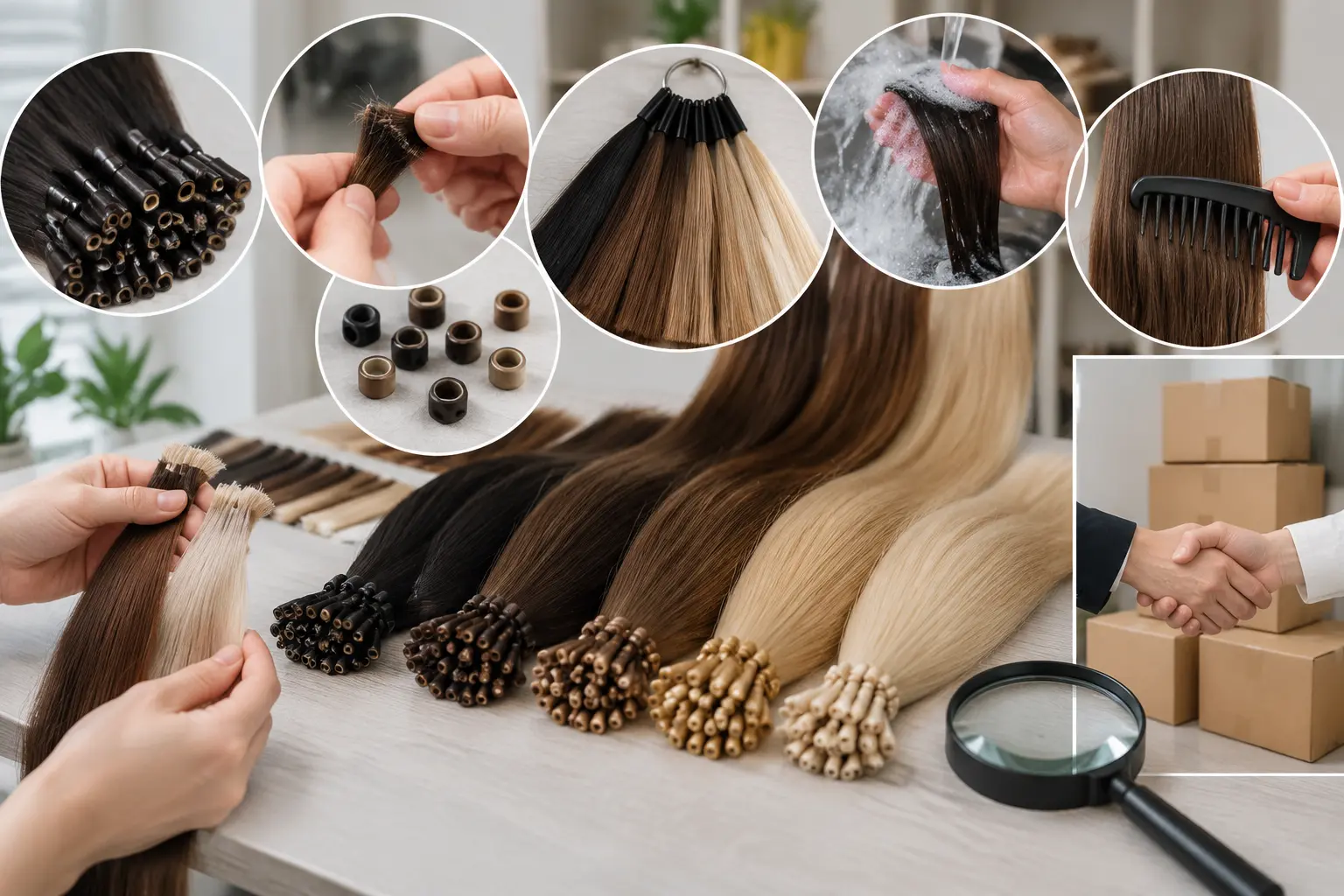
For B2B customers, microbeads are not only a beauty product. They are a service product that salon professionals install on real clients. This means consistency matters. If one batch performs well and the next batch changes, salons lose trust.
Key product checks
I suggest using a practical evaluation checklist before buying in volume.
| Evaluation Area | What to Check | Why It Matters |
|---|---|---|
| Hair source and grade | Human hair type, Remy alignment, cuticle condition | Affects softness and lifespan |
| Tip quality | Firmness, shape, shedding at tip | Affects installation security |
| Bead quality | Silicone lining, coating, size consistency | Affects grip and comfort |
| Color accuracy | Match to color ring, batch consistency | Reduces returns |
| Tangle test | Comb after wash and air dry | Shows real-use behavior |
| Shedding test | Brush from mid-length to ends | Reveals weak construction |
| Packaging | Labeling, length/color clarity | Helps wholesale and salon workflow |
| Supplier response | Communication speed, customization ability | Supports long-term cooperation |
Hair quality terms buyers should verify
Many suppliers use terms such as 100% human hair, Remy hair, or cuticle intact hair. These terms are important, but buyers should treat them as product claims that need verification through samples, documentation, and internal testing.
A buyer can ask:
- Can I test a sample before ordering?
- Is the hair aligned in the same cuticle direction?
- What is the recommended lifespan under proper care?
- Can you provide consistent color in repeat orders?
- Can you customize length, gram weight, tip size, or packaging?
- What quality control steps occur before shipment?
At RENAI HAIR, our business model includes manufacturing, R&D, international trade, and shipment quality control. Still, I believe every serious buyer should verify samples before committing to a new line. This protects both sides and helps the supplier understand the buyer’s market.
Quality control before shipment
For microbead extensions, a strong QC process may include:
-
Length verification
Staff checks that the finished hair matches ordered length. -
Weight verification
Staff confirms gram weight per pack or bundle. -
Color inspection
Staff compares production hair with approved color standards. -
Tip inspection
Staff checks shape, firmness, and shedding risk. -
Comb test
Staff observes shedding and smoothness. -
Packaging inspection
Staff confirms labels, barcodes, and customer requirements.
Supplier selection for brands and salons
A good supplier should do more than ship hair. A good supplier should understand market needs, customization, product development, and after-sales communication. If you are building a private label brand, you may also need packaging support, color development, and stable restocking.
Important supplier qualities include:
- Stable product quality
- Clear communication
- Experience with international markets
- Flexible customization
- Ability to develop new colors
- Professional after-sales support
- Strict outgoing inspection
Microbead hair extensions can be profitable for salons and brands, but only when the product is dependable. The best buying decision is not always the cheapest one. It is usually the supplier who can deliver stable quality, clear specifications, and long-term support.
How Should You Care for Microbead Hair Extensions?
Even high-quality extensions can fail if the client does not care for them correctly. Poor brushing, heavy oils near the beads, sleeping with wet hair, or delaying maintenance can cause matting and slippage. Microbead hair extensions need a clear care routine from day one.
Microbead hair extensions should be brushed gently, washed with extension-friendly products, dried fully at the roots, and maintained through regular salon appointments. Clients should avoid pulling, sleeping with wet hair, and applying heavy conditioners or oils near the beads. Proper care helps reduce tangling, shedding, and slippage.
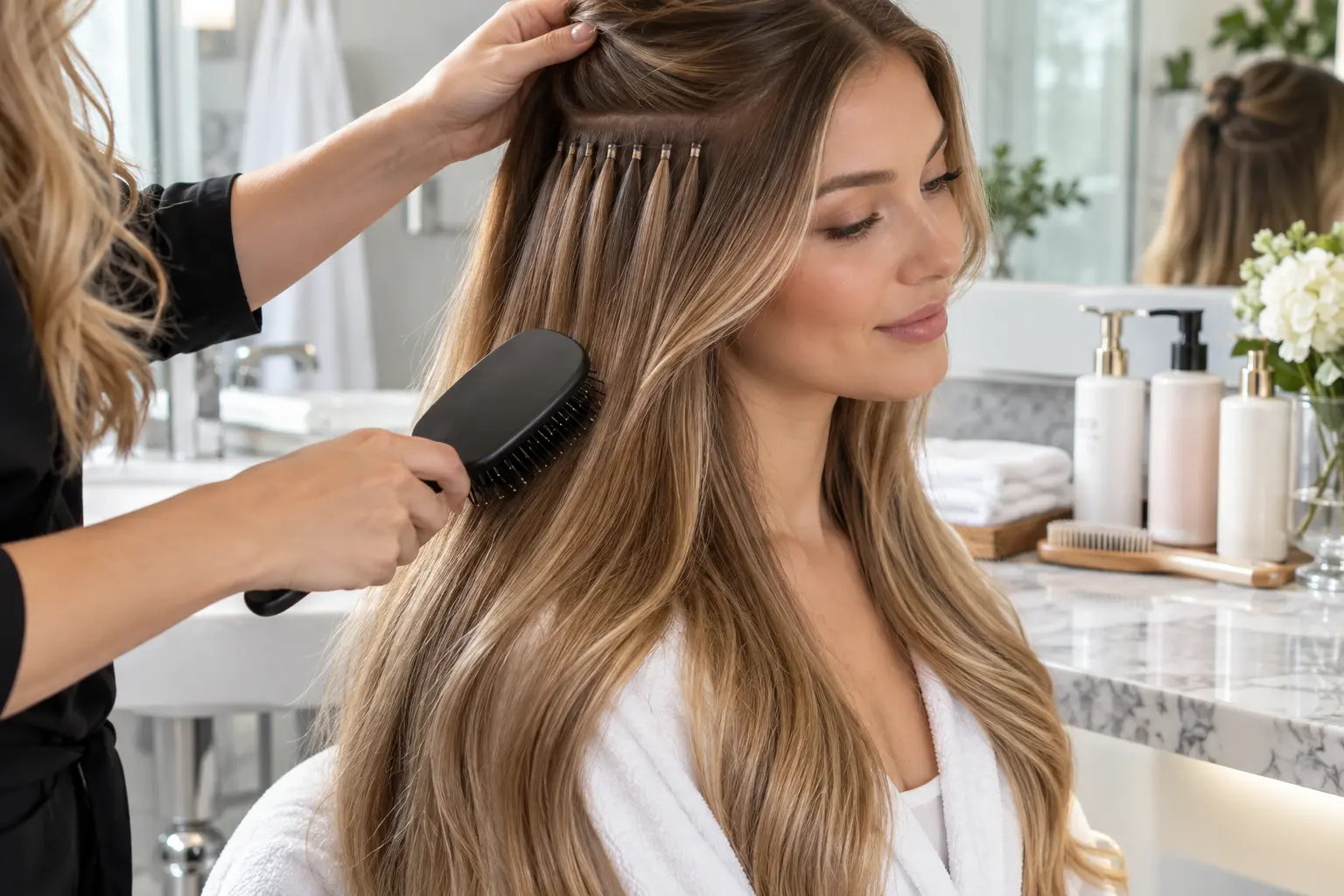
Aftercare is where many extension services succeed or fail. I have seen beautiful installations become difficult because the client did not understand daily maintenance. For salons and brands, a simple care card can reduce complaints and improve repeat purchases.
Daily care routine
Clients should follow a gentle routine:
- Brush from ends upward.
- Hold the roots while detangling.
- Use an extension-friendly brush.
- Avoid tugging around the bead area.
- Tie hair loosely before sleeping.
- Sleep on a silk or satin pillowcase when possible.
- Keep roots dry and separated.
The bead area needs special attention. If natural shed hair is not separated regularly, it can collect near the root and create tangling. This is normal with many semi-permanent methods, but the client must manage it.
Washing guidance
A safe washing routine usually includes:
-
Detangle before washing
Dry brushing reduces knots before shampoo. -
Shampoo the scalp gently
The client should not scrub aggressively around beads. -
Condition mid-lengths and ends
Heavy conditioner should not sit directly on bead attachments. -
Rinse thoroughly
Product buildup can cause dullness and discomfort[^6]. -
Dry the roots fully
Damp roots can increase tangling and odor risk. -
Style with heat protection
Human hair extensions can be heat styled, but heat still causes dryness[^7].
Maintenance timing
Most microbead installations require move-up appointments because natural hair grows[^8]. The timing depends on hair growth speed, installation method, and lifestyle. Many clients return every 6–8 weeks, but a stylist should set the schedule.
| Maintenance Issue | Possible Cause | Suggested Response |
|---|---|---|
| Beads slipping | Oil, wrong bead size, fine hair, poor clamping | Review product and installation |
| Tangling at roots | Delayed maintenance, poor brushing | Schedule move-up and educate client |
| Dry ends | Heat, overwashing, low moisture | Use quality leave-in on ends |
| Visible beads | Poor placement, thin top layers | Adjust sectioning |
| Discomfort | Too much tension, bead too close to scalp | Professional correction needed |
Care instructions for salons and brands
For B2B buyers, aftercare is part of product success. I recommend including printed or digital instructions with every order. The instructions should be simple enough for clients and specific enough for stylists.
Useful aftercare materials include:
- A one-page client care guide
- A stylist installation note
- A maintenance schedule card
- A product compatibility warning
- A brushing and sleeping guide
- A return and complaint documentation form
This may sound basic, but it reduces misunderstandings. If a client uses heavy oil directly on the beads and experiences slippage, the salon needs a care guide to reference. If the product itself has a quality issue, clear documentation helps the supplier investigate faster.
Microbead extensions are durable when cared for correctly. However, they are not maintenance-free. The best results come from a partnership between manufacturer, salon, stylist, and wearer.
Frequently Asked Questions
Are microbead hair extensions damaging?
Microbead hair extensions are not designed to use heat or glue, so they can be gentle when installed correctly. However, they can still cause damage if the strands are too heavy, the beads are too tight, or the client skips maintenance. A trained stylist should assess hair strength first.
How long do microbead hair extensions last?
The installation often needs maintenance every 6–8 weeks as natural hair grows. The hair itself may last longer depending on hair quality, processing, care routine, and frequency of heat styling. Buyers should test samples because lifespan claims vary by supplier and product grade.
Can microbead hair extensions be used on curly hair?
Yes, microbead extensions can be used on curly hair if the curl pattern, density, and texture are matched carefully. The stylist must place the beads so they remain hidden and comfortable. Curly-haired clients should receive specific detangling and drying instructions.
Are microbeads better than tape-in extensions?
Microbeads and tape-ins serve different needs. Microbeads allow strand-by-strand placement and avoid adhesive. Tape-ins can be faster to install and may lie very flat. The better choice depends on hair type, scalp condition, lifestyle, desired look, and stylist recommendation.
What should wholesale buyers ask before ordering microbead extensions?
Wholesale buyers should ask about hair type, Remy alignment, tip strength, bead options, color consistency, customization, MOQ, packaging, and quality control. They should request samples and test washing, brushing, shedding, and color stability before placing larger orders.
Conclusion
Microbead hair extensions are a flexible option for adding length, volume, and shape across fine, medium, thick, straight, wavy, and curly hair types. The best results depend on correct hair assessment, skilled installation, reliable product quality, and consistent aftercare. If you are a brand, wholesaler, salon, or distributor looking for stable human hair extension supply, RENAI HAIR can help you evaluate microbead extension options, customize specifications, and build a product line for your market.
[^1]: "Hair (musical)", https://en.wikipedia.org/wiki/Hair_(musical). Hair extension methods are broadly categorized by their attachment mechanism; cold-fusion or micro-link systems use mechanical clamping rather than heat, adhesive, or braiding, distinguishing them from keratin-bond, tape-in, and sew-in techniques. Evidence role: definition; source type: encyclopedia. Supports: Classification of hair extension methods by attachment mechanism, distinguishing heat-bond, adhesive, sewn, and bead-based systems. Scope note: General encyclopedic or trade sources may describe categories without providing standardized industry definitions [^2]: "Influence of surface structure on friction and wear ... - PMC", https://pmc.ncbi.nlm.nih.gov/articles/PMC10652250/. Silicone elastomers exhibit a relatively high coefficient of friction against smooth surfaces such as hair and provide a compliant interface that distributes clamping force more evenly than rigid metal, which may reduce slippage and localized pressure at the attachment point. Evidence role: mechanism; source type: research. Supports: Silicone's high friction coefficient and compliant surface properties can improve mechanical grip on hair strands and reduce localized pressure compared with bare metal. Scope note: Published studies on this specific application in hair extensions are scarce; the claim is inferred from general silicone material properties [^3]: "Hair", https://en.wikipedia.org/wiki/Hair. Remy hair is defined as human hair in which the cuticle layer is preserved and all strands are oriented in a uniform root-to-tip direction; this alignment is considered to reduce friction-induced tangling relative to non-Remy or processed alternatives. Evidence role: definition; source type: encyclopedia. Supports: Remy hair refers to human hair in which all strands are collected and aligned so that cuticles run in the same direction, reducing tangling compared with non-Remy hair. Scope note: The term lacks a single regulatory or international standard definition, and usage varies among suppliers and markets [^4]: "The structure of people's hair - PMC - NIH", https://pmc.ncbi.nlm.nih.gov/articles/PMC4201279/. The hair cuticle consists of overlapping keratinized scales that protect the inner cortex and medulla; intact cuticle layers contribute to surface smoothness, reduced friction between strands, and improved moisture retention, qualities that deteriorate when the cuticle is damaged by chemical or mechanical processing. Evidence role: definition; source type: research. Supports: The hair cuticle is the outermost protective layer of the hair shaft; preserving it during processing maintains the hair's smoothness, moisture retention, and resistance to tangling. Scope note: Industry use of 'cuticle intact' as a product grade is not governed by a universal standard, and verification requires microscopic examination [^5]: "Trichologist, Dermatotrichologist, or Trichiatrist? A Global ...", https://pmc.ncbi.nlm.nih.gov/articles/PMC6219239/. Trichological and dermatological guidance indicates that semi-permanent hair extension methods should be avoided in clients presenting with active alopecia, inflammatory scalp conditions, or significantly weakened hair shafts, as additional mechanical stress may exacerbate existing follicular damage. Evidence role: expert_consensus; source type: institution. Supports: Active hair loss, scalp inflammation, and structurally compromised hair are recognized contraindications for semi-permanent extension methods that apply mechanical load to the follicle. Scope note: Formal clinical guidelines specific to microbead extensions are limited; recommendations are largely based on general principles of hair and scalp health [^6]: "Scalp Condition Impacts Hair Growth and Retention via ... - PMC", https://pmc.ncbi.nlm.nih.gov/articles/PMC6369642/. Cosmetic science literature documents that repeated application of film-forming agents such as silicones and cationic conditioners leads to progressive surface deposition on hair fibers, reducing optical clarity and potentially contributing to scalp occlusion and discomfort if not adequately removed. Evidence role: mechanism; source type: research. Supports: Accumulation of conditioning agents, silicones, and styling product residues on hair and scalp surfaces can reduce light reflectance and create occlusive deposits that contribute to scalp irritation. Scope note: Effects on extension hair specifically, including bead attachment areas, have not been studied independently from natural hair [^7]: "Thermal Induced Changes in Cuticle and Cortex to ... - PMC", https://pmc.ncbi.nlm.nih.gov/articles/PMC12701549/. Research on thermal effects on hair fiber demonstrates that repeated exposure to temperatures above approximately 150°C causes progressive degradation of keratin proteins and surface lipids, reducing the hair's capacity to retain moisture and increasing susceptibility to breakage. Evidence role: mechanism; source type: research. Supports: Repeated exposure to high temperatures from styling tools degrades the hair's protein structure and lipid layer, reducing moisture retention and increasing brittleness. Scope note: Extension hair that has been chemically processed may be more vulnerable to thermal damage than virgin hair; thresholds vary by hair condition and tool temperature [^8]: "Human hair growth", https://en.wikipedia.org/wiki/Human_hair_growth. Human scalp hair grows at an average rate of approximately 1–1.5 centimeters per month, meaning that bead-based extension attachments placed at the root will migrate visibly within six to eight weeks, necessitating repositioning appointments. Evidence role: mechanism; source type: research. Supports: Human scalp hair grows at an average rate that causes bead attachments to migrate away from the scalp over weeks, requiring periodic repositioning. Scope note: Growth rates vary by individual, age, health status, and scalp region, so the cited interval is an approximation