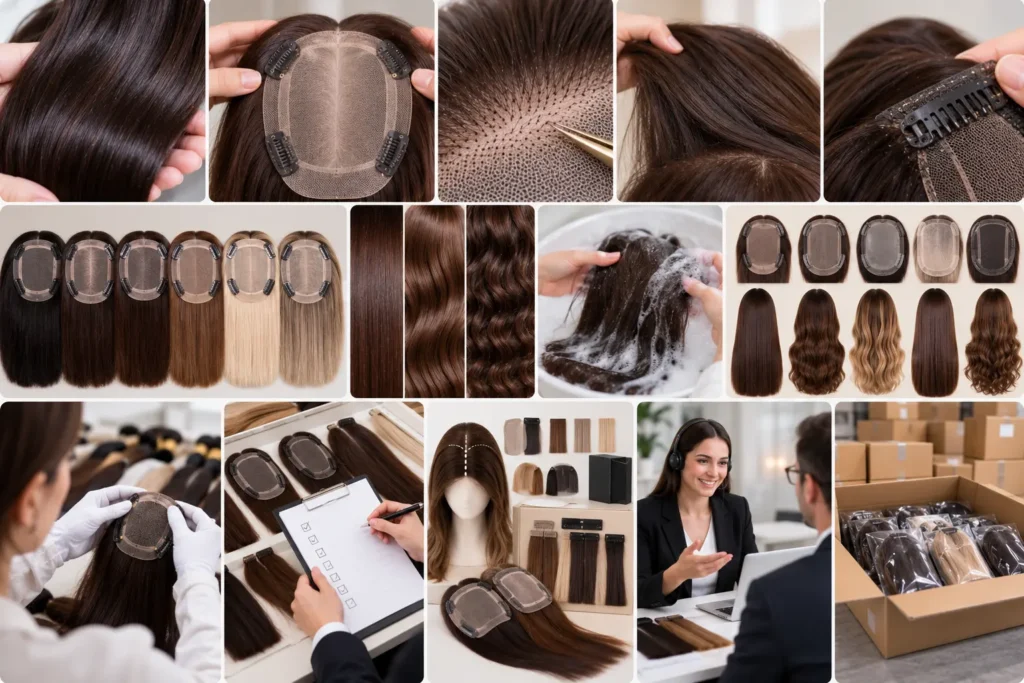

Human Hair Extensions Wholesale: A Complete Guide for Salons & Hair Businesses
Human hair extensions wholesale buying is very different from choosing extensions for personal use. A beautiful bundle can look profitable at first, but inconsistent color, shedding, or weak supply can hurt your salon or brand later. I wrote this guide to help professional buyers evaluate products, suppliers, and specifications before placing larger orders.
Human hair extensions wholesale means buying larger quantities of professional hair extension products from a manufacturer, distributor, or wholesale supplier for resale or salon use[^1]. Buyers should evaluate hair quality, product type, color consistency, customization options, factory quality control, lead times, and long-term supply capability before committing to bulk orders.[^2]

Many new buyers focus first on price. I understand why, because margin matters. However, I have seen that stable quality, clear product specifications, and reliable after-sales communication often matter more than a small unit-cost difference. Let’s break down what I would check before buying.
What Does Human Hair Extensions Wholesale Mean for Professional Buyers?
Buying hair for resale can feel simple until the first repeat order arrives with a different color, texture, or weight. That problem creates customer complaints and inventory pressure. I always suggest that buyers treat human hair extensions wholesale as a product development and supplier evaluation process, not just a purchase.
Wholesale hair extensions are professional products purchased in larger quantities by salons, distributors, beauty supply stores, hair extension brands, online retailers, and extension specialists. The key difference is that wholesale buyers must consider consistency, specifications, packaging, color range, manufacturing capacity, and repeat supply, not only the first visual impression.
Who Usually Buys Wholesale Hair Extensions?
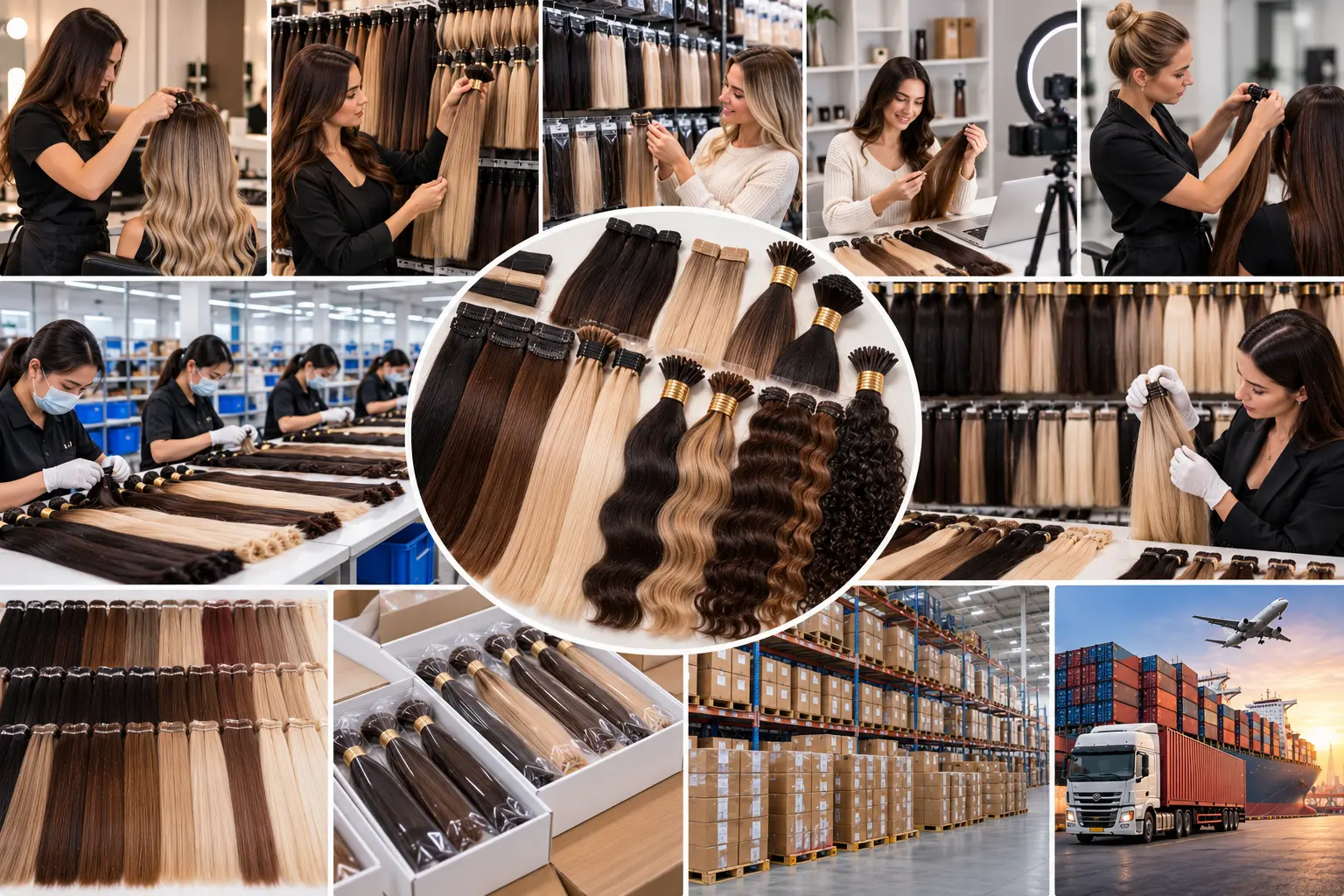
Professional wholesale buyers usually include:
- Hair extension brands
- Distributors and importers
- Wholesalers
- Professional salons
- Hair extension specialists
- Beauty supply businesses
- Online hair retailers
- Hair boutiques and stylists
I find that each buyer type has different priorities. A salon may care most about installation performance and client comfort. A distributor may focus on repeat supply, color inventory, and carton-level consistency. A new online brand may care about packaging, product cards, private label options, and fast-moving SKUs.
Why Wholesale Buying Is Different From Personal Buying
A personal buyer may choose one shade and one length. A professional buyer must build a system. That system includes method × length × weight × color × packaging × order cycle.
For example, a salon may need tape-in extensions in 18 inches, 20 inches, and 22 inches across natural browns, blondes, and balayage colors. A brand may need Genius Weft and Machine Weft in the same color family, so customers can move between methods without color confusion.
Here is a simple comparison:
| Buying Factor | Personal Use | Wholesale Business |
|---|---|---|
| Quantity | 1–3 packs | Dozens to thousands of packs |
| Main concern | Appearance | Consistency and sell-through |
| Color range | One shade | Full shade system |
| Testing | Basic feel check | Wash, styling, wear, and batch tests |
| Packaging | Less important | Often brand-critical |
| Supplier relationship | One-time purchase | Long-term supply partnership |
In my experience, the most successful buyers define their expected product before they negotiate price. They know the target customer, installation method, expected lifespan, packaging style, and return policy. That clarity helps a manufacturer or wholesale supplier recommend more suitable options.
Which Human Hair Extensions Wholesale Products Should You Compare?
Many buyers lose time because they compare unrelated products. A tape-in extension, a hand-tied weft, and a keratin strand serve different installation needs.[^3] I recommend that buyers compare human hair extensions wholesale products by application method first, then by hair quality, weight, color, and construction.
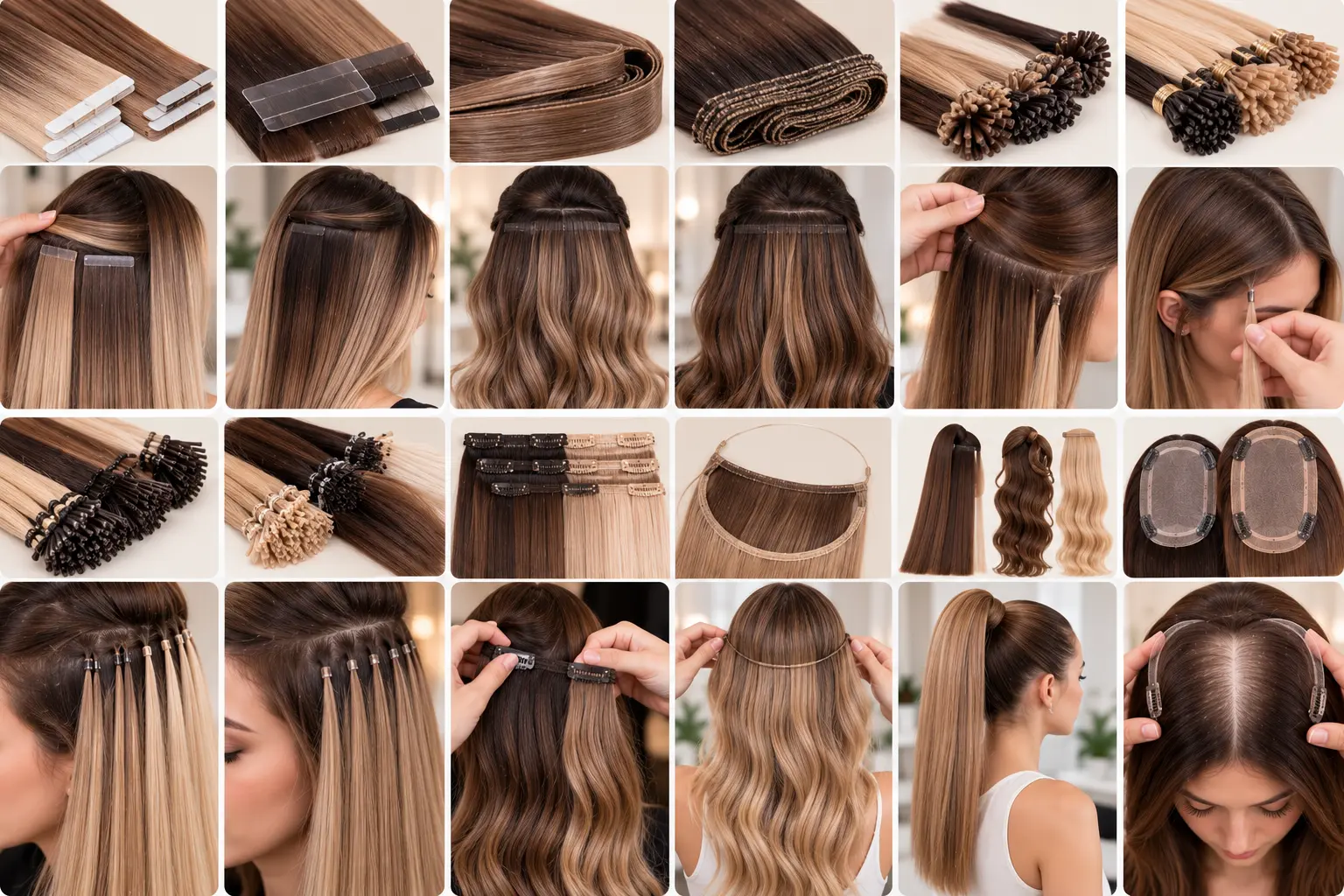
Professional wholesale suppliers may offer Tape-In Hair Extensions, Invisible Tape Hair Extensions, Genius Weft, Machine Weft, Hand-Tied Weft, Keratin or Prebonded Hair, I-Tip, Nano extensions, Clip-In Hair, Halo Hair, Ponytail extensions, and Hair Toppers. The best choice depends on your market, stylist skills, and customer demand.
Common Wholesale Hair Extension Categories
I usually suggest that buyers start with the products their customers already understand. New products can be added later after testing.
| Product Type | Common Buyer | Main Advantage | Key Evaluation Point |
|---|---|---|---|
| Tape-In Hair Extensions | Salons, online brands | Fast salon installation | Tape strength and hair direction |
| Invisible Tape Hair Extensions | Premium salons | Less visible attachment area | Bond area and color blending |
| Genius Weft | Extension specialists | Thin, flexible weft | Weft structure and shedding control |
| Machine Weft | Wholesalers, salons | Durable construction | Weft thickness and return hair |
| Hand-Tied Weft | Professional stylists | Lightweight feel | Weft delicacy and installation care |
| Keratin Extensions | Salons | Individual strand placement | Keratin bond quality |
| I-Tip and Nano Extensions | Extension specialists | No heat installation | Tip shape and bead compatibility |
| Clip-In and Halo Hair | Retail and boutiques | Easy temporary use | Clip security and comfort |
| Hair Topper | Hair boutiques | Coverage and volume | Base construction and density |
How I Would Choose the First Product Line
I would avoid launching every product at once unless the business already has strong inventory control. A more practical approach is to start with a focused product range.
For example:
- A salon-focused buyer may start with Tape-In Hair Extensions, Genius Weft, and Keratin Extensions.
- An online brand may start with Clip-In Hair, Halo Hair, and Tape-In Hair.
- A distributor may stock Machine Weft, Genius Weft, Tape-In, and popular individual-strand methods.
- A premium boutique may focus on Cuticle Intact Hair, Remy Hair, and lighter weft systems.
Why Construction Details Matter
Small construction differences can change the entire user experience. Tape tabs must hold well but remove cleanly with professional remover.[^4] Weft seams should feel comfortable, especially near the scalp. Keratin bonds should be shaped consistently so stylists can work efficiently.
When buyers ask RenaiHair about product options, I would usually suggest that they share their target market first. A buyer selling to professional salons may need different specifications from a buyer selling online to end consumers. The product should fit the channel, not only the catalog.
How Should You Evaluate Hair Quality Before a Wholesale Order?
A sample can look beautiful when it first arrives, but that first impression does not always show long-term performance. I have learned to slow down during sample testing because problems often appear after washing, drying, and heat styling. A clear test process protects both your margin and reputation.
Professional buyers should evaluate softness, hair direction, cuticle condition, thickness, ends, shedding, tangling, color, wash performance, and styling performance before placing a bulk order. Repeated wash tests and salon wear tests are more useful than judging wholesale hair extensions only by photos or fresh-out-of-package appearance.[^5]
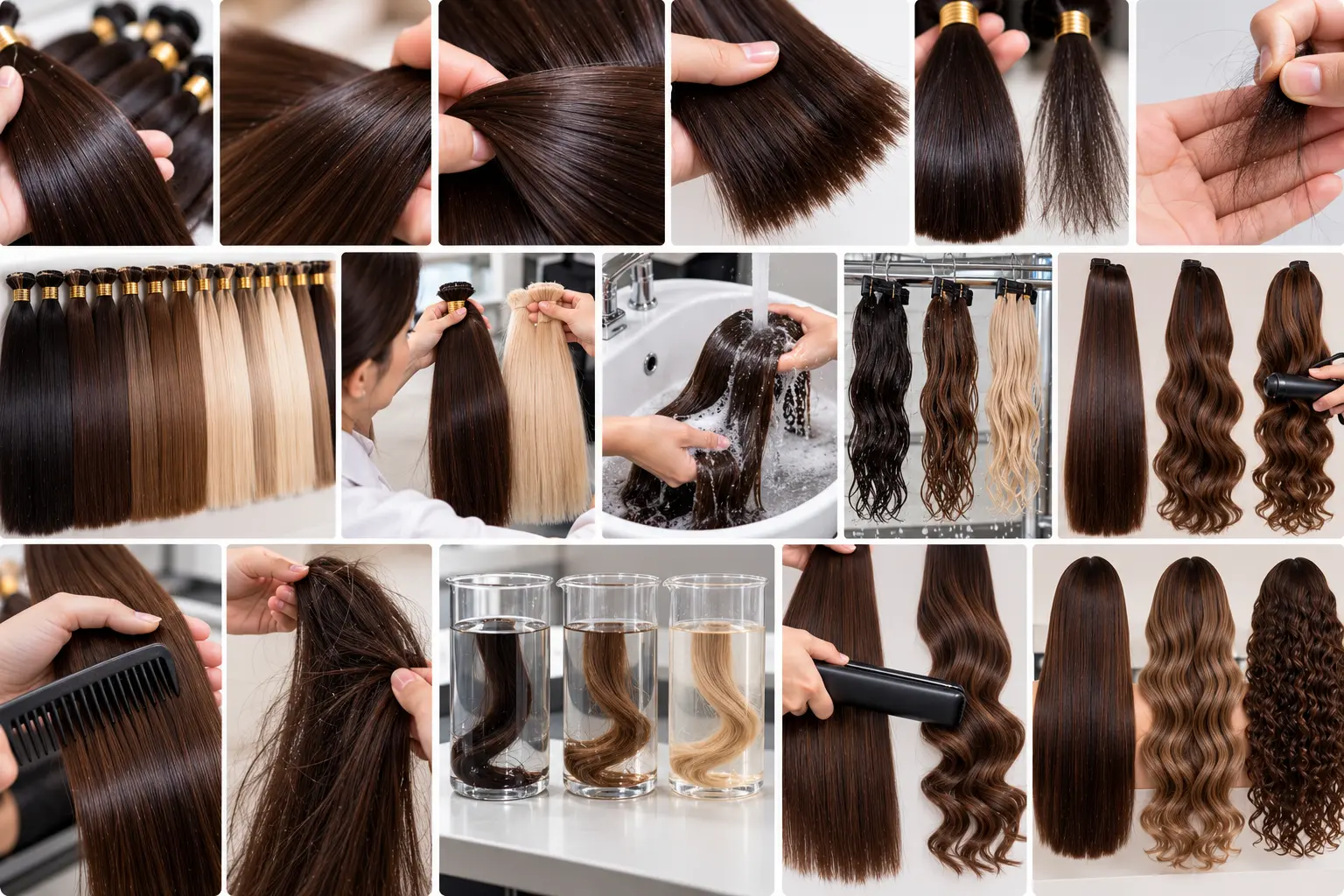
A Repeatable Sample Testing Process
I recommend that every buyer create a written sample checklist. This makes supplier comparisons more objective.
Step 1 — Initial Inspection
Check:
- Color accuracy
- Length
- Weight
- Smell
- Texture
- Hair ends
- Product construction
- Packaging condition
Step 2 — Wash Test
Wash and condition the hair according to your normal salon procedure. I would avoid unusual treatment during testing because the goal is to simulate real use.
Step 3 — Drying Test
Evaluate how the hair behaves after air drying or controlled blow drying. Some hair looks smooth when wet but becomes dry or puffy after drying.
Step 4 — Styling Test
Test straightening and curling under appropriate professional temperatures. Buyers should use qualified stylist judgment because overheating can damage any human hair product[^6].
Step 5 — Shedding and Tangling Evaluation
Observe whether shedding or tangling increases after repeated washing. I suggest testing several wash cycles before making a larger decision.
Step 6 — Salon Wear Test
Whenever possible, install the product on a model or test client. Real-world wear can reveal issues that table testing cannot show.
What “Good Hair Quality” Should Mean in B2B Buying
Good quality does not mean only soft hair. It means stable performance over time. For human hair extensions wholesale orders, buyers should care about batch consistency as much as sample beauty.
Important signs to document include:
- Hair remains manageable after washing.
- Ends do not become overly dry too quickly.
- Color does not fade unexpectedly under normal care.[^7]
- Wefts or bonds do not shed excessively.
- Tape or keratin performs according to the intended method.
- The product matches the stated length and weight tolerance.
I always prefer test notes over memory. A simple spreadsheet with photos after each wash can prevent emotional buying decisions.
If two suppliers offer similar prices, I would choose the one with clearer specifications and better repeat test results. A slightly cheaper product can become expensive if it causes returns, replacements, or salon complaints.
How Do You Build a Length, Weight, and Color Range for Human Hair Extensions Wholesale?
Inventory can become the hidden risk in a hair extension business. Too many colors and lengths can lock cash in slow-moving stock. Too few options can frustrate salons and customers. I suggest that buyers build a human hair extensions wholesale range from expected demand, then expand with sales data.
Wholesale buyers should start with the strongest combinations of method, length, weight, and color instead of stocking every possible option. A focused SKU plan reduces inventory pressure, helps buyers understand customer preferences, and makes repeat ordering easier. Popular specifications should be expanded only after real sales patterns appear.
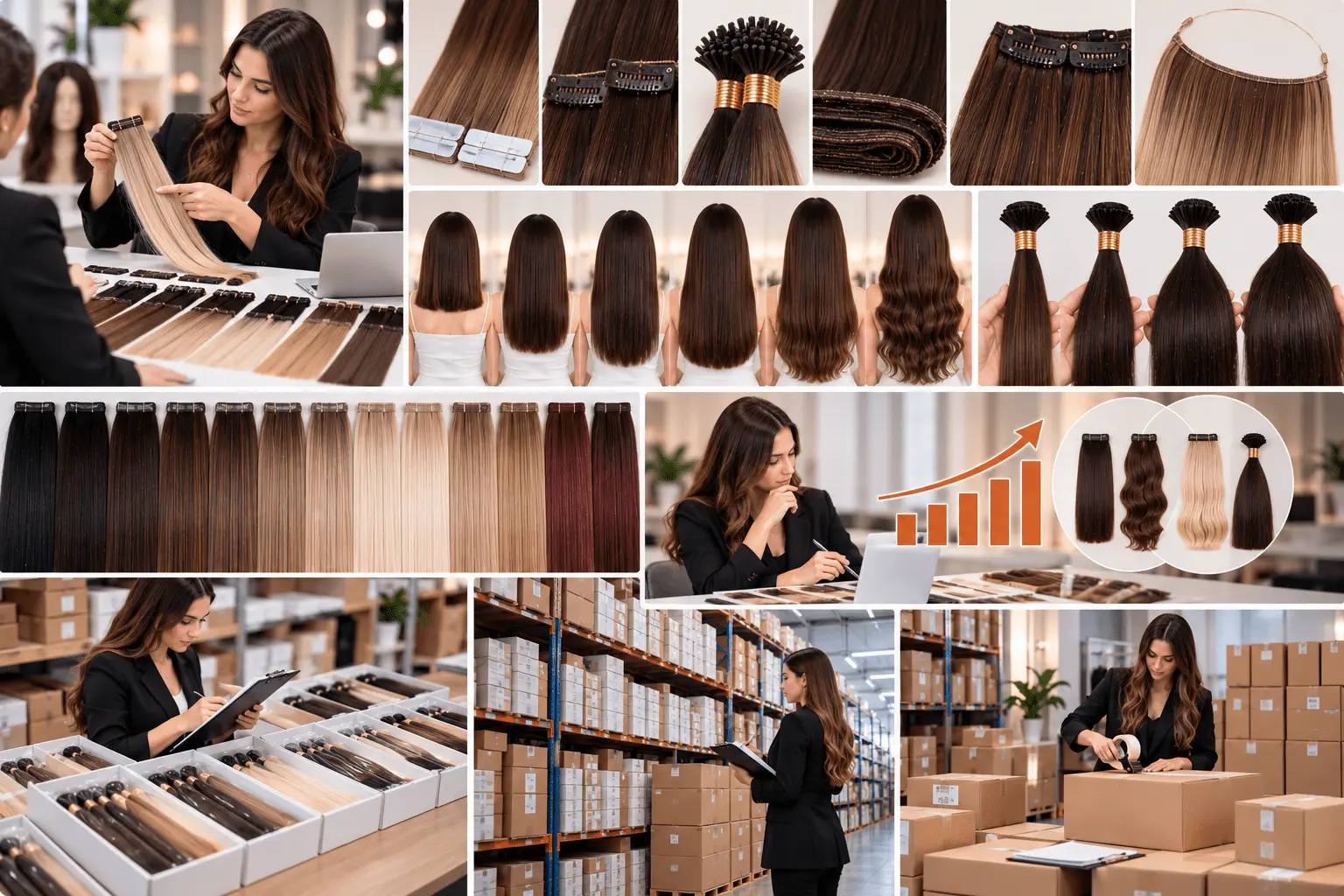
Start With Method × Length × Weight × Color
Every SKU adds complexity.[^8] A single product method can quickly become dozens of SKUs.
For example:
| Method | Lengths | Weights | Colors | Possible SKUs |
|---|---|---|---|---|
| Tape-In | 3 | 1 | 12 | 36 |
| Genius Weft | 4 | 1 | 10 | 40 |
| Keratin | 3 | 1 | 8 | 24 |
That simple plan already creates 100 SKUs. If you add more weights or more colors, the number grows quickly.
I recommend starting with your strongest expected combinations. A new brand may begin with:
- 16", 18", 20", and 22"
- Natural black, dark brown, medium brown, light brown
- Popular blonde shades
- One or two balayage or highlighted shades
- One or two core methods
A salon may stock fewer shades but use a reliable supplier for special orders. A distributor may need broader inventory because customers expect immediate availability.
Color Range Planning
Color inventory is one of the biggest challenges in wholesale hair extensions. Professional buyers may need:
- Natural colors
- Brown shades
- Blonde shades
- Ash shades
- Highlighted colors
- Balayage colors
- Ombre colors
I strongly recommend using a physical color ring. Digital photos are useful, but lighting, screens, and editing can distort shade perception.[^9] A physical ring makes communication between salons, distributors, and suppliers much easier.
Ask About Batch Color Consistency
Color consistency should not be assumed.[^10] Buyers should ask how the supplier controls color between production batches. I would ask questions such as:
- How are colors recorded?
- Can you keep a standard sample for repeat orders?
- How do you compare new production with previous batches?
- What is the acceptable shade tolerance?
- Can you provide production photos before shipment?
At RenaiHair, based on the business context I have, the company focuses on strict outgoing quality checks and product development for different lengths, colors, and product solutions. As a buyer, you should still verify the actual samples and order documentation for your specific market before scaling.
What Should You Ask a Human Hair Extensions Wholesale Supplier Before Buying?
A supplier can have attractive photos and still be a poor fit for your business. Slow replies, unclear specifications, weak quality control, or unstable production can create long-term problems. I recommend asking structured questions before choosing any human hair extensions wholesale partner.
Buyers should evaluate hair quality, product consistency, color consistency, product range, quality control procedures, customization capability, minimum order requirements, production capacity, communication, lead times, and after-sales support. The right supplier is not always the cheapest one; it is the one that can consistently meet your business requirements.[^11]
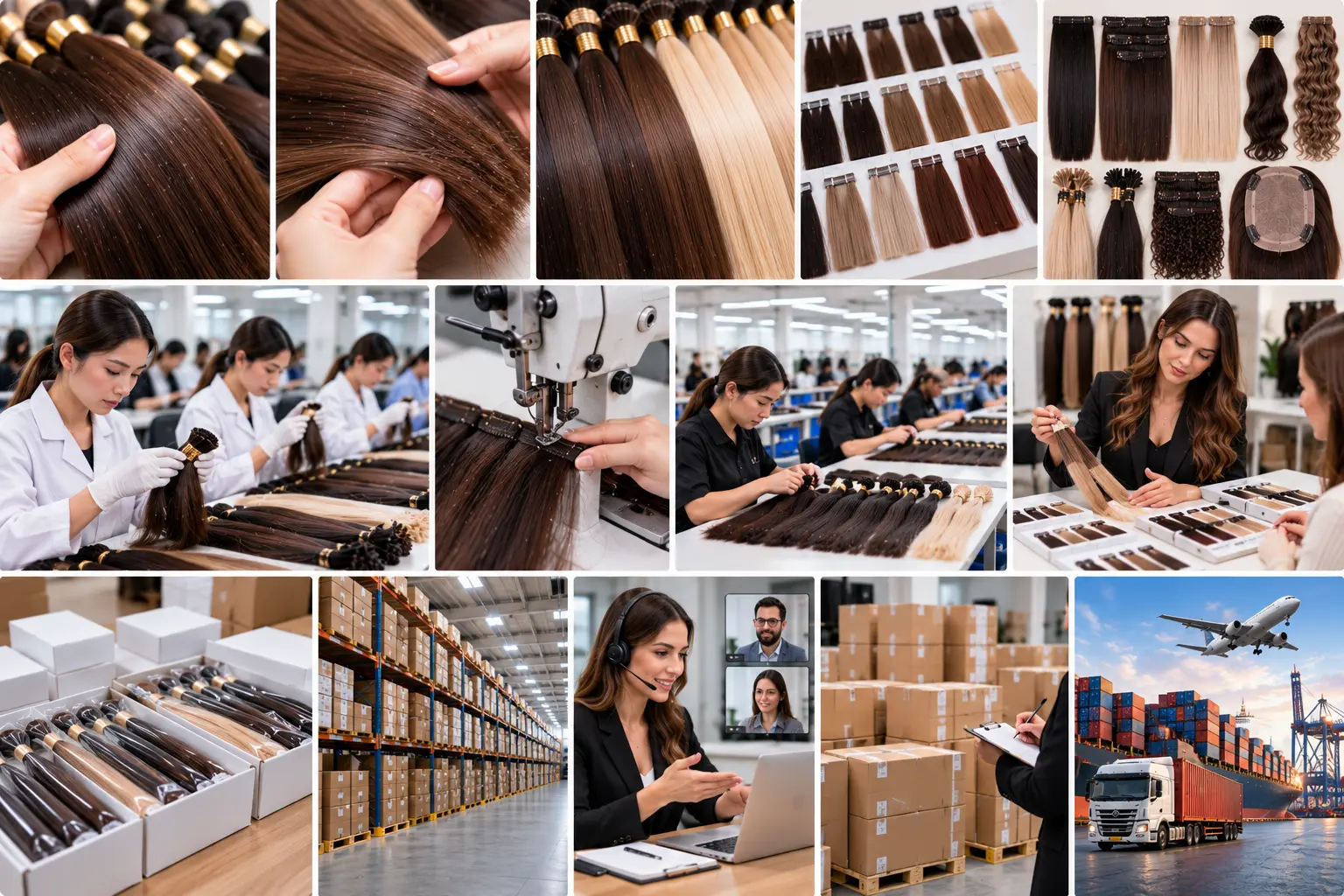
Manufacturer vs Trading Company
There is no universal rule that a manufacturer is always better than a trading company. A good trading company may offer strong sourcing and service. However, a manufacturer can be valuable when your business requires:
- Product development
- Custom specifications
- Private labeling
- Large-volume production
- Stable repeat orders
- Quality control requirements
- Faster technical feedback
For professional hair businesses, I would focus less on the label and more on capability. The key question is simple: Can this supplier consistently deliver the product my market needs?
Factory Quality Control Questions
Wholesale buyers should understand how production is controlled. I would ask:
- Which inspections are performed before shipment?
- How are length, weight, color, and construction checked?
- Are order specifications recorded clearly?
- Can the supplier provide real production or inspection images?
- How are defective items handled?
- How does the supplier manage repeat-order consistency?
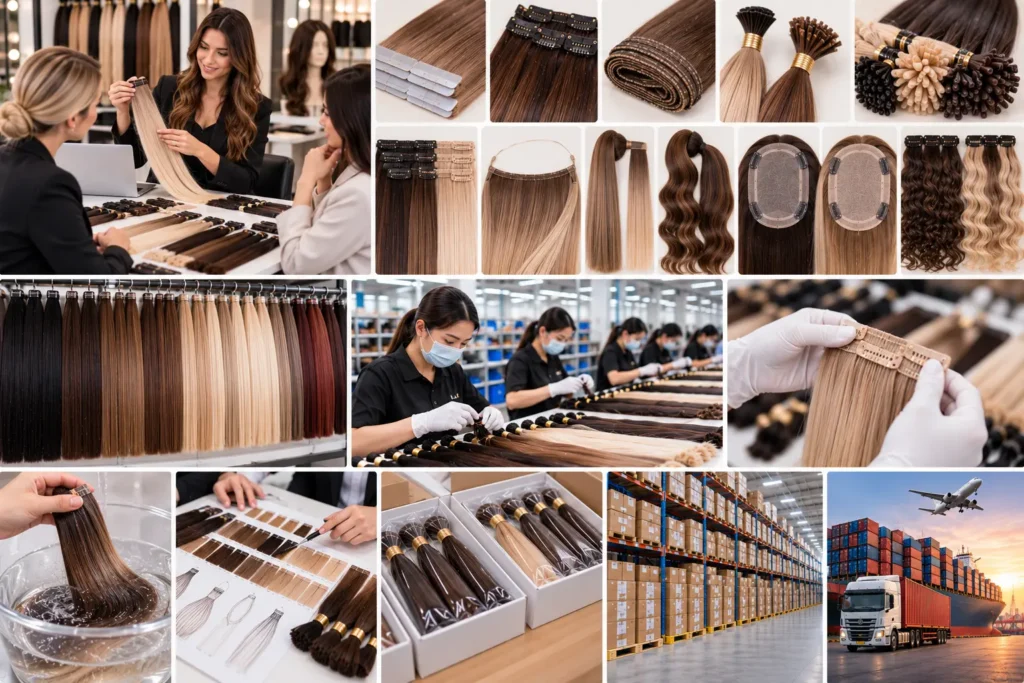
Real manufacturing images are useful because they show the process behind the finished product. They do not replace testing, but they help buyers understand whether the supplier has organized production.
Private Label Hair Extensions
If you want to build your own brand, ask about private label hair extensions early. Depending on manufacturing requirements and order quantity, customization may include:
- Tape specifications
- Weft specifications
- Product cards
- Packaging
- Color rings
- Labels
- Custom product combinations
Private labeling can help your brand look more professional and recognizable.[^12] However, I suggest that buyers confirm performance first. A beautiful box cannot solve poor hair quality.
Supplier Evaluation Checklist
Here is a practical checklist I would use before placing a larger order:
| Evaluation Area | What to Check |
|---|---|
| Hair quality | Wash, styling, tangling, shedding, ends |
| Product consistency | Length, weight, construction, finish |
| Color consistency | Color ring, batch samples, tolerance |
| Product range | Methods, lengths, colors, textures |
| QC process | Inspection steps and records |
| Customization | Private label, cards, tapes, wefts |
| MOQ | Minimum order by product and color |
| Capacity | Ability to handle repeat orders |
| Lead time | Sample time and bulk production time |
| Communication | Speed, clarity, technical understanding |
| After-sales support | Problem handling and documentation |
In my view, strong communication is underrated. If a supplier cannot explain specifications clearly before the order, problem-solving after shipment may be harder.
Frequently Asked Questions
Where can I buy wholesale hair extensions?
You can buy wholesale hair extensions from manufacturers, distributors, and specialized wholesale suppliers. I recommend comparing samples, product specifications, quality control processes, and communication before placing a bulk order. Professional buyers should avoid choosing only by price.
Can I put my own brand on hair extensions?
Yes, many manufacturers offer private-label and OEM services for hair extensions. Customization may include packaging, product cards, labels, color rings, tape specifications, and weft specifications. Availability usually depends on product type, order quantity, and manufacturing requirements.
Should I order samples before buying in bulk?
Yes, I strongly recommend ordering samples first. Samples allow you to test hair quality, color, construction, shedding, tangling, wash performance, and styling performance. Repeated wash testing is especially important because some issues appear only after several care cycles.
What type of hair extension should I sell first?
The best type depends on your target customers. Salons may need Tape-In, Genius Weft, Keratin, I-Tip, or Nano extensions. Online brands may begin with fewer high-demand products such as Clip-In, Halo, Tape-In, or popular weft systems. I would start focused and expand with sales data.
Is a hair extension manufacturer better than a trading company?
A manufacturer may be better when you need product development, private label support, custom specifications, large-volume production, and stable repeat orders. However, supplier capability matters more than the label. I would evaluate samples, QC procedures, communication, and consistency before deciding.
Conclusion
Human hair extensions wholesale buying requires more than finding a low price and attractive photos. I recommend that salons, distributors, and hair businesses evaluate product types, hair quality, color consistency, sample performance, private label options, factory quality control, and long-term supply capability. If you are comparing suppliers or developing your own product line, RenaiHair can discuss specifications, customization, and sample options before you move into larger orders. Contact RenaiHair to start a professional wholesale evaluation.
[^1]: "Monthly Wholesale Trade - Definitions", https://www.census.gov/wholesale/definitions.html. The U.S. Census Bureau defines wholesale trade as the sale of merchandise to retailers, industrial, commercial, institutional, or professional users, supporting the article’s use of “wholesale” for resale or professional purchasing; the definition is general commerce terminology and is not specific to hair extensions. Evidence role: definition; source type: government. Supports: A government statistical definition of wholesale trade as selling goods to retailers, businesses, or institutions rather than final consumers.. Scope note: The source would define wholesale trade generally, not the hair-extension category specifically. [^2]: "Supplier Selection Using Multi-Criteria Decision-Making ...", https://www.academia.edu/14244725/Supplier_Selection_Using_Multi_Criteria_Decision_Making_Methods. Procurement research on supplier selection identifies quality, delivery reliability, capacity, flexibility, and service as recurring evaluation criteria, supporting a multi-factor assessment before bulk purchasing; the evidence is from general supply-chain literature rather than hair-extension-specific studies. Evidence role: expert_consensus; source type: paper. Supports: Supplier selection research commonly treats quality, delivery performance, capacity, flexibility, and service as important criteria alongside cost.. Scope note: The evidence would be contextual because it applies to supplier selection broadly, not specifically to hair-extension wholesalers. [^3]: "Traction Alopecia - StatPearls - NCBI Bookshelf", https://www.ncbi.nlm.nih.gov/books/NBK470434/. Educational and clinical descriptions of hair extensions distinguish attachment methods such as wefts, adhesive tape systems, and bonded or fusion strands, supporting the article’s statement that these formats serve different installation needs; such sources usually discuss method categories rather than wholesale product selection. Evidence role: general_support; source type: education. Supports: Neutral educational or medical sources describing different hair-extension attachment methods, such as tape, weft, and bonded or fusion extensions.. Scope note: The source would support the distinction among methods, not prove which method is best for a given business. [^4]: "Synthetic Pressure Sensitive Adhesives for Biomedical ... - PMC", https://pmc.ncbi.nlm.nih.gov/articles/PMC10237363/. Research on removable pressure-sensitive adhesives describes performance as a balance among tack, adhesion, cohesion, and clean removability, providing a mechanism for why tape-in extensions require both secure hold and controlled removal; the evidence concerns adhesive systems generally and may not test commercial hair-extension tapes directly. Evidence role: mechanism; source type: paper. Supports: Adhesive science literature explaining that removable pressure-sensitive adhesives are evaluated by adhesion, tack, cohesion, and removability.. Scope note: The support is mechanistic and contextual unless the source specifically tests hair-extension tape adhesives. [^5]: "On Hair Care Physicochemistry: From Structure and ... - PMC", https://pmc.ncbi.nlm.nih.gov/articles/PMC9921463/. Hair-fiber research on weathering and grooming shows that washing, combing, heat, and environmental exposure can alter hair surface condition and mechanical behavior, supporting the rationale for evaluating extensions after repeated care cycles; this evidence explains why testing over time is relevant but does not directly compare every wholesale inspection method. Evidence role: mechanism; source type: paper. Supports: Research showing that washing, grooming, heat, and environmental exposure can change hair-fiber condition and performance over time.. Scope note: The source would justify repeated testing mechanistically, but it may not directly measure wholesale hair-extension sample protocols. [^6]: "Heat-damaged evaluation of virgin hair", https://pubmed.ncbi.nlm.nih.gov/30861299/. Studies of thermal treatment of human hair report structural and mechanical damage from high-temperature styling, supporting the article’s warning that overheating can damage human-hair products; the evidence applies to human hair fibers generally and not necessarily to every processed extension product under all conditions. Evidence role: mechanism; source type: paper. Supports: Laboratory studies showing that heat treatments can alter human hair fibers, including cuticle condition, protein structure, moisture, or mechanical properties.. Scope note: The source would support heat damage to human hair generally, while extension processing and coatings may affect the degree of damage. [^7]: "Investigation of hair dye deposition, hair color loss, and ...", https://pubmed.ncbi.nlm.nih.gov/27319056/. International and industry colorfastness methods assess color change after washing or related care exposures, supporting the article’s treatment of unexpected fading as a quality concern; most standardized methods are developed for textiles or dyed materials broadly rather than for all hair-extension products. Evidence role: general_support; source type: institution. Supports: Colorfastness standards and testing practices that evaluate whether dyed materials maintain color after washing or care exposure.. Scope note: The evidence would be contextual if drawn from textile colorfastness standards rather than hair-extension-specific standards. [^8]: "Impact of Inventory Levels and Product Variety on ...", https://www.scheller.gatech.edu/directory/research/marketing/rajavi/pdf/9-pom-2024-inventoryvariety.pdf. Operations-management research on product variety and SKU proliferation associates broader assortments with higher forecasting, inventory, and coordination complexity, supporting the article’s statement that each SKU adds operational burden; the evidence is general retail and supply-chain research rather than hair-extension-specific data. Evidence role: general_support; source type: paper. Supports: Operations and supply-chain research linking product variety or SKU proliferation with greater inventory, forecasting, and operational complexity.. Scope note: The source would support the inventory principle generally, not quantify complexity for hair-extension businesses. [^9]: "The Eye of the Beholder: How Lighting Affects Our Color ...", https://www.nist.gov/blogs/taking-measure/eye-beholder-how-lighting-affects-our-color-perception. Color-science research and standards note that perceived color depends on illuminant, viewing conditions, device calibration, and image processing, supporting the article’s caution that digital photos can distort shade perception; this evidence explains the mechanism but does not evaluate any particular supplier’s photographs. Evidence role: mechanism; source type: research. Supports: Color science explaining that perceived color depends on illumination, observer conditions, device calibration, and image processing.. Scope note: The source would support the general color-perception mechanism, not the accuracy of specific hair-extension images. [^10]: "Developments in image-based colorimetric analysis methods ...", https://pmc.ncbi.nlm.nih.gov/articles/PMC12634856/. CIE-based color-difference methods and manufacturing quality-control practices provide objective ways to compare color tolerances between batches, supporting the article’s warning that color consistency should be verified rather than assumed; the evidence concerns color measurement generally and may not specify hair-extension manufacturing. Evidence role: mechanism; source type: institution. Supports: Color-measurement standards and quality-control methods used to compare color differences and tolerances between production batches.. Scope note: The source would support the need for color-difference control generally, not prove the variability rate in hair-extension batches. [^11]: "Integrated Multicriteria Decision-Making Methods to Solve ...", https://pmc.ncbi.nlm.nih.gov/articles/PMC6811789/. Academic reviews of supplier-selection methods consistently treat cost as one criterion among quality, delivery reliability, service, and technical capability, supporting the article’s claim that the lowest-priced supplier is not necessarily the best fit; the evidence is cross-industry rather than specific to hair-extension sourcing. Evidence role: expert_consensus; source type: paper. Supports: Supplier-selection literature showing that cost is only one factor among quality, delivery reliability, service, and capability.. Scope note: The source would establish a general procurement principle, not identify the best supplier for any individual buyer. [^12]: "Package design as a branding tool in the cosmetic industry", https://pmc.ncbi.nlm.nih.gov/articles/PMC9123395/. Consumer-behavior research finds that packaging design and brand cues can affect recognition and perceived product quality, supporting the article’s statement that private labeling may make a brand appear more recognizable and professional; the evidence is general branding research and does not prove performance effects for hair-extension packaging specifically. Evidence role: general_support; source type: paper. Supports: Research indicating that packaging design and branding cues can influence brand recognition, perceived quality, and consumer evaluation.. Scope note: The support is contextual because packaging effects vary by category, audience, and execution.