
How many packs of hair extension do i Use ?
Not knowing how many packs of hair extensions to buy is one of the most common frustrations for first-time buyers. Order too few and you're left with a flat, unfinished look. Order too many and you've wasted money[^1]. The right answer depends on a few key factors — and once you understand them, ordering becomes straightforward.
The number of packs of hair extensions you need depends on your natural hair thickness, the length you want, and your desired volume. As a general rule, fine to medium hair requires 3–4 packs for a full head, thicker hair may need 5 or more packs, and partial applications or volume boosts need just 1–2 packs. The extension type also changes the count significantly.
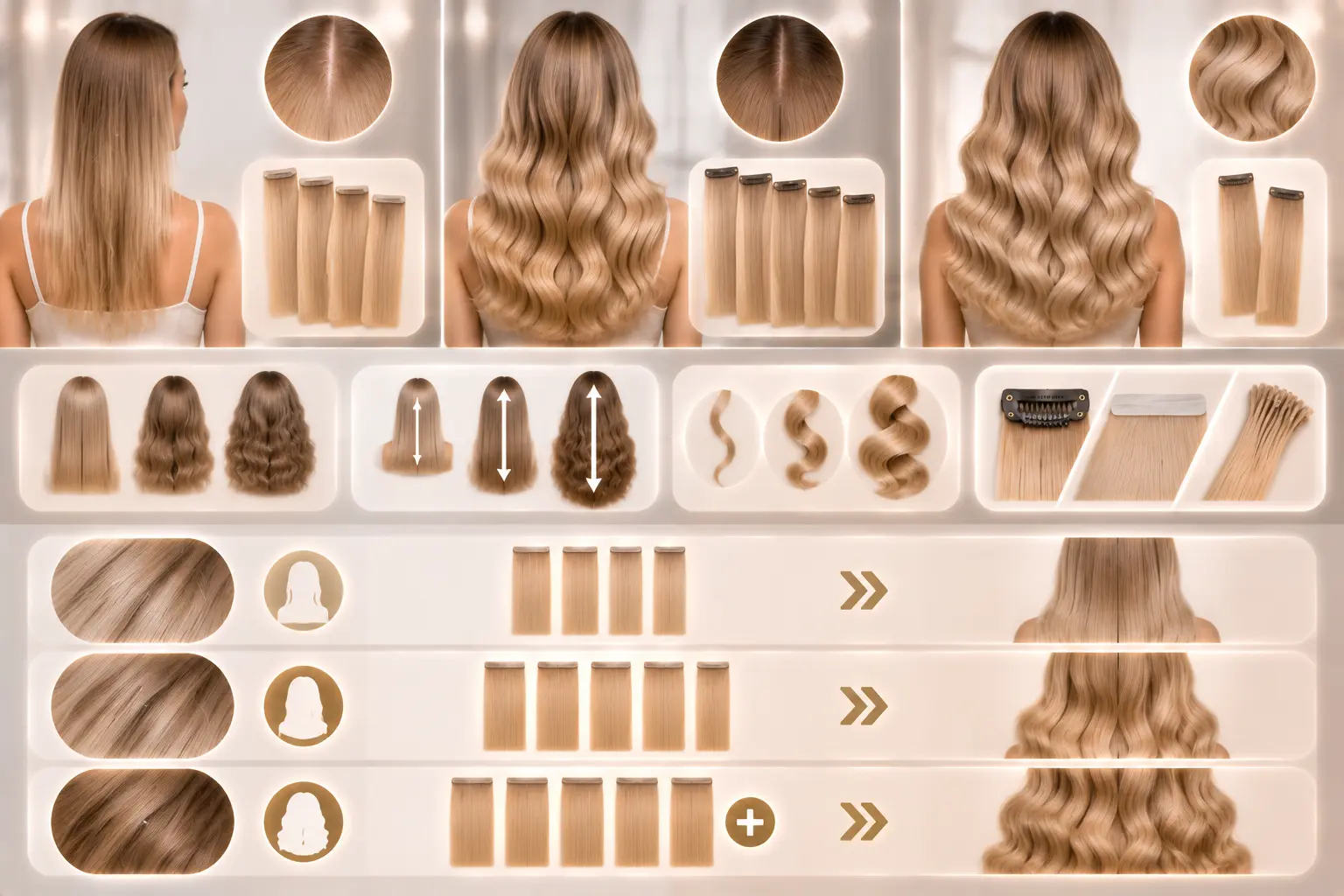
Those general numbers are a starting point, but they don't tell the whole story. The extension method you choose — tape in, hand tied weft, keratin fusion — changes the pack count dramatically. Let's break down each factor so you can place your order with confidence.
What Factors Determine How Many Packs of Hair Extensions You Need?
First-time buyers often search for a single magic number. The problem is that no single number fits every situation. Your hair is unique, and the answer depends on variables that interact with each other.
Understanding these core factors removes the guesswork. Once you know what drives the pack count, you can calculate your own needs accurately — whether you're ordering for yourself or stocking products for your clients.
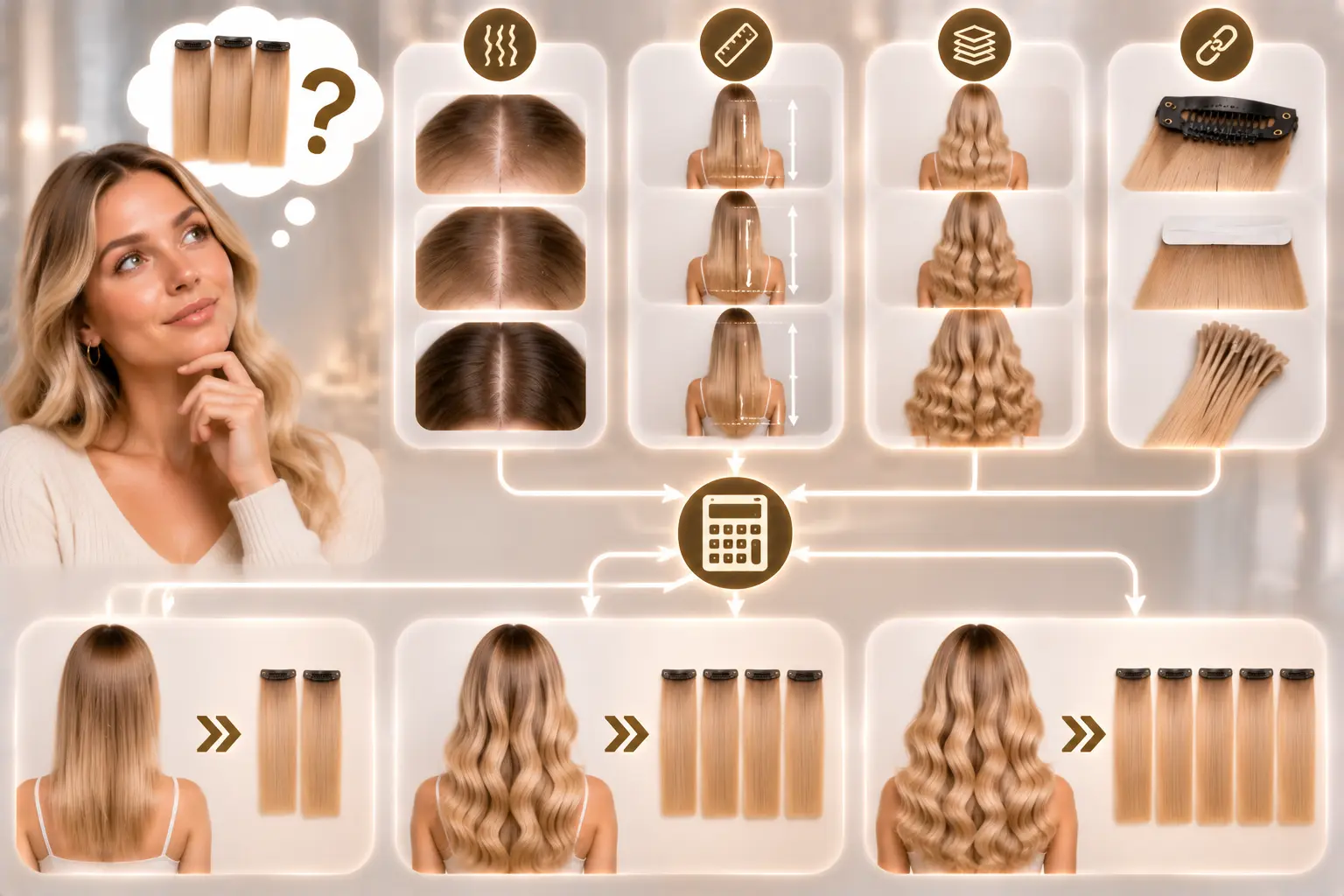
1. Natural Hair Thickness
This is the single biggest variable. Hair thickness falls into three broad categories:
- Fine hair — naturally low density, blends easily with extensions
- Medium hair — the most common type, requires a balanced amount
- Thick hair — high density, requires more extension hair to cover and blend naturally
If you skip this assessment, you risk a visible mismatch between your natural hair and the extensions.
2. Desired Length
Longer extensions carry more weight and cover more of your head. This affects how many rows or pieces you need to create a natural look. Here is a general breakdown:
| Target Length | Pack Requirement (Medium Hair) |
|---|---|
| 12–16 inches | 2–3 packs |
| 18–22 inches | 3–4 packs |
| 24 inches and above | 4–5+ packs |
3. Desired Volume and Style
A natural, everyday look requires less product than a full, high-volume blowout style. Be specific about your goal before ordering.
- Subtle volume boost — 1–2 packs
- Natural full look — 3–4 packs
- Maximum volume and length — 5+ packs
4. Extension Method
Different application methods use different amounts of hair per pack. This is often the factor buyers overlook entirely. I'll cover this in its own section below because it is critical for accurate ordering.
How Many Packs of Hair Extensions Do You Need by Hair Type?
Many buyers know their hair type but don't know how to translate it into a pack count. This is where a clear, structured guide helps — especially if you're ordering online without a stylist present.
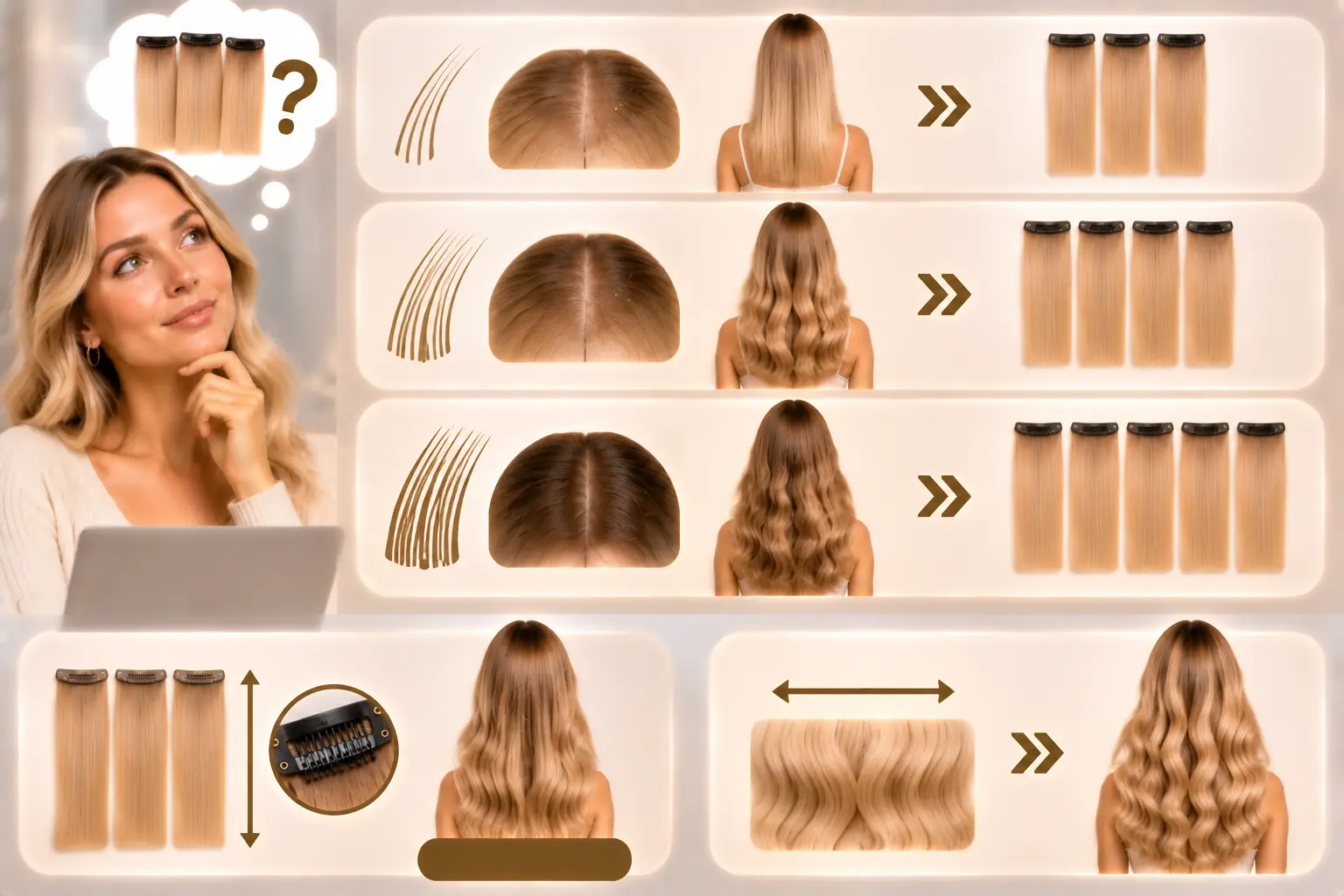
For most buyers, hair thickness is the fastest and most reliable way to estimate quantity. The guidelines below apply to a full head application at a standard length of 18–22 inches.
| Hair Type | Recommended Packs | Notes |
|---|---|---|
| Fine / Thin | 2–3 packs | Blends easily, less coverage needed |
| Medium | 3–4 packs | Standard full head application |
| Thick | 4–5 packs | Needs more hair to blend seamlessly |
| Very Thick / Coarse | 5–6+ packs | May require a professional consultation |
What If You Just Want to Add Volume?
If you're not chasing length and only want to add body and fullness, you can reduce the pack count significantly:
- Partial head or volume only — 1 to 2 packs
- Crown area boost — 1 pack is often sufficient
This is a popular use case for clients who already have long hair but want extra fullness for a special occasion or photoshoot.
What If You Have Very Short Natural Hair?
Short hair presents a different challenge. You need the extensions to blend with a very short base, which means more coverage around the perimeter of the head. In this case, add one extra pack to your standard estimate as a baseline. Very short hair combined with a thick natural texture may require 5 or more packs even for medium-length extensions[^2].
How Many Packs Do You Need for Each Hair Extension Type?
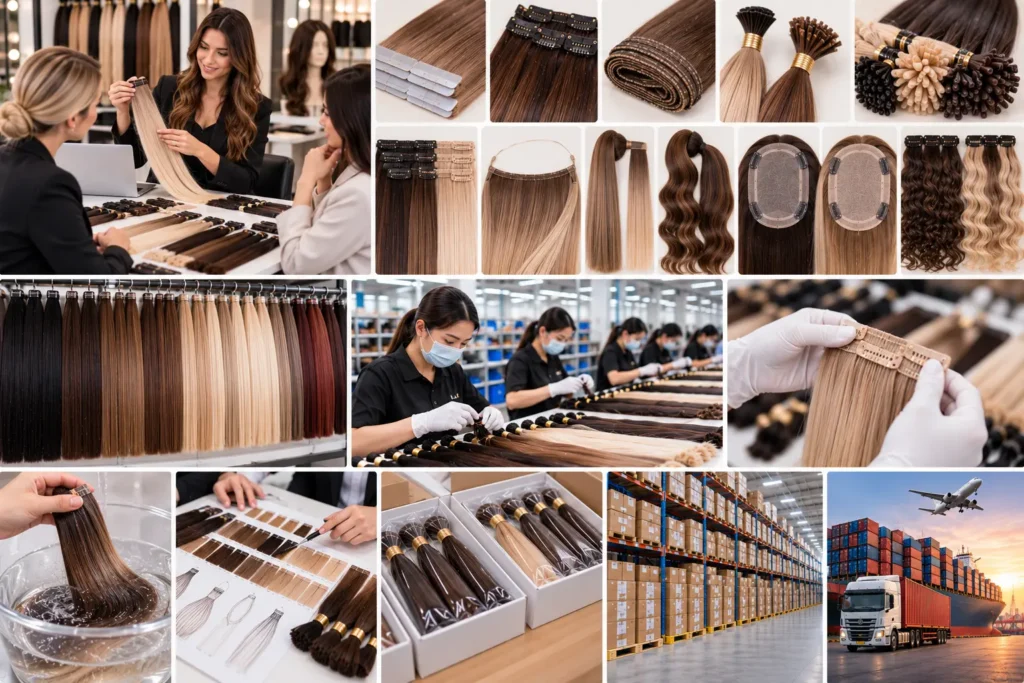
The application method changes everything. A keratin fusion set requires dramatically more packs than a machine weft application. At RENAI HAIR, we produce all major extension types, and we see this question come up constantly from first-time buyers across every product category.
Here is a direct breakdown by extension type.
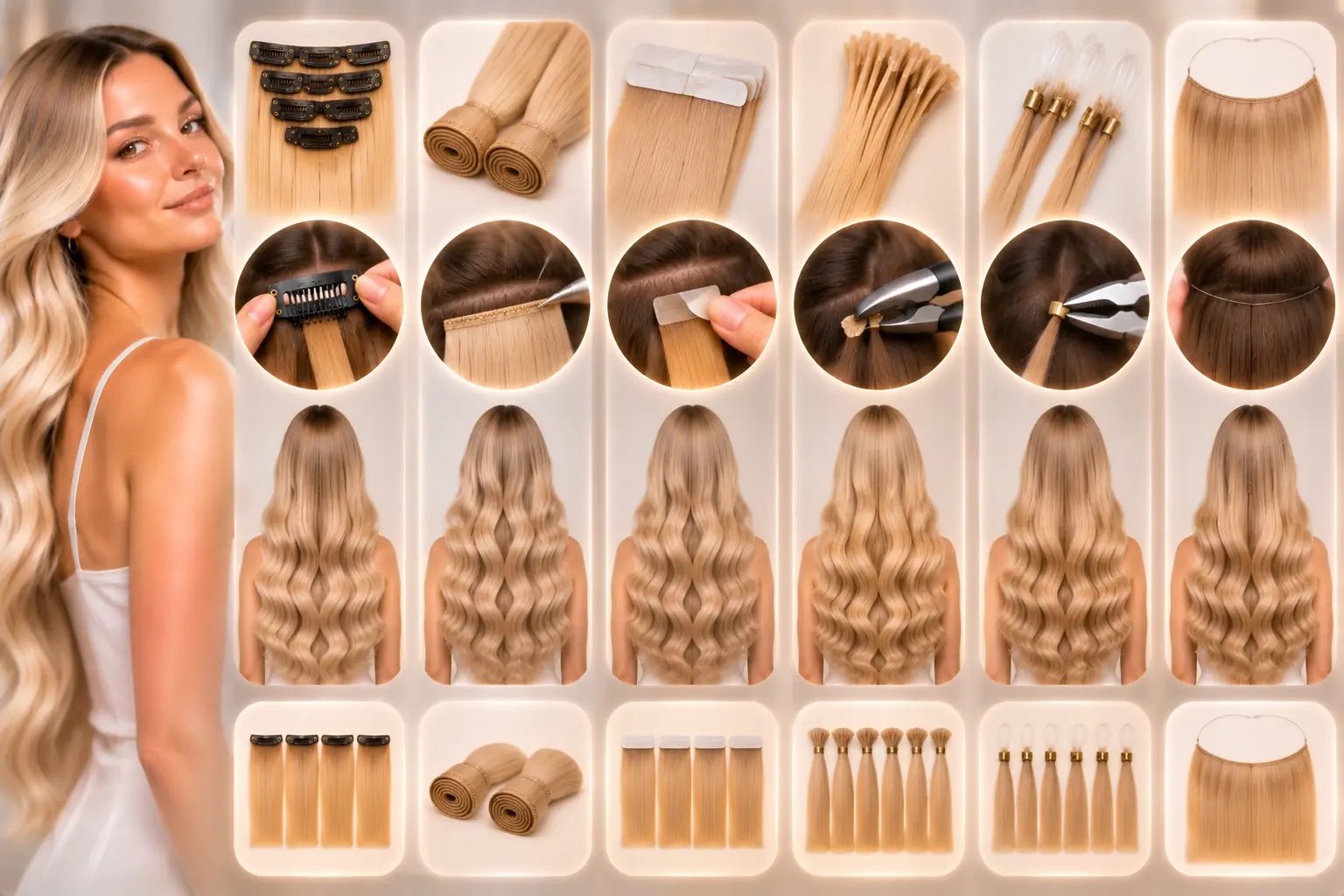
Pack Count by Extension Type
| Extension Type | Recommended Packs | Why |
|---|---|---|
| Hand Tied Weft | 2–3 packs | Flat, thin wefts require multiple rows |
| Machine Weft | 1–2 packs | Wider, denser wefts cover more area per pack |
| Genius Weft | 2–3 packs | Thin, flexible wefts similar to hand tied |
| Tape In Hair | 3–4 packs | Each pack contains sandwiched tape panels |
| Keratin / Prebonded | 6–8 packs | Individual strands require the highest quantity |
| Clip In Hair | 1–2 packs | Designed as a single full-head set |
Hand Tied Weft Hair Extensions
Recommended: 2–3 packs
Hand tied wefts are thin, flat, and flexible. They lie close to the scalp and create an extremely natural look. Because each weft is narrow, you need multiple rows to achieve full coverage. Two packs cover most medium-hair clients. Add a third pack if your hair is thick or if you want significant volume.
At RENAI HAIR, our Hand Tied Wefts are crafted with 100% Remy Human Hair with cuticles aligned in one direction[^3]. This minimizes tangling and ensures the wefts lay flat through multiple rows.
Machine Weft Hair Extensions
Recommended: 1–2 packs
Machine wefts are wider and have a slightly thicker base than hand tied wefts[^4]. One pack often covers a partial head application. Two packs typically deliver a full head of natural-looking volume. This is one of the most efficient options in terms of cost per pack.
Genius Weft Hair Extensions
Recommended: 2–3 packs
The Genius Weft is a newer innovation that combines the flatness of a hand tied weft with machine weft durability[^5]. The weft can be cut without shedding, which gives stylists more flexibility per pack. Even so, you will typically need 2–3 packs for a complete application.
Tape In Hair Extensions
Recommended: 3–4 packs
Tape in extensions come as small sandwiched panels applied along the hairline and throughout the mid-section of the head. Each pack contains roughly 20 pieces[^6]. For fine to medium hair, 3 packs (approximately 60 pieces) is a common full-head count. Thicker hair or longer lengths may push this to 4 packs.
Keratin / Prebonded Hair Extensions
Recommended: 6–8 packs
Keratin fusion extensions are applied strand by strand using a heat tool. Because each strand is individual, the total number of strands required is much higher. A standard full-head application uses 100–150 strands[^7], and packs are typically sold in 25–50 strand counts. This is the highest-pack-count method and is best applied by a certified professional.
Clip In Hair Extensions
Recommended: 1–2 packs
Clip in sets are designed as a complete system. Most quality sets come pre-assembled with multiple clips in a single pack, engineered to cover a full head in one application[^8]. One pack is usually sufficient for fine to medium hair. A second pack adds meaningful volume for thicker hair types.
Frequently Asked Questions
Can I use fewer packs and still get a full look?
You can, but the result may look thin or uneven. Using fewer packs than recommended saves money upfront but often leads to a reorder. I always suggest erring on the side of one extra pack — unused hair can often be returned if unopened, and running short mid-application is a bigger problem.
Do I need more packs for longer hair extensions?
Yes. Longer extensions require more rows or more pieces to create a seamless blend, especially around the nape and sides[^9]. As a rule, add one extra pack for every 4–6 inches beyond a standard 18-inch length application.
Does hair color affect how many packs I need?
Hair color does not directly affect pack count. However, if you are color-matching a complex highlight or ombre pattern, you may be working with multiple shades — which means ordering from each shade separately. Plan your total pack count first, then divide across the shades you need.
What if I order too few packs?
Ordering from a second batch later can cause color inconsistency, even within the same shade name. Dye lots vary between production batches[^10]. This is one of the most common complaints from buyers who underestimate their pack count. Always order with a small buffer.
Should I consult a stylist before ordering?
Yes — especially for keratin fusion and hand tied weft applications. A licensed stylist can assess your hair density, measure your head, and give you a precise pack count[^11]. At RENAI HAIR, we also assist wholesale and brand clients in estimating quantities for their product lines based on target end-user hair types.
Conclusion
Knowing how many packs of hair extensions to buy starts with three questions: How thick is your natural hair? How long and full do you want the final result? Which extension method are you using? Fine to medium hair typically needs 3–4 packs for a full head, while thicker hair may require 5 or more. The extension method shifts the range significantly — from 1–2 packs for clip ins and machine wefts up to 6–8 packs for keratin fusion. When in doubt, add one extra pack to your order to avoid running short mid-application.
If you are a brand, salon, or distributor building out a hair extensions product line and need help estimating quantities across SKUs, contact RENAI HAIR directly. Our team can guide you through product selection, pack weight recommendations, and bulk order planning based on your target market.
[^1]: "Sometimes hair extensions just aren't enough. That's why I ...", https://www.facebook.com/Ashleyhhairdesign/videos/sometimes-hair-extensions-just-arent-enough-thats-why-i-offer-both-hair-toppers/1675413267508748/. Professional extension training materials consistently identify under-application — defined as insufficient weft or strand coverage relative to the client's natural hair density — as a primary cause of visible unevenness, sparse sections, and failure to achieve the desired volume or length outcome. Evidence role: general_support; source type: education. Supports: Insufficient extension hair relative to natural hair density produces visibly thin or uneven results. Scope note: Empirical consumer studies quantifying the aesthetic outcomes of specific under-application scenarios are not widely available in the published literature; this claim is primarily supported by practitioner consensus in professional education contexts. [^2]: "What type of hair extensions are recommended for short ...", https://www.facebook.com/groups/HairExtensionInfo/posts/25953976157548972/. Professional extension training curricula note that clients with short natural hair require greater perimeter coverage to achieve seamless blending, and that high-density hair textures compound this requirement, often necessitating pack counts above the standard estimate for medium-length applications. Evidence role: general_support; source type: education. Supports: Short, thick natural hair requires additional extension hair for adequate coverage and blending. Scope note: Specific pack count thresholds for short, thick hair are not uniformly codified across cosmetology licensing bodies; recommendations vary by educator, extension method, and individual client assessment. [^3]: "Friction Dynamics of Straight, Curly, and Wavy Hair", https://pubmed.ncbi.nlm.nih.gov/38692901/. The hair cuticle, composed of overlapping keratinized scales, creates directional friction; when cuticles from multiple strands are oriented in opposing directions, scale interlocking increases, producing tangling — a mechanism that underlies the industry distinction between Remy and non-Remy hair. Evidence role: mechanism; source type: research. Supports: Alignment of hair cuticles in a single direction reduces inter-fiber friction and tangling. Scope note: Peer-reviewed tribological studies on hair cuticle directionality and tangling are primarily conducted in the context of hair care product testing rather than extension manufacturing specifically. [^4]: "Hand Tied vs Machine Weft Extensions: Key Differences", https://invisiblebeadextensions.com/blogs/hand-tied-extensions/machine-vs-hand-tied. Machine wefts are constructed using industrial sewing equipment that produces a wider, more uniform base with a reinforced thread track, resulting in a thicker weft base compared to hand tied wefts, which are assembled manually using a thin thread and produce a flatter, more flexible foundation. Evidence role: definition; source type: other. Supports: Machine wefts differ structurally from hand tied wefts in base width and thickness. Scope note: Quantitative measurements of weft base thickness across manufacturers are not standardized or publicly documented; the structural distinction described reflects general trade knowledge rather than independently verified dimensional specifications. [^5]: "Difference between genius weft hair extensions?", https://www.facebook.com/groups/762654947089579/posts/25154715727456828/. The Genius Weft is a relatively recent product category in the professional hair extension market, distinguished by a construction method that produces a thinner, more flexible weft than traditional machine wefts while offering greater structural integrity than hand tied wefts, including resistance to shedding when cut. Evidence role: historical_context; source type: other. Supports: The Genius Weft represents a distinct extension construction method combining characteristics of hand tied and machine weft techniques. Scope note: Independent technical documentation or peer-reviewed analysis of Genius Weft construction is not widely available; characterizations of this product type rely primarily on manufacturer and trade education sources. [^6]: "Tape-In Hair Extensions Shopping Guide - Cooviphair", https://cooviphair.com/blogs/blog/tape-in-hair-extensions-shopping-guide-how-many-packs-do-you-need?srsltid=AYCX9vIR35UBgWPnomCi7KJWwl9igAZUuf30z2OhB4KJNmsCZDhOp25E. Tape-in hair extension packs are commonly sold in counts of 20 pieces per pack across major manufacturers and distributors, though pack sizes can range from 10 to 40 pieces depending on the brand and weight specification. Evidence role: general_support; source type: other. Supports: Standard tape-in hair extension packs typically contain approximately 20 individual pieces. Scope note: No formal industry-wide standard governs tape-in pack piece counts; the figure of 20 pieces reflects common commercial practice rather than a codified specification, and buyers should verify pack contents with individual suppliers. [^7]: "Fusion Hair Extensions 101: Guide to Keratin Bond ...", https://donnabellahair.com/a/blog/fusion-hair-extensions-101?srsltid=AYCX9vJlc-sMGOBggH0t8IIwTkpFWfSb9SXNX6-GG1mVLB_jMffBHOaS. Professional cosmetology and extension training programs generally cite 100–150 individual keratin-bonded strands as the range required for a full-head application, though the precise count varies with the client's natural hair density and desired volume. Evidence role: general_support; source type: institution. Supports: The typical number of individual strands used in a full-head keratin fusion extension application. Scope note: Strand count recommendations vary by manufacturer and educator; a single authoritative industry-wide standard does not appear to be formally codified in publicly available regulatory or licensing documents. [^8]: "What We Do: Extension | NIFA", https://www.nifa.usda.gov/about-nifa/what-we-do/extension. Clip-in hair extension sets are conventionally packaged as multi-weft systems — typically comprising between five and ten individual wefts of varying widths — designed to be distributed across the full head in a single application session, distinguishing them from weft or strand-based methods sold in uniform packs. Evidence role: general_support; source type: other. Supports: Clip-in hair extension sets are typically sold as multi-piece systems designed to provide full-head coverage in a single purchase. Scope note: No formal industry standard defines the minimum piece count or weight required for a clip-in set to qualify as a full-head system; product configurations vary substantially across manufacturers and price points. [^9]: "How To Apply The Most Googled Hair Extension Technique ...", https://www.youtube.com/watch?v=G_MWmoIBX7g. Professional extension application guides describe a sectioning methodology in which longer extension lengths require additional horizontal rows placed progressively toward the nape and temporal regions to distribute weight evenly and prevent visible demarcation lines between natural and extension hair. Evidence role: mechanism; source type: education. Supports: Longer hair extensions require additional placement rows or pieces at the nape and lateral sections to achieve natural blending. Scope note: Sectioning protocols vary by extension method and educator; no single universally adopted standard governs row placement for specific extension lengths across all application techniques. [^10]: "Understanding Dye Lot Variations in Fabrics: A Guide by ...", https://deconovo.com/pages/understanding-dye-lot-variations-in-fabrics-a-guide-by-deconovo?srsltid=AYCX9vKMFkb5Eny22kXB0v31yy1ABbgNdS3qrbw9AkYUEK-uqBV9NNWv. Dye lot variation is a well-documented phenomenon in textile manufacturing, arising from differences in dye concentration, water chemistry, temperature, and fiber absorption across separate production runs, resulting in perceptible color differences even within nominally identical shade designations. Evidence role: mechanism; source type: research. Supports: Dye lot variation between production batches causes color inconsistency in textile and hair products. Scope note: Published research on dye lot variation is primarily situated in textile science broadly; peer-reviewed studies specific to human hair extension manufacturing are limited in the open literature. [^11]: "Apply for a Hair Weaving Specialist License | TDLR.Texas.gov", https://www.tdlr.texas.gov/barbering-and-cosmetology/individuals/apply-weaving.htm. State cosmetology licensing boards in the United States require candidates to complete accredited training programs that include hair structure assessment and chemical and physical service techniques; hair extension application is increasingly incorporated into advanced or continuing education curricula recognized by these boards. Evidence role: expert_consensus; source type: government. Supports: Licensed cosmetologists receive training relevant to hair extension application and client hair assessment. Scope note: Hair extension quantity estimation is not uniformly included in entry-level cosmetology licensing examinations; the depth of extension-specific training varies significantly by state, school, and whether the stylist has pursued additional certification.