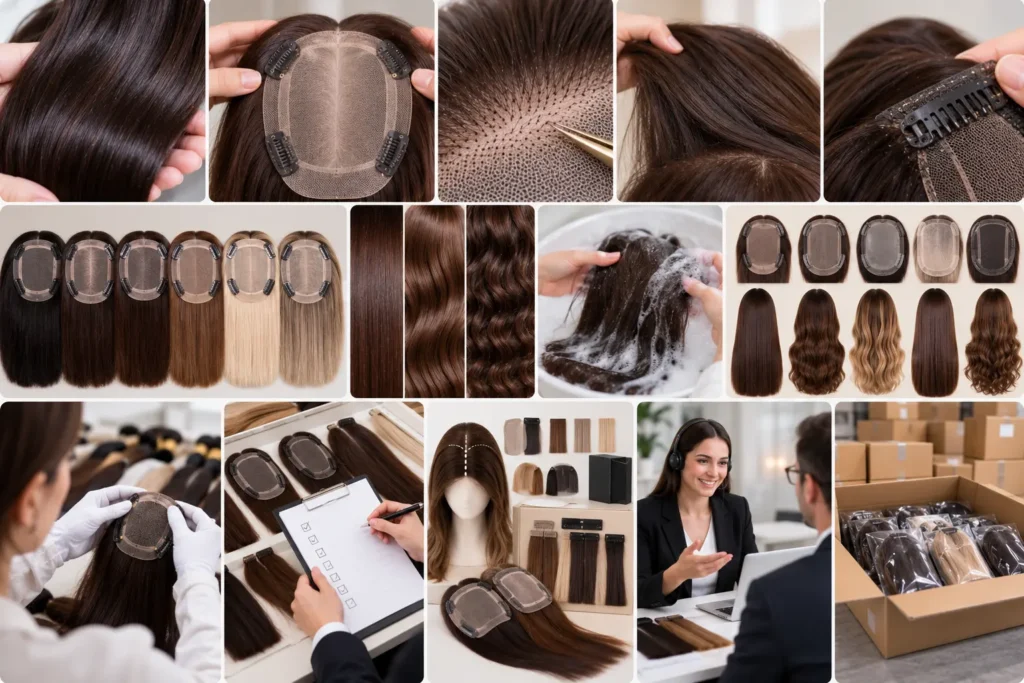

Frequently Asked Questions About Wholesale Hair Extensions
Wholesale Hair Extensions can feel easy to buy at first, but difficult to evaluate with confidence. A product may look beautiful in a photo, yet perform differently after washing, brushing, coloring, or salon installation. I wrote this guide to help professional buyers ask better questions before they commit to bulk orders.
Wholesale Hair Extensions are hair extension products purchased in larger quantities by salons, distributors, beauty supply businesses, and hair brands for resale or professional use. Buyers should evaluate hair quality, attachment construction, color range, customization options, supplier reliability, and sample performance before placing larger orders.
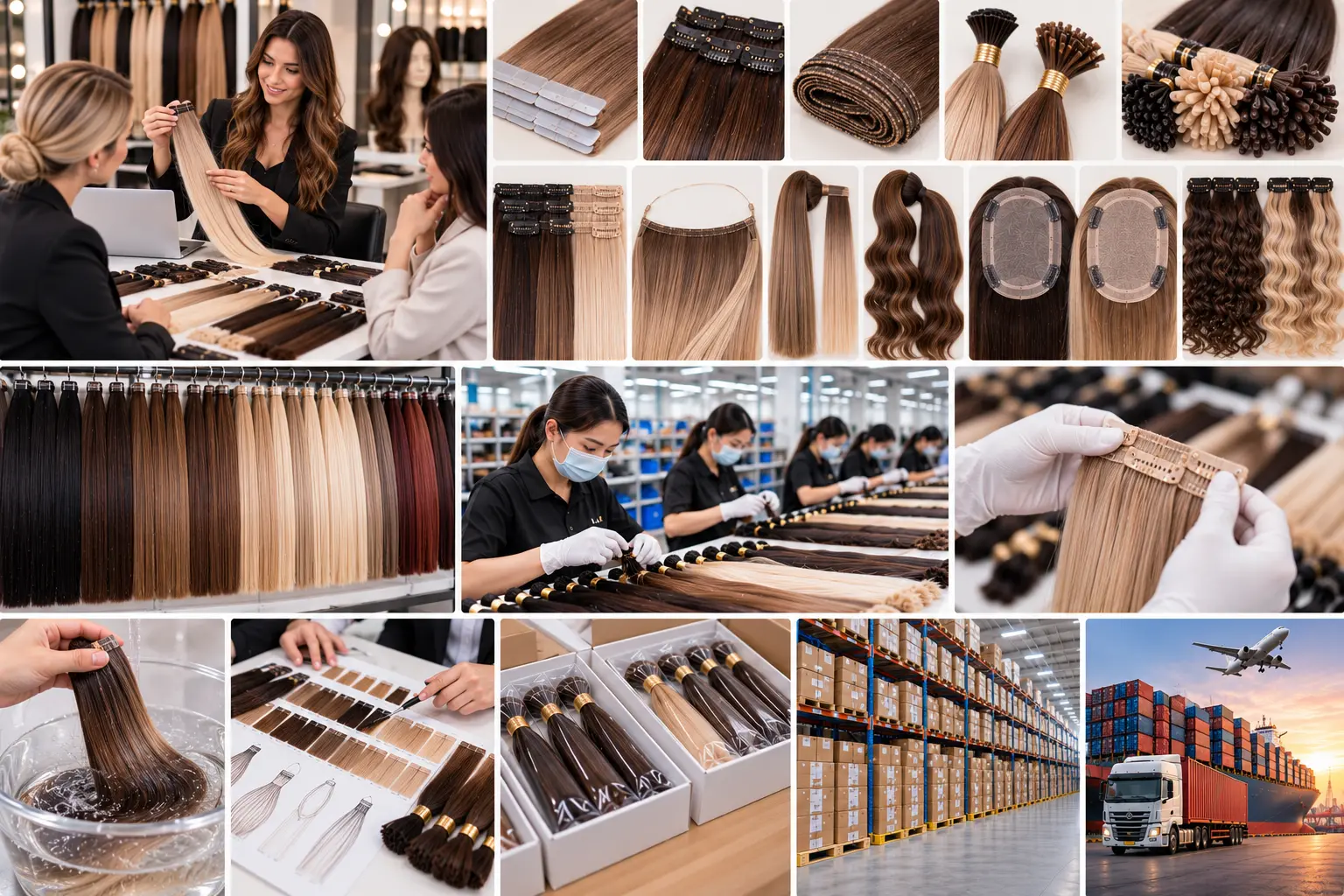
I work with professional buyers who often ask similar questions before choosing a supplier. The details below explain how I usually think through extension methods, samples, private labeling, customization, color planning, and realistic product lifespan.
What are the best Wholesale Hair Extensions for professional salons?
Many salons want one “best” extension method, but that question can create the wrong expectation. A method that works beautifully for one stylist may not fit another salon’s service menu, client hair type, or maintenance schedule. I prefer to match the method to the business model.
There is no single best option for every salon.[^1] Tape-ins, wefts, I-tips, and K-tips can all be suitable depending on the client’s natural hair, stylist training, desired result, budget, maintenance habits, and local customer demand.
How I compare salon extension methods
When I help a salon or brand compare methods, I start with three practical questions:
- Who is the end customer?
- What service does the stylist already know well?
- How much maintenance will the customer accept?
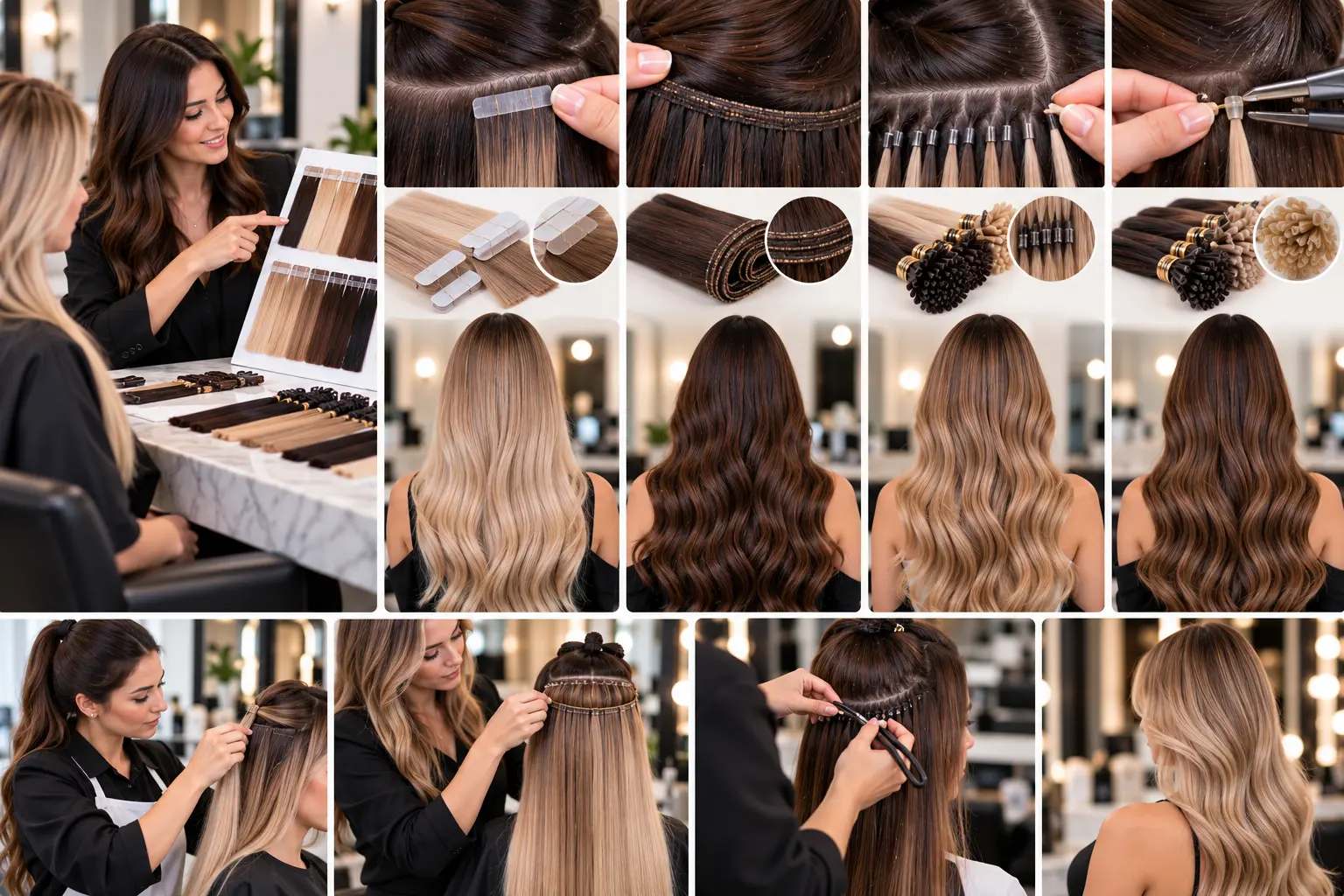
Different extension systems create different business outcomes. A salon that specializes in fast transformations may prefer tape-ins or wefts. A stylist who focuses on strand-by-strand luxury applications may prefer I-tips or K-tips. A boutique brand may carry several types to serve both salons and retail customers.
| Extension Type | Common Buyer Fit | Main Advantage | Evaluation Focus |
|---|---|---|---|
| Tape In Hair | Salons, beauty supply, brands | Fast installation | Tape strength, adhesive residue, tab flexibility |
| Genius Weft / Flex Weft | Salons, stylists, wholesalers | Natural volume and flexible placement | Weft thinness, shedding, return hair control |
| Machine Weft | Wholesale and high-volume buyers | Strong structure and cost efficiency | Stitching, thickness, consistency |
| Hand Tied Weft | Professional stylists | Flat, discreet installation | Knot quality, shedding, width consistency |
| I-Tip Hair | Strand-by-strand salons | No heat installation | Tip firmness, bead compatibility |
| K-Tip / Keratin Hair | Premium salon services | Durable bond when applied correctly | Keratin quality, bond shape, shedding |
What salon buyers should verify
I suggest that professional buyers avoid choosing only by trend. A popular product can still be a poor fit if the stylist team lacks training or if the local market prefers another service.
Buyers should check:
- Client hair density: Fine hair needs lighter, more discreet attachment points.
- Service time: Some methods are faster to install than others.
- Maintenance cycle: Clients must understand move-up or reinstallation timing.
- Retail price point: Premium methods require a market willing to pay.
- Stylist education: A good product can fail with poor installation.
At RENAI HAIR, we supply multiple extension types because professional buyers have different needs. I usually recommend that new wholesale buyers start with a controlled product range instead of buying every method immediately. A focused launch helps you monitor feedback, reduce dead inventory, and train your sales team more clearly.
Can I order Wholesale Hair Extensions samples before buying in bulk?
Buying bulk hair without testing can lead to costly mistakes. Photos and videos help, but they cannot show everything. Buyers need to feel the hair, wash it, brush it, and test how the attachment behaves under realistic conditions.
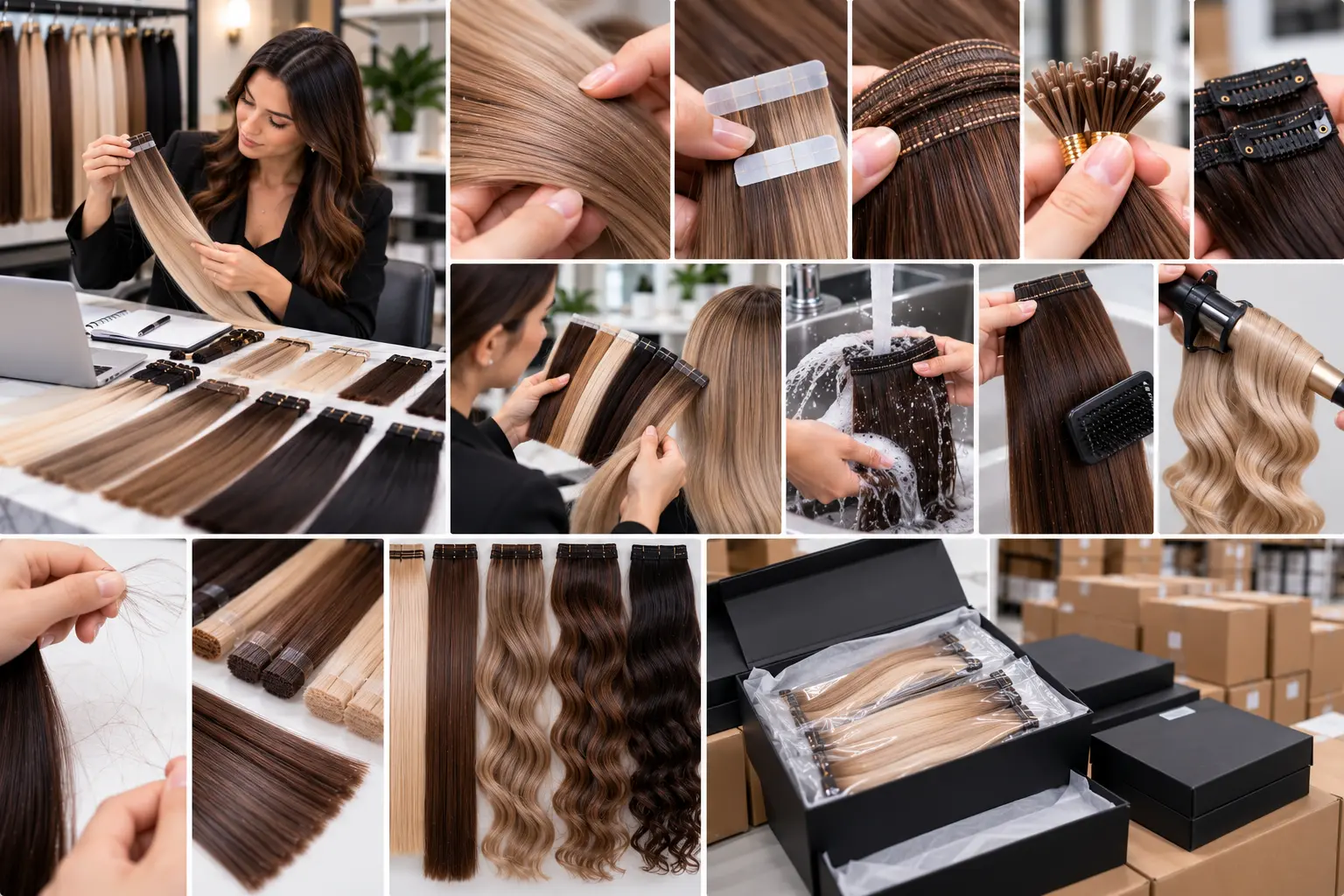
Yes, sample testing is highly recommended before buying Wholesale Hair Extensions in larger quantities. Samples allow buyers to evaluate texture, color accuracy, attachment construction, washing performance, shedding, styling response, and packaging details before committing to wholesale inventory.
What I include in a serious sample test
A sample should not sit in a drawer. I believe professional buyers should test it like a customer would use it. That means washing, drying, brushing, curling, straightening, and checking the product after handling.
A basic sample test can include:
- Initial inspection: Check length, weight, color, thickness, and attachment.
- Wash test: Use a mild shampoo and observe tangling or dryness.
- Brush test: Brush from ends upward and monitor shedding.
- Heat styling test: Curl or straighten within a reasonable temperature range.
- Color observation: Compare indoor, daylight, and salon lighting.
- Attachment check: Inspect tape, weft stitching, keratin bonds, clips, or tips.
Sample testing checklist
| Test Item | What to Look For | Why It Matters |
|---|---|---|
| Hair feel | Smooth but not overly coated | Heavy silicone can hide poor hair quality[^2] |
| Ends | Fullness from top to bottom | Thin ends affect customer satisfaction |
| Shedding | Minimal hair loss during brushing | Excess shedding can indicate weak construction |
| Tangling | Low tangling after washing | Important for repeat purchases |
| Color | Match to color ring or requirement | Reduces returns and complaints |
| Attachment | Stable, neat, and consistent | Protects salon reputation |
Why one sample is not always enough
One sample can give a first impression, but it may not represent every color, length, or product type. Longer lengths often need more careful evaluation because the hair has gone through more sorting and processing. Light blonde shades also need careful checking because strong chemical processing can affect softness and durability.[^3]
I often tell buyers to test the exact products they plan to sell. For example, if your target product is 22-inch blonde Genius Weft, do not judge the full order only from an 18-inch dark brown sample. The performance expectations are different.
Sample testing protects both sides. It helps the buyer set clear expectations, and it helps the supplier confirm specifications before production.
What is the difference between Wholesale Hair Extensions and private-label hair extensions?
Many new brand owners confuse wholesale and private label, so they compare suppliers in the wrong way. This can lead to unclear quotations, missed packaging costs, or unrealistic branding expectations. I separate the product purchase from the branding service.
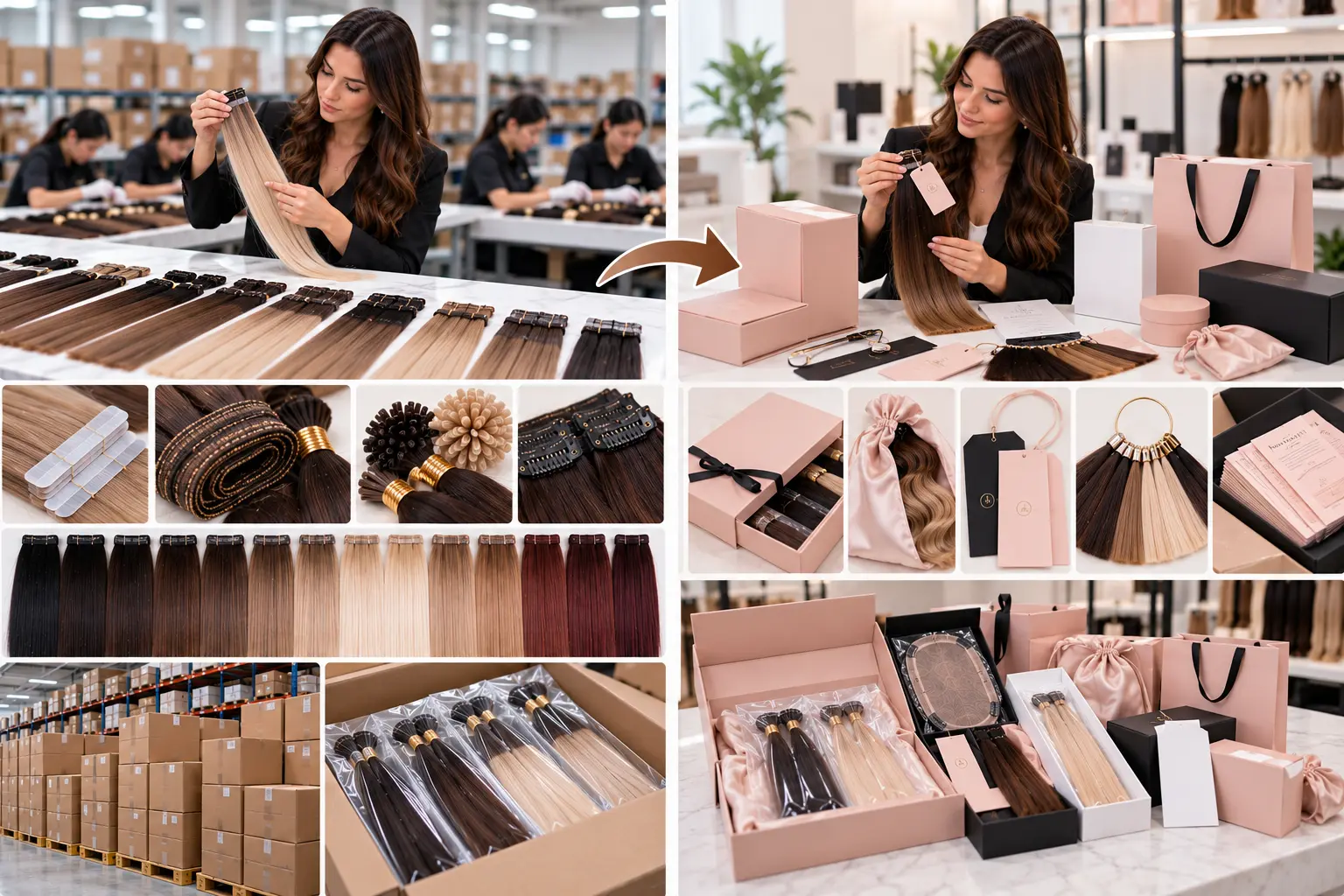
Wholesale Hair Extensions are usually purchased in quantity from a supplier for resale or salon use. Private-label hair extensions include brand customization, such as logo packaging, labels, tags, color rings, instruction cards, or other brand elements.
Wholesale vs. private label
Wholesale buying focuses on product supply. Private labeling adds a branding layer. Some buyers only need neutral packaging because they sell through salons or internal channels. Other buyers want a complete branded presentation for e-commerce, boutique retail, or distributor networks.
| Category | Wholesale Hair Extensions | Private-Label Hair Extensions |
|---|---|---|
| Main purpose | Bulk purchasing | Branded resale |
| Packaging | Standard or neutral | Customized with brand elements |
| MOQ | Often lower | May be higher depending on packaging |
| Best for | Salons, distributors, wholesalers | Brands, boutiques, e-commerce sellers |
| Key concern | Product consistency | Product consistency + brand presentation |
What private-label buyers should prepare
If you want to build your own brand, I recommend preparing a simple brand brief before asking for a quotation. This saves time and reduces misunderstanding.
A good brief may include:
- Brand name and logo files
- Preferred packaging style
- Product types and quantities
- Target price range
- Color and length plan
- Barcode or SKU requirements
- Insert card or care instruction content
- Market positioning: budget, mid-range, or premium
The practical side of branding
Private label does not automatically make a product premium. The product still needs stable quality, clear specifications, and repeatable supply. Nice packaging can help the first sale, but product performance creates the second sale.
At RENAI HAIR, we support wholesale and customized options depending on buyer needs. I always suggest that new brands finalize product quality first, then upgrade packaging. This order matters because a beautiful box cannot solve shedding, tangling, or inconsistent color.
For serious B2B buyers, private label works best when the brand has a clear customer group. A salon-focused brand may need professional education cards. A beauty supply brand may need strong shelf display. An online brand may need packaging that photographs well and protects the hair during shipping.
How do I know whether human hair extensions are good quality?
New hair extensions can look smooth and shiny, which makes quality evaluation difficult. Some products look excellent because of temporary coating, but the real test begins after washing and styling. Buyers need a process, not just a visual opinion.
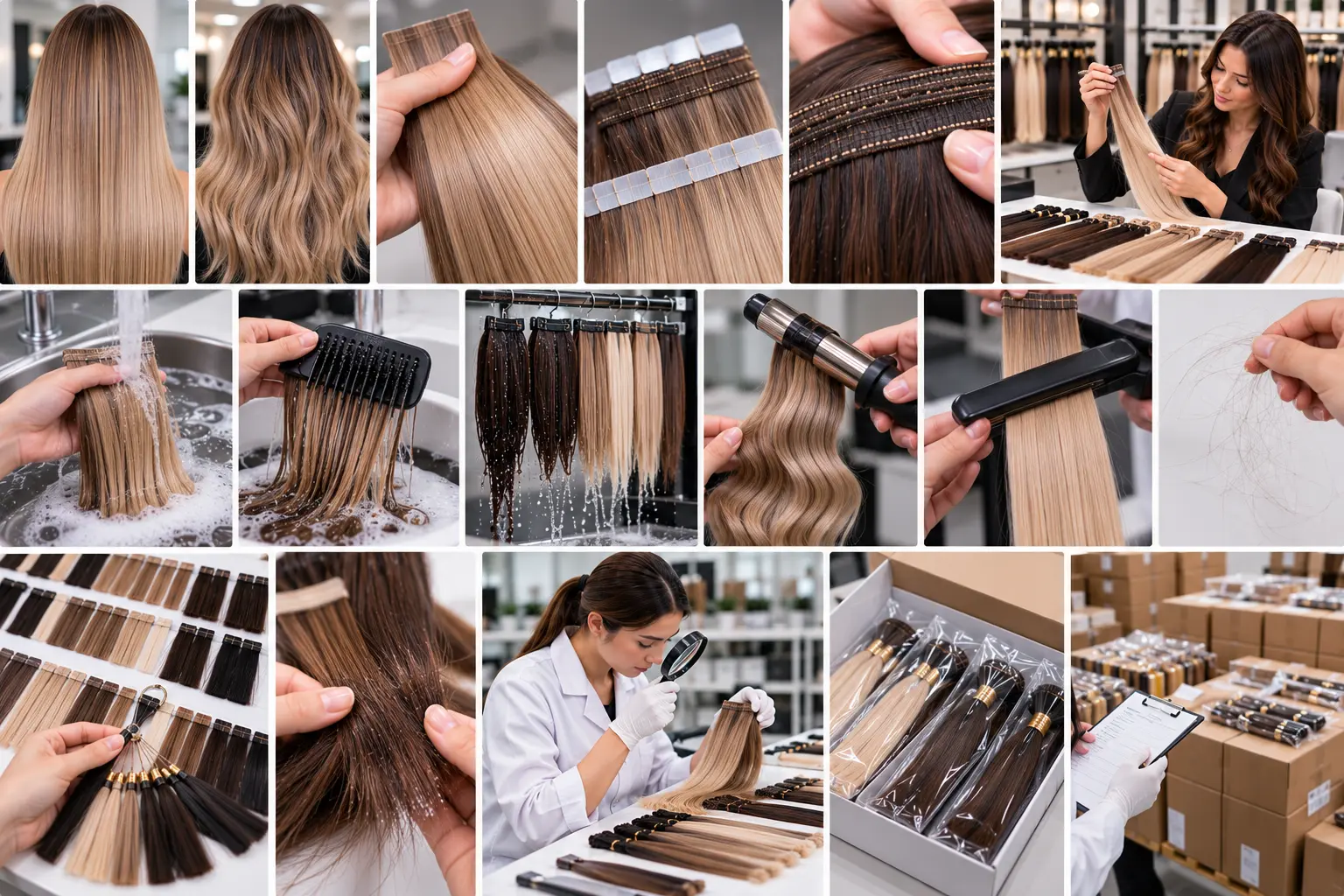
Do not judge human hair extensions only by their new appearance. Good quality should be assessed through hair source claims, construction, specifications, washing tests, brushing tests, styling response, shedding control, color consistency, and supplier quality control records.
Key quality indicators
I usually break quality into two parts: hair material and product construction.
Hair material may include:
- 100% Human Hair
- Remy Hair
- Cuticle Intact Hair
- Virgin or processed hair, depending on the supplier’s definition
- Color-treated human hair
Product construction may include:
- Weft stitching
- Tape tab design
- Keratin bond shape
- Clip strength
- Tip firmness
- Hair ratio and end fullness
Buyers should verify supplier claims through documents, samples, and their own testing where possible. Terms like “Remy” and “cuticle intact” are important, but buyers should still examine real performance.
Practical tests I recommend
A simple but useful test plan includes:
- Measure length and weight
- Confirm the product matches the invoice or sample agreement.
- Inspect the hair ratio
- Check whether the ends are full enough for your target market.
- Wash and air dry
- Observe dryness, swelling, tangling, and wave changes.
- Brush after drying
- Check shedding and smoothness.
- Use controlled heat
- Test styling response with reasonable salon temperatures.
- Review color stability
- Watch for unusual fading or color transfer.
Why construction matters as much as hair
A bundle of good hair can still become a bad product if the construction is weak.[^4] For example, a weft may shed if stitching is not secure. Tape-ins may fail if adhesive quality is poor. Keratin bonds may crack if the bond material is unstable.
For B2B buyers, quality control should happen before shipment. At RENAI HAIR, our business context includes strict outgoing inspection, but I still encourage buyers to define their own acceptance standards. Professional buyers may request photos, videos, sample confirmation, or third-party inspection for large orders.
A good supplier should not be afraid of reasonable testing. Clear testing protects long-term cooperation.
Can Wholesale Hair Extensions be customized for my market?
Standard products work for many businesses, but they may not fit every market. A salon chain in Europe, a beauty supply store in the United States, and a distributor in the Middle East may all need different lengths, colors, weights, and packaging.
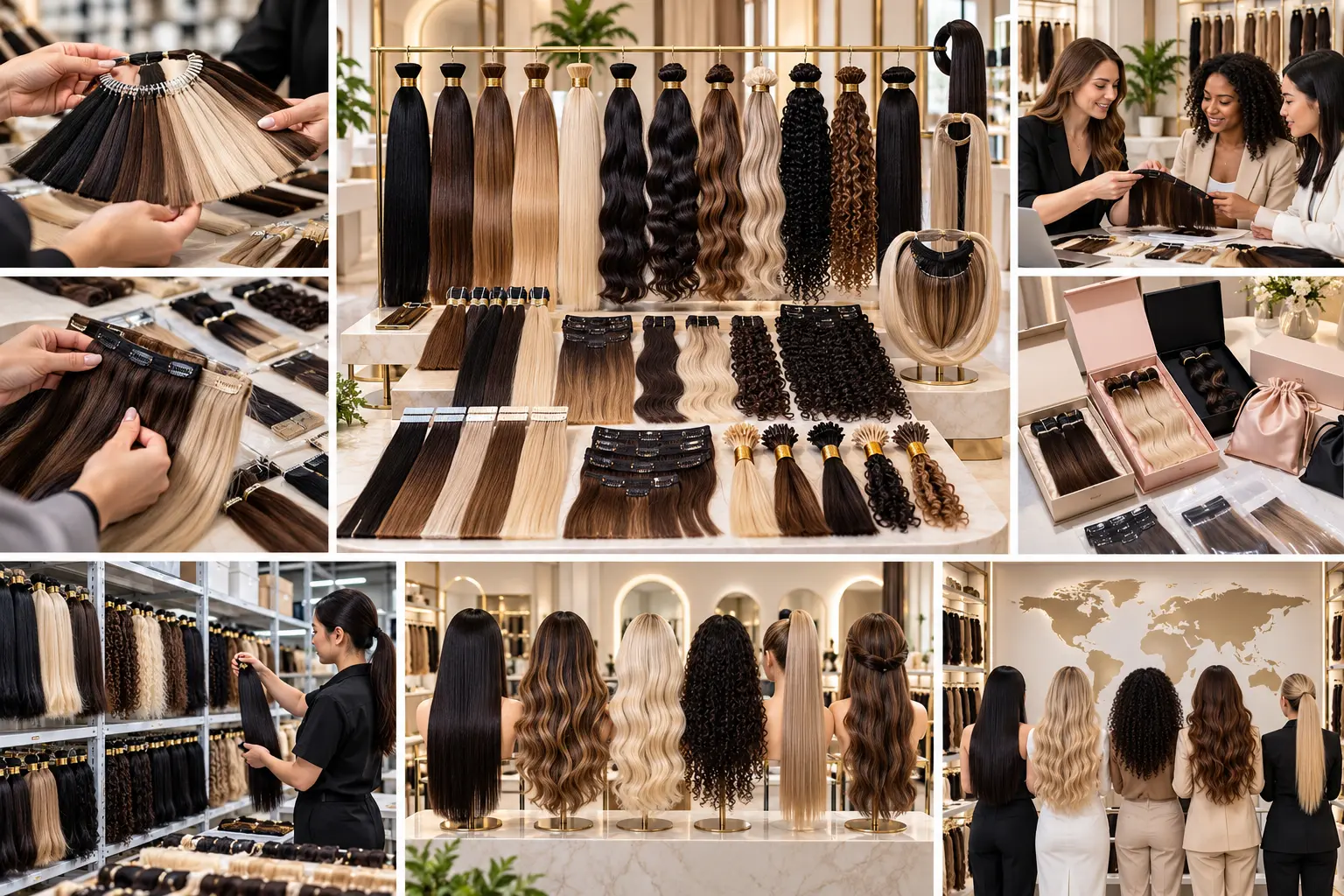
Yes, Wholesale Hair Extensions can often be customized depending on the manufacturer. Customization may include length, weight, color, texture, attachment method, weft type, packaging, private labeling, and product assortment for different market positions.
Common customization options
Customization is one of the main reasons buyers work directly with a manufacturer. It gives the buyer more control over product fit and brand identity.
| Custom Area | Examples | Buyer Benefit |
|---|---|---|
| Length | 14, 16, 18, 20, 22, 24 inches | Fits local demand and pricing |
| Weight | 50g, 100g, 120g, custom grams | Controls fullness and cost |
| Color | Natural, blonde, rooted, balayage, ombre | Matches customer preferences |
| Texture | Straight, body wave, deep wave | Expands product range |
| Attachment | Tape, weft, clip, halo, keratin, I-tip | Supports different services |
| Packaging | Bags, boxes, labels, cards | Builds brand presentation |
How I suggest planning customization
Customization sounds exciting, but too many options can create inventory pressure. I suggest starting with a focused plan. A new brand does not need 80 colors and 10 methods on day one. It needs a sellable range that reflects real demand.
A practical launch plan might include:
- 2–3 product methods
- 6–10 core colors
- 3–5 popular lengths
- Standard packaging first, then custom packaging
- One premium product line before expanding
Production realities buyers should understand
Custom products may require higher MOQs, longer lead times, and clearer confirmation.[^5] Color matching can be especially detailed. A buyer may need to provide a color sample, Pantone reference for packaging, or previous product benchmark.
For hair extensions, customization should always balance creativity with repeatability. A beautiful custom shade is useful only if the supplier can reproduce it consistently. I recommend keeping approved color samples, product specifications, and packaging files on record.
At RENAI HAIR, we work with different lengths, colors, hair qualities, and extension methods. My usual advice is simple: customize what matters to your customer, not everything that is technically possible.
How do I choose colors for my Wholesale Hair Extensions business?
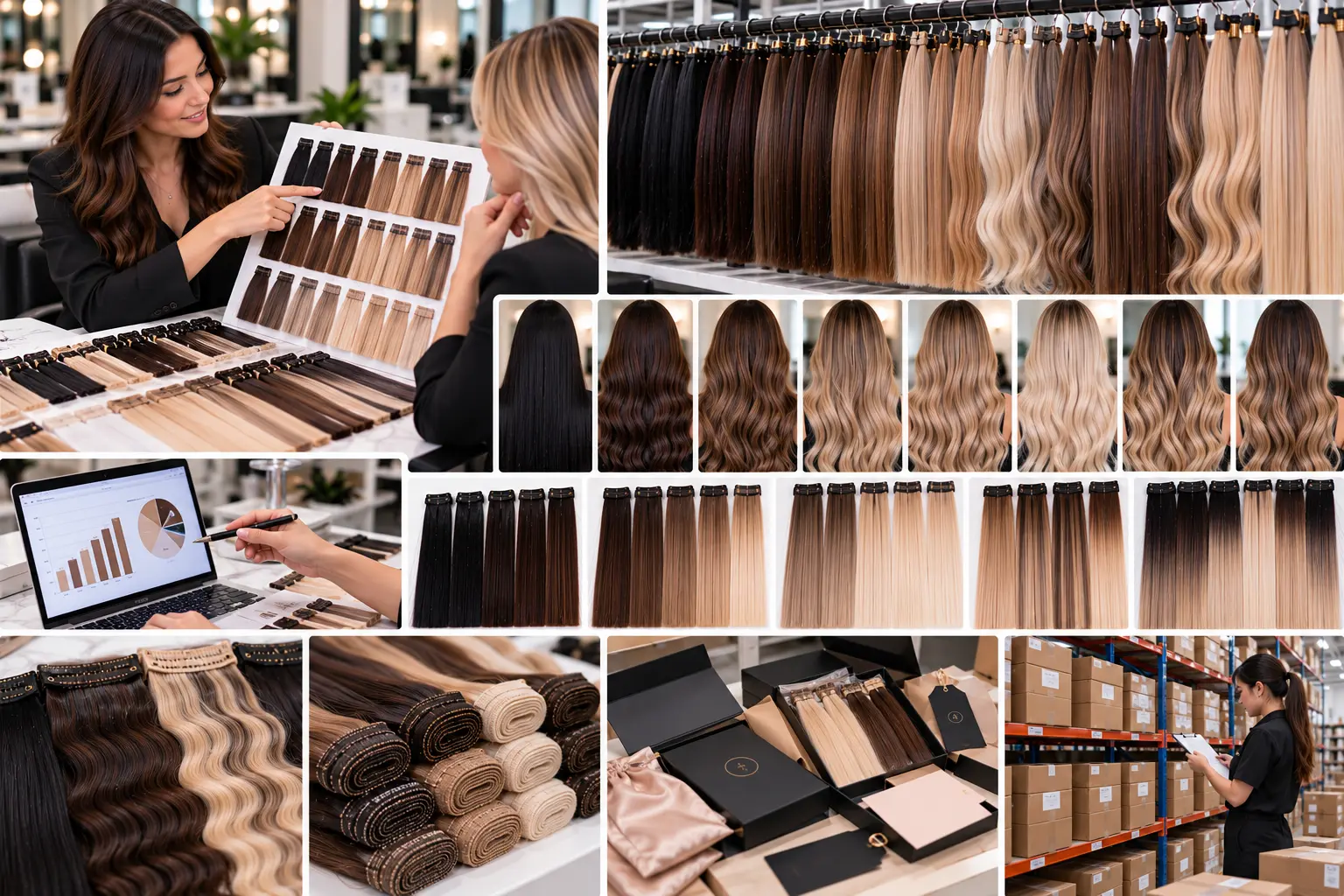
Color selection can make or break inventory performance. If buyers choose too many slow-moving shades, cash sits on the shelf. If they choose too few colors, stylists cannot serve real clients. I like to build color ranges from market data, not guesswork.
To choose colors for a Wholesale Hair Extensions business, start with the shades most requested by your target customers. Then build a core range of black, brown, blonde, highlighted, balayage, and ombre colors based on local trends and sales feedback.
Start with customer demand
A salon buyer should review service history. A distributor should review reorder data. A new brand should study competitors, local salons, and social media trends. The goal is not to carry every color. The goal is to carry the colors customers actually buy.
Common core color groups include:
- Natural black and dark brown
- Medium brown and chestnut
- Light brown and dark blonde
- Platinum, ash, and warm blonde
- Piano colors and highlights
- Rooted blonde
- Balayage and ombre shades
Color planning by business type
| Business Type | Suggested Color Strategy |
|---|---|
| Professional salon | Match the salon’s most common color services |
| Beauty supply store | Stock fast-moving natural and fashion shades |
| Hair extension brand | Build a clear color chart and hero shades |
| Distributor | Carry broad but controlled shade groups |
| Stylist boutique | Focus on premium blends and custom looks |
Why color rings matter
I strongly recommend using a physical color ring when possible. Screen colors are unreliable because monitors, lighting, cameras, and filters change the appearance.[^6] A physical color ring helps stylists and customers compare shades under real lighting.
For B2B purchasing, color consistency is also important. Buyers should define acceptable color tolerance with the supplier. Human hair products involve processing, so slight batch variation can happen.[^7] However, professional suppliers should manage variation carefully and communicate clearly.
Inventory tip from my experience
I have seen buyers order too many fashion shades too early. The shades look exciting, but they do not always move quickly. I prefer a “core plus test” strategy:
- Stock proven core colors.
- Add a small quantity of trend shades.
- Track actual sales.
- Reorder winners.
- Remove slow movers.
This approach keeps the product line fresh without creating unnecessary stock risk.
How long do human Wholesale Hair Extensions last?
Many buyers want a fixed lifespan to print on packaging, but hair extension longevity is not that simple. The same product can last differently depending on installation, washing habits, heat tools, chemical services, and daily care.
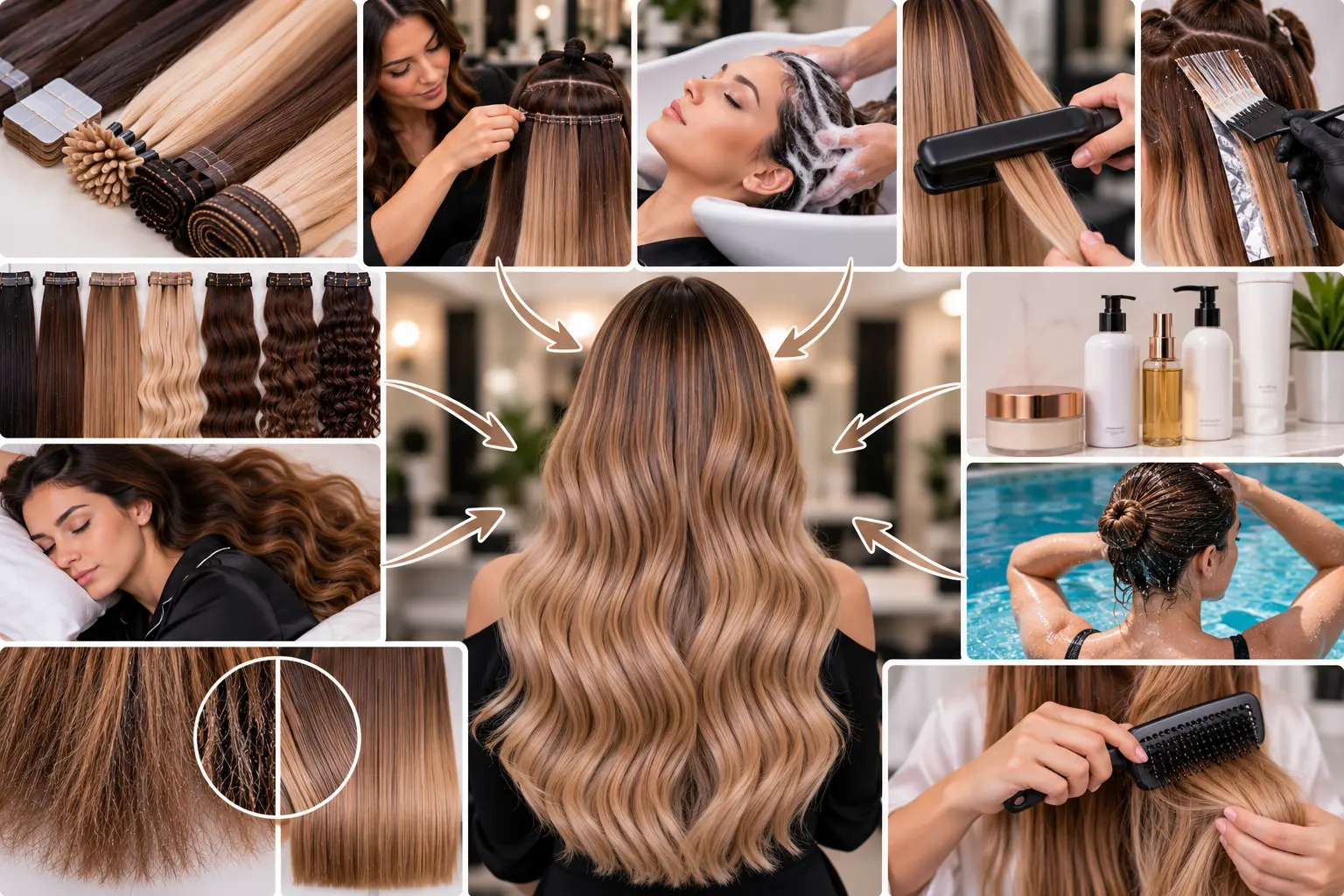
There is no universal lifespan for human Wholesale Hair Extensions.[^8] Longevity depends on hair quality, extension method, installation skill, frequency of wear, maintenance routine, washing products, heat styling, chemical treatments, and aftercare discipline.
What affects lifespan most?
The quality of the hair matters, but it is not the only factor. A good product can fail early if the customer sleeps with wet hair, uses harsh shampoo, applies too much heat, or ignores maintenance appointments.[^9]
Key lifespan factors include:
- Hair quality grade and processing level
- Extension method
- Stylist installation technique
- Frequency of wear
- Washing and conditioning routine
- Heat styling temperature
- Chemical coloring or bleaching
- Swimming, sun exposure, and hard water
- Brushing habits
- Storage when not worn
Different products, different expectations
Clip-ins and halo extensions may last longer for some users because they are not worn continuously. Tape-ins, wefts, I-tips, and K-tips experience more daily stress because they stay installed. However, proper care can improve performance across all methods.
| Product Type | Wear Pattern | Lifespan Consideration |
|---|---|---|
| Clip In Hair | Occasional wear | Storage and brushing matter greatly |
| Halo Hair | Occasional wear | Less attachment stress |
| Tape In Hair | Semi-permanent | Adhesive care and reinstallation matter |
| Weft Hair | Semi-permanent | Stitching, brushing, and move-ups matter |
| I-Tip Hair | Semi-permanent | Bead placement and maintenance matter |
| K-Tip Hair | Semi-permanent | Bond care and heat exposure matter |
How brands should communicate lifespan
I recommend careful wording. Instead of promising a fixed number of months, brands can explain that lifespan depends on care and professional installation. This is more accurate and reduces unrealistic customer expectations.
A professional care guide should include:
- Use sulfate-free or extension-safe products when appropriate.
- Brush gently from ends to roots.
- Avoid sleeping with wet hair.
- Limit excessive heat styling.
- Use heat protectant.
- Follow stylist maintenance appointments.
- Avoid bleaching extensions after purchase unless professionally assessed.
For wholesale buyers, product lifespan should be evaluated during sample testing and customer feedback cycles. A supplier can provide guidance, but the final performance also depends on real-world use.
Frequently Asked Questions
What is the minimum order quantity for Wholesale Hair Extensions?
The minimum order quantity depends on the supplier, product type, customization level, and packaging requirements. Standard wholesale items may have lower MOQs, while custom colors, private-label packaging, or special specifications may require higher quantities.
Are Remy Hair and Cuticle Intact Hair the same thing?
They are related terms, but buyers should verify how each supplier defines them. Remy Hair usually means the hair cuticles are aligned in the same direction.[^10] Cuticle Intact Hair suggests the cuticle layer remains preserved. Always test samples and confirm specifications.
Can I sell Wholesale Hair Extensions under my own brand?
Yes, many buyers sell wholesale hair extensions under their own brand through private labeling. You may customize packaging, labels, care cards, and product presentation. You should confirm MOQ, logo requirements, packaging cost, and production time before ordering.
How should I compare different hair extension suppliers?
Compare suppliers by product consistency, sample performance, communication speed, customization ability, quality control process, export experience, and after-sales support. Price matters, but the cheapest product can become expensive if it causes returns, complaints, or unstable reorders.
Should I choose 100% Human Hair for my product line?
For professional salons and serious hair extension brands, 100% Human Hair is usually preferred because it can offer better styling flexibility and a more natural look.[^11] Buyers should still test washing, shedding, color, and attachment quality before making bulk purchasing decisions.
Conclusion
Wholesale Hair Extensions require careful evaluation because product quality, construction, color planning, customization, and supplier reliability all affect long-term business results. I recommend starting with samples, testing them realistically, and building a focused product range based on your market. If you are developing a salon line, wholesale range, or private-label hair extension brand, contact RENAI HAIR to discuss product options, specifications, and sample testing for your business.
[^1]: "Traction Alopecia - StatPearls - NCBI Bookshelf", https://www.ncbi.nlm.nih.gov/books/NBK470434/. A dermatology review of hair-extension use supports the view that extension suitability is method- and user-dependent, noting that attachment technique, traction, hair characteristics, and maintenance affect outcomes and adverse events. Evidence role: expert_consensus; source type: paper. Supports: A dermatology or cosmetology review should support that hair-extension outcomes and risks vary by method, attachment tension, hair type, application technique, and maintenance practices.. Scope note: Such a source would support the general principle of individualized method selection, not determine which commercial method is best for a particular salon. [^2]: "On Hair Care Physicochemistry: From Structure and ... - PMC", https://pmc.ncbi.nlm.nih.gov/articles/PMC9921463/. Cosmetic-science literature on silicone conditioning agents supports that silicones can deposit on the hair shaft and reduce friction, improving perceived smoothness and shine. Evidence role: mechanism; source type: paper. Supports: A cosmetic-science paper should explain that silicones deposit on hair fibers, reduce friction, increase shine or smoothness, and can temporarily improve tactile properties.. Scope note: This supports the mechanism by which coating can affect perceived quality, but it does not prove that any specific extension sample is poor quality. [^3]: "Effects of excessive bleaching on hair: comparative analysis of ...", https://pmc.ncbi.nlm.nih.gov/articles/PMC11652465/. Studies of oxidative hair bleaching show that lightening treatments can damage hair-fiber structure and reduce mechanical properties such as strength and surface integrity. Evidence role: mechanism; source type: paper. Supports: A hair-fiber study should support that bleaching and oxidative lightening can damage the cuticle or cortex and reduce mechanical strength, smoothness, or durability.. Scope note: The source would support the general effect of bleaching on hair fibers, not the processing history of any particular wholesale product. [^4]: "Traction alopecia: the root of the problem", https://pubmed.ncbi.nlm.nih.gov/29670386/. Medical and cosmetic literature on hair extensions indicates that attachment method, bond placement, and mechanical tension are important determinants of extension performance and adverse outcomes. Evidence role: mechanism; source type: paper. Supports: A dermatology or cosmetic-science source should support that attachment design and application technique affect extension performance and risk of failure or hair damage.. Scope note: The evidence is contextual because published studies usually address clinical complications or attachment mechanics rather than wholesale manufacturing defects specifically. [^5]: "Why Focusing on Lead Time, Not Just Efficiency and Cost ...", https://interpro.wisc.edu/lead-time-drives-manufacturing-success/. Operations-management research on product customization supports that greater customization can increase production complexity, setup requirements, and lead-time uncertainty. Evidence role: general_support; source type: paper. Supports: An operations-management paper should support that product customization increases production complexity, setup requirements, planning uncertainty, or lead time.. Scope note: The evidence would support the general manufacturing principle, not the exact MOQ or lead time policies of a specific hair-extension supplier. [^6]: "Editorial: Advances in color science: From color perception to ...", https://pmc.ncbi.nlm.nih.gov/articles/PMC9927385/. Color-science guidance on digital imaging supports that perceived color varies with illumination, capture settings, display calibration, and viewing environment. Evidence role: mechanism; source type: education. Supports: A university or color-science source should explain that color appearance depends on illumination, camera capture, display calibration, and viewing conditions.. Scope note: This supports the unreliability of screen-only color matching generally, not the accuracy of any specific supplier's product photographs. [^7]: "Quantifying whole human hair scalp fibres of varying curl - PMC", https://pmc.ncbi.nlm.nih.gov/articles/PMC11733847/. Hair-science research shows that human hair fibers vary in physical and chemical properties and that cosmetic processing can alter color, surface condition, and mechanical performance. Evidence role: general_support; source type: paper. Supports: A hair-science paper should support that human hair fibers vary naturally and that chemical processing can further alter color, surface condition, or mechanical properties.. Scope note: The citation would support the plausibility of batch variation, not quantify acceptable tolerance levels for wholesale hair extensions. [^8]: "Hair Cosmetics: An Overview - PMC - NIH", https://pmc.ncbi.nlm.nih.gov/articles/PMC4387693/. Reviews of hair-shaft weathering support that hair durability varies with cumulative exposure to washing, grooming, heat, ultraviolet light, and chemical treatments. Evidence role: expert_consensus; source type: paper. Supports: A review on hair weathering should support that hair durability is affected by grooming, washing, chemical treatments, heat, sunlight, and mechanical stress.. Scope note: The source supports why a universal lifespan is scientifically difficult to state, but it does not provide a specific lifespan range for wholesale extensions. [^9]: "Establishment of Heat‐Damaged Model for Hair - PMC - NIH", https://pmc.ncbi.nlm.nih.gov/articles/PMC12308778/. Hair-fiber research indicates that water exposure, surfactants, friction, and heat styling can alter the hair shaft and contribute to cumulative damage. Evidence role: mechanism; source type: paper. Supports: A hair-science or dermatology source should support that wet-state friction, cleansing practices, heat styling, and mechanical stress can damage hair fibers or affect extension wear.. Scope note: This supports mechanisms of damage and early failure but does not directly test every listed aftercare behavior in commercial hair extensions. [^10]: "Artificial hair integrations", https://en.wikipedia.org/wiki/Artificial_hair_integrations. Reference definitions of Remy hair generally describe it as collected or arranged so that the hair cuticles remain aligned in the same direction, a feature associated with reduced tangling. Evidence role: definition; source type: encyclopedia. Supports: A neutral reference should define Remy hair in relation to cuticle alignment or hair strands running in the same direction.. Scope note: Definitions vary in commercial use, so the citation would clarify the term but would not verify a supplier's Remy claim. [^11]: "When it comes to human hair vs. synthetic, which do you ...", https://www.reddit.com/r/Wigs/comments/1f7zhp4/when_it_comes_to_human_hair_vs_synthetic_which_do/. Institutional guidance comparing human and synthetic hair products supports that human hair generally offers greater styling flexibility and a natural appearance compared with many synthetic fibers. Evidence role: general_support; source type: institution. Supports: A medical, educational, or institutional source should support that human hair extensions or hairpieces generally allow more heat styling and can look more natural than many synthetic options.. Scope note: The evidence is a general comparison and may not apply to all modern heat-resistant synthetic fibers or all grades of human hair.