
The potentially billion dollar hair extensions market
The hair extensions market is bigger than most people realize — and it's still growing. If you're a brand owner, wholesaler, or distributor wondering whether now is the right time to enter or expand in this space, the numbers might surprise you. Let me walk you through what the data actually shows and what it means for buyers.
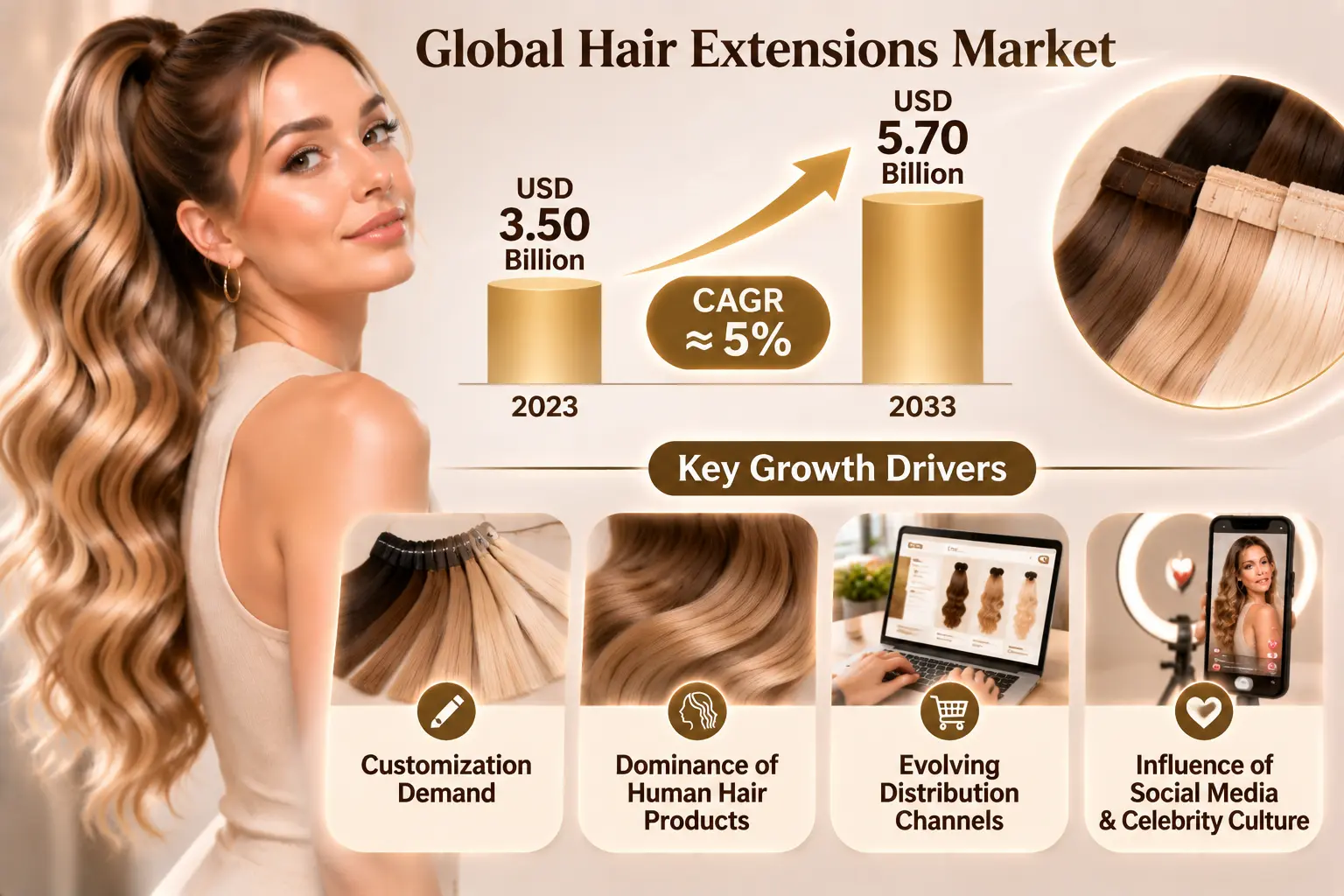
The global hair extensions market was valued at USD 3.50 billion in 2023 and is projected to reach USD 5.70 billion by 2033, growing at a compound annual growth rate (CAGR) of approximately 5%.[^1] That sustained growth is being driven by demand for customization, the dominance of human hair products, evolving distribution channels, and the ongoing influence of social media and celebrity culture on consumer beauty choices[^2].
Understanding the market at a macro level is one thing. But for B2B buyers — brands, wholesalers, distributors, and salon chains — the more important question is: which trends actually affect your purchasing decisions? The sections below break that down clearly.
Is the human hair extensions segment really dominating the market?
Many buyers already suspect human hair outperforms synthetic — but the market data confirms it decisively. Synthetic alternatives continue to lose ground as consumers become more educated and more demanding about product quality, longevity, and styling flexibility.
Human hair extensions dominate the global market because they offer a natural look, accept heat styling and coloring, and last significantly longer than synthetic alternatives.[^3] Buyers who stock human hair products consistently report stronger customer retention and fewer product complaints compared to those sourcing synthetic lines.
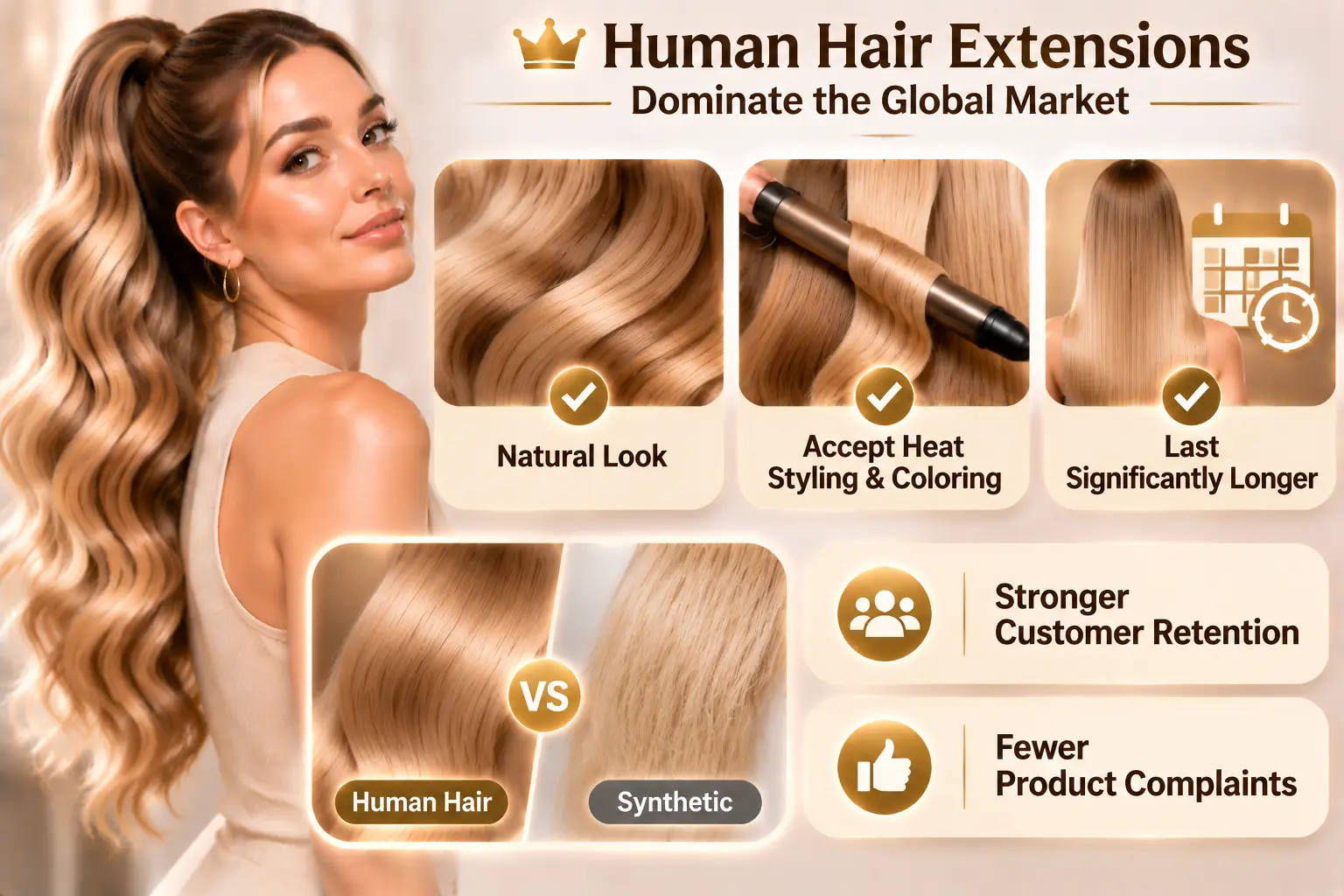
The preference gap between human hair and synthetic hair is widening — and it has real procurement implications for any business building a product line.
Why human hair commands a premium and earns it
There are several reasons human hair extensions have pulled away from synthetic alternatives in market share:
- Longevity. A well-maintained set of quality human hair extensions can last 6–12 months or longer. Synthetic alternatives typically degrade in weeks to months, especially under heat.[^4]
- Styling versatility. Human hair can be blow-dried, straightened, curled, and colored. Synthetic hair cannot tolerate most of these processes.
- Natural appearance. Human hair blends more seamlessly with the wearer's own hair in terms of texture, sheen, and movement.
- Repeat purchase behavior. End consumers who invest in human hair tend to become loyal buyers and to upgrade their purchases over time.
From a B2B perspective, stocking human hair product lines positions your brand at the premium end of the market — which is exactly where sustained margin and customer loyalty live.
What "human hair" actually means in procurement
Not all human hair is the same. The term covers a spectrum of quality levels that significantly affect both price and product performance:
| Hair Type | Cuticle Condition | Tangle Resistance | Price Range |
|---|---|---|---|
| [Remy Hair | Cuticles aligned in one direction | High | Mid to Premium](https://pubmed.ncbi.nlm.nih.gov/35478184/)[^5] |
| Cuticle Intact Hair | Cuticles fully intact and unstripped | Very High | Premium |
| Non-Remy Hair | Cuticles stripped or misaligned | Low | Budget |
| Virgin Hair | Unprocessed, cuticles intact | Very High | Premium |
Buyer's note: When evaluating suppliers, always request documentation and samples that confirm hair grade. Claims of "100% Remy" or "Cuticle Intact" should be verifiable through physical sample inspection and, ideally, third-party quality assessment.
At RENAI HAIR, we specialize in 100% Human Hair, Remy Hair, and Cuticle Intact Hair. These distinctions are not marketing language to us — they represent specific sourcing, processing, and quality control standards that our customers have the right to evaluate before committing to any order.
How are distribution channels changing the hair extensions market?
The old model — brands buying from manufacturers, selling to distributors, who then supplied salons — is fragmenting fast. Multiple new channels have emerged, and each carries different implications for how B2B buyers need to structure their sourcing.
Hair extensions are now sold through e-commerce platforms, specialty beauty stores, salon professionals, direct-to-consumer brand websites, and social media storefronts. This multichannel expansion is increasing overall market access but also intensifying competition at every tier. Buyers who can move product across multiple channels have a structural advantage.[^6]
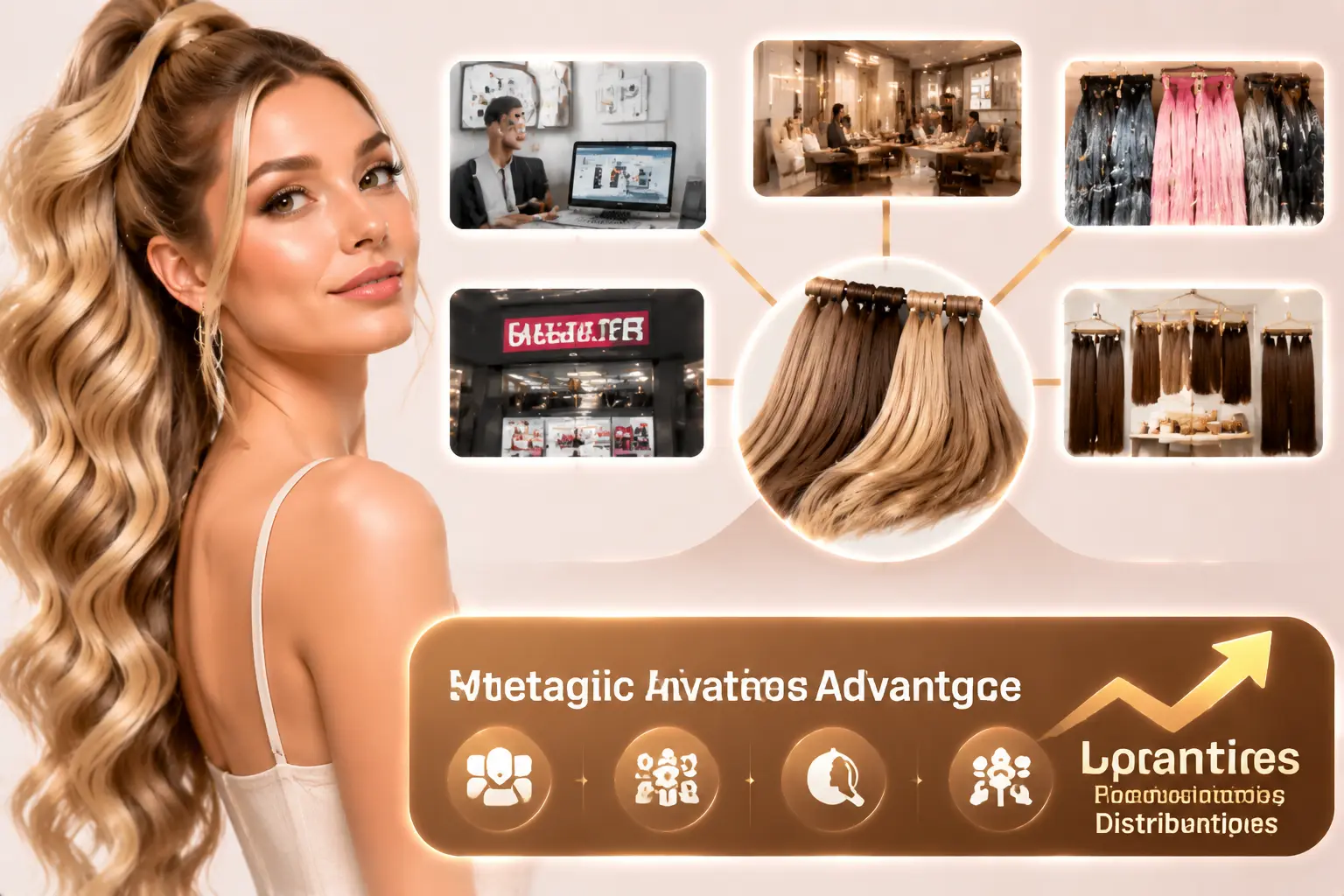
The channel shift isn't just about where products are sold. It affects what products sell, in what formats, and at what price points.
How each distribution channel shapes product demand
E-commerce platforms (Amazon, Shopify, TikTok Shop, etc.)
These channels favor:
- Standardized SKUs with clear product photography
- Products that solve a specific problem (length, volume, clip-in convenience)
- Strong customer reviews and return policies
- Price transparency and competitive positioning
For B2B buyers sourcing for e-commerce brands, consistency across production batches is critical. Color matching, weight per weft, and packaging presentation must remain stable across reorders.
Salon and professional channels
These channels favor:
- Premium human hair products that clients will pay for
- Weft formats that stylists can apply with confidence (Hand Tied Weft, Genius Weft, Tape In)
- Supplier education and technical support
- Reliable availability for reorders on a client-by-client basis
Beauty supply stores and distributors
These buyers typically need:
- Broader SKU depth across textures, lengths, and colors
- Competitive wholesale pricing with reliable margins
- Strong stock availability and consistent quality control
Understanding which channel your end customer serves will directly shape which product formats, price tiers, and quality grades belong in your procurement plan.
What role does customization play in today's hair extensions market?
Cookie-cutter product lines are losing ground. Today's end consumers are arriving with specific requests — particular lengths, precise color matches, preferred application methods. Brands and distributors that can meet those requests are building loyalty. Those that can't are losing customers to those who can.
Demand for customized hair extensions — in terms of color, texture, length, and application method — is one of the strongest growth drivers in the market today.[^7] B2B buyers who source from manufacturers with genuine customization capability have a measurable competitive advantage over those limited to fixed catalog offerings.
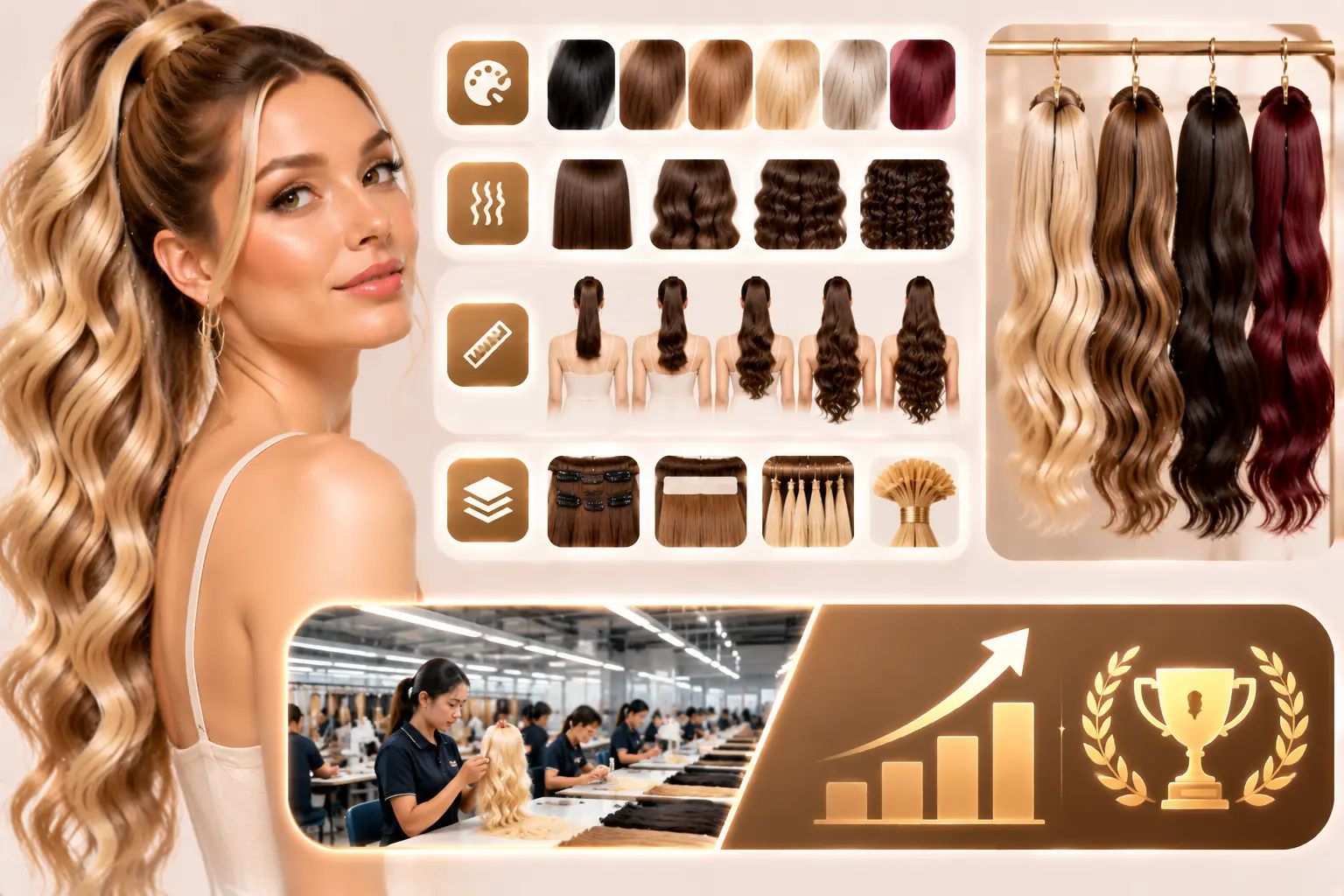
Customization isn't just a consumer-facing trend. It is a sourcing challenge that separates capable manufacturers from catalog suppliers.
What meaningful customization capability looks like
When I evaluate a manufacturer's customization claims, I look at several specific areas:
Color development and matching
- Can the manufacturer produce custom colors from a swatch or reference sample?
- Do they have an in-house color lab and colorist team, or do they outsource this?
- How consistent is color across production batches?
Length and weight flexibility
- What is the actual range of lengths available (typically 10" to 30"+)?
- Can weight per pack (grams) be customized for private label products?
Texture options
- Straight, wavy, body wave, deep wave, curly — each requires different processing
- Texture consistency across batches is a common failure point
Application method breadth
- A manufacturer with full product line capability (Tape In, Weft, Keratin/Prebonded, Clip In, etc.) gives buyers flexibility to expand their range without switching suppliers
At RENAI HAIR, we support customization across all of these dimensions — length, color, texture, and product format — because our customers are building brands, not just placing single orders. We also continue to develop new products and new colors as market demand evolves.
How did COVID-19 affect the hair extensions market, and has it recovered?
The pandemic stress-tested every part of the beauty supply chain. Salons closed. Logistics slowed. Consumer spending priorities shifted. For hair extension businesses that had concentrated supply chains or limited cash reserves, the impact was severe.
COVID-19 caused significant disruption to the hair extensions market through salon closures, supply chain interruptions, and reduced consumer spending.[^8] However, the market has demonstrated strong recovery as restrictions lifted, with pent-up demand, the rise of at-home hair care, and accelerated e-commerce adoption all contributing to renewed growth[^9].

The pandemic revealed structural vulnerabilities that smart B2B buyers are now actively working to address.
What the recovery period revealed about supplier resilience
The businesses that recovered fastest shared several characteristics:
- Diversified supply chains. Buyers who sourced from a single supplier faced acute shortages. Those with two or three vetted manufacturers had options.
- Strong manufacturer relationships. Buyers with established relationships received priority allocation during constrained periods. Spot buyers did not.
- Flexible product formats. As salons closed, demand shifted toward at-home application products (Clip In, Halo Hair, Tape In with simple application). Brands with diverse product formats could pivot. Single-format brands could not.
- E-commerce capability. Brands already selling online maintained revenue while retail channels went dark.
The post-COVID period has also accelerated a structural shift: more end consumers are comfortable purchasing hair extensions online, which has permanently expanded the addressable market for well-positioned e-commerce brands.
Frequently Asked Questions
How large is the global hair extensions market?
The global hair extensions market was valued at approximately USD 3.50 billion in 2023. It is projected to grow at a CAGR of around 5% through 2033, reaching an estimated USD 5.70 billion. Growth is being driven by demand for human hair products, social media influence, and expanding distribution channels.
Why are human hair extensions preferred over synthetic?
Human hair extensions offer a more natural appearance, greater styling versatility, and longer product lifespan than synthetic alternatives. They can be heat-styled and colored, which synthetic hair cannot tolerate. For end consumers making a significant investment, human hair consistently delivers better long-term value.
What markets are growing fastest for hair extensions?
What should B2B buyers look for when evaluating a hair extensions supplier?
Buyers should assess hair grade (Remy vs. non-Remy vs. Cuticle Intact), batch-to-batch color and quality consistency, customization capability, production capacity, quality control processes, and the supplier's track record with international clients. Request physical samples and verify certifications independently.
Is now a good time to enter or expand in the hair extensions market?
With the market on a confirmed growth trajectory toward USD 5.70 billion by 2033, the fundamentals are favorable. The strongest opportunity lies in building a differentiated brand around human hair products with genuine customization capability, sold across multiple distribution channels including e-commerce.
Conclusion
The hair extensions market is a well-documented, multi-billion dollar category with a clear growth trajectory. For B2B buyers — whether you are building a brand, expanding a wholesale line, or adding hair extensions to an existing beauty supply business — the opportunity is real and supported by consistent market data. The winning position belongs to buyers who prioritize human hair quality, build relationships with manufacturers that offer genuine customization, and develop multi-channel distribution strategies. If you are evaluating hair extension suppliers or looking to develop a new product line, I'd encourage you to reach out to the RENAI HAIR team. We bring manufacturing depth, quality control discipline, and international market experience to every partnership we build.
[^1]: "Hair Extension Market Size & Growth Analysis, 2033", https://www.persistencemarketresearch.com/market-research/hair-extensions-market.asp. Market sizing and compound annual growth rate projections for the global hair extensions industry are reported by market research firms tracking the personal care and beauty accessories sector; figures vary by methodology and scope of product categories included. Evidence role: statistic; source type: research. Supports: The market size valuation of USD 3.50 billion in 2023 and projected growth to USD 5.70 billion by 2033 at approximately 5% CAGR. Scope note: Different research providers use varying definitions of 'hair extensions' (e.g., inclusion or exclusion of wigs and hairpieces), which can produce materially different market size estimates. [^2]: "Modelling the significance of celebrity endorsement ... - PMC", https://pmc.ncbi.nlm.nih.gov/articles/PMC10245062/. Academic and industry research on social media marketing documents a statistically significant relationship between influencer content exposure and consumer purchase intent in the beauty and personal care category, with platform-specific effects varying by demographic group. Evidence role: mechanism; source type: research. Supports: The role of social media platforms and celebrity influence in shaping consumer beauty product purchasing decisions. Scope note: Most studies measure purchase intent or brand awareness rather than actual sales conversion, and findings may not generalize uniformly across all beauty sub-categories including hair extensions. [^3]: "Human Hair Extension Market Size, Share & Growth [2034]", https://www.fortunebusinessinsights.com/human-hair-extension-market-106648. Market segmentation analyses of the global hair extensions industry consistently report human hair as the larger revenue-generating segment, attributed to higher average selling prices and sustained consumer preference for natural-origin products. Evidence role: statistic; source type: research. Supports: The market share dominance of human hair extensions relative to synthetic alternatives in the global hair extensions market. Scope note: Unit volume share may differ from revenue share given the significant price differential between human and synthetic products; the basis of 'dominance' should be specified as revenue or units. [^4]: "Human vs Synthetic Hair Extensions | What's The Difference?", https://www.beautyclublondon.co.uk/blog/human-vs-synthetic-hair-extensions/. Studies on polymer-based synthetic hair fibers indicate significant structural degradation at temperatures commonly used in heat styling, whereas human hair keratin structures, while also susceptible to heat damage, tolerate repeated thermal exposure more effectively when properly maintained. Evidence role: general_support; source type: research. Supports: The relative durability advantage of human hair extensions over synthetic alternatives, particularly under thermal styling conditions. Scope note: Lifespan figures depend heavily on maintenance practices, application method, and individual hair care routines, making precise universal timeframes difficult to establish empirically. [^5]: "Cuticle - Designed by nature for the sake of the hair", https://pubmed.ncbi.nlm.nih.gov/35478184/. Cosmetic science literature defines Remy hair by the preservation of the hair cuticle in a root-to-tip unidirectional orientation, which minimizes inter-fiber friction and the resulting tangling that occurs when cuticles of opposing orientations interlock. Evidence role: definition; source type: research. Supports: The technical definition of Remy hair as characterized by unidirectional cuticle alignment and its functional relationship to reduced tangling. Scope note: The term 'Remy' lacks a universally enforced industry standard or regulatory definition, meaning its application in commercial contexts varies and may not always correspond to the technical definition. [^6]: "Crafting Integrated Multichannel Retailing Strategies", https://www.hbs.edu/ris/Publication%20Files/09-125.pdf. Retail and supply chain management research consistently finds that firms operating across multiple distribution channels achieve higher revenue per customer and greater resilience to channel-specific disruptions compared to single-channel operators. Evidence role: expert_consensus; source type: research. Supports: The competitive and revenue advantages associated with multichannel distribution strategies in retail and consumer goods markets. Scope note: Most multichannel advantage research is conducted at the broader retail level; direct evidence specific to the hair extensions or beauty accessories market is limited. [^7]: "Consumer Demand for Personalized Skincare and Makeup", https://www.linkedin.com/pulse/rise-customized-beauty-consumer-demand-personalized-skincare-phukan-qrwwc. Consumer research in the beauty sector identifies personalization as a significant purchase motivator, with surveys indicating that a substantial proportion of consumers are willing to pay a premium for products tailored to their specific needs, including color, texture, and format preferences. Evidence role: general_support; source type: research. Supports: The role of product personalization and customization as a growth driver in the beauty and personal care market. Scope note: Evidence for customization as a growth driver is more robustly documented at the broader beauty category level than specifically within the hair extensions sub-segment. [^8]: "Impact of the coronavirus pandemic on establishments and ...", https://www.bls.gov/spotlight/2021/impact-of-the-coronavirus-pandemic-on-businesses-and-employees-by-industry/home.htm. Government labor and economic statistics from 2020–2021 document widespread temporary and permanent closures of personal care service establishments, including hair salons, with corresponding declines in industry revenue and employment across major markets. Evidence role: historical_context; source type: government. Supports: The disruption to salon-based beauty services and associated supply chains during the COVID-19 pandemic period. Scope note: Aggregate salon closure data does not isolate the hair extensions segment specifically; the magnitude of impact on extensions versus other salon services requires sector-specific sourcing. [^9]: "Online consumer resilience during a pandemic - PMC - NIH", https://pmc.ncbi.nlm.nih.gov/articles/PMC9759595/. Consumer behavior research conducted during the 2020–2022 period documents a measurable increase in at-home personal care product purchases and a sustained acceleration of e-commerce channel adoption within the broader beauty and personal care category. Evidence role: mechanism; source type: research. Supports: The shift toward at-home personal care and accelerated e-commerce adoption in the beauty sector during and after the COVID-19 pandemic. Scope note: Evidence for this trend is strongest at the broader beauty category level; direct attribution to the hair extensions sub-segment specifically requires more granular consumer survey data. [^10]: "Emerging Middle Class in the East Asia and Pacific Region", https://openknowledge.worldbank.org/entities/publication/508f6362-03c6-45fa-ae8b-9a5aaf2ef7e6. Regional analyses of the global beauty and personal care market consistently identify Asia-Pacific as a high-growth zone, attributed to urbanization rates, rising disposable incomes, and expanding retail infrastructure, though specific hair extensions segment shares require category-level market reports for precise figures. Evidence role: statistic; source type: research. Supports: Regional distribution of hair extensions market share and the relatively faster growth trajectory of the Asia-Pacific region. Scope note: Regional growth rates for the hair extensions sub-segment specifically may differ from broader beauty market trends and should be verified against category-specific data.