Key Tips You Need to Know About K-Tip Hair Extension
Dealing with fine, thin, or short natural hair every morning gets exhausting fast. You want volume, length, and confidence — but most extension methods feel bulky, visible, or high-maintenance. K-tip hair extensions offer a discreet, long-lasting solution that works with your natural hair rather than against it.
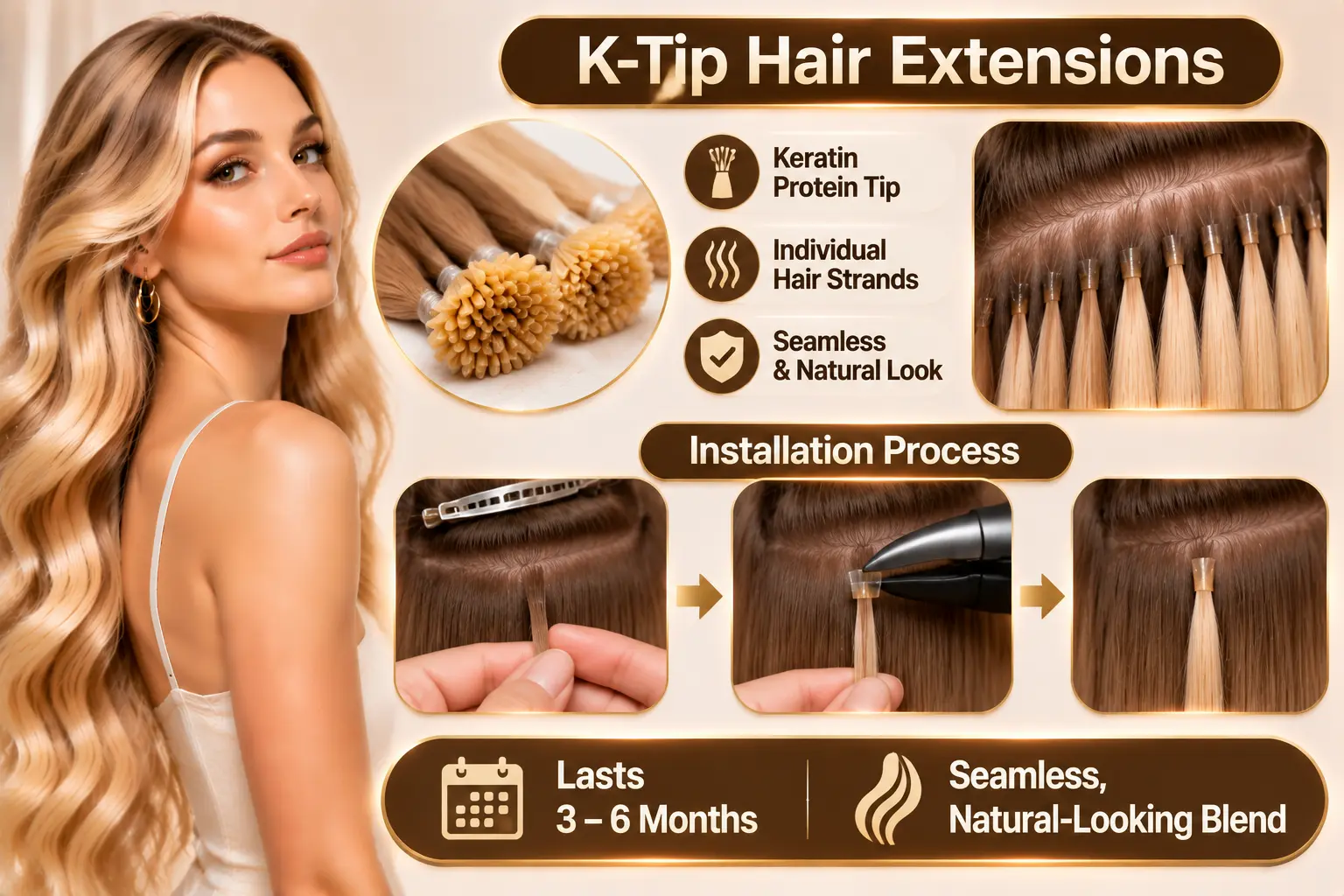
K-tip hair extensions, also called keratin tip or prebonded extensions, are individual hair strands pre-tipped with a keratin protein bond.[^1] A certified stylist uses a heat tool to fuse each bond directly to a small section of your natural hair.[^2] The result is a seamless, natural-looking blend that can last three to six months with proper care.[^3]
Understanding the basics is only the first step. Before you book your appointment — or before you stock this product for your clients — there are several critical details that separate a great K-tip experience from a disappointing one. Let's work through each one.
What Are K-Tip Hair Extensions, Exactly?
Many clients walk into a salon having heard the term "keratin extensions" but with no clear picture of what the product actually is. That confusion can lead to mismatched expectations and poor results.
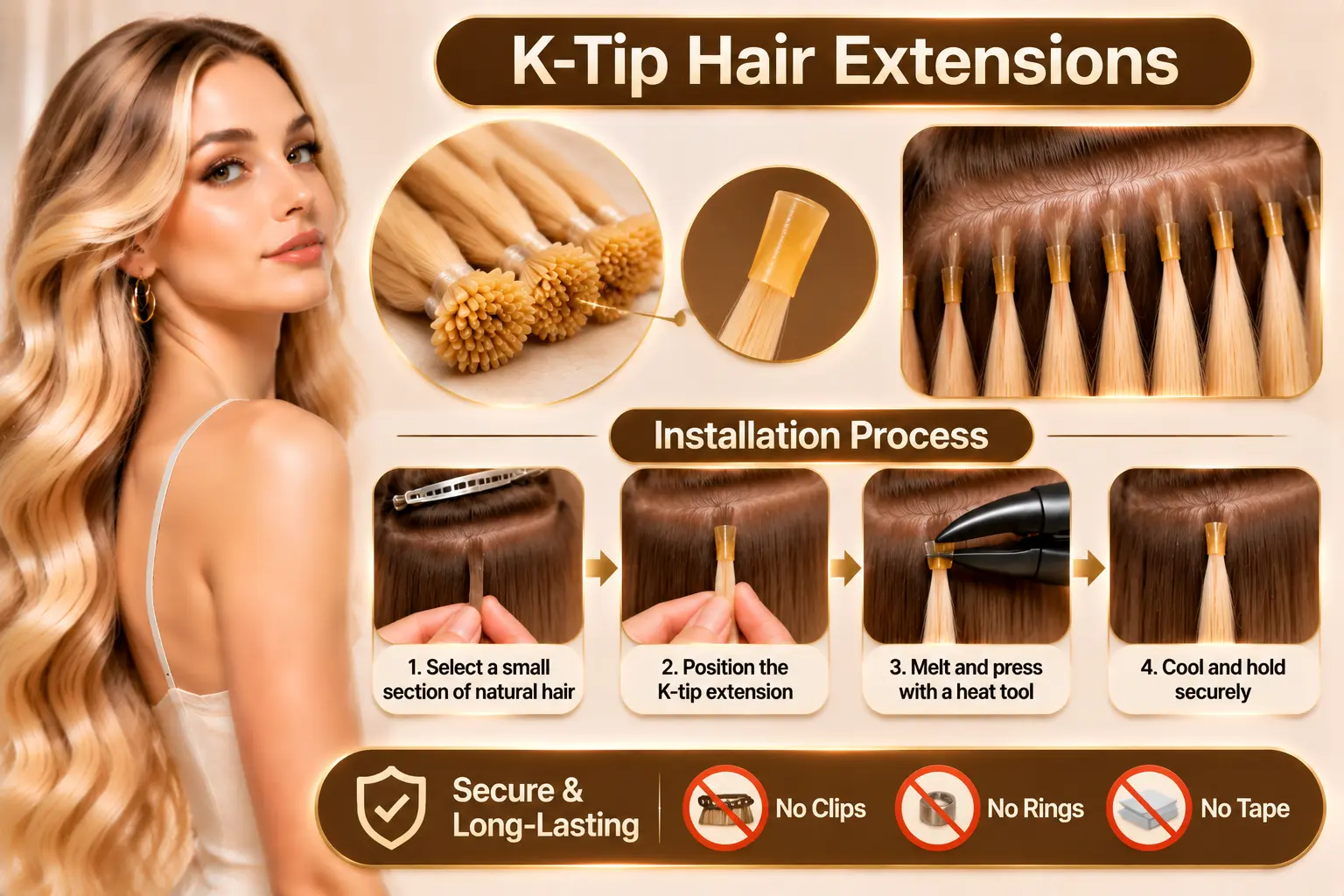
K-tip extensions are individual hair strands bonded with a small keratin tip at one end. A stylist melts that tip using a fusion heat tool, then wraps and presses it around a thin section of your natural hair. Once cooled, the bond holds securely without any clips, rings, or tape.
Why Keratin as the Bonding Material?
Keratin is not a random choice. Your natural hair is itself made largely of keratin protein.[^4] Using a keratin-based adhesive means the bond material is chemically similar to your own hair — which is one reason K-tip extensions feel so natural and blend so seamlessly.
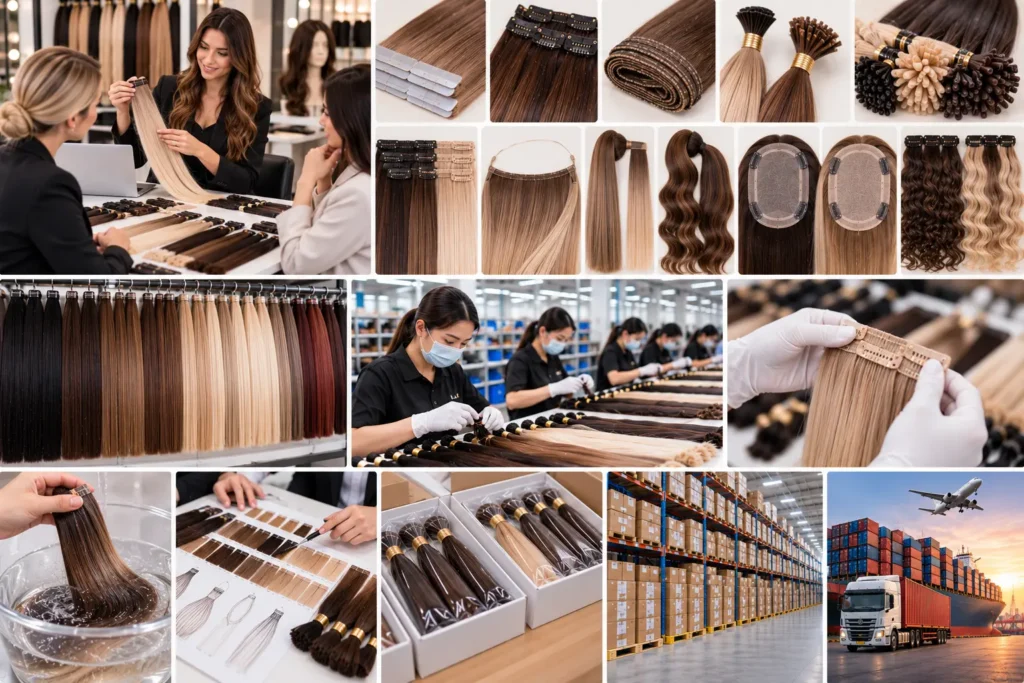
From a manufacturing standpoint, the quality of the keratin compound matters enormously. At RENAI HAIR, our Keratin/Prebonded Hair products use a refined keratin formula that bonds firmly without becoming brittle or discoloring over time. That said, buyers should always request product samples and verify formulation details before placing large orders.
What Does the Installation Look Like?
Here is a simple breakdown of the K-tip installation process:
- Sectioning — The stylist divides your hair into thin, even sections.
- Threading — Each K-tip strand is threaded into a fusion tool or heat connector.
- Melting the bond — Heat softens the keratin tip.
- Pressing and rolling — The stylist presses the melted tip around your natural hair and rolls it to form a secure cylinder bond.
- Cooling — The bond hardens within seconds as it cools.
- Repeat — A full head typically requires 100 to 150 individual strands.[^5]
The entire process can take two to four hours depending on the volume and length desired.[^6]
Who Is a Good Candidate?
K-tip extensions work best on:
- Medium to thick natural hair — The bond needs enough natural hair to grip.
- People with healthy scalps — Heat and bonding adhesives can stress a compromised scalp.
- Clients willing to commit to home care — These extensions reward consistent maintenance.
How Are K-Tip Extensions Different from Micro-Link Extensions?
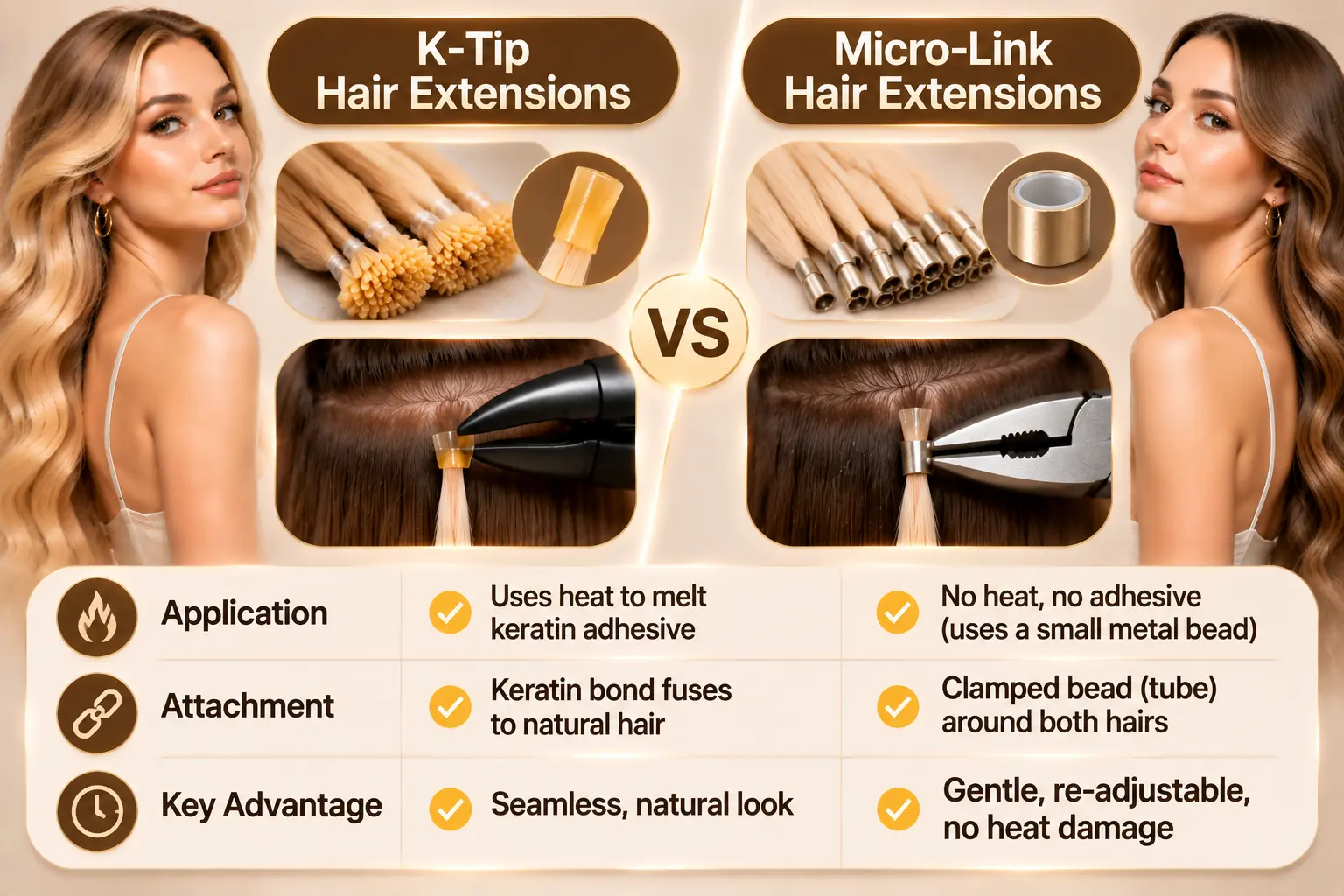
This is one of the most common questions buyers and stylists ask. Both methods attach individual strands to small sections of natural hair, so the end result looks similar. The process, however, is quite different.
Side-by-Side Comparison
| Feature | K-Tip Extensions | Micro-Link Extensions |
|---|---|---|
| Attachment method | Keratin bond + heat fusion | Silicone microbead + clamping |
| Heat required | Yes | No (heat-free) |
| Adhesive used | Keratin protein | None |
| Longevity | 3–6 months | 2–4 months |
| Maintenance visits | Every 3–4 months | Every 6–8 weeks |
| Best for | Medium to thick hair | Fine to medium hair |
| Removal process | Heat tool dissolves bond | Pliers re-open bead |
Which Method Is Better for Your Clients?
Neither method is universally superior. The right choice depends on:
- Client's hair type — Finer hair often tolerates micro-links better because there is no heat involved.
- Lifestyle — K-tips last longer between salon visits, which appeals to busy clients.
- Oil and product use — Clients who use heavy oil-based products may find that keratin bonds loosen faster.[^9] Micro-links are unaffected by oils.
- Budget — K-tip installation tends to cost more upfront, but the longer interval between maintenance appointments can offset that.
For brands and distributors building a product line, stocking both K-tip and micro-link extensions gives your customers flexibility and positions you as a comprehensive supplier.
What Precautions Should You Take Before Getting K-Tip Extensions?
Rushing into K-tip extensions without proper preparation is one of the most common reasons clients end up unhappy. A few precautions upfront make a significant difference in the final result.
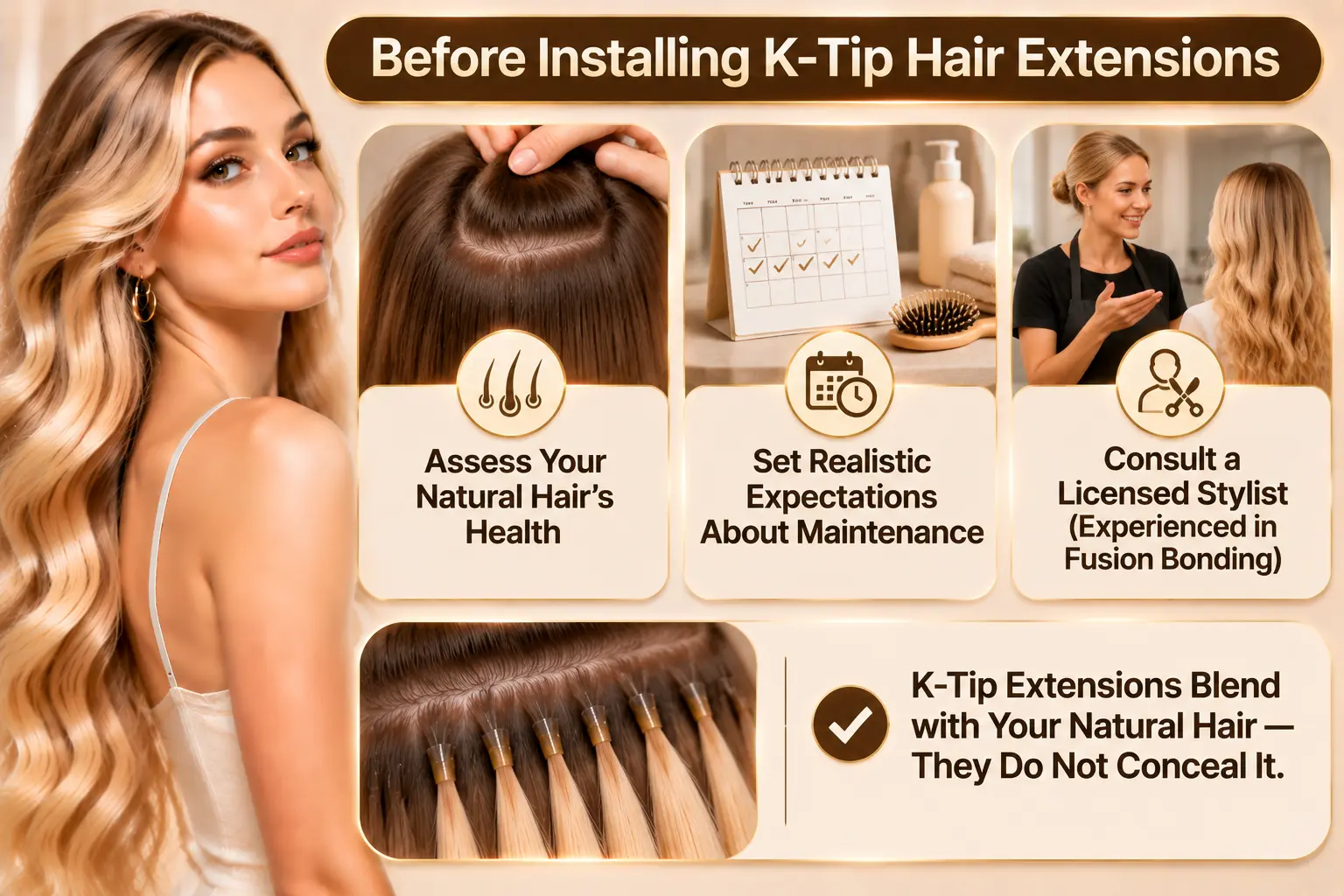
Before installing K-tip hair extensions, assess your natural hair's health, set realistic expectations about maintenance, and consult with a licensed stylist experienced in fusion bonding. These extensions blend with your natural hair — they do not conceal it — so the condition of your own hair directly affects the final look.
Check Your Hair and Scalp Health First
K-tip installation applies heat near the scalp. If your hair is:
- Chemically over-processed — Weakened hair may break at the bond point.
- Experiencing active hair loss — Bonded extensions can worsen shedding.[^10]
- Very fine or sparse — The bond may not hold securely or may be visible through the hair.
Always conduct a thorough hair and scalp assessment before proceeding.
Understand What K-Tips Actually Do
A point I always make clear during consultations: K-tip extensions add length and volume to your existing hair — they do not cover it. They function as extensions of what you already have. If your natural hair is damaged, uneven, or discolored, those issues will still show.
This is fundamentally different from wearing a wig or a full head of clip-in extensions. Managing this expectation upfront prevents disappointment.
Key Questions to Ask Yourself (or Your Client)
- How much daily maintenance am I genuinely willing to do?
- Do I regularly use heavy conditioners, oils, or bond-building treatments that might weaken the keratin bond?
- Am I comfortable avoiding certain hairstyles — like very tight ponytails — for months at a time?
- Do I have a budget for the initial investment and eventual maintenance appointments?
Honest answers to these questions determine whether K-tip extensions are the right fit.
How Do You Maintain K-Tip Hair Extensions Properly?
Poor maintenance is the number one reason K-tip extensions fail early. Clients often underestimate how specific the care routine needs to be.
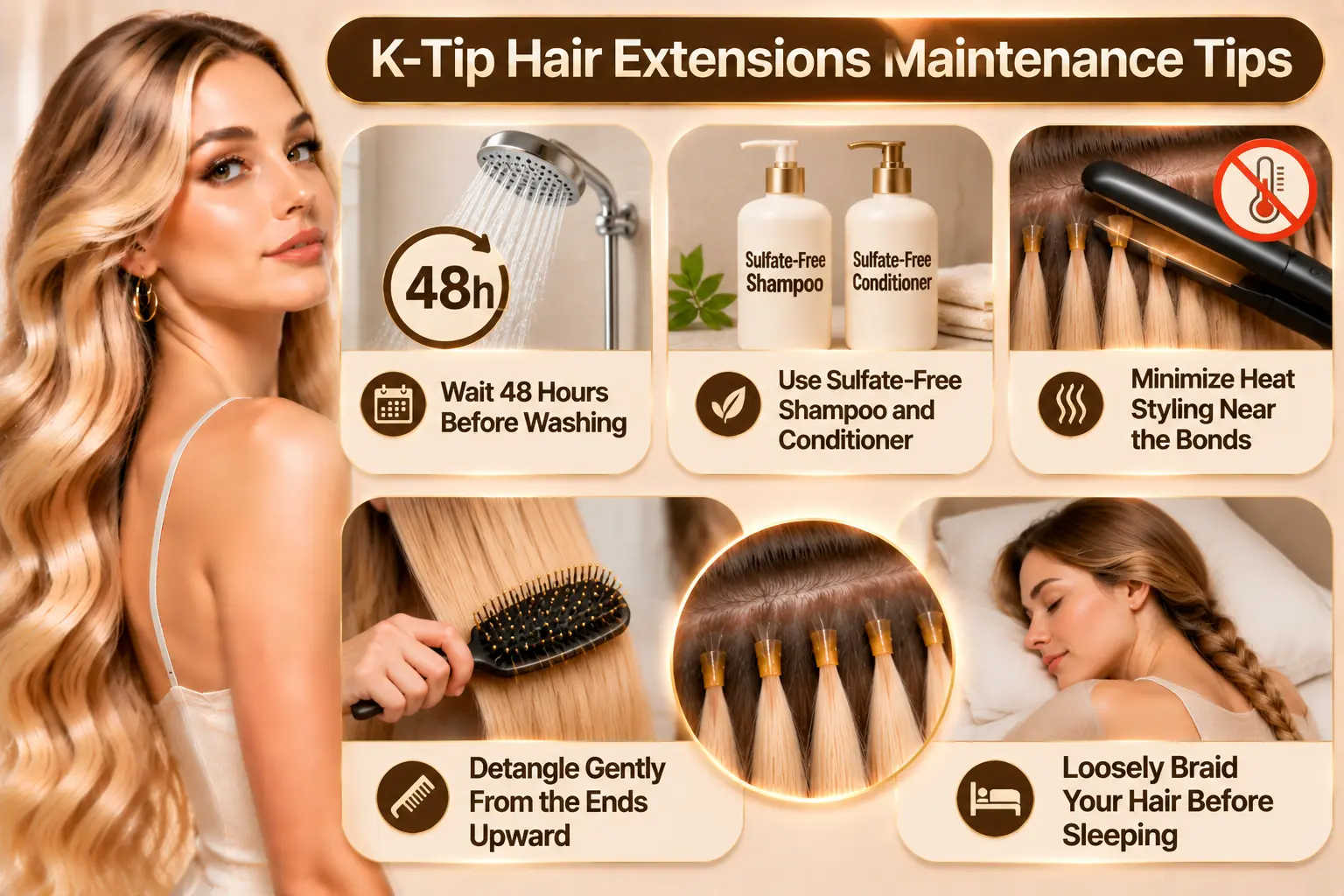
The First 48 Hours Are Critical
Immediately after installation, the keratin bonds need time to fully cure and harden. During this window:
- Do not wash your hair.
- Avoid getting your hair wet in rain, a pool, or a shower.
- Do not tie your hair up tightly.
- Avoid exercising heavily, as sweat can interfere with curing.
Skipping this waiting period is one of the most common mistakes — and it can cause bonds to loosen prematurely.
Daily and Weekly Care Habits
Washing:
- Use a sulfate-free, extension-safe shampoo.
- Wash gently in a downward motion — do not pile hair on top of your head.
- Follow with a lightweight, bond-safe conditioner, applied mid-length to ends only. Keep conditioner away from the bond points.
Drying:
- Pat hair dry with a microfiber towel — do not rub.
- Allow hair to air dry as much as possible before using a blow dryer.
- When blow drying, keep the nozzle pointed downward and away from bonds.
Heat Styling:
- Always apply a heat protectant spray before using any hot tool.
- Keep styling tools at low to medium-low heat settings.
- Never apply direct heat to the bond points themselves — this can melt or weaken the keratin adhesive.
Detangling:
- Use a loop brush or wide-tooth comb.
- Start detangling from the ends and work upward.
- Hold the hair above the area you are combing to reduce tension at the bonds.
Nighttime Routine
Overnight tangling is a major cause of early bond damage and hair breakage. Before sleeping:
- Loosely braid your extensions into one or two low braids.
- Sleep on a satin or silk pillowcase to reduce friction.
- Never sleep with wet hair — damp bonds are weaker and more susceptible to tangling.
Products to Avoid
| Avoid | Reason |
|---|---|
| Sulfate-containing shampoos | Strip the bond and dry out hair |
| Heavy oil treatments near bonds | Breaks down keratin adhesive |
| Alcohol-based styling products | Dry and weaken bond integrity |
| Clarifying shampoos | Too harsh for bonded extensions |
| Dry shampoo directly on bonds | Build-up weakens bond grip |
Frequently Asked Questions
How long do K-tip hair extensions last?
With proper care, K-tip extensions typically last between three and six months. The exact duration depends on your hair growth rate, daily maintenance habits, and the quality of the keratin bonds. Higher-quality 100% Remy human hair extensions generally last longer than synthetic or low-grade alternatives.
Can K-tip extensions damage your natural hair?
K-tip extensions can cause damage if installed incorrectly, applied to unhealthy hair, or maintained poorly. When installed by a qualified stylist on healthy hair and cared for properly at home, the risk of damage is low. Always consult a licensed professional before installation.
What type of hair is used in K-tip extensions?
The best K-tip extensions use 100% human Remy hair with the cuticle intact and aligned in one direction. This ensures a natural look, smooth texture, and minimal tangling. Avoid blended or synthetic keratin tip extensions if longevity and natural appearance are priorities.
Can I color or highlight K-tip extensions?
Pre-colored K-tip extensions — including balayage, highlights, and mixed-color options — are widely available and are the safer choice. Chemically processing already-installed extensions is risky and can weaken both the hair and the keratin bonds. Consult your stylist before applying any color treatments.
How are K-tip extensions removed?
A stylist uses a specialized heat tool to re-soften the keratin bond, then gently slides it off the natural hair. A bond remover solution is typically applied afterward to dissolve any residue. Attempting to remove K-tip extensions at home without proper tools risks significant hair breakage.
Conclusion
K-tip hair extensions remain one of the most popular fusion extension methods available today — and for good reason. When installed correctly and maintained with care, they deliver a seamless, natural look that lasts months. The key takeaways: understand how keratin tip bonds work, choose the right candidate, set clear expectations before installation, and commit to a consistent home care routine. For brands, distributors, and salons sourcing K-tip extensions, hair quality is everything.
At RENAI HAIR, our Keratin/Prebonded Hair extensions are crafted from 100% pure Remy human hair with intact cuticles, available in a full range of lengths, solid colors, highlights, balayage, and mixed-color options. Contact us today to request samples, discuss custom specifications, or explore wholesale pricing for your product line.
[^1]: "based bond to attach extension strands to your natural hair. ...", https://www.facebook.com/CodenHair/videos/pre-bonded-hair-extension-k-tip-extensions-are-a-type-of-hair-extensions-that-us/690984490487558/. Cosmetology training materials describe prebonded or keratin-tip extensions as individual extension strands with keratin adhesive tips that are attached strand by strand. Evidence role: definition; source type: education. Supports: A cosmetology education source should support the terminology and describe keratin-tip extensions as individual prebonded strands.. Scope note: This supports the general definition of the method, not the quality or performance of any particular product. [^2]: "Keratin Hot Fusion Hair Extensions - Application & Information", https://www.youtube.com/watch?v=Xpmyhlai54k. Cosmetology instruction on fusion extensions explains that a heated applicator softens the keratin bond so it can be attached around a small section of the client's hair. Evidence role: mechanism; source type: education. Supports: A cosmetology source should confirm that fusion extensions use heat to soften a keratin bond and attach it to small sections of natural hair.. Scope note: This supports the general installation mechanism, not the safety of an individual installation. [^3]: "Hair Extensions 101: Everything You Need to Know", https://brownbeautybarberschool.edu/news/hair-extensions-101-everything-you-need-to-know/. Cosmetology education sources commonly place the wear period for keratin fusion extensions in the range of several months, often about three to six months with appropriate maintenance. Evidence role: general_support; source type: education. Supports: A neutral cosmetology or extension-training source should support the typical three-to-six-month wear period for keratin fusion extensions under proper care.. Scope note: This is a typical-use range; actual longevity varies with hair growth, installation quality, maintenance, and product construction. [^4]: "The structure of people's hair - PMC - NIH", https://pmc.ncbi.nlm.nih.gov/articles/PMC4201279/. Scientific reviews of hair-fiber structure identify keratins as the principal structural proteins that make up the human hair shaft. Evidence role: definition; source type: paper. Supports: A scientific review or paper should confirm that keratin is the principal structural protein of human hair.. [^5]: "Rich Choices I Tip Hair Extensions Human Hair 100% Real ...", https://www.amazon.com/Rich-Choices-Extensions-Extension-Keratin/dp/B0FJFD481K. Extension-training references commonly describe full-head fusion installations as requiring roughly one hundred or more individual strands, with the exact count depending on density and desired result. Evidence role: statistic; source type: education. Supports: A cosmetology or extension-training source should give typical strand counts for full-head keratin or fusion installations.. Scope note: This supports a planning estimate rather than a fixed clinical or technical requirement. [^6]: "Curious how long hair extensions really take? Let's break it ...", https://www.instagram.com/reel/DQrfyJXEuPd/?hl=en. Cosmetology training resources describe keratin fusion extension installation as a multi-hour service, with duration varying by strand count, sectioning, and desired density. Evidence role: statistic; source type: education. Supports: A cosmetology training source should support the general time range for installing a full set of keratin fusion extensions.. Scope note: This supports the general time burden but not a guaranteed appointment length for every stylist or client. [^7]: "Traction Alopecia: Clinical and Cultural Patterns - PMC", https://pmc.ncbi.nlm.nih.gov/articles/PMC8530059/. Dermatology and professional hair-care guidance advises caution with extensions on fine or fragile hair because added weight and attachment points can increase stress on existing hair. Evidence role: expert_consensus; source type: institution. Supports: A dermatology or professional cosmetology source should support the need for caution and individualized assessment when extensions are applied to fine or fragile hair.. Scope note: This supports the need for professional assessment; visibility of bond points is a practical cosmetology issue rather than a medical outcome. [^8]: "Why everyone loves Micro Links • No glue or heat • Reusable ...", https://www.instagram.com/reel/DVfiU6CjPKb/. Cosmetology sources distinguish fusion extensions, which use heat-softened keratin bonds, from micro-link extensions, which secure hair with small beads or tubes that are mechanically clamped. Evidence role: definition; source type: education. Supports: A cosmetology reference should distinguish heat-fusion keratin extensions from micro-link or micro-bead extensions that are mechanically clamped.. Scope note: This supports the attachment-method distinction, not comparative superiority or client suitability. [^9]: "Eco-Friendly and High-Performance Bio-Polyurethane ... - PMC", https://pmc.ncbi.nlm.nih.gov/articles/PMC11174640/. Adhesion research shows that oils and surface contaminants can reduce adhesive wetting and bond strength, providing a mechanistic basis for avoiding heavy oils near bonded extensions. Evidence role: mechanism; source type: research. Supports: A materials or cosmetic-science source should support the broader mechanism that oils can interfere with adhesive bonding or reduce bond integrity.. Scope note: This is contextual support from adhesion science and may not directly test commercial keratin hair-extension bonds. [^10]: "Traction Alopecia: Clinical and Cultural Patterns - PMC", https://pmc.ncbi.nlm.nih.gov/articles/PMC8530059/. Dermatology literature on traction alopecia identifies hair extensions among styling practices that can impose sustained tension on follicles and contribute to hair loss in susceptible individuals. Evidence role: mechanism; source type: paper. Supports: Dermatology literature should support that hair extensions can contribute to traction-related hair loss or worsen shedding when they add tension to the hair shaft and follicle.. Scope note: This supports a risk mechanism; it does not mean every properly installed bonded extension will cause shedding. [^11]: "Aftercare Guide: Keratin Fusion Hair Extensions", https://beaudee.net/keratin-fusion-hair-extensions-aftercare/. Professional extension-aftercare guidance typically recommends delaying washing after keratin fusion installation, limiting direct heat on bonds, detangling gently, and protecting the hair during sleep. Evidence role: general_support; source type: education. Supports: A cosmetology aftercare source should support the general maintenance practices recommended for keratin fusion extensions.. Scope note: This supports the general aftercare protocol; exact waiting periods and product restrictions may vary by bond formulation and stylist instructions.