
Invisible Tape-In vs Regular Tape-In: Wholesale Specification Checklist
Tape-in hair extensions look deceptively simple from the outside — but sourcing the wrong construction type can quietly drain your margins and damage your brand's reputation. When buyers confuse invisible tape-in and regular tape-in at the wholesale level, they end up with mismatched quality expectations, high return rates, and unhappy salon clients. Understanding the structural difference before you place a bulk order is the most important step in building a reliable product line.
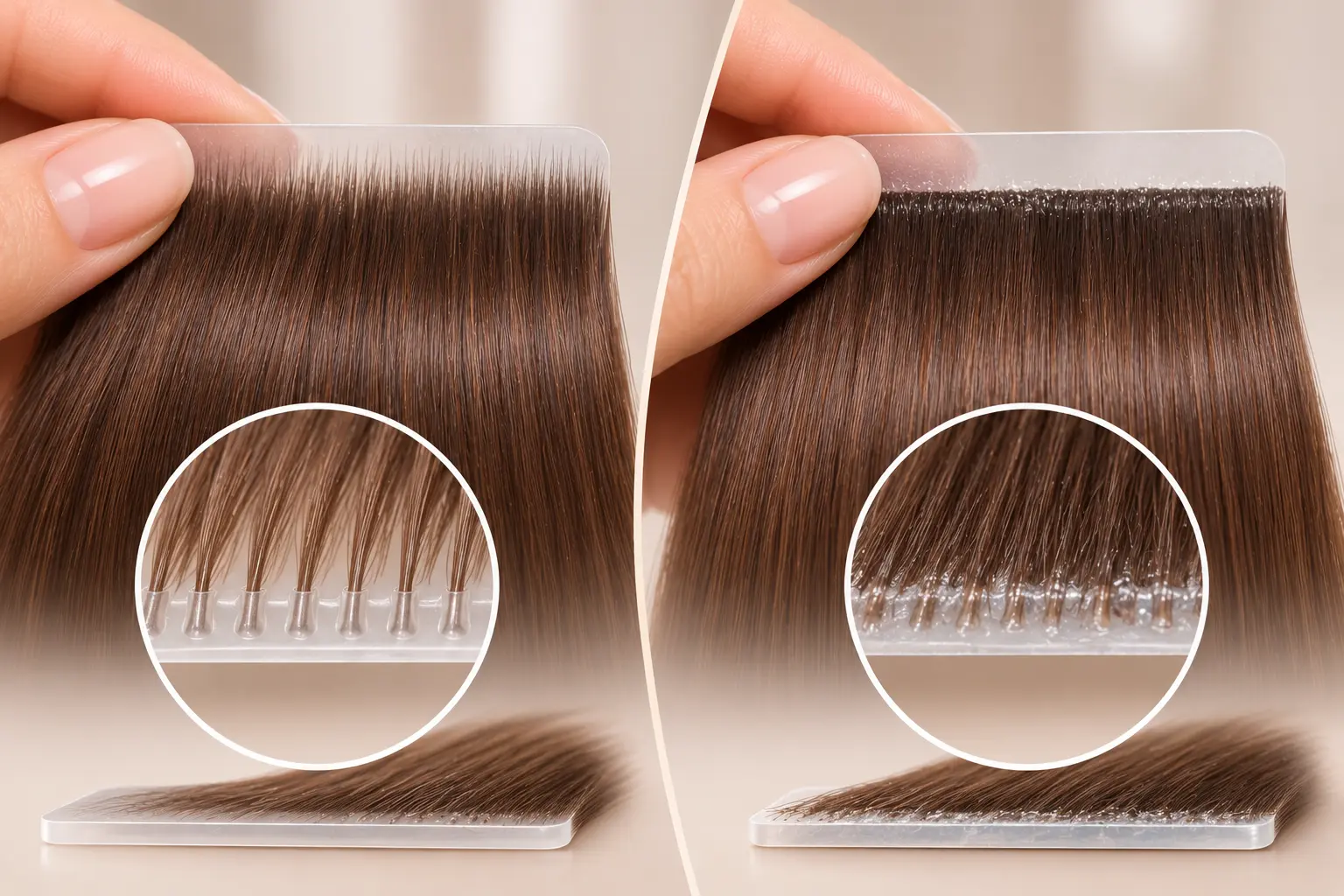
Invisible tape-in and regular tape-in extensions share the same PU tape base and standard dimensions, but differ fundamentally in how the hair is attached. Invisible tape-in uses a machine-injection process that inserts individual strands directly into the PU layer, while regular tape-in bonds hair to the PU surface with adhesive[^1]. This structural difference affects durability, shedding rate, production cost, and ultimately, wholesale pricing.
Both product types share more specification overlap than most buyers realize — but the differences that do exist are commercially significant. Keep reading to work through every spec category you should verify before signing a wholesale purchase agreement.
What Is the Core Construction Difference Between Invisible and Regular Tape-In?
Most buyers assume tape-in is tape-in. That assumption costs money. When you order a mixed assortment without understanding the construction method, your salon clients notice the quality gap — even if you don't see it immediately on the product sheet.
The core difference is how the hair attaches to the PU (polyurethane) base[^2]. Invisible tape-in uses a machine-injection method that inserts individual hair strands directly into the PU material itself. Regular tape-in uses adhesive to bond a weft of hair onto the surface of the PU tape.
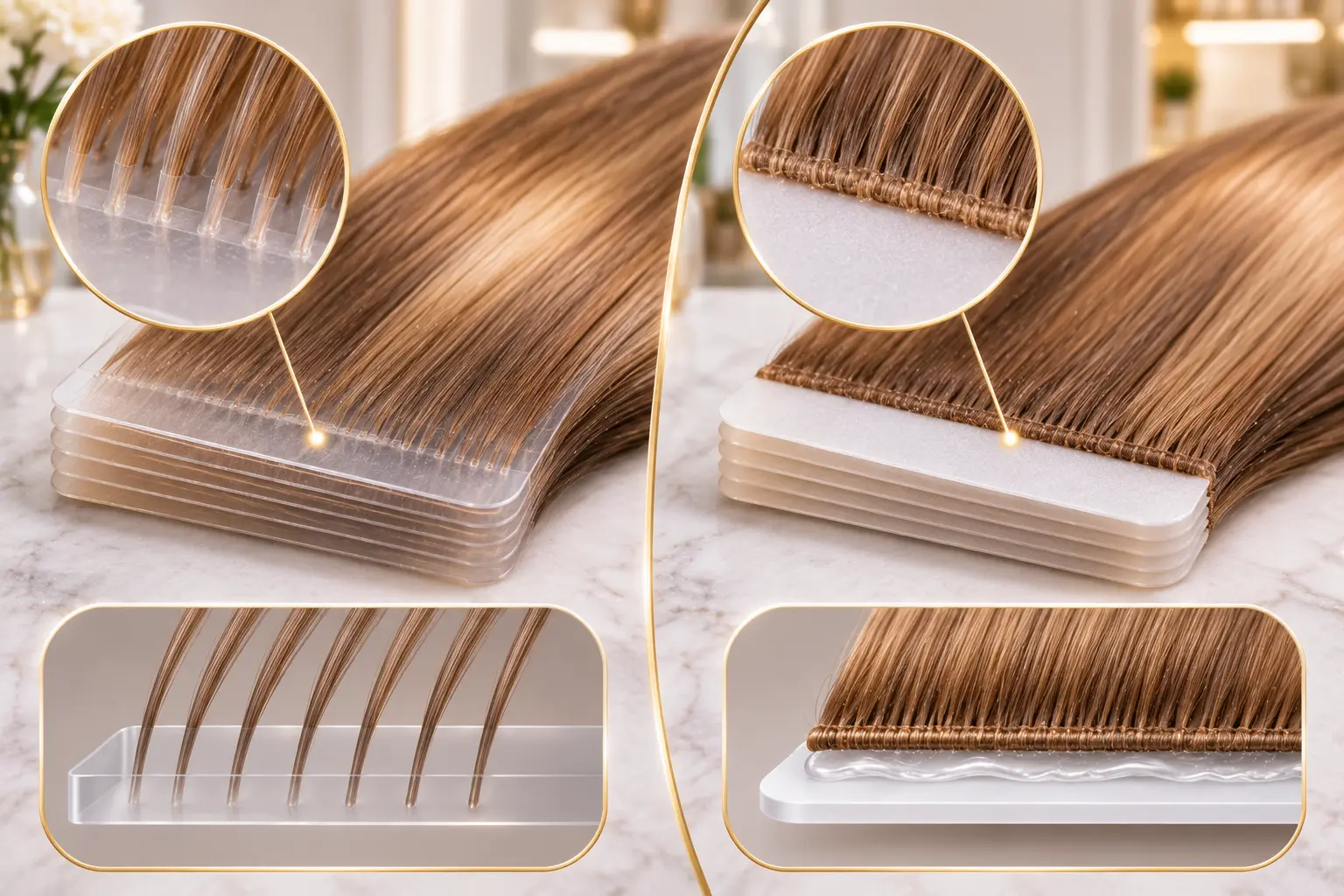
This distinction affects nearly every downstream performance variable — from how long the piece lasts in a client's hair to how it behaves under heat tools and repeated removal.
Invisible Tape-In: Machine-Injection Construction
In invisible tape-in production, each strand of hair is mechanically inserted into the PU base one by one using specialized equipment. The result is hair that is physically embedded within the tape layer rather than sitting on top of it.
Key structural properties:
- No visible adhesive line at the hair root where it meets the tape
- Hair strands are anchored individually, which distributes tension evenly
- The PU base remains thin and flexible because there is no glue layer adding bulk
- When applied to the client's hair, the tape lays flatter against the scalp
Regular Tape-In: Adhesive-Bond Construction
In regular tape-in production, a prepared weft of hair is laid across the PU tape surface and bonded using hair-grade adhesive. The PU tape is then cut to size after bonding.
Key structural properties:
- An adhesive layer is visible at the base where hair meets tape — this is normal for this construction type
- Hair is bonded in a strip rather than inserted individually
- Production time is significantly shorter, which reduces unit cost
- End result is a product that performs well for most salon applications when made with quality materials
How Does This Affect Your Wholesale Decision?
| Specification Factor | Invisible Tape-In | Regular Tape-In |
|---|---|---|
| Hair attachment method | Machine-injected into PU | Adhesive-bonded to PU surface |
| Shedding resistance | Higher — individually anchored | Moderate — depends on adhesive quality |
| Durability | Longer wear cycle | Standard wear cycle |
| Visible glue line | None | Present (normal for this type) |
| Production complexity | High | Standard |
| Wholesale cost | Significantly higher | Lower — most popular price point |
| Market demand volume | Niche / premium segment | High volume — mainstream preference |
From my experience working with wholesale buyers across different markets, regular tape-in remains the dominant purchase choice at the wholesale level. The lower unit cost makes it accessible for a wider client base, and when produced with 100% Remy Human Hair and quality adhesive, it performs reliably. Invisible tape-in appeals to premium brand segments and buyers building a high-end extension line where the retail price point supports the higher production cost[^3].
Are the Tape Dimensions the Same for Both Types?
Dimension inconsistency is one of the most common spec complaints I see from new wholesale buyers. If your supplier ships product with inconsistent tape widths, your salon clients cannot achieve uniform application rows — and the entire set looks uneven on the head.
Both invisible tape-in and regular tape-in are produced to the same standard industry dimensions: 4 cm wide × 0.8 cm tall. This consistency is intentional. It means the two product types are interchangeable in terms of application technique and tool compatibility.
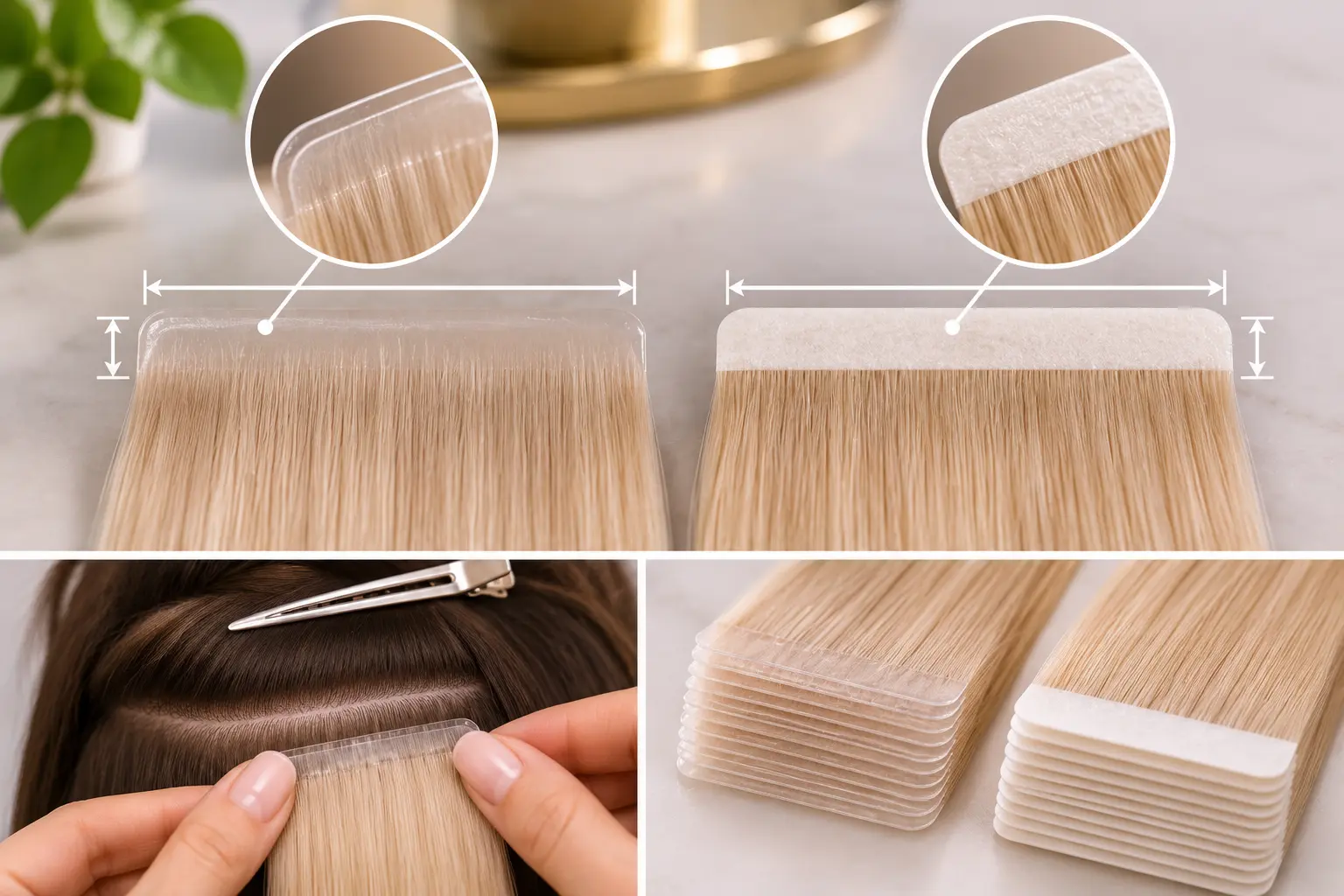
Understanding these dimensions in a wholesale context means more than just knowing the numbers — it means knowing what tolerances to specify and what to inspect on arrival.
Standard Tape Dimensions: What They Mean in Practice
The 4 cm width corresponds to the horizontal span of the tape piece as it sits against the client's natural hair. This width is designed to:
- Create a natural, blended look across a standard hair section
- Stack neatly when multiple pieces are applied in the same row
- Work with standard tape-in application tools (sandwich irons, sectioning clips)
The 0.8 cm height refers to the vertical depth of the tape base — how much of the tape contacts the client's hair when sandwiched. This measurement affects:
- How securely the tape grips the natural hair section
- How visible the tape bond is between sections
- How easily the piece can be removed and reapplied during maintenance
What to Specify in Your Wholesale Purchase Order
When ordering either product type, your spec sheet should explicitly state:
- Tape width: 4.0 cm (acceptable tolerance: ±0.1 cm)
- Tape height: 0.8 cm (acceptable tolerance: ±0.05 cm)
- PU tape color: Confirm whether you need clear, beige, or dark brown tape to match your target hair color range
- Tape edge finish: Clean-cut edges without fraying or uneven trim lines
- Pre-tape protection: Confirm whether pieces ship with the protective backing intact to prevent tape-to-tape sticking during transit
I always recommend requesting a pre-production sample set before bulk confirmation. Measure at least 10 pieces from the sample with a digital caliper. If width variation exceeds your tolerance across those 10 pieces, that variation will only be more pronounced across a 500-piece production run.
What Are the Standard Weight and Pack Specifications?
Weight per piece and pack quantity directly affect your landed cost calculation, your retail pricing model, and your inventory management system. Getting this wrong in a wholesale contract creates compounding errors across your entire supply chain.
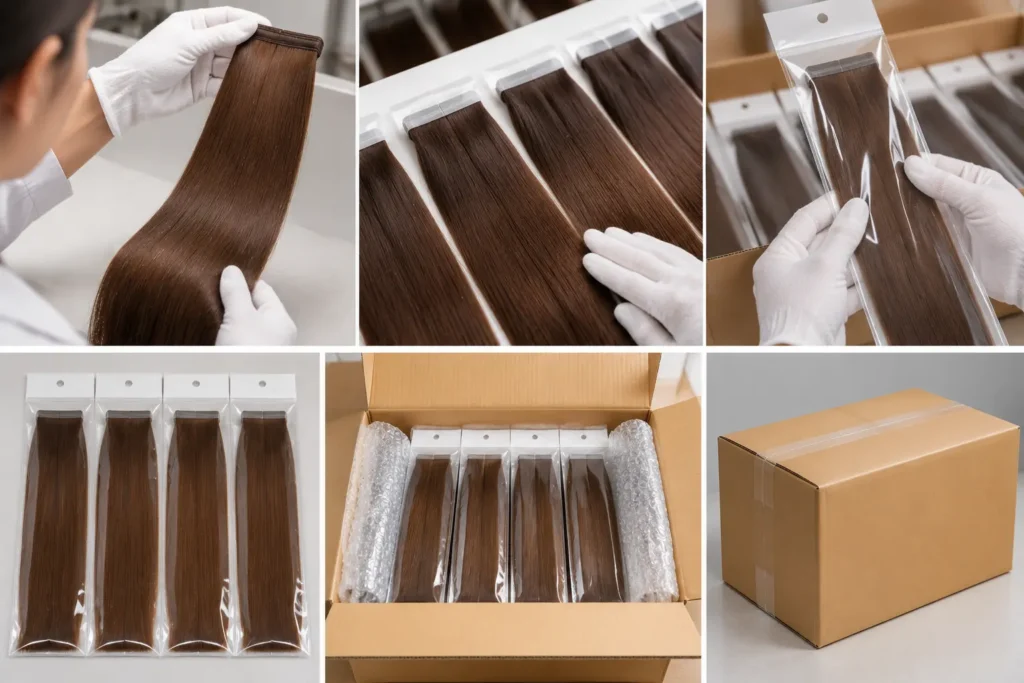
The standard specification for both invisible tape-in and regular tape-in is 2.5 grams per piece, packaged as 40 pieces per pack. This gives you 100 grams of hair per pack as your baseline unit for cost and inventory calculations.
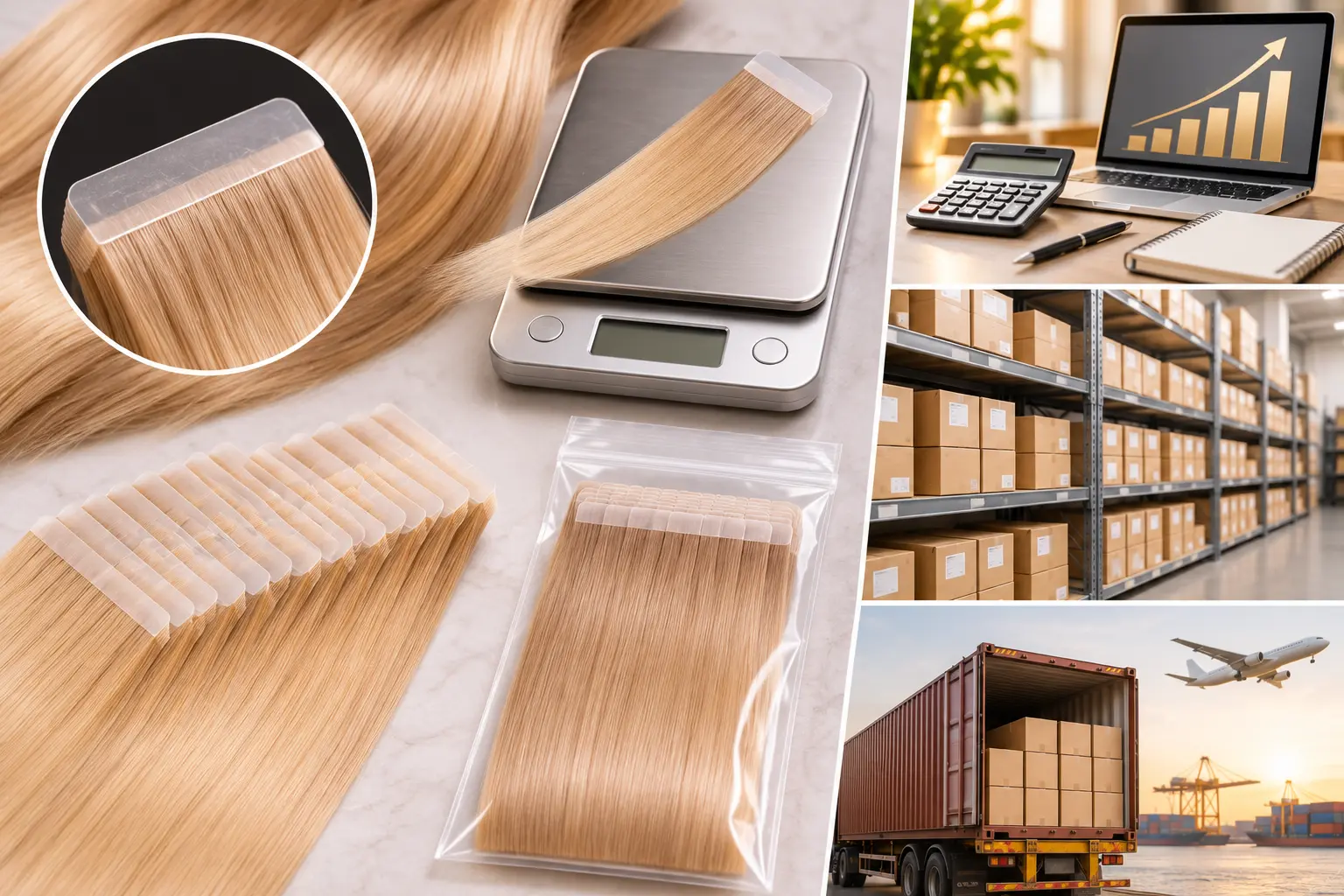
These numbers sound straightforward, but weight consistency across a bulk production run is where many suppliers fall short. Here is how to evaluate this spec category properly.
Why 2.5g Per Piece Matters for End Users
A single tape-in application typically requires 40 to 60 pieces for a full head installation, depending on the client's hair density and desired result. At 2.5g per piece:
- A 40-piece pack covers a light to medium volume full-head application
- Clients needing a fuller result will purchase 1.5 to 2 packs
- Stylists can predict exactly how many packs to recommend per consultation
If your supplier's pieces are running light — say, 2.1g or 2.2g per piece — the end client will notice the difference in thickness and coverage, even if the piece count is correct. Weight consistency protects your brand.
How to Verify Weight at Wholesale Inspection
You do not need to weigh every piece individually. A statistically valid sampling approach works for quality inspection:
- Weigh the full pack on a calibrated scale — target weight: 100g ± 3g for a 40-piece pack
- Pull 10 random pieces and weigh them individually — each should fall within 2.3g–2.7g
- Document and photograph any pieces outside tolerance before accepting the shipment
- Note length and color when reviewing weight — longer lengths and darker, heavily-processed colors may have slightly different weights due to processing, but variation should be consistent within a single SKU
Standard Wholesale Pack Specification Summary
| Specification | Standard Value | Notes |
|---|---|---|
| Weight per piece | 2.5 g | Tolerance: ±0.2g acceptable |
| Pieces per pack | 40 pcs | Standard industry pack count |
| Total weight per pack | 100 g | Use for landed cost calculation |
| Recommended full-head quantity | 40–60 pcs | Varies by client hair density |
| Available lengths | Typically 12"–24" | Confirm with supplier per SKU |
Pack Labeling Requirements for Wholesale Buyers
If you are building a private label brand, your pack specification should also cover:
- Hang tag or sticker with length, color code, weight, and piece count
- Inner packaging — heat-sealed pouch vs. box vs. sleeve
- Outer carton quantity — how many packs per export carton
- Barcode and SKU format if you're selling through retail or e-commerce channels
These are negotiable in a B2B supplier relationship and should be confirmed in writing before production begins.
Frequently Asked Questions
Is invisible tape-in worth the higher wholesale cost?
It depends on your market segment. If your clients are professional salons serving premium clientele who pay for longevity and low shedding, invisible tape-in justifies its price. For high-volume or price-sensitive markets, regular tape-in with quality Remy hair delivers strong value and is the preferred choice for most wholesale buyers.
Can invisible tape-in and regular tape-in be mixed in the same application?
Technically yes — the tape dimensions are identical, so they apply the same way. However, mixing construction types in a single application is not recommended. Durability and wear cycle differences between the two types will create an inconsistent maintenance schedule for the stylist and client.
What adhesive is used in regular tape-in extensions, and does it matter for wholesale buyers?
Yes, adhesive quality matters significantly. High-grade medical or cosmetic-grade adhesive holds longer, removes more cleanly, and is safer for repeated application cycles. Always ask your supplier to specify the adhesive type and confirm it is heat-resistant to at least 180°C for compatibility with flat iron removal tools[^4].
How should I store tape-in extensions before selling them?
Store packs flat, away from direct sunlight and humidity. Keep them at room temperature. Avoid stacking heavy objects on top of packs — pressure can cause tape pieces to bond to each other through the backing. Proper storage protects the adhesive integrity before the product ever reaches a client.
What is the difference between Remy and non-Remy tape-in extensions at the wholesale level?
Remy hair has all cuticles aligned in the same direction, which prevents tangling and extends the wear life of the extension[^5]. Non-Remy hair is chemically processed to mask misaligned cuticles and tends to degrade faster — especially through repeated washing and heat styling[^6]. For any professional wholesale tape-in line, 100% Remy Human Hair with intact cuticles is the minimum quality standard.
Conclusion
The choice between invisible tape-in and regular tape-in comes down to three variables: construction method, durability requirements, and price positioning. Both products share the same 4 × 0.8 cm tape dimension and 2.5g per piece / 40-piece pack standard — but the machine-injection construction of invisible tape-in delivers measurably better shedding resistance at a higher wholesale cost. Regular tape-in remains the dominant wholesale choice for most markets. Use this specification checklist to evaluate samples, write precise purchase orders, and hold suppliers to consistent quality across every production run.
If you are building or expanding a tape-in extension product line and need a supplier who can deliver both construction types in verified Remy Human Hair with stable quality and professional QC — reach out to our team at RENAI HAIR to discuss your specifications.
[^1]: "How to Make Seamless Tape-In Extensions From Bulk Hair: DIY Guide", https://hairweftingtape.com/blogs/news/how-to-turn-raw-bulk-hair-and-ponytails-into-ultra-thin-seamless-tape-ins-at-home?srsltid=AYCX9vIfWoJLsNV7XjYuwN53c0sYZbxSXS_E-rsoTzsZq-RbfLmVd5sO. Studies on pressure-sensitive adhesive systems applied to flexible polymer substrates describe surface-bonding mechanisms consistent with those attributed to tape-in hair extension construction, where a fiber bundle is laminated to a PU carrier using a contact adhesive. Evidence role: mechanism; source type: research. Supports: That pressure-sensitive or hair-grade adhesive bonding to a polyurethane substrate is the standard construction method for tape-in hair extensions. Scope note: General adhesive science literature does not specifically address hair extension manufacturing; application to this product category is inferential. [^2]: "Buy PU Film for Tape in Hair Extensions, Hair Extension Making Material ...", https://www.etsy.com/in-en/listing/4561070946/pu-film-for-tape-in-hair-extensions-hair. Polyurethane films are documented in materials science literature as flexible, biocompatible substrates suitable for skin-contact adhesive applications due to their elasticity, moisture resistance, and compatibility with pressure-sensitive adhesive systems. Evidence role: definition; source type: research. Supports: That polyurethane film is used as a flexible, skin-compatible substrate in adhesive-based cosmetic or hair applications. Scope note: General polyurethane film literature does not specifically address hair extension tape products; the connection to this application is contextual. [^3]: "Hair Wigs And Extensions Market Size, Share & 2031 Growth Trends Report", https://www.mordorintelligence.com/industry-reports/hair-wigs-and-extensions-market. Economic literature on product differentiation in consumer goods markets supports the principle that higher production complexity and input costs are associated with premium price positioning, a dynamic observed in the hair extension wholesale sector where construction method complexity correlates with wholesale and retail price tiers. Evidence role: general_support; source type: research. Supports: That production complexity and higher manufacturing costs are associated with premium market positioning in the hair extension wholesale industry. Scope note: No published study was identified that specifically analyzes invisible tape-in versus regular tape-in pricing tiers; the market positioning claim is supported by general economic theory rather than direct empirical evidence from the hair extension industry. [^4]: "Rational Design of Waterborne Polyurethane Pressure Sensitive ...", https://pmc.ncbi.nlm.nih.gov/articles/PMC8949434/. Professional hair styling tool specifications and cosmetology safety guidelines document flat iron operating temperatures commonly ranging from 150°C to 230°C, with 180°C cited as a standard working temperature for extension removal procedures. Evidence role: general_support; source type: institution. Supports: That professional flat irons used for hair extension removal operate at temperatures up to or around 180°C, establishing a minimum heat-resistance requirement for compatible adhesives. Scope note: A direct adhesive specification standard for hair extension tape at 180°C was not identified in publicly available regulatory or standards documents; the threshold cited in the article may reflect industry convention rather than a formal standard. [^5]: "Mechanical extension of human hair and the movement of the cuticle", https://pubmed.ncbi.nlm.nih.gov/11413498/. Hair fiber research establishes that the cuticle layer, composed of overlapping keratinous scales, generates directional friction; when cuticles are aligned root-to-tip across all fibers in a bundle, inter-fiber friction is minimized, reducing tangling — the defining property attributed to Remy-grade hair. Evidence role: definition; source type: research. Supports: That Remy hair is characterized by unidirectional cuticle alignment, and that this structural property reduces fiber-to-fiber friction and tangling compared to hair with randomized cuticle orientation. Scope note: The term 'Remy' is a trade designation without a universally enforced regulatory standard; cuticle alignment claims in commercial products are not independently verified by a single authoritative body. [^6]: "Remy Hair Extensions vs Virgin vs Non-Remy: Labels Explained", https://www.beautico.io/blogs/journal/remy-vs-virgin-vs-non-remy-hair-extensions?srsltid=AYCX9vKxLXJs8TtJ6GLxc9uHHEChDDM3UBLJeA67N2L04GulBLob5y8X. Hair science literature describes the use of acid treatments and silicone coating in commercial hair processing to smooth the fiber surface and reduce visible tangling in non-cuticle-aligned hair; such treatments are associated with progressive cuticle degradation and reduced tensile integrity under repeated washing and heat exposure. Evidence role: mechanism; source type: research. Supports: That non-Remy hair is commonly subjected to acid baths or silicone coating to remove or mask misaligned cuticles, and that this processing reduces fiber durability under repeated mechanical and thermal stress. Scope note: Peer-reviewed studies specifically comparing Remy and non-Remy extension longevity under controlled salon conditions are limited; most available evidence is drawn from general hair fiber chemistry research.