
Hair Extension Quality Control Before International Shipment
Inconsistent hair extension quality control can destroy buyer trust overnight. A single shipment of mismatched colors, shedding wefts, or incorrect weights can trigger returns, chargebacks, and lost accounts. Establishing rigorous pre-shipment inspection protocols protects your brand, your margins, and your customer relationships.
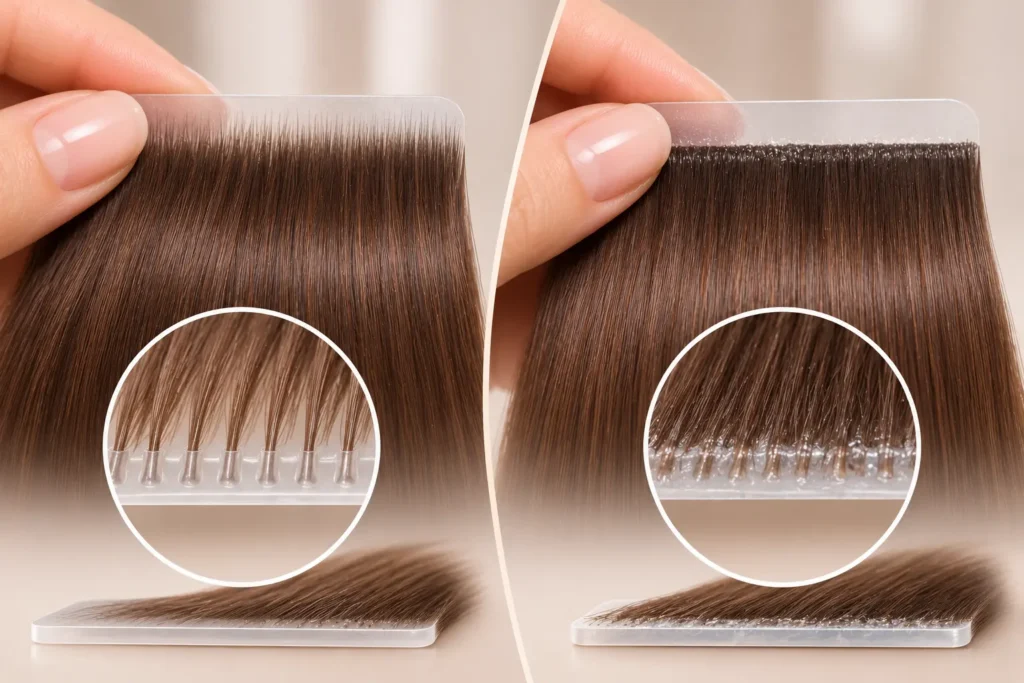
Hair extension quality control before international shipment involves systematic inspection of color consistency, hair authenticity (virgin, Remy, cuticle intact), length, weight, fullness grade, wash-test durability, and packaging integrity. Additionally, product-specific checks — such as weft seam inspection for Genius Wefts or adhesive testing for Tape-Ins — ensure every unit meets buyer specifications before it leaves the factory floor.
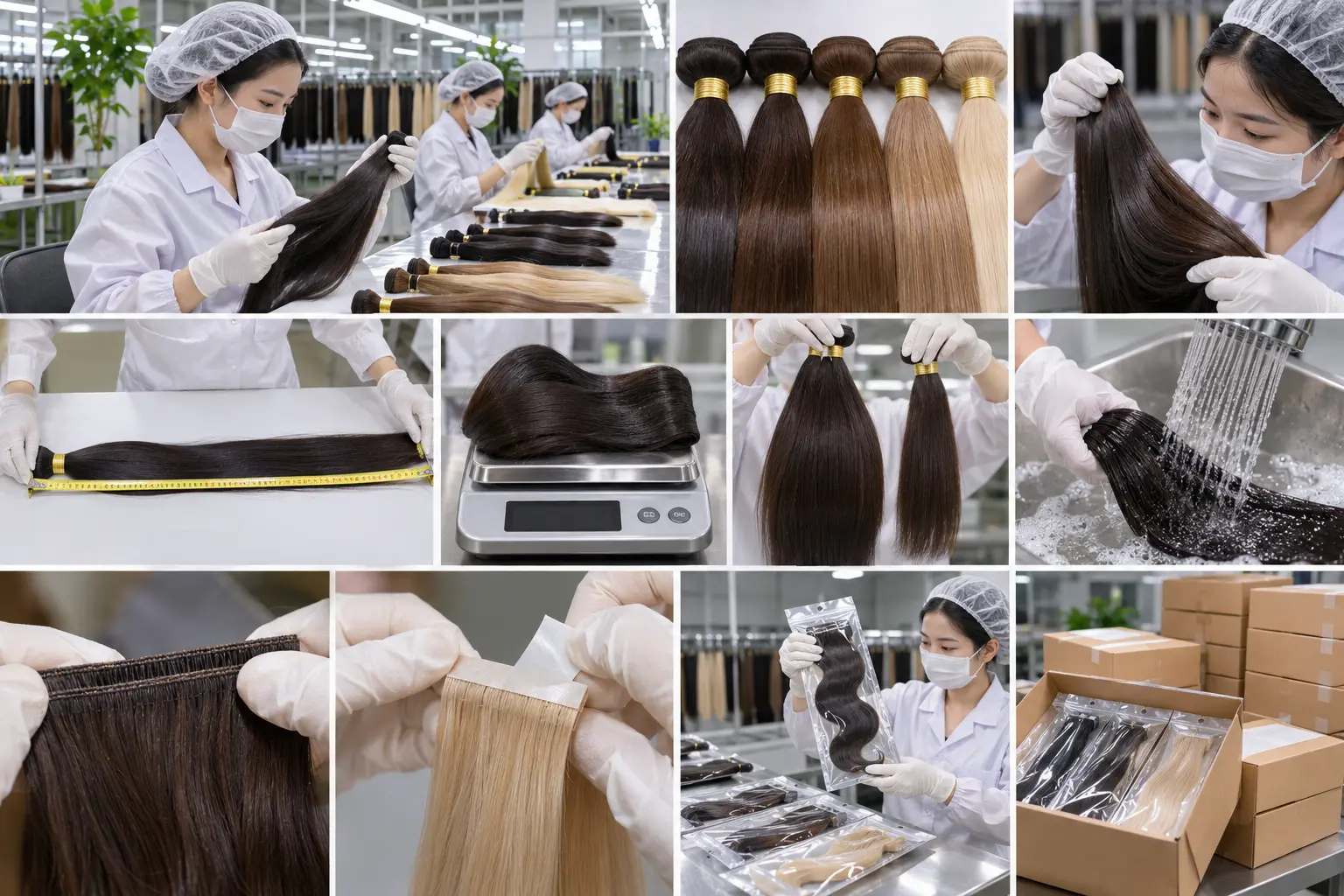
At our facility, every order passes through a multi-stage quality control pipeline before it earns a shipping label. Below, I break down each inspection checkpoint we use — and that you, as a buyer, should demand from any supplier.
Why Does Color Consistency Matter in Hair Extension Quality Control?
Color is the first thing an end consumer notices. If a batch of balayage extensions arrives with visible shade drift between packs, your brand credibility suffers immediately. Even minor inconsistencies can make color-matching impossible for stylists.
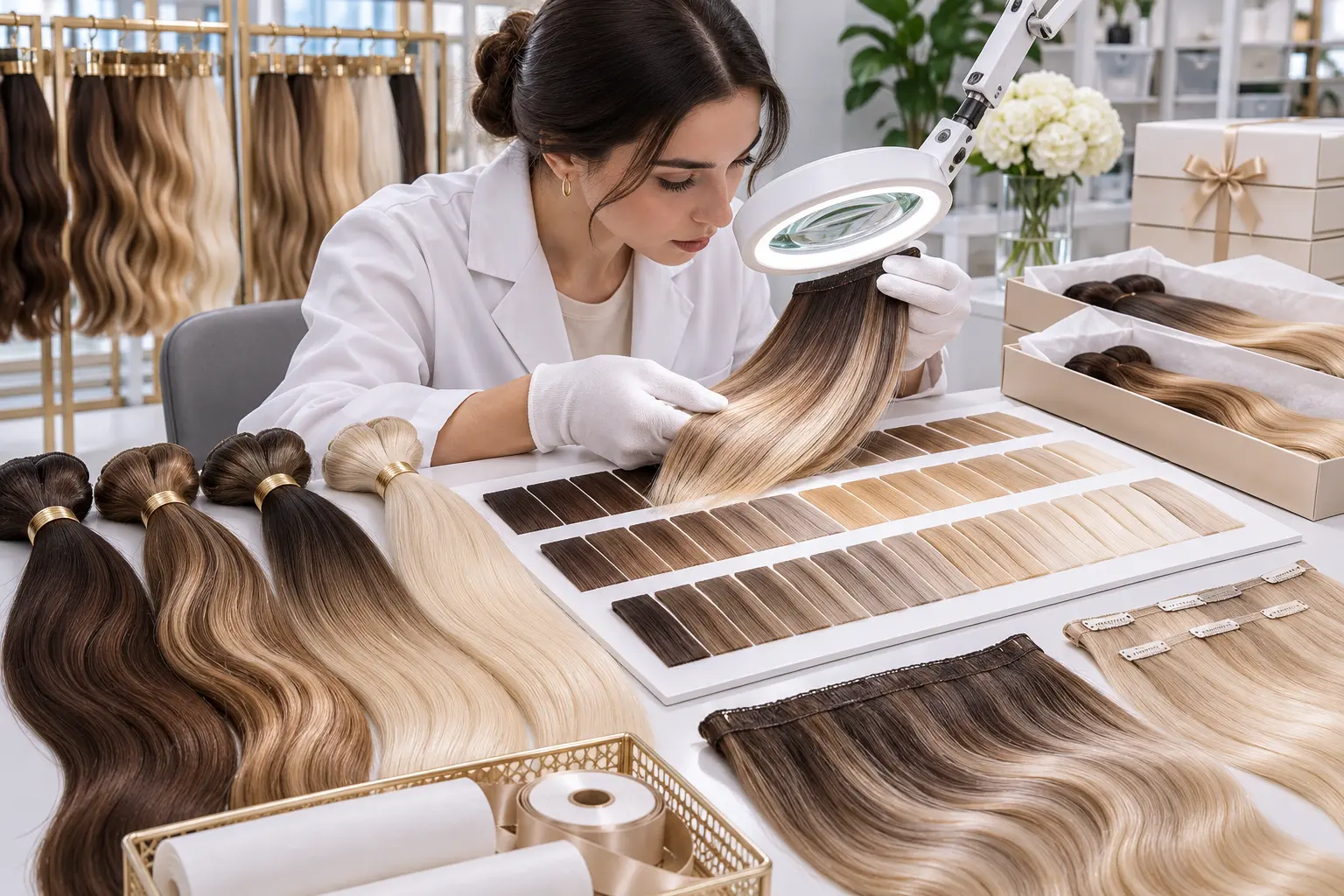
Color consistency inspection means verifying every bundle, weft, or piece against a standardized color swatch board before packing. This step is especially critical for complex colorwork like rooted tones, balayage blends, ombré transitions, and lighter shades, where even half-a-shade deviation is visible to the naked eye.
How We Inspect Color Consistency
At our production facility, we maintain a physical standard color board for every colorway we produce. During the final inspection stage, the QC team pulls sample pieces from each production batch and compares them side-by-side against the master swatch under controlled, neutral lighting. We specifically avoid fluorescent overhead light because it can distort warm and cool tones.
Here are the colorwork categories that receive extra scrutiny:
- Rooted colors — The root shadow must start and end at the same point across all units. Gradient transitions should look uniform.
- Balayage and ombré — Hand-painted color transitions are inherently variable. We define acceptable transition zones (e.g., the blend should begin between 3–5 inches from the root) and reject units outside that window.
- Light blondes and pastels — These shades reveal the slightest processing variation. We check for unwanted brassiness, ashiness, or uneven toner deposit.
- Piano and highlight mixes — The ratio of highlight to lowlight strands must match the approved sample.
What Buyers Should Ask
When evaluating a supplier's color QC process, ask these questions:
| Question | Why It Matters |
|---|---|
| Do you use a physical master color swatch board? | Digital photos shift across screens; physical boards are the standard. |
| Under what lighting conditions do you inspect? | Neutral or daylight-balanced light is essential for accurate comparison. |
| How do you handle batch-to-batch variation in complex colors? | A good answer involves defined tolerance ranges, not vague reassurances. |
| Can you send a pre-production color sample for approval? | This is standard practice for custom or first-time orders. |
I always recommend that new buyers request a pre-production color approval sample before the full run begins. It adds a few days to the timeline, but it eliminates the most common source of international shipment disputes.
How Do You Verify Hair Authenticity — Virgin, Remy, and Cuticle Intact?
The global hair extension market is flooded with mislabeled products. Hair marketed as "Remy" or "virgin" may actually be non-Remy, acid-washed, or silicone-coated.[^1] Buyers who skip hair authenticity verification risk selling products that tangle and deteriorate within weeks — and facing a wave of customer complaints.
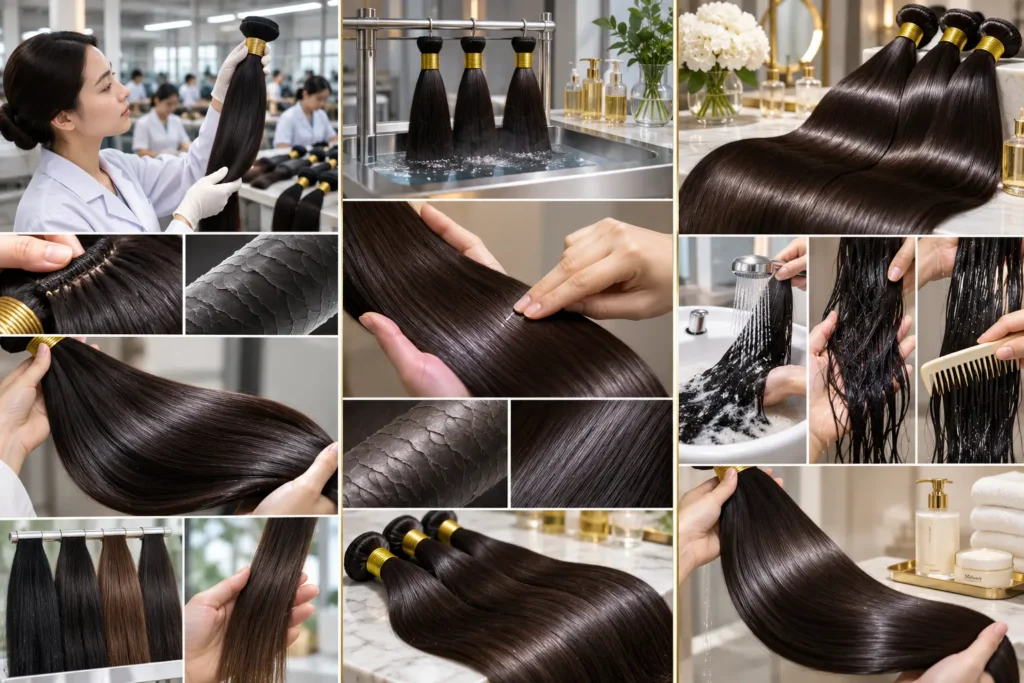
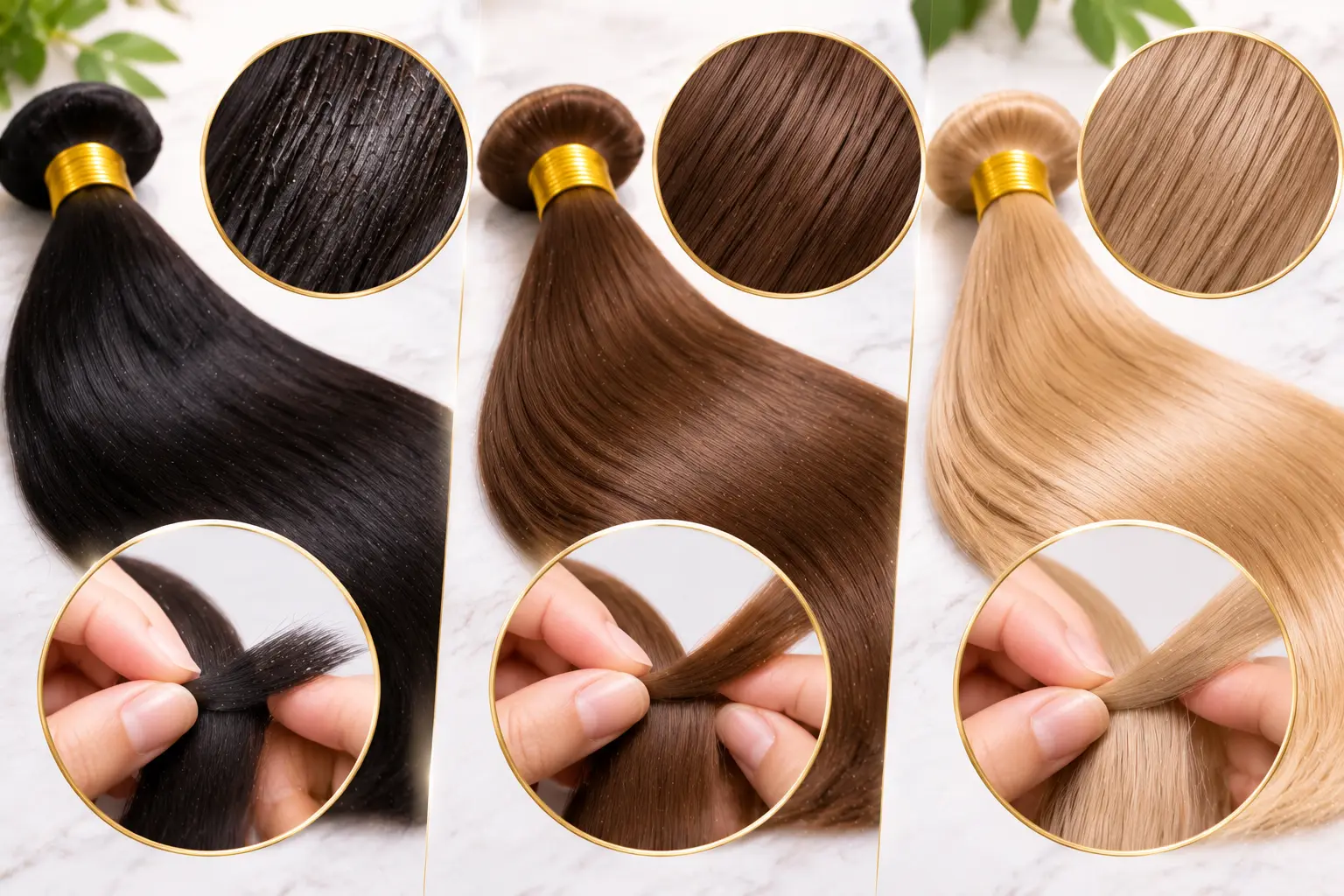
Hair authenticity testing confirms whether the product is genuinely virgin hair (unprocessed), Remy hair (cuticles aligned in one direction), or cuticle intact hair (natural cuticle layer preserved). Each designation carries specific performance expectations, and the inspection methods differ accordingly.
Key Authenticity Checks
1. Cuticle Direction Test (The Finger-Slide Test)
The simplest and most telling field test: run your fingers from tip to root along a strand. Genuine cuticle-intact, Remy hair feels smooth in the root-to-tip direction and slightly rougher tip-to-root.[^2] If the hair feels identically smooth in both directions, the cuticle has likely been stripped and the hair coated with silicone — a telltale sign of non-Remy processing.
2. Chemical Coating Detection
Silicone-coated hair feels unnaturally silky when new but degrades rapidly after several washes.[^3] We test by washing sample strands 3–5 times with a clarifying shampoo. If the hair turns from silky to straw-like, the coating has washed off — revealing the stripped cuticle underneath.
3. Virgin Hair Verification
True virgin hair has never been chemically treated. Under magnification, the cuticle scales appear uniform and undamaged.[^4] We also check for processing indicators such as:
- Uniform artificial color (virgin hair has natural color variation along the strand)
- Over-consistent texture (virgin hair has subtle irregularities)
- Chemical odor on fresh production batches
4. Documentation Review
Reputable suppliers should provide clear material sourcing documentation. While third-party lab testing exists, most B2B buyers rely on a combination of physical tests, supplier track record, and sample evaluation.
Pro tip for buyers: Always order a trial sample before committing to a large purchase. Wash-test it yourself. The hair's behavior after five or more washes tells you more than any certificate.
Why Are Length and Weight Checks Essential Before Shipment?
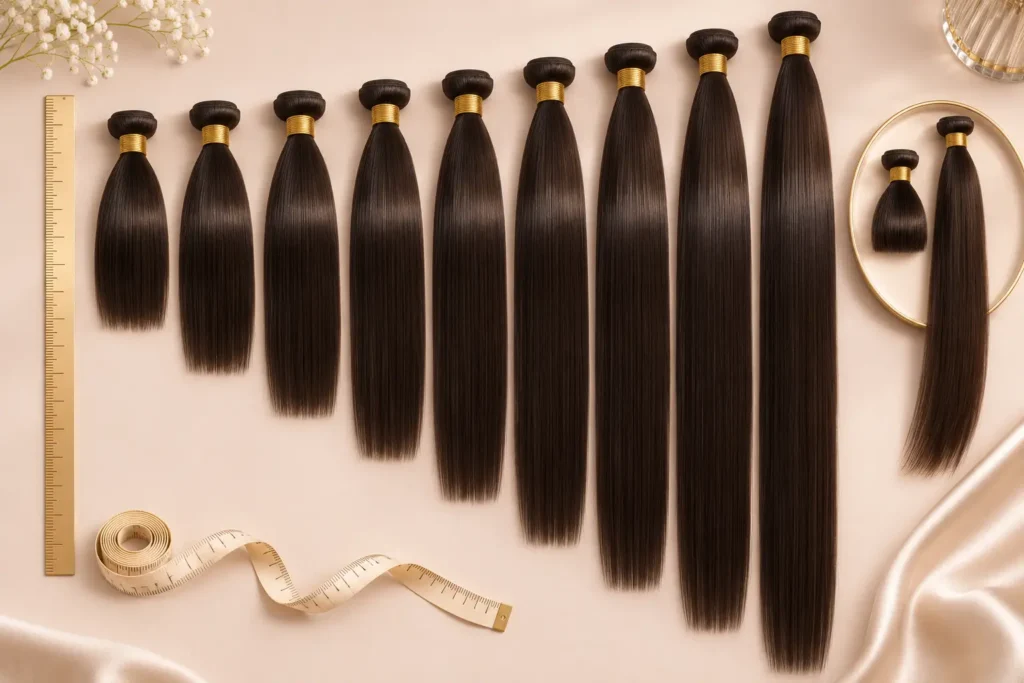
A buyer orders 22-inch, 100-gram weft bundles. The shipment arrives at 20.5 inches and 92 grams. That may seem close enough — until a salon professional measures and rejects the product. Length and weight discrepancies erode buyer confidence and create costly return logistics across international borders.
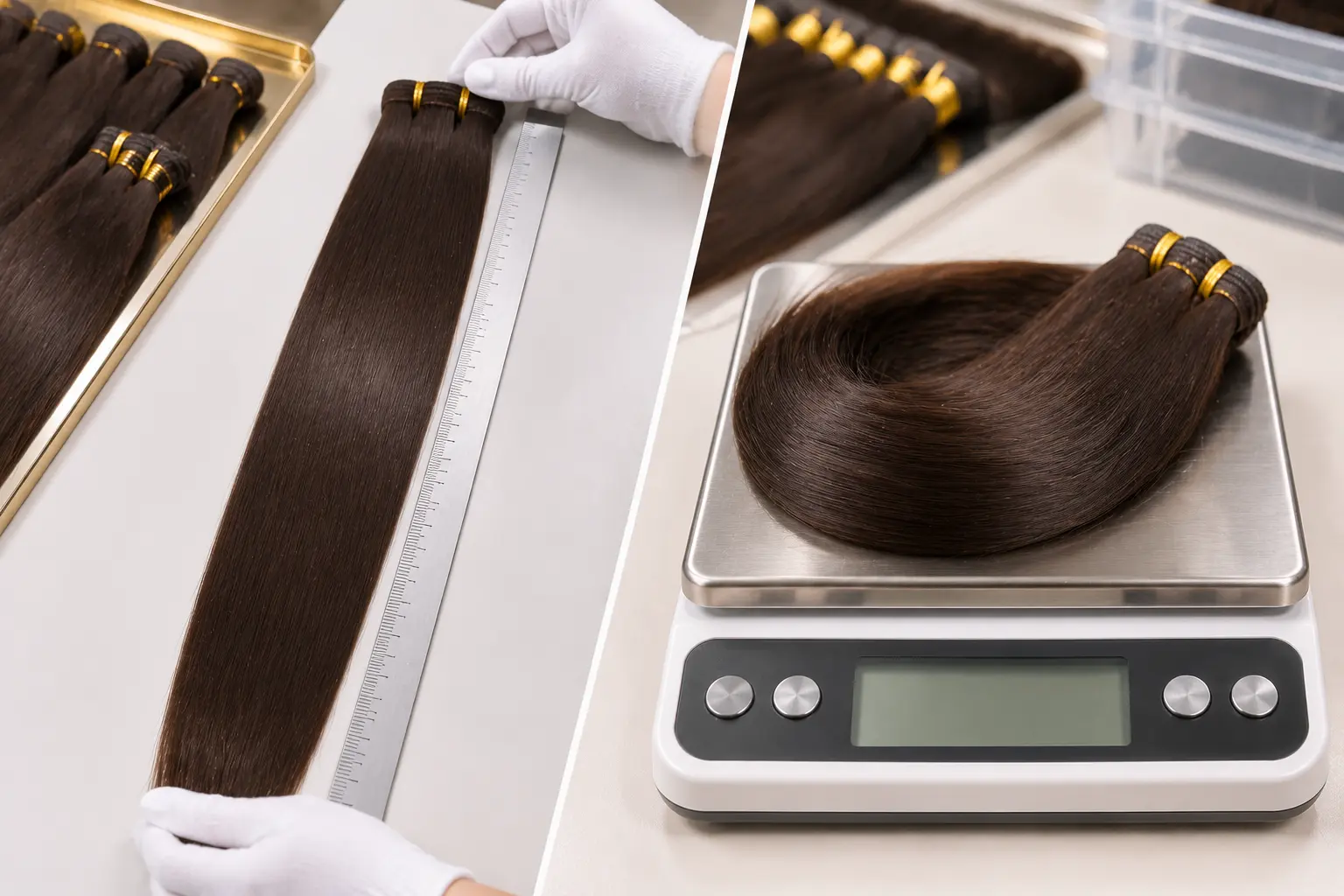
Pre-shipment length and weight inspection ensures every unit meets the exact specifications stated on the purchase order. Length is measured on straightened strands (not stretched), and weight is verified using calibrated digital scales at the individual-unit level, not just batch averages.
How We Measure
Length Measurement Protocol:
- Hair is laid flat on a clean measurement surface.
- For wavy and curly textures, length is measured in the hair's natural state unless the buyer specifies stretched length.
- We measure from the attachment point (weft seam, tape tab, keratin bond) to the longest strands.
- Acceptable tolerance: typically ±0.5 inch, though this should be agreed upon with the buyer before production.
Weight Measurement Protocol:
- Each individual unit (single weft piece, tape-in set, clip-in set) is weighed on a calibrated digital gram scale.
- We record weight per unit, not just total batch weight. Averaging can mask significant per-unit variation.
- Acceptable tolerance: typically ±2–3 grams per 100g unit.
| Specification | Standard Tolerance | Red Flag |
|---|---|---|
| Length | ±0.5 inch | >1 inch short consistently |
| Weight per unit | ±2–3 grams | >5% under target across batch |
| Weight consistency across batch | <5% variation unit-to-unit | Random units 10%+ lighter |
Why Batch Averages Are Misleading
I have seen suppliers report that a batch "averages" the correct weight. But if half the units are 95g and half are 105g, no individual customer receives a consistent product. We inspect and record at the individual unit level because that is what the end buyer actually receives.
What Does Fullness Grade Inspection Look Like — Single Drawn vs. Double Drawn?
Fullness is one of the most common sources of buyer disappointment. A customer expecting thick, blunt-cut ends receives tapered, thin-looking extensions. The issue usually traces back to unclear fullness specifications or insufficient inspection at the factory level.
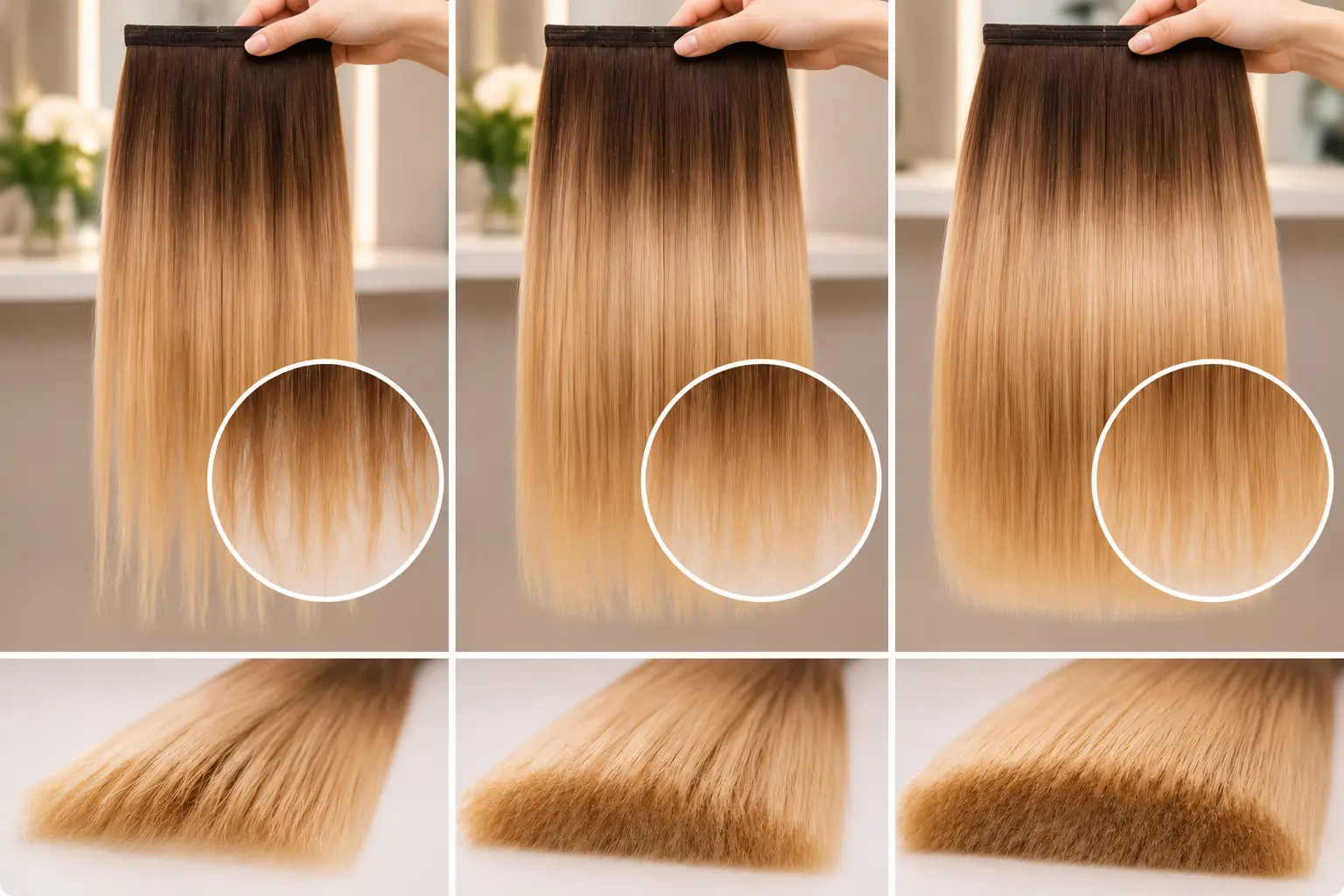
Fullness grade inspection verifies whether the hair meets Single Drawn, Double Drawn, or a custom fullness standard specified by the buyer. This involves evaluating the density and distribution of shorter hairs relative to the full length — essentially, how thick the hair remains from root to tip.
Understanding the Grades
- Single Drawn: Contains a natural mix of hair lengths. Approximately 50% of strands reach the full stated length. The ends taper naturally. This is the most affordable option.
- Double Drawn: Short hairs have been manually removed. Approximately 70–80% of strands reach the full length. Ends appear thick and blunt.
- Super Double Drawn: An even higher percentage (80–90%+) of full-length strands. The most labor-intensive and expensive grade.
How We Inspect Fullness
Our QC team fans the hair flat and visually evaluates the density at the bottom third of the weft or bundle. We compare against physical reference samples for each fullness grade. For Double Drawn orders, we specifically look for:
- Minimal thin, wispy strands at the ends
- Consistent thickness from mid-length to tip
- Overall density matching the approved production sample
This is a visual and tactile inspection. There is no machine that reliably automates fullness grading — it requires experienced QC personnel who handle hair products daily.
Why Is Wash Testing the Most Important Durability Check?
Every other inspection measures what the hair looks like fresh off the production line. Wash testing reveals what the hair actually is. Silicone coatings, weak dye bonds, poor cuticle alignment — all of these hidden problems surface after repeated washing. Skipping wash tests is the single biggest quality control mistake a supplier can make.
Wash testing involves submerging the hair extension in warm water, applying shampoo, scrubbing thoroughly, rinsing, blow-drying, and repeating the cycle at least five times. The purpose is to evaluate post-wash frizz, shedding rate, and color fade under conditions that simulate real consumer use.
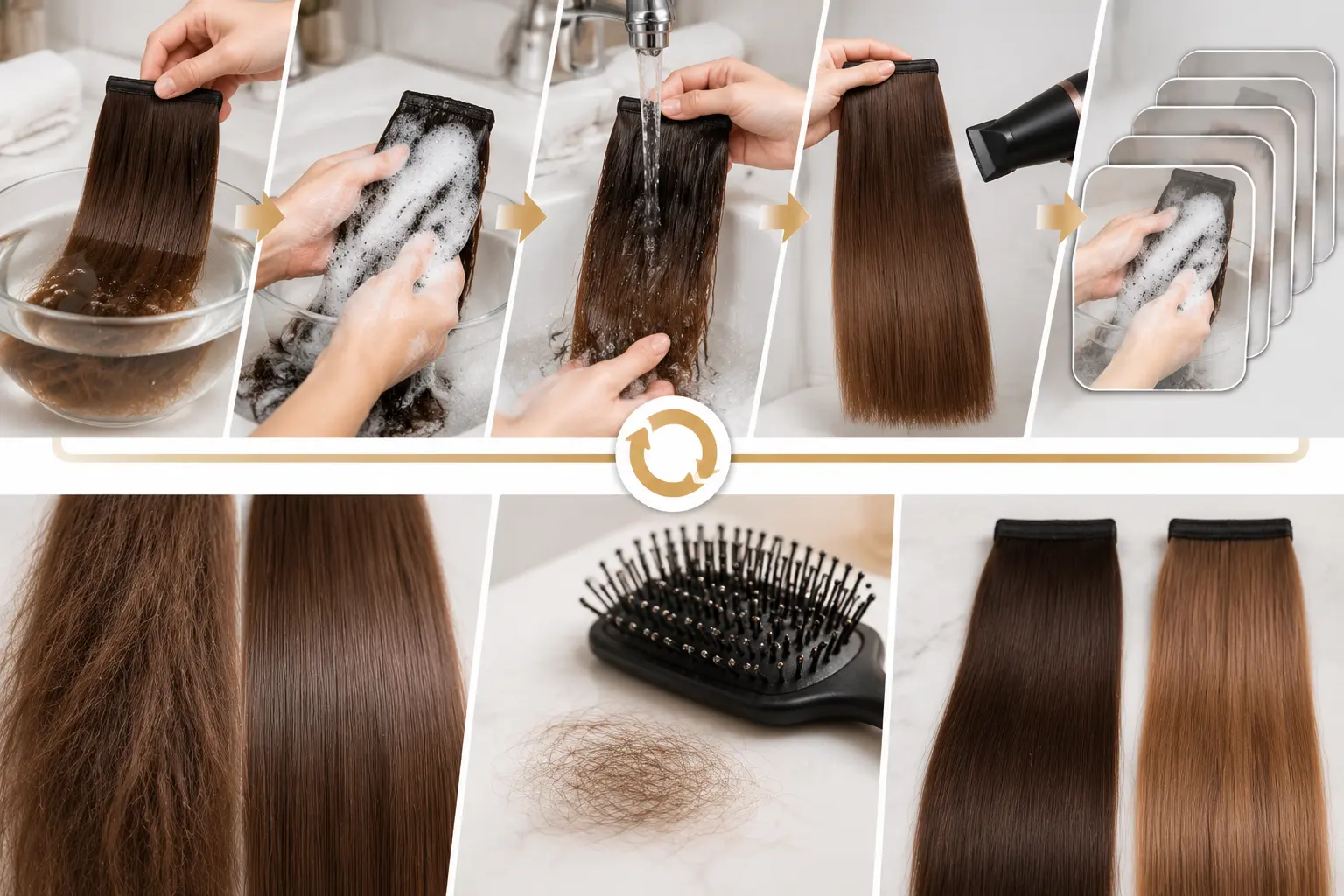
Our Five-Wash Protocol
- Prepare warm water (approximately 35–40°C / 95–104°F) — simulating a typical shower temperature.
- Submerge the sample and apply a standard sulfate-free shampoo.
- Scrub and agitate the hair thoroughly for 1–2 minutes. We do not handle it gently — the goal is to simulate real wear conditions.
- Rinse completely, gently squeeze out excess water, and blow-dry on medium heat.
- Repeat the full cycle at least 5 times on the same sample.
What We Evaluate After Wash Testing
| Test Criterion | Pass Indicators | Fail Indicators |
|---|---|---|
| Frizz/Tangling | Hair remains smooth, manageable, minimal tangling | Excessive frizz, matting, straw-like texture |
| Shedding | Minimal loose strands (comparable to natural shedding) | Clumps of hair coming out, visible thinning |
| Color Fade | Color remains true, no visible shift | Noticeable fading, brassiness, or uneven bleed |
| Texture Retention | Wavy/curly patterns hold; straight hair stays smooth | Texture loss, inconsistent wave pattern |
Why Five Washes Minimum?
Silicone-coated, non-Remy hair typically passes one or two washes without issue. The coating begins to break down around wash three to four.[^5] By wash five, the true quality of the hair is exposed. I have personally seen samples that felt luxurious out of the package turn into an unmanageable, tangled mess after just five wash cycles. This single test saves our buyers from shipping inferior product to their customers.
What Product-Specific Quality Checks Should You Demand?
General inspection catches universal issues. But each hair extension format has unique construction details that require targeted verification. A Genius Weft has different failure points than a Tape-In, and a Hair Topper has completely different specifications than a K-Tip bond. Product-specific checks ensure the construction itself meets professional standards.
Product-specific hair extension quality control targets the structural and functional characteristics unique to each product type — including seam integrity, adhesive performance, bond formation, base construction, and density mapping.
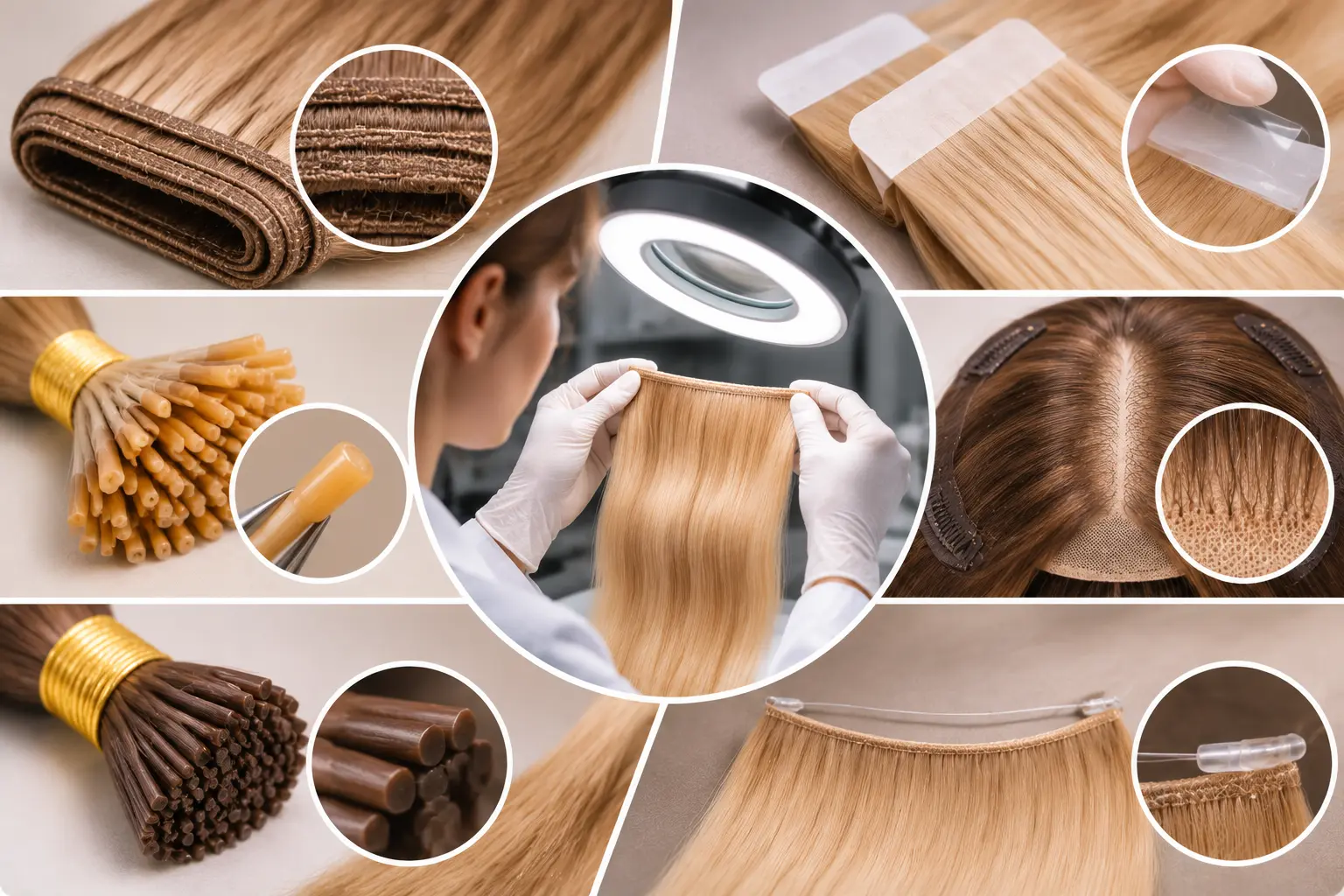
Genius Weft Inspection
- Seam integrity: Inspect the full length of the weft seam under magnification. Look for loose threads, skipped stitches, or uneven bonding.
- Width consistency: Measure the weft width at multiple points. It should be uniform across the entire piece.
- Cut-and-return test: Genius Weft is designed to be cut without unraveling. We cut a small section and verify the seam holds.
Tape-In Hair Inspection
- Adhesive tape dimensions: Tape tabs should be uniformly sized (typically around 4 cm × 0.8 cm, though this varies by design). Irregular tape sizes create visible bumps during installation.
- Adhesive strength: The tape should adhere firmly to itself when sandwiched. We test by pressing two tabs together and checking bond strength after 30 seconds.
- Tape alignment: The adhesive strip should be perfectly aligned with the hair root line. Misaligned tape creates installation problems.
Keratin / Pre-bonded (K-Tip) Inspection
- Bond size and shape: Each keratin tip should be uniform in size and cleanly formed. Oversized or lumpy bonds are uncomfortable and visible.
- Bond attachment strength: A gentle tug test confirms the bond is securely attached to the hair strand. It should not crack or separate.
- Color match: The keratin tip color should match (or be transparent) so it blends invisibly during installation.
Hair Topper Inspection
- Base/net dimensions: Measure the base size against the order specification. Even 0.5 cm deviation matters for scalp coverage.
- Density mapping: Hair density should be even across the base unless a graduated density was specified. Thin spots are unacceptable.
- Knot security: For hand-tied bases, tug individual strands to verify knot tightness. Loose knots lead to rapid shedding.
- Parting space: If the topper includes a silk top or lace part, check that the parting area looks natural and is correctly positioned.
| Product | Key Specific Checks | Common Defect |
|---|---|---|
| Genius Weft | Seam integrity, width, cuttability | Seam unraveling after cutting |
| Tape-In | Tape size, adhesive strength, alignment | Weak adhesive, misaligned tabs |
| K-Tip / Pre-bonded | Bond shape, attachment, color | Oversized or brittle bonds |
| Hair Topper | Base size, density, knot security, parting | Uneven density, incorrect base dimensions |
How Does Packaging Inspection Protect Your Brand?
You can produce a flawless hair extension. But if it arrives in a crushed box with a smudged label, the buyer's first impression is damaged. For international shipments that endure weeks of handling, transit, and customs processing, packaging integrity is not cosmetic — it is functional protection.[^7]
Packaging inspection verifies that each unit is clean, complete, correctly labeled, and structurally sound before it enters the shipping carton. This includes inner packaging (individual product packaging) and outer packaging (carton labeling, padding, moisture protection).
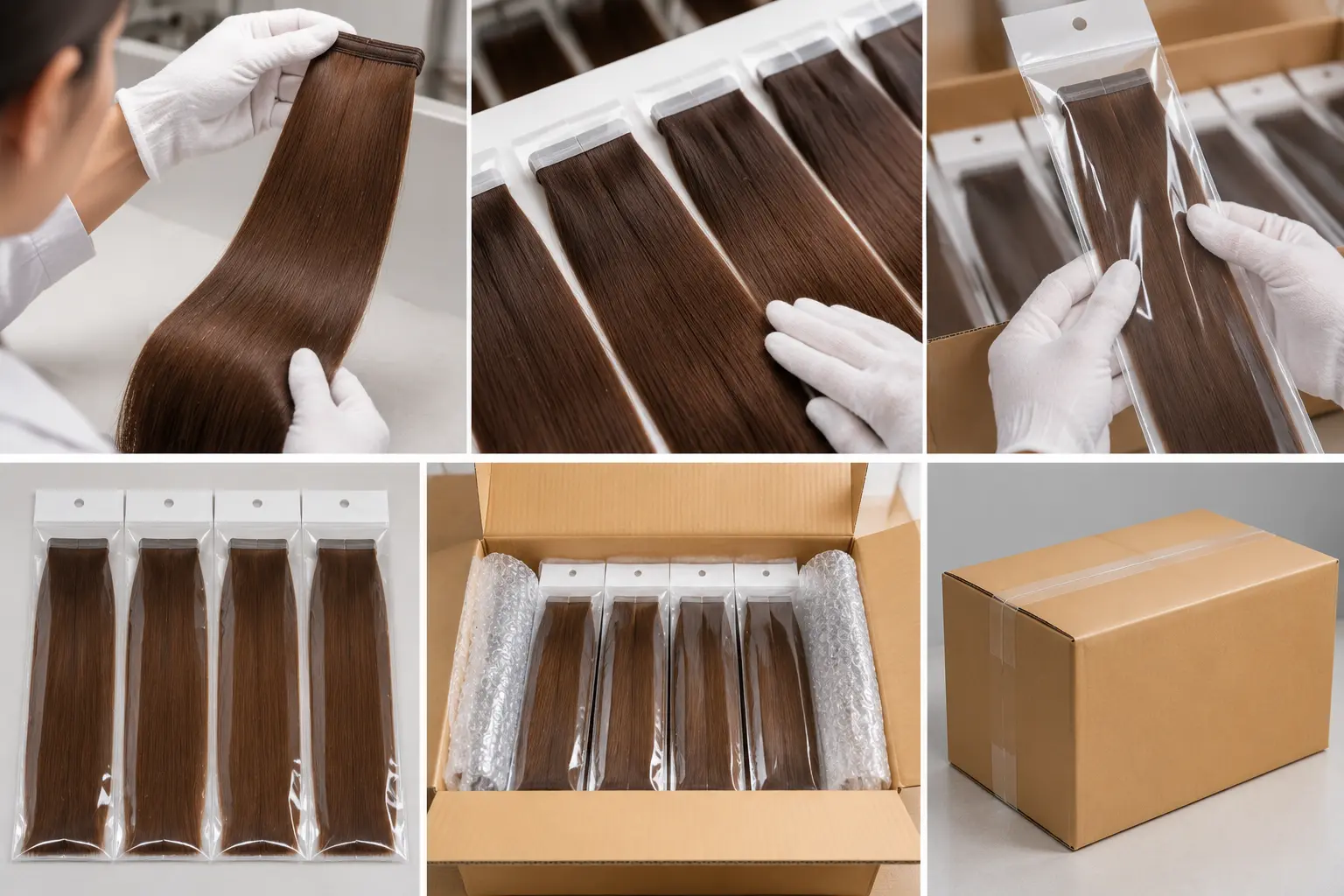
Our Packaging Checklist
- Cleanliness: No dust, hair debris, oil stains, or manufacturing residue on packaging surfaces.
- Completeness: All specified packaging components present — inner box, tissue paper, instruction card, branded elements, hang tags.
- Label accuracy: Product name, shade number, length, weight, and any barcode or SKU must match the actual product inside. Mislabeling is a surprisingly common error that causes warehouse chaos on the buyer's end.
- Structural integrity: Boxes should be uncrumpled, uncompressed, and properly sealed. For international shipments, inner packaging should withstand pressure from stacking in shipping cartons.
- Moisture protection: We include silica gel packs and moisture-resistant inner wrapping for shipments to humid climates or those traveling by sea freight.[^8]
A note for buyers: If you provide custom branded packaging, send clear packaging specifications — including box dimensions, label placement, and assembly instructions — alongside your product order. The clearer your packaging brief, the fewer errors you will encounter.
Frequently Asked Questions
How many units should be inspected per shipment?
For large orders, we follow an AQL (Acceptable Quality Level) sampling plan[^9], typically inspecting a statistically significant random sample from each production batch. For smaller orders or first-time production runs, we often inspect 100% of units to establish a quality baseline.
Can buyers request a third-party inspection before shipment?
Yes. Many of our B2B customers arrange independent third-party inspections at our facility before shipment. We welcome this — it builds trust and gives buyers documented verification. Common inspection firms include SGS, Bureau Veritas, and Intertek.[^10]
What happens if a quality issue is found during inspection?
Defective units are separated immediately. Depending on the defect type and severity, we either rework the product (e.g., repackaging, minor color adjustment) or reproduce affected units. The order does not ship until it passes re-inspection.
How should buyers communicate quality standards to their supplier?
Provide a written quality specification sheet with every order. Include approved color samples, length and weight tolerances, fullness grade, packaging details, and any product-specific requirements. The more detailed and documented your expectations, the more accountable both parties can be.
Does wash testing delay production timelines?
Wash testing typically adds 1–2 days to the QC phase. We build this into our standard production schedule. Given that it is the single most effective test for detecting hidden quality issues, the small time investment is overwhelmingly worthwhile.
Conclusion
Thorough hair extension quality control before international shipment is not a luxury — it is a business necessity. From color consistency checks against master swatch boards to multi-cycle wash testing, from precise length and weight verification to product-specific structural inspections, every checkpoint exists to protect buyers from costly quality failures.
The key takeaway: demand transparency and documentation from your supplier. Ask to see their QC process, request pre-production samples, and do not hesitate to arrange third-party verification for significant orders.
At RENAI HAIR, we have built our reputation on the principle that no product ships until it passes every stage of our inspection pipeline. If you are sourcing 100% human hair extensions and need a manufacturing partner with proven, systematic quality control, reach out to our team to discuss your product specifications and quality requirements.
[^1]: "Untangling where your hair extensions really come from", https://www.bbc.com/news/magazine-37781147. Industry analyses and investigative reports have documented widespread mislabeling in the hair extension trade, with products marketed as Remy or virgin hair frequently found to be acid-washed or silicone-coated non-Remy material. Evidence role: general_support; source type: research. Supports: That mislabeling of hair extension products — including non-Remy hair sold as Remy or virgin — is a documented problem in the global hair extension market.. Scope note: Direct large-scale quantitative studies on mislabeling prevalence in the hair extension market are limited; available evidence is largely drawn from trade investigations and consumer advocacy reports rather than controlled scientific surveys. [^2]: "Investigation of scale effects and directionality dependence on ...", https://pubmed.ncbi.nlm.nih.gov/16675116/. Tribological studies of human hair fiber have demonstrated that the overlapping, roof-tile arrangement of cuticle scales creates anisotropic frictional properties, with lower friction measured in the root-to-tip direction and higher friction in the tip-to-root direction — a property diminished when cuticles are chemically stripped. Evidence role: mechanism; source type: research. Supports: That the directional asymmetry of hair cuticle scales produces measurable differences in friction depending on whether the fiber is stroked from root to tip or tip to root.. Scope note: Published tribological measurements are typically conducted on intact scalp hair under laboratory conditions; the degree to which these findings translate directly to extension hair that has undergone collection and processing is not always explicitly addressed in the literature. [^3]: "On Hair Care Physicochemistry: From Structure and Degradation to Novel Biobased Conditioning Agents - PMC", https://pmc.ncbi.nlm.nih.gov/articles/PMC9921463/. Research in cosmetic chemistry has shown that silicone-based coatings, including dimethicone derivatives commonly applied to hair fibers, are susceptible to gradual removal through repeated surfactant exposure during washing, progressively diminishing their conditioning effect. Evidence role: mechanism; source type: research. Supports: That silicone-based coatings applied to hair fibers are progressively removed by repeated shampooing, leading to deterioration of the treated hair's tactile properties.. Scope note: Most published research addresses silicone behavior on intact human hair rather than on acid-stripped extension hair specifically; the degradation rate on processed extension fiber may differ from findings on natural hair. [^4]: "Scanning Electron Microscopy Study of Hair Shaft Damage Secondary to Cosmetic Treatments of the Hair - PMC", https://pmc.ncbi.nlm.nih.gov/articles/PMC4989398/. Trichological and forensic hair analysis studies using scanning electron microscopy have demonstrated that chemical treatments — including bleaching, dyeing, and acid washing — produce measurable structural damage to the hair cuticle, including scale lifting, erosion, and fragmentation, which can be distinguished from the relatively intact cuticle morphology of unprocessed hair under magnification. Evidence role: mechanism; source type: research. Supports: That microscopic examination of hair cuticle scales can differentiate virgin (unprocessed) hair from chemically treated hair based on the degree of cuticle scale damage or uniformity.. Scope note: Microscopic cuticle assessment is primarily a research and forensic tool; practical application in routine factory quality control typically relies on tactile and wash-based proxies rather than direct microscopy. [^5]: "Silicones: use of substantive properties on skin and hair", https://pubmed.ncbi.nlm.nih.gov/19456912/. Cosmetic science literature on silicone deposition and removal from hair fibers indicates that repeated shampooing progressively reduces silicone coating levels, with substantive loss of conditioning properties typically observed after multiple wash cycles, though the precise cycle at which degradation becomes perceptible varies with shampoo formulation and application method. Evidence role: mechanism; source type: research. Supports: That silicone coatings applied to hair fibers show measurable degradation in conditioning performance after a specific number of wash cycles.. Scope note: Published studies generally measure silicone deposition on intact hair rather than on acid-stripped extension fiber; the specific wash-cycle threshold of three to four cited in the article is an empirical industry observation and may not correspond directly to controlled laboratory findings. [^6]: "Our Genius Wefts are ultra thin and flexible making it a popular choice for seamless and natural-looking hair extensions. Here are the key benefits", https://www.facebook.com/lookelevenhairextensions/posts/our-genius-wefts-are-ultra-thin-and-flexible-making-it-a-popular-choice-for-seam/1310298750079567/. Within the professional hair extension industry, 'Genius Weft' refers to a machine-sewn weft construction engineered with a reinforced, ultra-thin seam that allows the weft to be cut to custom widths without unraveling — a property that distinguishes it from standard machine wefts and hand-tied wefts. Evidence role: definition; source type: other. Supports: That Genius Weft is a distinct hair extension construction format characterized by an exceptionally thin seam designed to remain intact when cut.. Scope note: Genius Weft is a trade term used across multiple manufacturers rather than a formally standardized product category; construction specifications may vary between suppliers, and no single authoritative technical standard governs its definition. [^7]: "Customs as Doorkeepers: What Are Their Effects on International Trade?♦", https://www.usitc.gov/research_and_analysis/documents/Customs_as-Doorkeepers-What_Are_Their_Effects_on_International_Trade.pdf. International logistics data from freight and trade institutions indicate that sea freight shipments between major manufacturing and consumer markets — such as Asia to North America or Europe — typically involve transit times of three to six weeks, during which cargo undergoes multiple handling transfers, stacking pressure, and variable environmental conditions that can compromise packaging structural integrity. Evidence role: general_support; source type: institution. Supports: That international shipments, particularly by sea freight, involve extended transit durations and multiple handling stages that subject packaging to cumulative physical stress.. Scope note: Transit times and handling conditions vary significantly by route, shipping mode, carrier, and customs clearance efficiency; the figures cited represent general ranges rather than conditions specific to hair extension shipments. [^8]: "8 Essential Roles of Silica Gel Packets in Packaging for Moisture Control", https://www.drycon.global/blog/role-of-silica-gel-packets-in-packaging/. Packaging science literature and materials handling standards document that silica gel desiccants function by adsorbing ambient water vapor, thereby reducing relative humidity within sealed packaging environments; this property is widely applied in the protection of moisture-sensitive goods during extended sea freight transit, where cargo holds can experience significant humidity fluctuations. Evidence role: mechanism; source type: research. Supports: That silica gel desiccants are an established and effective method for controlling relative humidity within product packaging during transit, reducing moisture-related damage.. Scope note: The moisture-control effectiveness of silica gel is dependent on the quantity used relative to package volume, the seal integrity of the packaging, and ambient humidity levels during transit; it does not provide absolute moisture exclusion and may be insufficient without complementary moisture-barrier packaging materials. [^9]: "ISO 2859-1", https://chemistry.unt.edu/~tgolden/courses/iso2859-1.pdf. The Acceptable Quality Level (AQL) framework is codified in ISO 2859-1, which specifies sampling procedures and tables for inspection by attributes, providing a statistically grounded basis for determining sample sizes relative to lot size and acceptable defect rates. Evidence role: definition; source type: institution. Supports: That Acceptable Quality Level (AQL) sampling is a formally defined, internationally standardized statistical method for determining the number of units to inspect from a production batch.. [^10]: "Inspection", https://www.intertek.com/inspection/. SGS, Bureau Veritas, and Intertek are among the largest internationally accredited testing, inspection, and certification bodies, operating under frameworks such as ISO/IEC 17020 for inspection body accreditation and widely engaged for pre-shipment verification in international trade. Evidence role: general_support; source type: institution. Supports: That SGS, Bureau Veritas, and Intertek are internationally accredited conformity assessment and inspection organizations operating across global supply chains.. Scope note: Accreditation scope varies by country office and product category; buyers should verify that a specific firm's local office holds relevant accreditation for textile or cosmetic product inspection.