A Comprehensive Guide to V Light Hair Extensions
V Light Hair Extensions can solve a real salon problem: clients want fuller hair, but many have thin areas where traditional tape, weft, or bond methods feel too visible. That creates stress for stylists and buyers. In this guide, I explain how this method works, where it fits, and how to evaluate quality.
V Light Hair Extensions are lightweight strand-by-strand or micro-tape hair extensions cured with a light-activated adhesive system[^1]. They are often used for thinning areas, top sections, sides, and hairline blending because the attachment can be small, flat, and discreet when applied by a trained professional.

The method looks simple on social media, but procurement teams, salon owners, and brand buyers should look deeper. The right product depends on hair quality, adhesive safety, curing equipment, technician skill, removal process, and supplier reliability.
What Are V Light Hair Extensions?
Many salons face the same issue: clients want invisible volume, but standard extension systems can look bulky on fine hair. If the attachment shows, the service loses trust. V Light Hair Extensions offer a more discreet option for selected areas when the hair, glue, and machine are properly matched.
V Light Hair Extensions are a light-cured hair extension system that attaches small sections of extension hair to natural hair using resin or gel adhesive. The bond is cured with a V-light machine, creating a flat, lightweight connection designed to blend with natural hair and support flexible styling.

How the system is different
V-Light systems became popular because they address a gap between traditional tape-ins, keratin bonds, and topper solutions. Tape-ins are fast, but the tape tab can be too wide for sparse areas. Keratin bonds can be small, but they may feel firm and require heat.[^2] Hair toppers cover larger thinning zones, but some clients do not want a base piece.
V Light Hair Extensions sit in a more targeted category. They usually use:
- Small extension pieces
- Light-activated resin or gel glue
- A curing lamp or V-light machine
- Fine sectioning and careful placement
- Gentle removal oil or solvent
In my experience working with hair extension buyers, the main attraction is not only the “invisible” look. The real commercial value is that salons can offer a service for clients who were not good candidates for standard methods.
Common application styles
There are two main application approaches in the market:
-
Direct strand attachment
The stylist applies V Light glue to attach a small amount of extension hair directly to natural hair. -
Micro-tape or pre-taped hair attachment
The stylist applies small pre-taped hair pieces and cures the adhesive system with a V-light tool.
Both methods require skill. A buyer should never evaluate the product only by a short demo video. The same hair can perform very differently depending on adhesive amount, curing time, section size, natural hair density, and aftercare.
Where V Light works best
V Light Hair Extensions are commonly used for:
- Thinning sides
- Crown blending
- Hairline detail work
- Small bald-looking gaps
- Volume correction after breakage
- Natural-looking density on fine hair
- Salon clients who need discreet attachments
However, they are not automatically the best choice for every client. A professional stylist should check scalp condition, natural hair strength, shedding level, lifestyle, and maintenance habits before application.[^3]
| Extension Type | Best Use | Main Advantage | Buyer Concern |
|---|---|---|---|
| V Light Hair Extensions | Fine areas, sides, top blending | Small and discreet attachment | Requires trained application |
| Tape In Hair | Fast full-head volume | Efficient salon service | Tape visibility on sparse hair |
| Keratin Bonds | Long-lasting strand work | Flexible placement | Heat and removal management |
| Hand Tied Weft | Fullness and length | Natural movement | Needs anchor method |
| Hair Topper | Larger thinning zones | Broad coverage | Client acceptance and base comfort |
For wholesale buyers, I suggest treating V Light as a specialized salon solution, not a replacement for every extension method.
How Do V Light Hair Extensions Work?
The biggest concern with any new extension method is risk. A salon may see demand online, but a poor application can cause slipping, residue, or customer complaints. V Light Hair Extensions work best when the hair, adhesive, curing light, and stylist technique function as one controlled system.
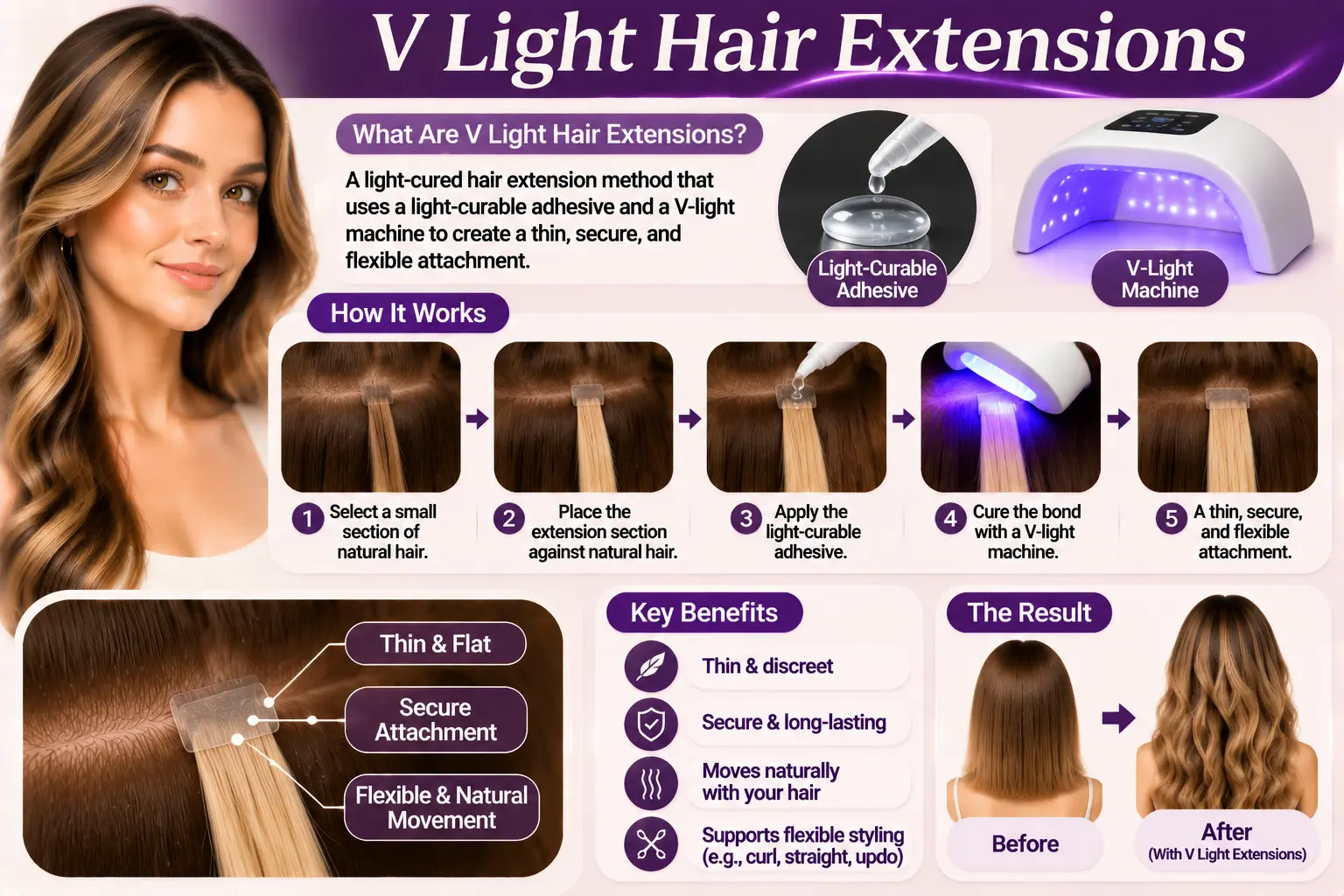
V Light Hair Extensions work by placing a small hair extension section against natural hair, applying a light-curable adhesive, and curing the bond with a V-light machine. The cured attachment is designed to be thin, secure, and flexible enough to move naturally with the client’s own hair.
The basic application process
A typical V-Light service includes several steps. Exact procedures vary by brand, so salons should follow the manufacturer’s instructions and conduct patch or strand testing where appropriate.
-
Consultation and hair assessment
The stylist checks scalp health, density, breakage, oil level, and target coverage area. -
Sectioning
The stylist isolates a small section of natural hair. The section must not be too thin or too heavy. -
Extension placement
A small extension piece is aligned with the natural hair. Placement should avoid excessive tension. -
Adhesive application
V Light glue or resin is applied in a controlled amount. -
Light curing
The V-light machine cures the adhesive. Curing time can vary by system.[^4] -
Finishing and blending
The stylist trims, styles, and checks bond comfort. -
Aftercare instruction
The client receives guidance on washing, brushing, heat styling, and maintenance.
Why light curing matters
The V-light concept is interesting because the adhesive is not only “air dried.” The light helps cure the resin or glue into a more stable attachment.[^5] This is why buyers often evaluate the machine and glue together, not separately.
For B2B buyers, I recommend asking suppliers for:
- Recommended curing time
- Adhesive ingredient documentation
- Safety data sheets when available
- Operating instructions
- Voltage and plug options
- Machine warranty terms
- Packaging and private label options
- Sample kits for salon testing
A V Light system should be evaluated as a service method, not just a hair product.
What buyers should test before ordering in bulk
If I were preparing a wholesale purchase, I would run a small internal trial before placing a large order. The trial should include different hair textures, colors, and lengths because each variation may behave differently.
Here is a practical testing checklist:
| Test Area | What to Check | Why It Matters |
|---|---|---|
| Bond strength | Slipping after washing and brushing | Reduces client complaints |
| Bond flatness | Whether the attachment feels bulky | Supports comfort and invisibility |
| Color blending | Root area and extension match | Improves final salon result |
| Removal | Residue and natural hair stress | Protects client hair |
| Curing consistency | Same result across technicians | Supports salon scalability |
| Packaging | Clear instructions and labeling | Helps retail and training |
At RENAI HAIR, our product development mindset is based on stable quality and repeatable salon results. For V Light Hair Extensions, I would encourage buyers to request samples first and test them under real salon conditions, especially if they plan to sell kits to stylists or beauty supply channels.
Are V Light Hair Extensions Good for Thin Hair?
Thin hair creates a difficult balance. Clients want coverage, but their natural hair may not support heavy attachments. If the method is too bulky, the extension becomes visible. V Light Hair Extensions can be a good option because they are designed for small, lightweight, targeted placement.
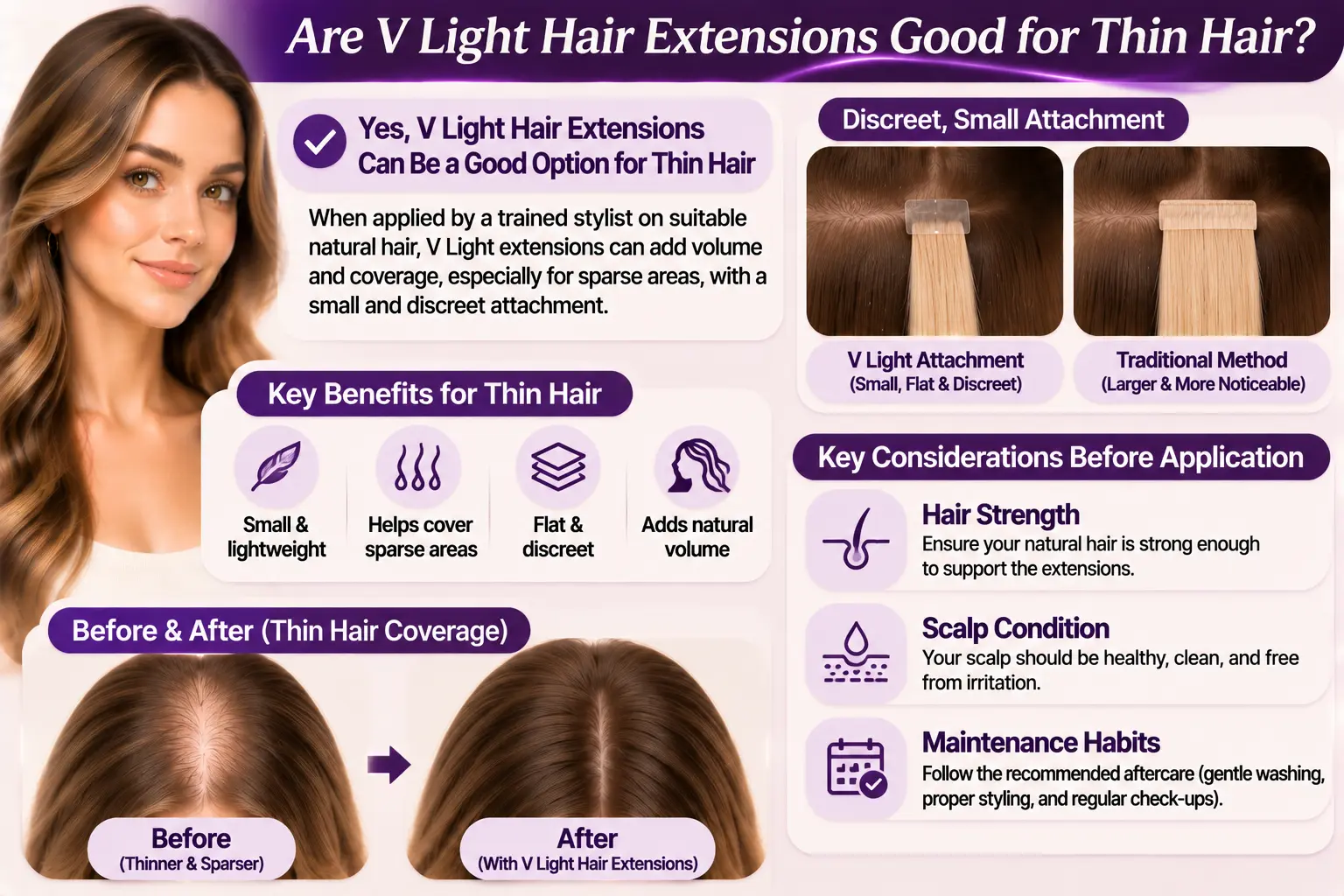
V Light Hair Extensions can be good for thin hair when they are applied by a trained stylist on suitable natural hair. Their small attachment size helps cover sparse areas more discreetly than many traditional methods, but the client’s hair strength, scalp condition, and maintenance habits must be evaluated first.
Benefits for thinning areas
The biggest reason V-Light services attract attention is the ability to work in areas where ordinary extensions may be visible. This includes the sides of the head, front blending zones, and partial thinning areas near the top.
Key benefits include:
-
Lightweight feel
Small attachments can reduce the heavy sensation that some clients feel with larger systems. -
Natural appearance
Fine placement helps the extension blend into natural hair movement. -
Flexible coverage
Stylists can target small gaps instead of applying a full row or large base. -
Comfort for selected clients
When applied correctly, the attachment can feel less bulky than some traditional options. -
Strong social media appeal
Before-and-after results can look dramatic, which helps salons market the service.
However, buyers should stay realistic. TikTok popularity does not replace professional evaluation. The system still depends on technique, hair condition, and correct aftercare.
When V Light may not be suitable
V Light Hair Extensions are not suitable for every thinning hair case. I would be cautious in the following situations:
- Active scalp irritation
- Excessive shedding
- Very weak or breaking natural hair
- Severe alopecia without enough anchor hair
- Clients who cannot follow aftercare
- Clients with strong oil buildup near the scalp
- Untrained technicians applying the system
For more advanced thinning, a hair topper or medical consultation may be more appropriate. For clients with scalp conditions, a qualified professional should assess the situation before any extension service.
Comparing V Light with other thin hair solutions
| Solution | Good For | Less Ideal For |
|---|---|---|
| V Light Hair Extensions | Small sparse areas and invisible detail work | Severe hair loss or very weak anchor hair |
| Tape In Hair | Fast length and volume | Very thin top sections |
| Hair Topper | Larger coverage areas | Clients wanting no base or clip feeling |
| Clip In Hair | Temporary styling | Daily long-term thinning coverage |
| Keratin Bonds | Strand-by-strand flexibility | Clients avoiding heat or firm bonds |
For brand owners, I see V Light as a valuable addition to a product line, especially when paired with Remy human hair, cuticle intact hair, and clear salon training materials. The product can create a premium service category, but only if the quality and education are strong.
How Long Do V Light Hair Extensions Last?
Longevity matters because salons need predictable results. If extensions slip too early, the client loses confidence. If they stay too long without maintenance, the natural hair may tangle. V Light Hair Extensions usually have a service window, and buyers should communicate that window clearly.
V Light Hair Extensions commonly last around 8 to 10 weeks[^6] when properly installed and maintained, although some systems may become easier to remove after about 4 weeks. Actual wear time depends on natural hair condition, adhesive quality, curing process, washing habits, oil exposure, and stylist technique.

Factors that affect wear time
No extension method lasts the same for every client. With V Light Hair Extensions, I would pay attention to these variables:
-
Natural hair strength
Stronger anchor hair can usually support the attachment better. -
Scalp oil level
Oil can reduce adhesive performance over time.[^7] -
Shampoo and conditioner habits
Heavy conditioners near the roots may weaken attachment points. -
Brushing technique
Rough brushing can pull on the bonds. -
Curing quality
Under-curing may cause slipping. Overuse of adhesive may create bulk or residue.[^8] -
Extension weight
Heavy pieces can stress thin natural hair. -
Lifestyle
Swimming, sweating, frequent heat styling, and high humidity may affect wear.[^9]
Maintenance timeline
A practical salon maintenance plan may look like this:
| Time After Application | What to Check |
|---|---|
| First 48 hours | Avoid washing if the system instructions recommend it |
| Week 2 | Check comfort, tangling, and early slipping |
| Week 4 | Inspect bonds and decide whether adjustment is needed |
| Week 6–8 | Plan maintenance or removal |
| Week 8–10 | Remove or reinstall if the natural hair condition allows |
This timeline is only a general guide. The actual schedule should follow the adhesive system instructions and the stylist’s evaluation.
How V Light extensions are removed
Removal is one of the most important parts of quality control. A beautiful application does not matter if removal damages the client’s natural hair.
A common removal process includes:
- Applying a silicone-based oil or suitable remover to the bond area.
- Allowing it to sit for about 10 minutes, depending on the system.
- Gently loosening the tabs or bonds.
- Sliding the extension out without pulling.
- Using a detangling tool and fine-tooth comb carefully.
- Washing and assessing the natural hair.
Some systems may use a heat tool to help remove micro-tape pieces. Salons should follow the product instructions and avoid aggressive pulling.
For wholesale buyers, I suggest testing removal during sampling. Many buyers only test installation, but removal reveals the true quality of the adhesive system. Good wholesale V Light Hair Extensions should support a complete service cycle: application, wear, maintenance, and safe removal.
How Should Buyers Choose Wholesale V Light Hair Extensions?
A salon trend can create fast demand, but fast demand can also bring inconsistent products into the market. Buyers may see similar photos from many suppliers, yet the hair quality, glue stability, and machine reliability can differ greatly. Wholesale V Light Hair Extensions should be evaluated with a structured purchasing checklist.
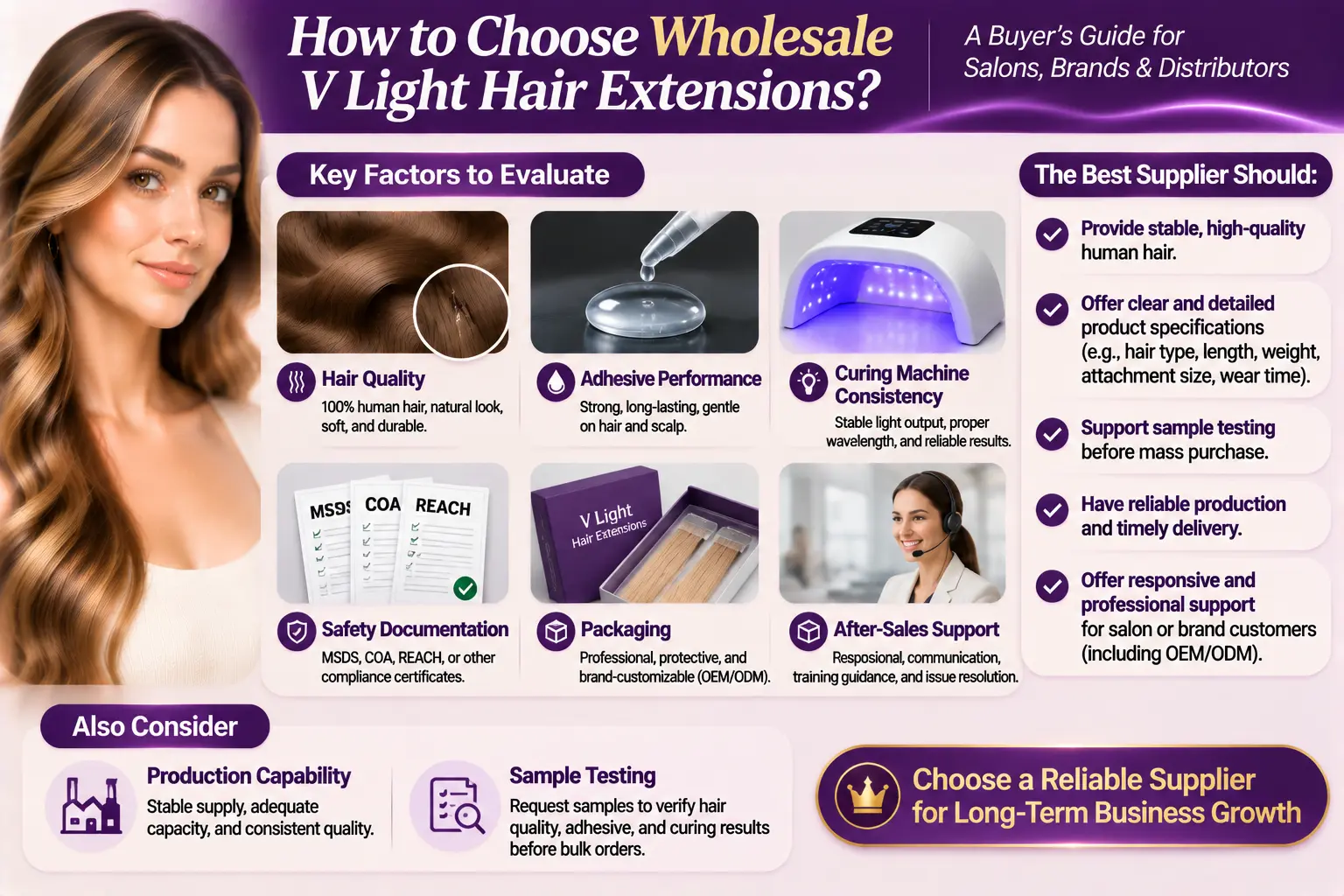
Buyers should choose wholesale V Light Hair Extensions by testing hair quality, adhesive performance, curing machine consistency, safety documentation, packaging, after-sales support, and supplier production capability. The best supplier should provide stable human hair quality, clear specifications, sample testing, and responsive support for salon or brand customers.
Hair quality standards to check
The hair itself still matters most. A good attachment system cannot fix poor hair quality. For premium markets, buyers usually look for:
- 100% human hair
- Remy hair alignment
- Cuticle intact hair when required
- Consistent color matching
- Stable length ratio
- Soft texture after washing
- Minimal shedding and tangling
- Reliable batch consistency
At RENAI HAIR, we focus on human hair extension products such as Genius Weft, Flex Weft, Machine Weft, Hand Tied Weft, Tape In Hair, Keratin Hair, Clip In Hair, Halo Hair, Ponytail, Hair Topper, and related tools. That background matters because V Light products should not be developed in isolation. They should match the quality expectations of a salon’s full extension menu.
Supplier evaluation checklist
Before placing a wholesale order, I would ask a supplier these questions:
-
What hair grades and origins are available?
The answer should be specific enough for procurement comparison. -
Can I receive samples before bulk production?
Samples help test real salon performance. -
What adhesive system is recommended?
Glue quality and curing compatibility affect retention. -
Does the machine have safety documentation?
CE, FCC, or other certifications should be treated as documents buyers verify, not as marketing slogans.[^10] -
Can the supplier support private label packaging?
Brand owners often need customized kits, labels, and instructions. -
What is the quality control process before shipment?
The supplier should inspect color, length, weight, texture, and packaging. -
How does the supplier handle after-sales issues?
Responsive support is important when launching a new salon service.
What a wholesale kit may include
A professional V Light hair extension kit may include:
- V-light curing machine
- V Light glue or resin
- Micro hair extension pieces
- Sectioning tools
- Removal oil or remover
- Comb and clips
- User instructions
- Packaging for retail or salon use
Some suppliers promote fast installation, sometimes around 30 minutes for selected applications. I would treat this as possible for trained professionals and limited coverage areas, not a guaranteed time for every client. Full consultation, sectioning, blending, and aftercare explanation can take longer.
Comparing supplier offers
| Evaluation Point | Strong Supplier Signal | Risk Signal |
|---|---|---|
| Hair quality | Wash-tested, soft, consistent | Good only before washing |
| Glue system | Clear instructions and stable cure | Unknown formula or no guidance |
| Machine | Consistent light output and documents | No warranty or unclear specs |
| QC process | Pre-shipment inspection | Only product photos |
| Support | Fast communication and samples | Slow response after payment |
| Customization | Color, length, packaging options | One-size-only offer |
For long-term B2B customers, I believe the best decision is not the cheapest unit price. It is the supplier who can help you reduce complaints, maintain stable quality, and develop new products as market demand changes.
Frequently Asked Questions
Are V Light Hair Extensions safe?
V Light Hair Extensions can be safe when a trained professional uses a suitable adhesive system, correct curing method, and gentle removal process. Safety also depends on the client’s scalp condition and natural hair strength. Buyers should verify product documents and conduct salon testing before large-scale use.
Can V Light Hair Extensions be used on the top of the head?
Yes, V Light Hair Extensions are often used for top-section blending and thinning areas because the attachments can be small and discreet. However, the stylist must confirm that the client has enough healthy natural hair to support the attachment without tension or visibility.
Do V Light Hair Extensions damage natural hair?
They should not damage natural hair when applied, maintained, and removed correctly. Damage risk increases with poor sectioning, too much adhesive, heavy extension pieces, rough brushing, or aggressive removal.[^11] Professional evaluation and proper aftercare are essential.
What hair quality is best for wholesale V Light Hair Extensions?
For premium salon markets, 100% human hair, Remy hair, and cuticle intact hair are preferred because they offer better softness, movement, and long-term appearance.[^12] Wholesale buyers should wash-test samples and compare color, shedding, tangling, and texture before bulk orders.
How often should clients maintain V Light Hair Extensions?
Many clients need a check around 4 to 6 weeks, with removal or reinstallation often planned around 8 to 10 weeks. The exact schedule depends on the adhesive system, client hair growth, oil level, lifestyle, and stylist recommendation.
Conclusion
V Light Hair Extensions offer salons and hair brands a modern solution for discreet volume, thin hair coverage, and detailed blending. They work best when buyers evaluate the complete system: human hair quality, adhesive, curing machine, removal process, training, and supplier reliability. If you are sourcing wholesale V Light Hair Extensions, I recommend starting with samples and structured salon testing. Contact RENAI HAIR to discuss custom lengths, colors, packaging, and professional product options for your market.
[^1]: "A review of the development of radical photopolymerization ...", https://pubmed.ncbi.nlm.nih.gov/20859059/. Reviews of photopolymerization describe how light-activated resin systems cure through photoinitiators that form polymer networks under suitable irradiation, supporting the general mechanism of a light-cured adhesive; this evidence is mechanistic and does not test V Light hair-extension products directly. Evidence role: mechanism; source type: paper. Supports: Light-curable adhesive systems harden through photoinitiated polymerization or crosslinking under appropriate wavelengths.. Scope note: Contextual support for the adhesive mechanism, not direct validation of a specific V Light system. [^2]: "Keratin Bond Application Tools - 2x", https://lineonehair.com/products/bonds-application-tool?srsltid=AYCX9vL_dvWQ41N9m0uoLbrVwDs-kGrPo80ORrF2fcP1ILGhQ59SV7DC. Cosmetology training materials on fusion hair extensions describe keratin or protein-based bonds being attached with heated tools, which supports the statement that these methods can require heat; the source would not necessarily establish how firm the bonds feel to every client. Evidence role: general_support; source type: education. Supports: Fusion or keratin-bond extension methods commonly use heated tools to soften or attach the bond.. Scope note: Supports the heat-application aspect more directly than the subjective feel of firmness. [^3]: "Guidance on Preparing Workplaces for COVID-19", https://www.osha.gov/sites/default/files/publications/OSHA3990.pdf. Dermatology guidance on traction alopecia identifies extensions and tension-bearing hairstyles as potential contributors to hair loss, supporting the need to assess scalp condition, hair strength, and maintenance practices before application; the guidance is general and not specific to V Light systems. Evidence role: expert_consensus; source type: institution. Supports: Dermatology guidance links extensions and tight hairstyles with traction-related hair damage and emphasizes caution for vulnerable hair or scalp conditions.. Scope note: General dermatology support, not a V Light-specific clinical guideline. [^4]: "Characterization of Photopolymerization of Dentin Adhesives ...", https://pmc.ncbi.nlm.nih.gov/articles/PMC1995012/. Studies of light-cured adhesives report that curing outcomes depend on formulation, wavelength, irradiance, and exposure duration, supporting the statement that curing time can vary by system. Evidence role: mechanism; source type: paper. Supports: Cure rate and degree of conversion in light-cured adhesives depend on resin composition, photoinitiator system, light wavelength, intensity, and exposure time.. [^5]: "Evolution of Dental Resin Adhesives—A Comprehensive ...", https://pmc.ncbi.nlm.nih.gov/articles/PMC11942969/. Polymer science literature on photocurable resins explains that light exposure initiates polymerization or crosslinking, converting reactive resins into more stable solid networks; this supports the curing mechanism but does not prove the retention performance of any hair-extension bond. Evidence role: mechanism; source type: paper. Supports: Light curing can transform liquid or gel resin systems into crosslinked or polymerized solids with greater mechanical stability.. Scope note: Mechanistic support only; product-specific durability would require direct testing. [^6]: "Hair Extensions 101: Everything You Need to Know", https://brownbeautybarberschool.edu/news/hair-extensions-101-everything-you-need-to-know/. Cosmetology education sources commonly advise maintenance or repositioning of semi-permanent hair extensions after several weeks because natural hair growth changes the attachment position, offering contextual support for an 8–10 week service window; this does not directly verify V Light retention across brands. Evidence role: general_support; source type: education. Supports: Professional hair-extension guidance commonly places maintenance or removal in a several-week window as natural hair grows and attachments move away from the scalp.. Scope note: Contextual maintenance support, not independent wear-time testing for V Light systems. [^7]: "Towards Reliable Adhesive Bonding - PMC - NIH", https://pmc.ncbi.nlm.nih.gov/articles/PMC12195023/. Adhesion research shows that oily surface contamination can impair adhesive wetting and lower bond strength, providing mechanistic support for avoiding oil buildup around adhesive attachment points; the evidence is general surface-science evidence rather than a direct trial on hair extensions. Evidence role: mechanism; source type: paper. Supports: Oil contamination can interfere with wetting and bonding, reducing adhesive strength on surfaces.. Scope note: Contextual adhesion evidence, not a study of V Light bonds on human hair. [^8]: "Polymerization Kinetics, Shrinkage Stress, and Bond Strength ...", https://pmc.ncbi.nlm.nih.gov/articles/PMC11734277/. Research on light-cured resin adhesives links insufficient degree of conversion with reduced mechanical properties and residual uncured components, supporting the warning that under-curing can compromise bond performance; the evidence is drawn from resin-adhesive systems generally, not from V Light hair-extension testing. Evidence role: mechanism; source type: paper. Supports: Incomplete curing is associated with poorer mechanical properties and residual uncured material in resin systems.. Scope note: Mechanistic analogy from adhesive and resin literature rather than direct product evidence. [^9]: "Double-Sided Pressure-Sensitive Adhesive Materials under ...", https://pmc.ncbi.nlm.nih.gov/articles/PMC11403543/. Materials research on adhesives and hair fibers shows that moisture, temperature, and humidity can alter bonding behavior and fiber properties, supporting the claim that swimming, sweating, heat styling, and humid conditions may affect wear; the evidence is environmental and mechanistic rather than a direct V Light wear study. Evidence role: mechanism; source type: paper. Supports: Moisture, temperature, and humidity can affect adhesive performance and hair-fiber behavior.. Scope note: Contextual evidence from materials science and hair-fiber research. [^10]: "FCC ID Search | Federal Communications Commission", https://www.fcc.gov/oet/ea/fccid. Official European Commission and FCC materials describe CE marking and equipment authorization as regulatory compliance frameworks supported by conformity documentation or searchable authorization records, supporting the recommendation that buyers verify certification claims. Evidence role: definition; source type: government. Supports: Official regulatory sources define CE marking and FCC authorization as compliance processes with documentation that can be reviewed or verified.. [^11]: "Traction Alopecia: Clinical and Cultural Patterns - PMC", https://pmc.ncbi.nlm.nih.gov/articles/PMC8530059/. Dermatology reviews of traction alopecia identify extensions, tight styling, and sustained mechanical tension as risk factors for hair loss and breakage, supporting the warning that poor application and heavy or rough handling can increase damage risk; the literature addresses extensions broadly rather than V Light systems specifically. Evidence role: mechanism; source type: paper. Supports: Hair extensions and other tension-bearing styles can contribute to traction alopecia or breakage when they impose sustained pulling forces on hair follicles and shafts.. Scope note: Directly relevant to extension-related risk, but not specific to this adhesive method. [^12]: "Systems Approach to Human Hair Fibers: Interdependence ...", https://pmc.ncbi.nlm.nih.gov/articles/PMC6393780/. Hair-fiber studies show that cuticle damage and cuticle-scale orientation influence friction, combing forces, and tangling, supporting the quality rationale for preferring intact and aligned human hair in extensions; the evidence supports the material mechanism rather than verifying any supplier’s Remy labeling. Evidence role: mechanism; source type: paper. Supports: Hair cuticle condition and orientation affect friction, combing behavior, tangling, and perceived smoothness.. Scope note: Supports the hair-fiber quality mechanism, not the authenticity of commercial Remy claims.