Synthetic Vs. Human Hair Clip In Extensions
Human hair clip in extensions can feel confusing when you compare them with synthetic alternatives for the first time. The market offers many colors, lengths, textures, and price points, which can blur the real differences. The simple solution is to evaluate both options by material, styling freedom, durability, appearance, maintenance, and long-term value.
Synthetic clip in extensions are usually cheaper, pre-styled, and easy to wear without daily styling, but they cannot handle heat, chemical processing, or long-term wear as well. Human hair clip in extensions look more natural, can be curled, straightened, colored, and reused longer, making them stronger for premium customers and B2B hair businesses.
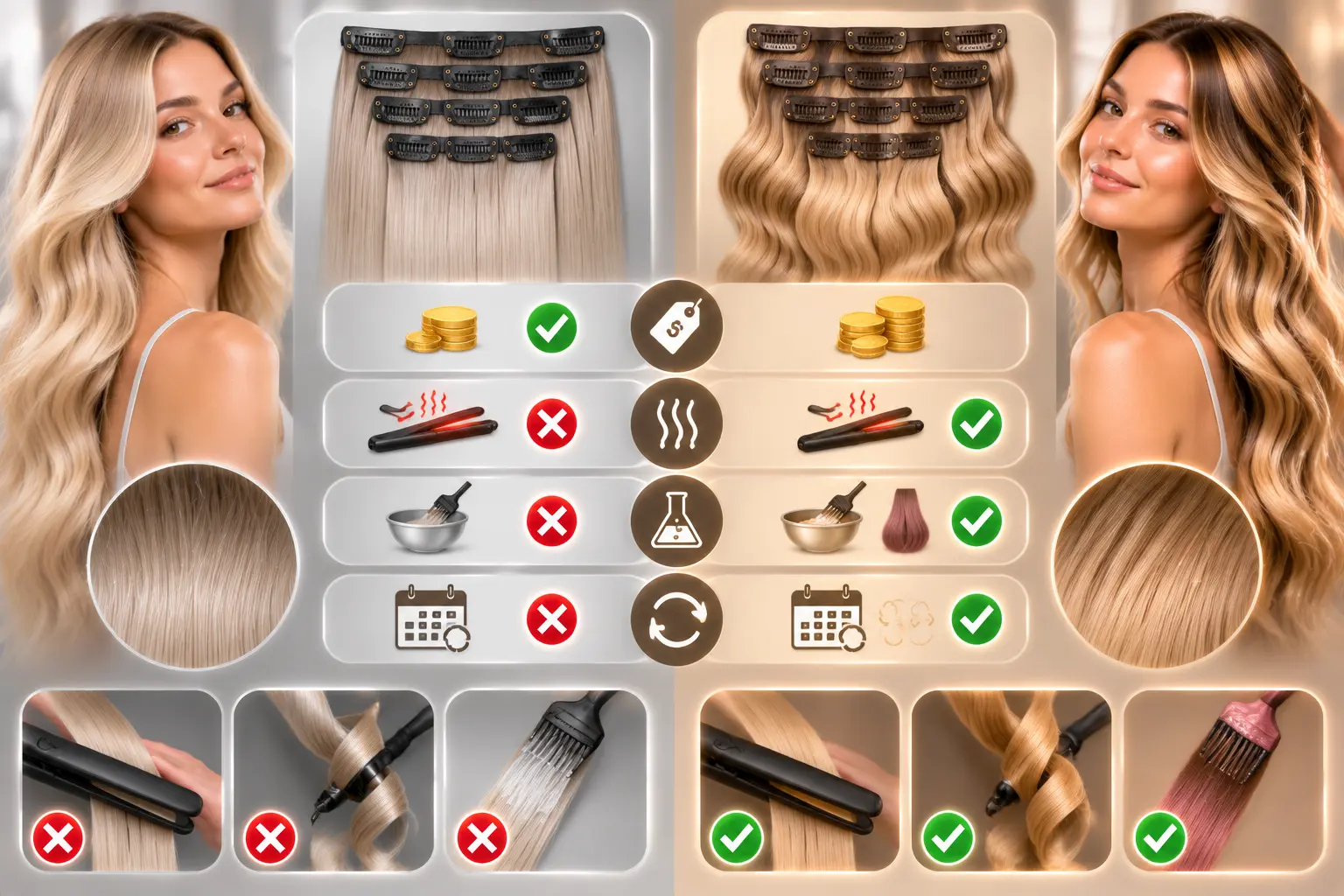
I have seen many buyers start with synthetic hair because the price looks attractive. Then they move to human hair when their customers ask for better movement, better blending, and more styling options. The right choice depends on your buyer profile, retail positioning, and quality expectations.
What Is the Difference Between Synthetic and Human Hair Clip In Extensions?
Choosing between synthetic and human hair clip in extensions can feel overwhelming because both products may look similar in photos. The problem starts when buyers only compare color and price. The risk is that they miss the real differences in fiber behavior, styling limits, and customer satisfaction.
Synthetic clip ins are made from man-made fibers, often plastic-based materials designed to imitate hair. Human hair clip in extensions are made from real human hair, so they behave more like natural hair. The key difference is performance: human hair offers more realism, styling flexibility, and longevity, while synthetic hair offers lower cost and fixed styling.
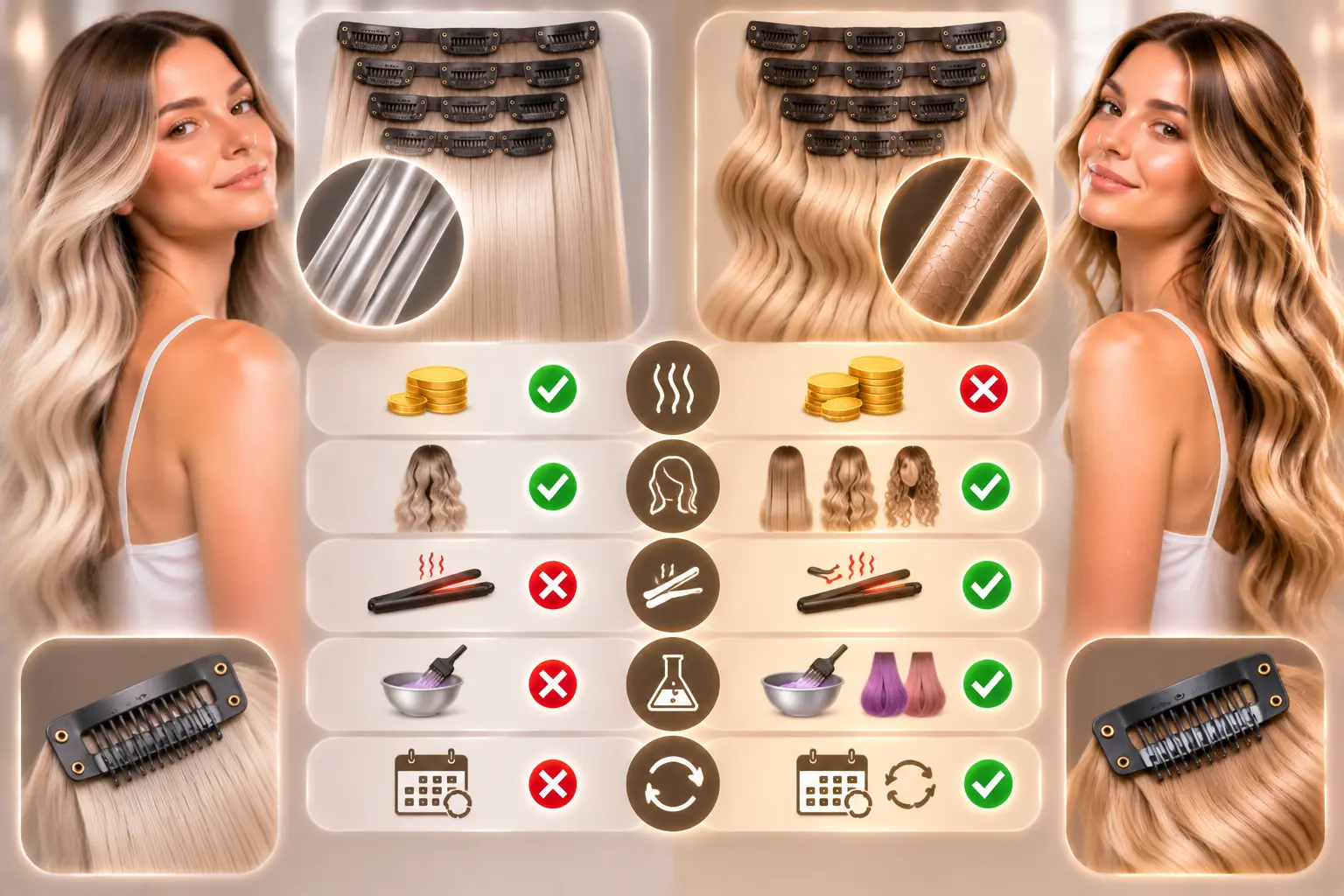
Synthetic hair is made to imitate human hair
Synthetic hair extensions are usually made from fibers such as acrylic, polyester, PVC, or other plastic-based materials[^1]. Manufacturers process these fibers into strands that copy the appearance of natural hair. The result can look neat, shiny, and consistent, especially when the product is new.
However, synthetic hair does not have a natural cuticle[^2]. It does not absorb moisture, color, or styling products in the same way as real hair. This matters because buyers often expect extensions to behave like their own hair once they wear them.
Synthetic hair can be useful when the customer wants:
- A low-cost fashion accessory
- A fixed curl or wave pattern
- Occasional wear for parties or events
- A product that requires little styling time
- A bold color that may not need to look completely natural
In my experience, synthetic clip ins work best for short-term use or trend-driven retail collections. They are less suitable for premium salons or brands that promise realistic blending.
Human hair behaves more like the client’s own hair
Human hair clip in extensions are made from collected human hair. Premium options may use Remy hair, where the cuticles are aligned in the same direction, or cuticle intact hair, where the outer cuticle layer is preserved as much as possible. Buyers should verify these claims through supplier documentation, samples, and quality inspection rather than relying only on marketing terms.
Here is a simple comparison:
| Factor | Synthetic Clip In Extensions | Human Hair Clip In Extensions |
|---|---|---|
| Material | Man-made fiber | Real human hair |
| Appearance | Can look shiny or artificial | More natural movement and texture |
| Heat styling | Usually not recommended | Usually possible with proper care |
| Coloring | Very limited | Possible, depending on hair quality |
| Lifespan | Shorter | Longer with proper care |
| Price | Lower | Higher |
| Best for | Occasional wear, budget buyers | Premium retail, salons, repeat customers |
For B2B buyers, this difference affects more than product description. It affects return rates, customer reviews, reorder potential, and brand positioning.
If your customers expect salon-level results, human hair clip in extensions usually create fewer compromises.
How Do Synthetic and Human Hair Clip In Extensions Perform in Daily Wear?
Daily performance is where many buyers notice the biggest difference. A product may look good on a mannequin, but real customers care about comfort, blending, shine, tangling, and movement. If the hair does not perform well during normal use, the low purchase price can become expensive through complaints and returns.
Synthetic clip ins can hold a preset style well, especially in controlled conditions. Human hair clip in extensions usually perform better when customers want a natural look, flexible styling, and realistic movement. Synthetic hair may resist humidity better in some cases, but human hair blends more naturally and can be refreshed with proper care.
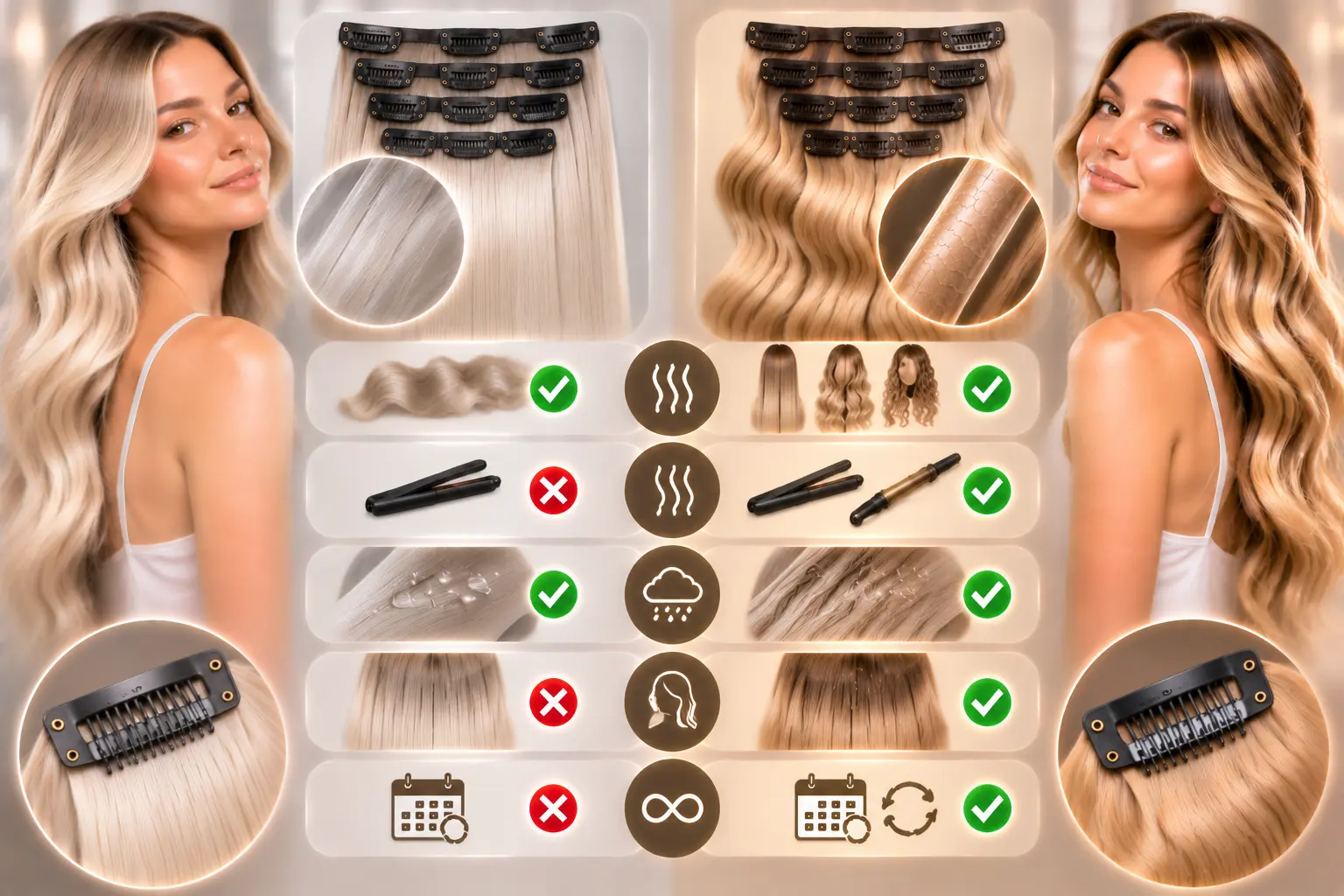
Weather and climate matter
Synthetic extensions often keep their original shape. If the product is manufactured with waves or curls, the style tends to stay fixed. This can be helpful for customers who do not want to spend time styling their extensions.
In warm or humid weather, synthetic fibers may not frizz in the same way as natural hair[^3]. That sounds like an advantage, but it also means the hair may not blend perfectly with the customer’s own hair if the natural hair reacts to humidity.
Human hair clip in extensions behave more like real hair because they are real hair. They can become dry, frizzy, or wavy depending on humidity, storage, and care routine. This is not always a defect. It is a natural material response. However, premium buyers usually accept this because they also get better movement, texture, and styling control.
Movement and shine affect realism
One of the first things I check when evaluating clip ins is movement. Good extensions should fall naturally, swing softly, and blend with the wearer’s own hair. Excessive shine can make synthetic pieces look artificial under sunlight or salon lighting.
Important performance points include:
-
Shine level
Synthetic hair can look overly glossy. Human hair usually has a softer, more natural shine[^4]. -
Touch and softness
Human hair generally feels more natural between the fingers. Synthetic fibers may feel smooth but less realistic. -
Tangle resistance
Both types can tangle. However, lower-grade synthetic hair may mat faster, especially at the nape area. -
Blend with natural hair
Human hair clip in extensions usually blend better because they can be heat-styled with the client’s own hair. -
Longevity during repeated use
Human hair often lasts longer when customers wash, dry, store, and style it correctly.
Daily wear comparison for buyers
| Daily Wear Factor | Synthetic Hair | Human Hair |
|---|---|---|
| Holds original style | Strong | Moderate to strong, depending on care |
| Natural blending | Moderate | Strong |
| Heat and humidity response | Style stays fixed, but may look separate | Reacts like natural hair |
| Reusability | Limited | Better long-term reuse |
| Customer maintenance | Low styling, careful handling | More care, more styling freedom |
For a beauty supply store, synthetic clip ins may serve entry-level buyers. For a salon, stylist, or premium hair extension brand, human hair clip in extensions usually provide a better customer experience.
Can You Style and Color Human Hair Clip In Extensions More Easily?
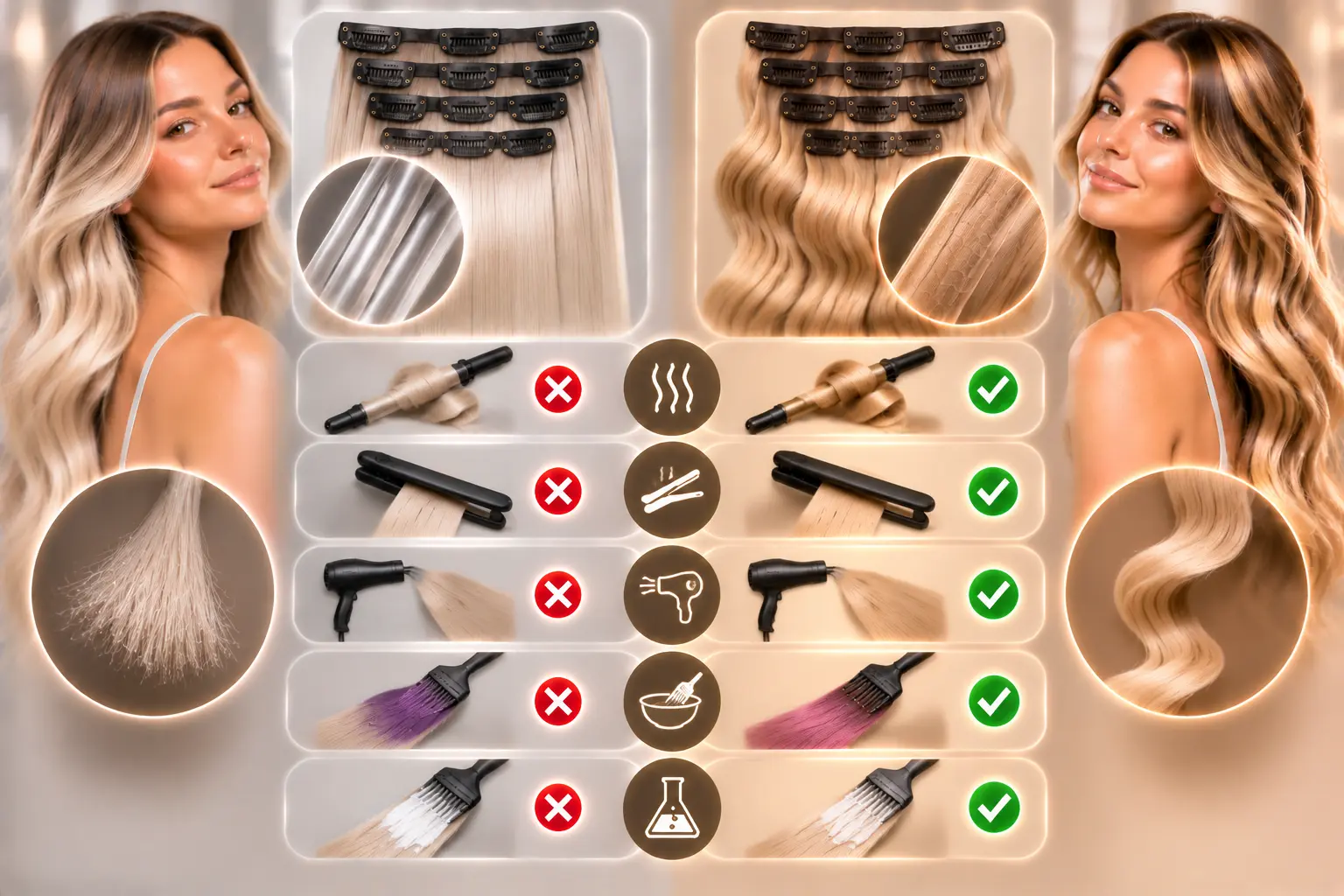
Styling is a major reason customers choose one type over the other. The problem is that many new buyers assume all extensions can be curled, straightened, washed, dyed, or toned. That assumption can damage the product and cause disappointment, especially with synthetic fibers.
Human hair clip in extensions are easier to style and color because they tolerate heat and chemical services better than synthetic hair. Synthetic extensions are usually not suitable for curling irons, straighteners, blow dryers, bleach, or permanent dye unless the supplier clearly states that the fiber is heat-resistant or color-safe.
Heat styling is the biggest difference
Synthetic hair is made from plastic-like fibers. High heat can burn, melt, shrink, or permanently deform the strands[^5]. Some synthetic products are labeled as heat-resistant, but buyers should still check the safe temperature range. Many heat-resistant fibers only tolerate limited heat, often lower than common salon styling tools.
Human hair clip in extensions can usually be:
- Straightened
- Curled
- Blow-dried
- Braided
- Waved
- Restyled after washing
- Blended with the wearer’s natural hair
That said, human hair is not indestructible. Excessive heat can still cause dryness, split ends, rough texture, and reduced lifespan. I usually recommend that brands educate customers to use a heat protectant and keep tool temperatures moderate.
A practical guidance range for many human hair extensions is:
| Styling Tool | Safer Practice |
|---|---|
| Flat iron | Use moderate heat and fewer passes |
| Curling iron | Avoid holding heat too long |
| Blow dryer | Use low to medium heat when possible |
| Hot brush | Test on a small section first |
| Heat protectant | Recommended before styling |
Coloring and chemical processing require caution
Human hair can often be dyed darker, toned, or professionally colored. However, bleaching is more stressful. If hair has already been processed during manufacturing, additional chemical work can reduce quality.
For B2B buyers, I recommend setting clear product expectations:
- Virgin hair may allow more color flexibility, but buyers should verify the claim.
- Remy hair focuses on cuticle direction, not automatic bleach resistance.
- Pre-colored hair may not lift evenly.
- Light blond shades have usually gone through stronger processing.
- Chemical treatments can void warranties if the supplier’s care policy says so.
Synthetic hair does not accept regular hair dye well. Since the fiber is not porous like human hair, color molecules do not penetrate in the same way[^6]. Some users try fabric dye, color spray, or diluted colored shampoo, but results can be uneven and temporary.
Why styling flexibility matters for B2B sales
Styling freedom increases the product’s retail value. Customers may buy one set of human hair clip in extensions and use it for many looks. A stylist can blend the extensions into a haircut, curl pattern, or event style.
For businesses, this can support:
- Higher retail pricing
- Better before-and-after content
- Salon upselling
- Bridal and event styling packages
- Repeat purchases in multiple lengths and colors
- Stronger brand reviews
In my work with hair extension buyers, I find that styling flexibility often separates basic products from premium collections. If your customers care about natural finish and creative control, human hair clip in extensions are usually the stronger option.
Which Clip In Extensions Offer Better Value for B2B Buyers?
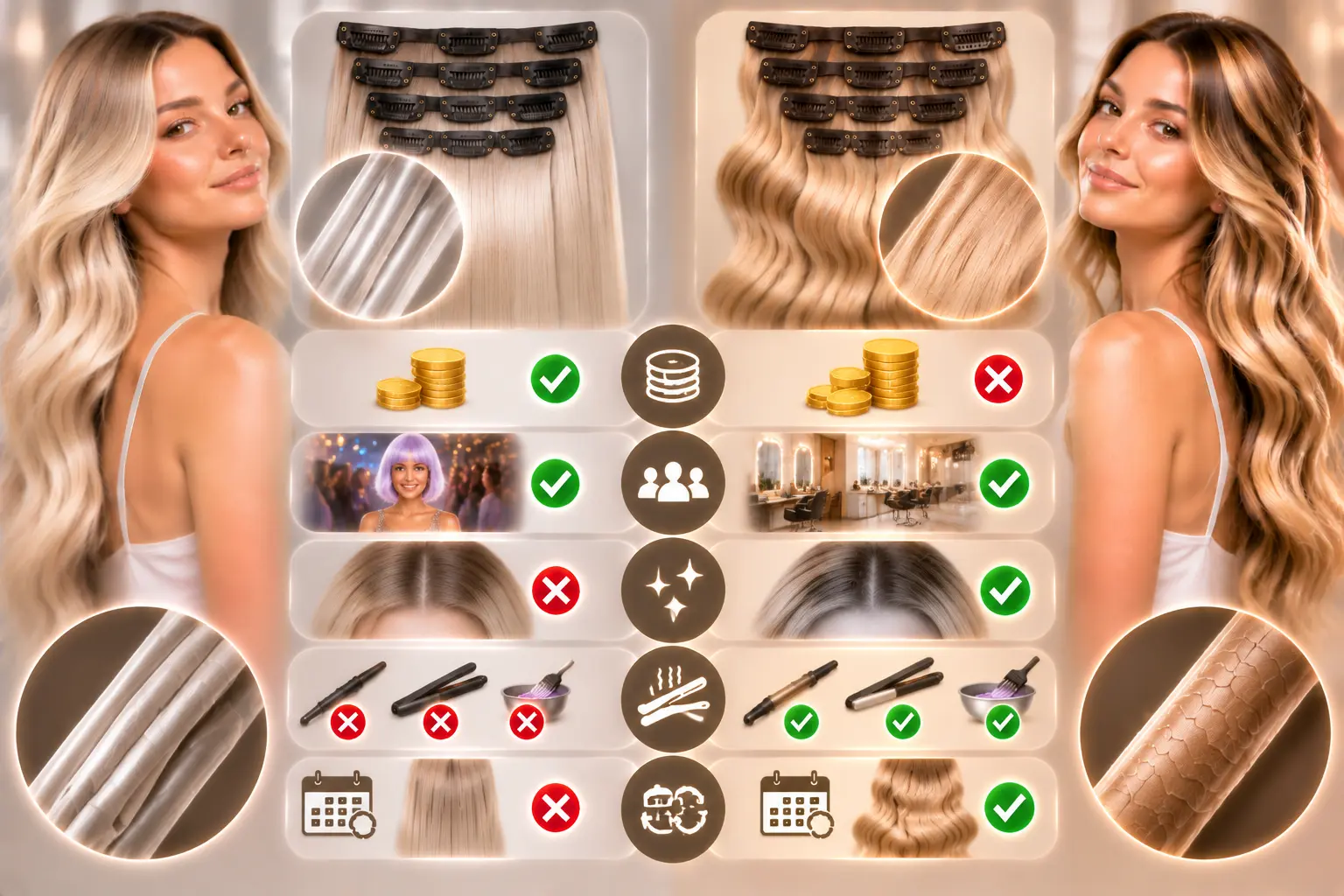
Price can easily dominate the buying decision. The problem is that the cheapest product is not always the best value. A low-cost item can become expensive if it causes complaints, low repeat orders, or weak reviews[^7]. For B2B buyers, value should include margin, lifespan, customer profile, and brand positioning.
Synthetic clip ins offer better upfront affordability, while human hair clip in extensions usually offer better long-term value for premium brands, salons, and repeat-purchase channels. If the target customer wants occasional fashion wear, synthetic may work. If the customer wants natural blending, styling freedom, and durability, human hair is usually worth the higher price.
Initial cost versus total value
Synthetic hair costs less because man-made fibers are easier to produce at scale. The manufacturing process does not require collecting, sorting, aligning, and processing real human hair. This makes synthetic products attractive for budget retail and fast-changing fashion colors.
Human hair costs more because the raw material is more limited. Quality control also takes more effort[^8]. Manufacturers need to consider length ratio, color consistency, shedding control, weft construction, clips, washing performance, and packaging.
For B2B buyers, the better question is not only “What is the unit price?” The better question is:
“What product will satisfy my customer and protect my brand reputation?”
B2B value comparison
| Buyer Type | Better Fit | Reason |
|---|---|---|
| Budget fashion retailer | Synthetic | Lower price, trend colors, occasional wear |
| Beauty supply store | Both | Can serve entry-level and premium customers |
| Hair salon | Human hair | Better styling and blending |
| Hair extension brand | Human hair | Stronger quality positioning |
| Bridal stylist | Human hair | Better heat styling and natural finish |
| Online beginner store | Depends | Synthetic for price; human hair for reviews and repeat sales |
Product lifespan changes the value equation
Synthetic extensions may cost less, but they often have a shorter usable life. They can lose softness, tangle, or look artificial after repeated wear. Human hair clip in extensions can last longer when customers care for them correctly.
A simple customer care routine can include:
- Detangle before and after wear.
- Wash only when needed.
- Use sulfate-free shampoo when appropriate.
- Apply conditioner to mid-lengths and ends.
- Air dry when possible.
- Store flat or in a satin bag.
- Avoid sleeping or swimming with clip ins.
When brands sell human hair, they should include care instructions. This reduces avoidable damage and helps customers get better results.
Margin and positioning matter
A synthetic product may allow a lower retail price, but it can limit brand perception. A human hair product may require a higher investment, but it can support premium packaging, salon education, influencer content, and stronger customer loyalty.
For example, a brand may create:
- A basic synthetic line for entry-level customers
- A premium human hair clip in extensions line for repeat buyers
- A professional salon line with Remy or cuticle intact hair
- A color ring and sample program for wholesale clients
At RENAI HAIR, we focus on B2B supply, so I always think about how the product will perform after it leaves the factory. Stable quality, consistent colors, and strict outgoing inspection matter because buyers need products that support their long-term business, not only a one-time sale.
How Should Buyers Evaluate a Human Hair Clip In Extensions Supplier?
Supplier selection can be the hardest part of the buying process. Many suppliers use similar words, such as “100% human hair,” “Remy,” “double drawn,” or “premium quality.” The risk is that buyers may accept these claims without checking samples, documentation, production ability, and quality control standards.
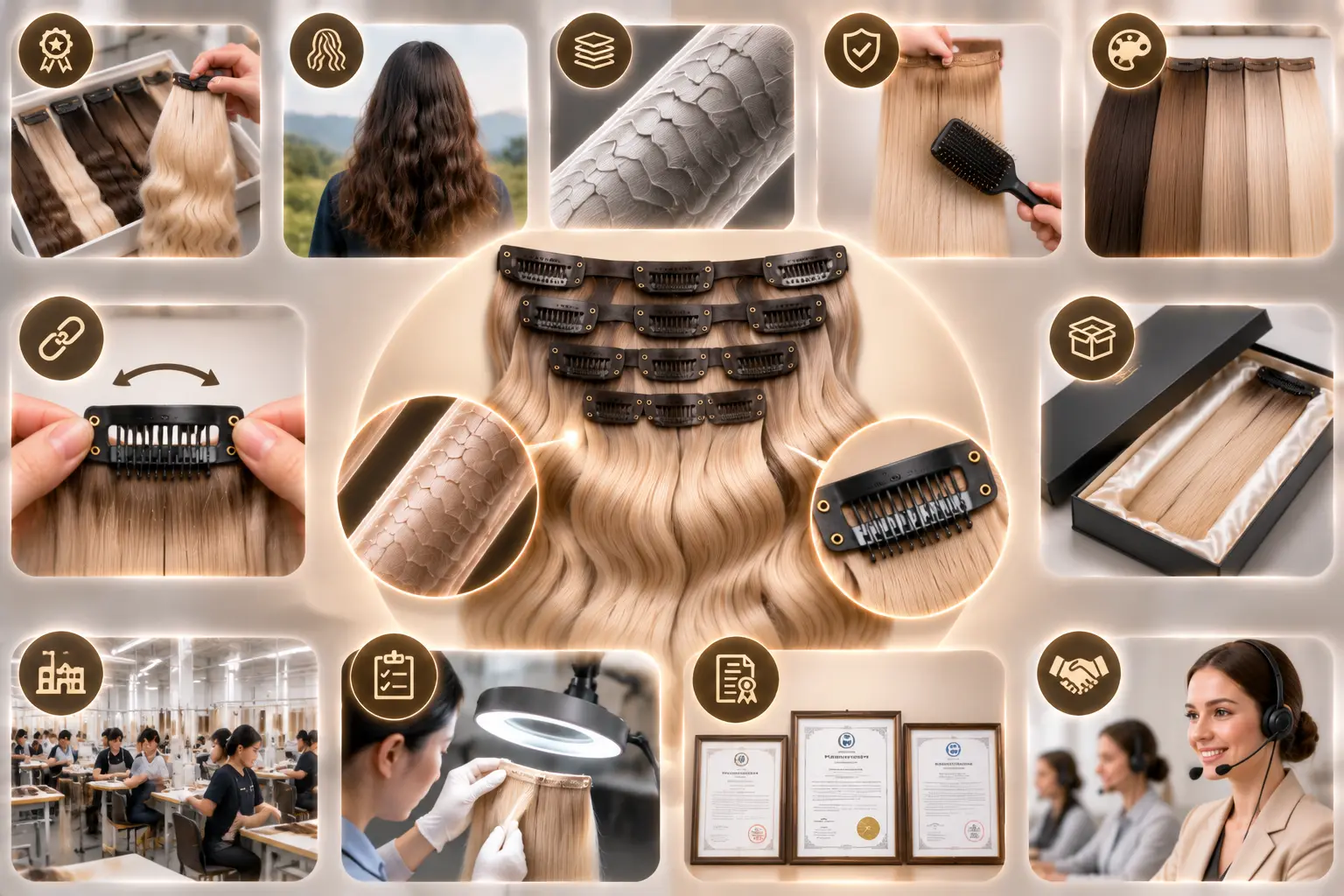
Buyers should evaluate a human hair clip in extensions supplier by checking sample quality, hair source claims, cuticle alignment, shedding control, color consistency, clip strength, packaging, production capacity, inspection process, and after-sales support. Certifications and quality claims should be treated as documents to verify, not assumptions to accept.
Start with samples before bulk orders
A product photo cannot show everything. I always recommend sample testing before a larger purchase. A good sample review should check both appearance and performance.
Sample inspection points include:
- Hair softness before and after washing
- Shedding when gently combed
- Tangling after air drying
- Color match under natural and indoor light
- Weft stitching quality
- Clip comfort and grip
- Thickness from top to ends
- Odor after unpacking
- Packaging protection during shipping
Buyers should also test the hair after one or two washes. Some low-quality products look smooth at first because of heavy coating. After washing, the coating may fade and reveal dryness, tangling, or uneven processing.
Ask the right supplier questions
A qualified supplier should answer practical questions clearly. Vague answers can be a warning sign.
Useful questions include:
- What hair grades or qualities do you offer?
- Do you supply Remy hair or cuticle intact hair?
- How do you inspect shedding and tangling before shipment?
- Can you make private label packaging?
- What lengths, colors, and weights are available?
- Can you match custom colors?
- What is the minimum order quantity?
- How do you handle quality issues after delivery?
- Can you support repeat orders with consistent color and texture?
- What documents or certifications can you provide for verification?
These questions help buyers move beyond price. They also reveal whether the supplier understands professional B2B requirements.
Compare product specifications carefully
Human hair clip in extensions can vary by weight, length, construction, and set design. A lower price may simply mean less hair per set.
| Specification | Why It Matters |
|---|---|
| Length | Longer hair costs more and needs stronger quality control |
| Weight per set | Affects fullness and retail value |
| Number of pieces | Affects placement and blending |
| Weft type | Influences comfort, durability, and appearance |
| Clip quality | Affects grip and customer comfort |
| Hair ratio | Determines fullness from top to ends |
| Color process | Affects softness and consistency |
| Packaging | Supports brand presentation and shipping protection |
Look for manufacturing and service capability
For B2B buyers, a supplier is not only a product source. The supplier is part of the customer experience. Stable production, product development, and communication can make a major difference.
At RENAI HAIR, our business focuses on 100% Human Hair, Remy Hair, and Cuticle Intact Hair products for global B2B clients. We manufacture and supply products such as Genius Weft, Flex Weft, Machine Weft, Hand Tied Weft, Tape In Hair, Keratin Hair, Clip In Hair, Halo Hair, Ponytail, and Hair Topper products. I mention this because supplier range matters when a buyer wants to build a complete product line.
A strong supplier should support:
- Consistent reorder quality
- New product development
- Multiple colors and lengths
- Private label options
- Professional sales communication
- Clear quality standards
- Care guidance for customers
- Practical after-sales support
When buyers choose a supplier, they should also consider whether professional evaluation is needed for special applications. For example, if a salon plans to color, bleach, or heat-style extensions heavily, it should test the product first and make application-specific decisions with qualified stylists.
Frequently Asked Questions
Are synthetic clip in extensions better than human hair clip in extensions?
Synthetic clip ins are better for low-cost, occasional wear and fixed styles. Human hair clip in extensions are better for natural blending, heat styling, coloring, and longer-term use. The better choice depends on the customer’s budget, styling needs, and quality expectations.
Can I curl or straighten synthetic clip in hair extensions?
Most synthetic clip in hair extensions should not be curled or straightened with regular heat tools because the fibers can melt or burn. Some heat-resistant synthetic hair allows limited styling, but buyers should always check the supplier’s temperature guidance before using heat.
How long do human hair clip in extensions last?
Human hair clip in extensions can last several months or longer with proper care[^9], depending on hair quality, frequency of use, styling habits, and maintenance. Gentle washing, careful detangling, moderate heat, and correct storage can help extend the usable life.
Can human hair clip in extensions be dyed?
Many human hair clip in extensions can be dyed or toned, but results depend on the original hair quality and previous processing. Darkening is usually easier than bleaching. Buyers should test a small section first and use a qualified color professional for important applications.
What should wholesale buyers check before ordering clip in extensions?
Wholesale buyers should check sample quality, weight, length, hair ratio, clip strength, shedding, tangling, color consistency, packaging, supplier capacity, and after-sales policy. They should also verify claims such as Remy hair or cuticle intact hair through samples and supplier documentation.
Conclusion
Synthetic and human hair clip in extensions serve different buyers. Synthetic options are affordable, pre-styled, and simple for occasional use. Human hair clip in extensions offer a more natural look, better styling freedom, and stronger long-term value for salons, brands, wholesalers, and premium retailers. If you are building or expanding a professional hair extension line, I recommend starting with samples, testing performance, and choosing a supplier with stable quality control. Contact RENAI HAIR to discuss custom clip in hair extension options for your market.
[^1]: "Artificial hair integrations", https://en.wikipedia.org/wiki/Artificial_hair_integrations. Synthetic hair fibers used in extensions and wigs are predominantly derived from thermoplastic polymers such as acrylic, polyester, and polyvinyl chloride (PVC), engineered to mimic the visual properties of natural hair. Evidence role: definition; source type: research. Supports: That synthetic hair extensions are commonly manufactured from plastic-based polymer fibers including acrylic, polyester, and PVC. Scope note: Specific fiber composition may vary by manufacturer and product line; a general materials science or textile source may not address hair extension products directly. [^2]: "The structure of people's hair - PMC - NIH", https://pmc.ncbi.nlm.nih.gov/articles/PMC4201279/. Human hair is characterized by a cuticle layer consisting of overlapping keratinized scales that regulate moisture exchange and protect the cortex, a structure not replicated in synthetic polymer fibers. Evidence role: definition; source type: encyclopedia. Supports: That natural human hair possesses a cuticle layer composed of overlapping scales, a structural feature absent in synthetic polymer fibers. Scope note: Sources describing human hair anatomy do not directly compare cuticle function to synthetic extension fibers; the distinction is implied rather than experimentally demonstrated in most general references. [^3]: "The kinetics of moisture sorption by hair", https://pubmed.ncbi.nlm.nih.gov/39528912/. Human hair is a hygroscopic material; its keratin protein structure absorbs atmospheric moisture, causing swelling of the cortex and changes in fiber geometry that manifest as frizz or curl alteration in humid conditions, a response not exhibited by hydrophobic synthetic polymer fibers. Evidence role: mechanism; source type: research. Supports: That human hair is hygroscopic and undergoes structural changes in response to ambient humidity, a property not shared by synthetic polymer fibers. Scope note: Research on hair hygroscopicity typically addresses natural hair in isolation; comparative studies specifically examining synthetic extension fibers under equivalent humidity conditions are less commonly published. [^4]: "Analyzing the laser-light reflection from human hair fibers. I. ...", https://pubmed.ncbi.nlm.nih.gov/12858229/. Studies on hair fiber optics indicate that the cuticle scale microstructure of human hair produces a diffuse reflectance pattern, whereas smooth-surfaced synthetic polymer fibers tend toward higher specular gloss under equivalent lighting conditions. Evidence role: mechanism; source type: research. Supports: That synthetic polymer fibers tend to exhibit higher specular reflectance than human hair due to differences in surface microstructure. Scope note: Published optical studies typically focus on natural hair or textile fibers independently; direct comparative measurements of commercial hair extension products are less commonly reported in peer-reviewed literature. [^5]: "Effects of Thermoforming Parameters on Woven Carbon Fiber ...", https://pmc.ncbi.nlm.nih.gov/articles/PMC11355111/. Thermoplastic polymers commonly used in synthetic hair fibers, including acrylic and polyester, have glass transition and melting temperatures that fall within or below the operating range of standard hair styling tools (150–230°C), making them vulnerable to permanent deformation under direct heat application. Evidence role: mechanism; source type: research. Supports: That thermoplastic fibers such as acrylic and polyester used in synthetic hair products are susceptible to deformation, melting, or degradation when exposed to temperatures typical of hair styling tools. Scope note: Exact thermal thresholds vary by specific polymer formulation and product construction; general polymer data may not reflect the precise behavior of proprietary synthetic hair fiber blends. [^6]: "True porosity measurement of hair: a new way to study ...", https://pubmed.ncbi.nlm.nih.gov/18818850/. Oxidative hair colorants function by diffusing through the swollen cuticle into the cortex of human hair, where they undergo polymerization to form larger color molecules; this mechanism is not replicable in synthetic polymer fibers, which lack comparable porosity and chemical reactivity. Evidence role: mechanism; source type: research. Supports: That conventional oxidative hair dyes penetrate human hair via the porous cuticle and cortex, a pathway unavailable in non-porous synthetic polymer fibers. Scope note: Research on hair dye chemistry focuses on human hair; the specific dye resistance of commercial synthetic hair extension fibers is less frequently studied in peer-reviewed sources. [^7]: "The True Cost of Poor Customer Service to Your Business", https://www.midlandstech.edu/news/true-cost-poor-customer-service-your-business. Research in consumer behavior and retail economics consistently demonstrates that product quality failures generate costs beyond the initial transaction, including return processing, negative word-of-mouth, and reduced repeat purchase rates, which can collectively exceed the savings achieved through lower unit pricing. Evidence role: general_support; source type: research. Supports: That product quality deficiencies generate downstream business costs including returns, negative reviews, and reduced customer retention that can exceed initial savings from lower unit costs. Scope note: General consumer behavior research may not be specific to the hair extension market; the magnitude of these effects varies by product category, customer segment, and retail channel. [^8]: "Evolution of structural characteristics and its determinants ...", https://www.sciencedirect.com/science/article/abs/pii/S0921344923004391. The global human hair trade involves collection, sorting, and processing of a finite biological material, with supply concentrated in specific geographic regions; the labor-intensive nature of collection and quality grading contributes to higher raw material costs compared to synthetic polymer fibers produced through scalable industrial manufacturing. Evidence role: general_support; source type: institution. Supports: That human hair is a finite biological raw material subject to supply constraints and labor-intensive collection and processing, contributing to higher costs relative to industrially produced synthetic fibers. Scope note: Comprehensive, independently verified market data on global human hair supply volumes and pricing is limited; available figures often derive from trade association estimates or industry reports rather than peer-reviewed economic studies. [^9]: "How Long Are Hair Extensions Supposed to Last", https://journal.lspr.edu/public/journals/5/submission_1157_1072_coverImage_en.html?bnb=0EJMmH. Consumer and industry assessments of human hair extension durability generally indicate a usable lifespan ranging from several months to over a year, contingent on factors including hair quality, frequency of use, heat exposure, and adherence to recommended care protocols. Evidence role: general_support; source type: research. Supports: That human hair extensions, when properly maintained, retain acceptable quality for a period of several months under regular use conditions. Scope note: Standardized lifespan testing for hair extensions is not widely published in peer-reviewed literature; available estimates are largely derived from industry guidelines and consumer experience rather than controlled experimental studies.