5 REASONS WHY YOU NEED THE Hair PONYTAIL
Struggling to add length and volume to your ponytail without spending hours in the salon? A limp, flat ponytail can drain your confidence fast — especially when you want a polished, camera-ready look in minutes. The Hair Ponytail extension solves that problem instantly, delivering dreamy length and texture with zero fuss.
The Hair Ponytail extension is a clip-in hairpiece designed to wrap around your existing ponytail, adding instant length, volume, and texture in minutes. With built-in clips, combs, and a drawstring, it fits securely on all hair types and lengths. It delivers a natural, undetectable finish — making it one of the easiest and most versatile hair extension styles available today.
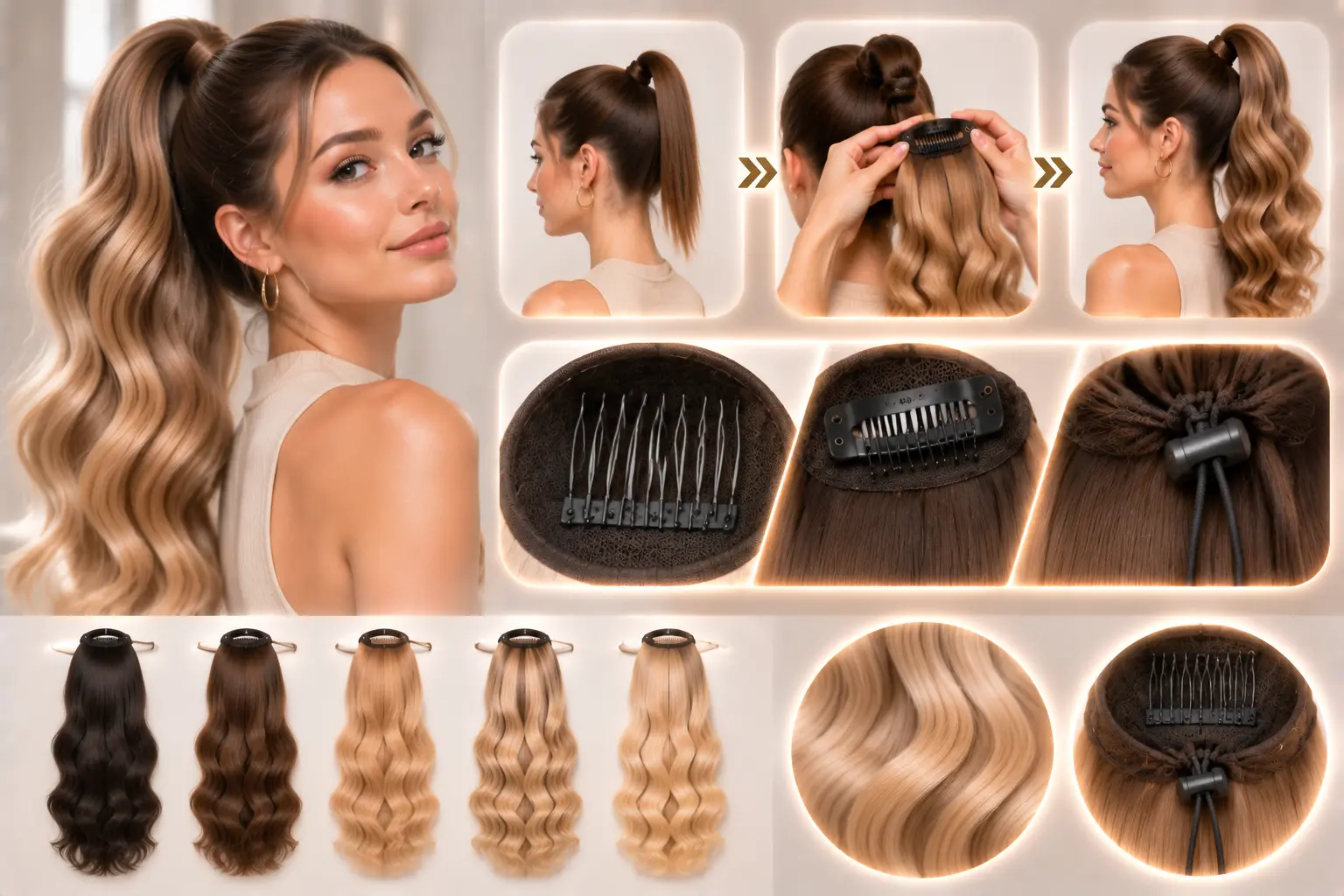
The Hair Ponytail has been a firm favourite since its launch more than five years ago[^1]. But what exactly makes it so popular? Below, I break down the five key reasons buyers, stylists, and everyday wearers keep coming back to this piece.
Is the Hair Ponytail Extension Really Easy to Apply?
Most people give up on hair extensions the moment application feels complicated. Tangled clips, uneven placement, and wasted time in front of the mirror kill confidence before you even step out the door. You deserve a solution that works — fast.
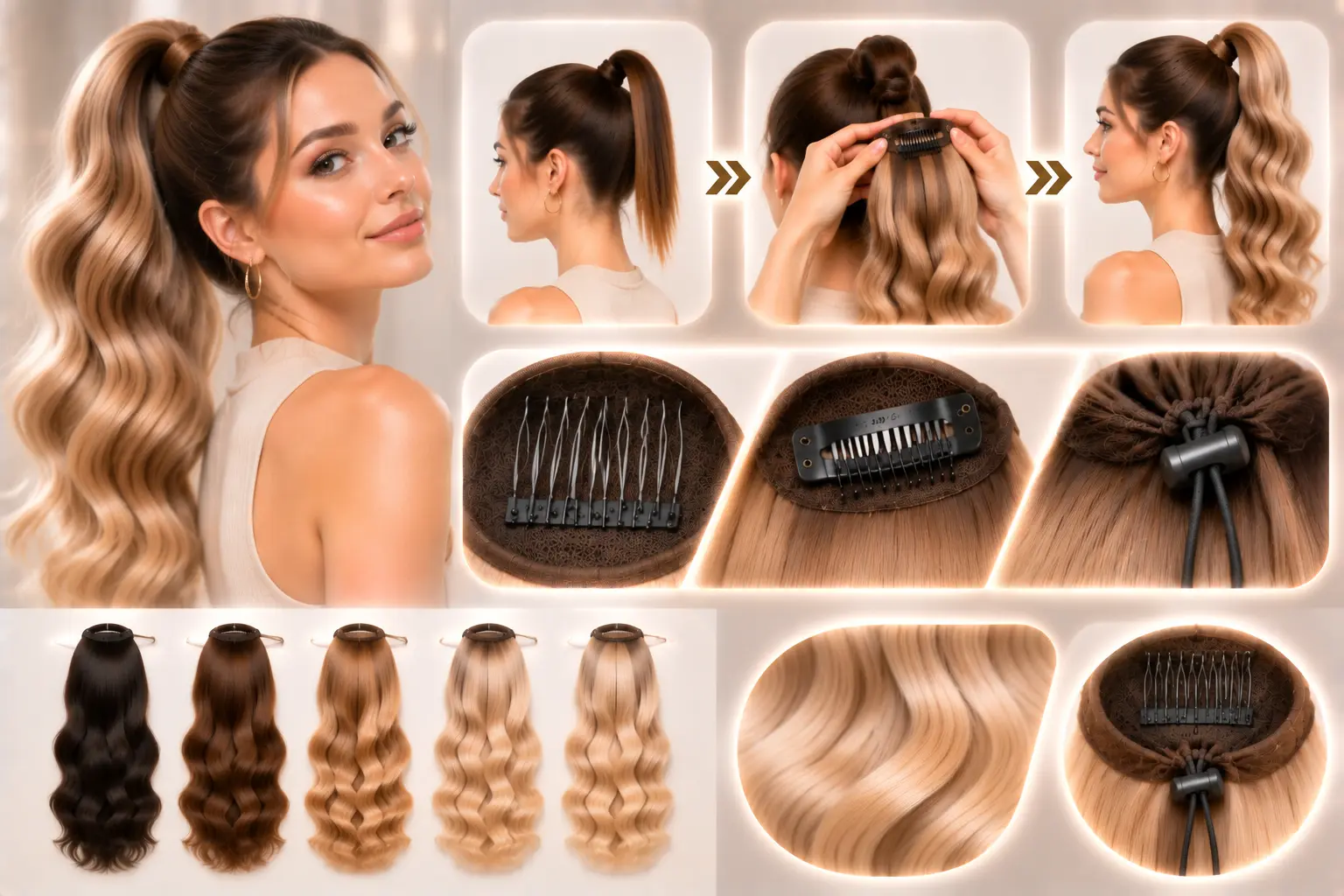
The Hair Ponytail is one of the most beginner-friendly extensions on the market. Built-in clips, combs, and a drawstring work together to create a secure, comfortable fit in minutes. No professional tools, no salon appointments, no experience required.
What Makes the Application System Work So Well?
The three-component attachment system is what sets this ponytail apart from simpler, single-clip alternatives. Each element plays a specific role:
- Clips anchor the piece to your natural hair quickly and firmly.
- Combs grip the hair from underneath, distributing weight evenly across the base.
- Drawstring allows you to tighten or loosen the fit for a custom, comfortable hold.
Together, these three components eliminate the two most common complaints about clip-in ponytails: slipping and pulling.
Who Benefits Most From This Design?
I find this system particularly valuable for customers who are new to extensions. There is no learning curve. You gather your natural hair into a ponytail, secure it, attach the piece, and wrap the drawstring. The whole process takes under five minutes once you have done it once or twice[^2].
For content creators, event-goers, or anyone working to a tight morning schedule, that speed is genuinely transformative. You spend less time on application and more time on everything else — including, yes, capturing content for social media.
| Attachment Feature | Function | Benefit |
|---|---|---|
| Built-in clips | Primary anchor to natural hair | Fast, secure attachment |
| Integrated combs | Grip and weight distribution | Reduces pulling on scalp |
| Adjustable drawstring | Custom tightening | Personalised, comfortable fit |
The result is an extension that stays put throughout the day — whether you are at a desk, at a gym, or at a wedding.
Does the Hair Ponytail Deliver Natural-Looking Length?
Short or thin ponytails are frustrating. You want length, movement, and that effortlessly layered look — but your natural hair simply is not there yet. Product after product promises a natural finish and delivers something that looks obviously fake.
The Hair Ponytail is designed at a natural midi length of 22 inches. That dimension hits the sweet spot between dramatic and realistic — long enough to turn heads, natural enough to pass as your own.

Why 22 Inches Is the Right Length
Twenty-two inches reaches well past the shoulder blades for most wearers[^3]. At this length, the hair has enough weight and movement to fall naturally, creating soft, cascading layers that blend convincingly with your own texture. It avoids the stiff, theatrical look that can come with longer synthetic pieces.
The layered construction of this ponytail adds dimension. Instead of a blunt, uniform mass of hair, you get a graduated finish that mimics the way natural hair actually grows and moves.
What If 22 Inches Is Too Long?
This is one of the smartest features of the product. All hairpieces in this range can be trimmed at home to suit your preferred length and face shape. You do not need professional scissors or a stylist. A clean cut at the desired length is all it takes.
This flexibility means the same piece works for:
- Someone who wants a bold, long finish — wear it at full 22 inches.
- Someone who prefers a mid-length look — trim to 16 or 18 inches.
- Someone with a shorter natural base — trim to match and blend seamlessly.
That adaptability adds significant value per purchase. You are not locked into a single look.
Does the Hair Ponytail Move and Flow Like Real Hair?
Stiff, plasticky extensions that sit flat and refuse to move are an immediate giveaway. Everyone can spot them. A synthetic piece that does not flow destroys the illusion you are trying to create.
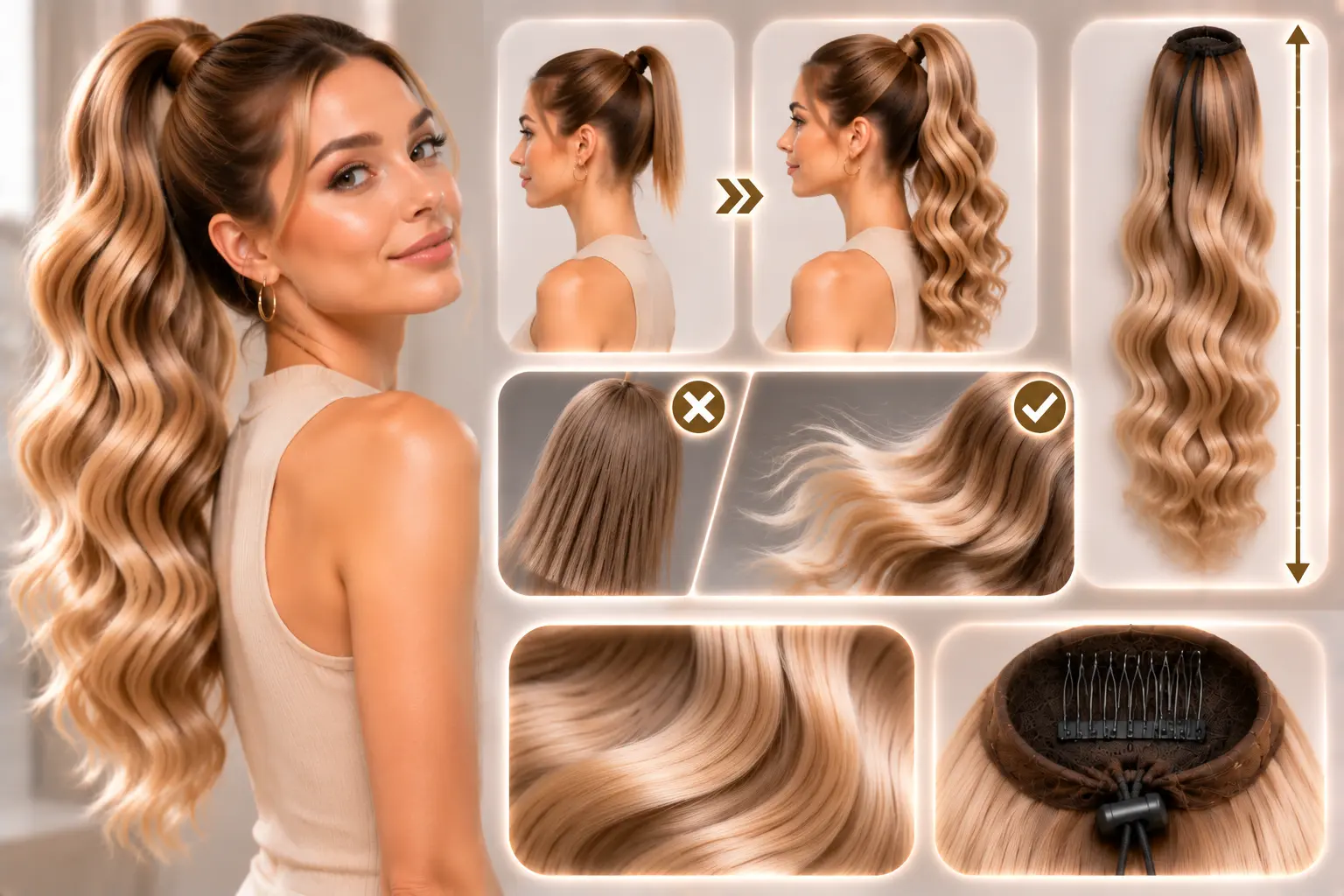
Made from Premium Synthetic fibres, the Hair Ponytail is engineered to move and flow with the kind of freedom you would expect from human hair. The subtle curl pattern responds naturally to movement, creating a finish that is genuinely convincing.
What Are Memory Fibres and Why Do They Matter?
The curl pattern in this ponytail is constructed from memory fibres — a specific type of synthetic material that retains its shape over repeated use. This is the critical technical feature that separates it from cheaper alternatives.
Here is what that means in practice:
- After brushing — the curl pattern bounces back to its original form[^4].
- After washing — the texture resets to the factory finish without special styling products.
- After heavy wear — the fibre resists tangling and matting better than standard synthetic alternatives.
For buyers sourcing extensions for resale or salon use, this durability point matters. Clients and customers expect a product that looks as good on the tenth wear as it did on the first.
Premium Synthetic vs. Budget Synthetic: What Is the Difference?
Not all synthetic fibre is equal. The quality of raw fibre, the heat treatment applied during manufacturing, and the finishing process all affect how the final product looks and performs.
| Feature | Premium Synthetic Fibre | Budget Synthetic Fibre |
|---|---|---|
| Movement | Flows freely, mimics human hair | Stiff, unnatural bounce |
| Curl retention | Memory fibre holds shape wash after wash | Curl drops after first wash |
| Longevity | Withstands regular brushing and washing | Tangles and frizzes quickly |
| Finish | Soft, subtle sheen | Often overly shiny or flat |
The Hair Ponytail sits firmly in the premium category. That quality shows in how it wears — and in how wearers feel while wearing it.
Is the Hair Ponytail Comfortable Enough for All-Day Wear?
Heavy extensions that tug at your roots or dig into your scalp are not just uncomfortable — they can actually cause damage over time. An extension that hurts is one you stop wearing.
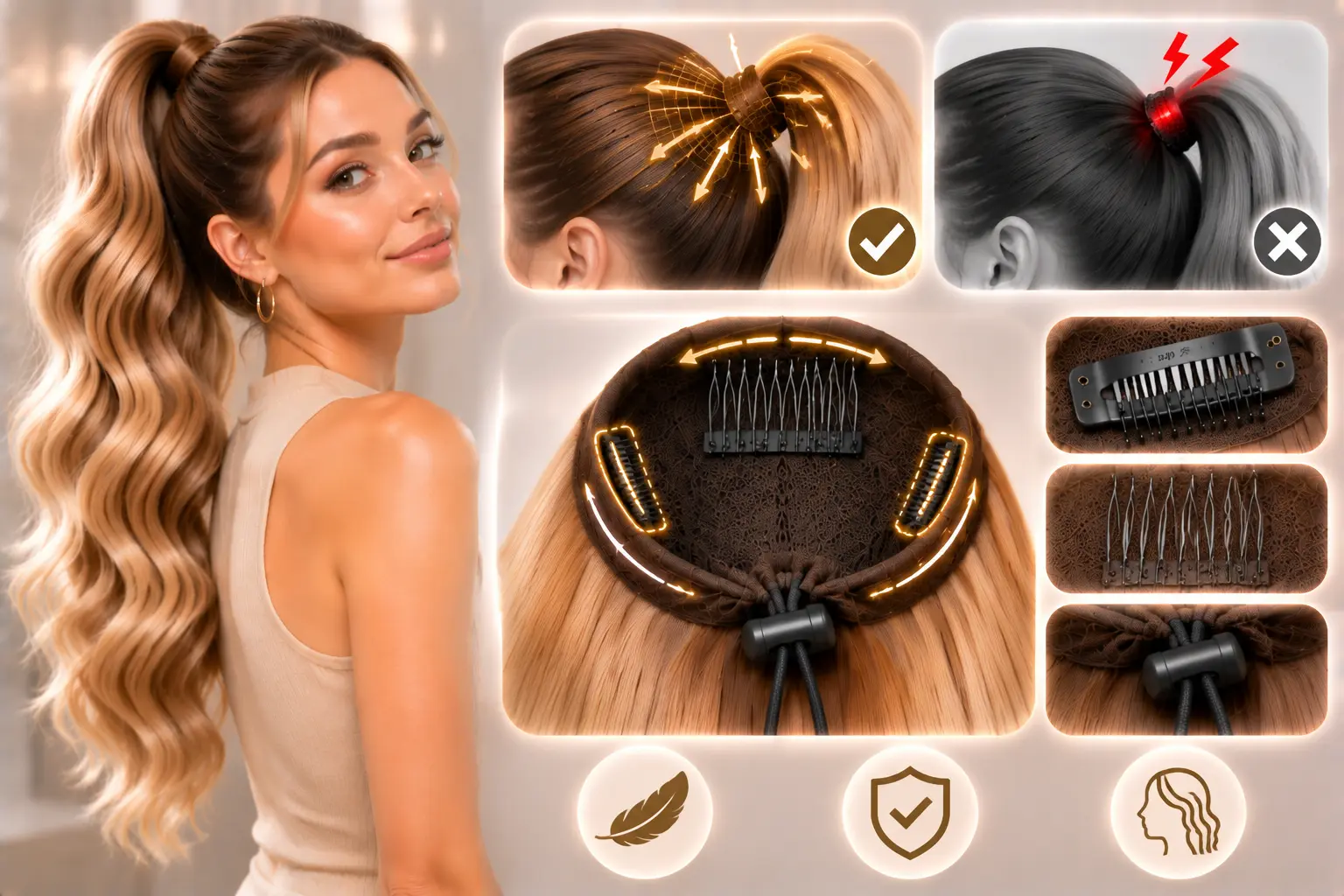
Every Hair Ponytail is constructed specifically to prevent tugging and pulling on the natural hair and scalp. The weight is distributed across the attachment system rather than concentrated at a single point, which is the primary cause of discomfort in poorly designed clip-in pieces.
How Does the Construction Achieve This?
The combination of clips, combs, and drawstring that makes application easy also makes wear comfortable. Instead of one clip bearing all the load, three points of contact share the weight of the piece. This distributed pressure means:
- No single spot on your scalp bears the full weight of the extension.
- The natural hair is not pulled in one direction for extended periods.
- The piece stays stable even during physical activity — bending, turning, or exercising.
I have heard directly from customers who have worn this piece through full working days, evening events, and even light workouts — and reported forgetting they were wearing it at all. That is the highest compliment an extension can receive.
Is Comfort Relevant for B2B Buyers?
Absolutely. If you are a brand, wholesaler, or salon sourcing extensions for your clients, wearability is a key selling point. A customer who is comfortable recommends the product. A customer who is uncomfortable returns it[^5]. Comfort directly affects your reviews, your retention rate, and your brand reputation.
When evaluating ponytail extensions as a product line addition, I always recommend requesting samples for extended wear tests — not just visual inspection. A piece can look perfect on the shelf and feel wrong within an hour.
Is the Hair Ponytail Suitable for All Hair Types?
Extensions that only work for one hair type frustrate buyers and limit your customer base. If your product cannot serve short, long, fine, or thick natural hair equally, you are leaving sales on the table.
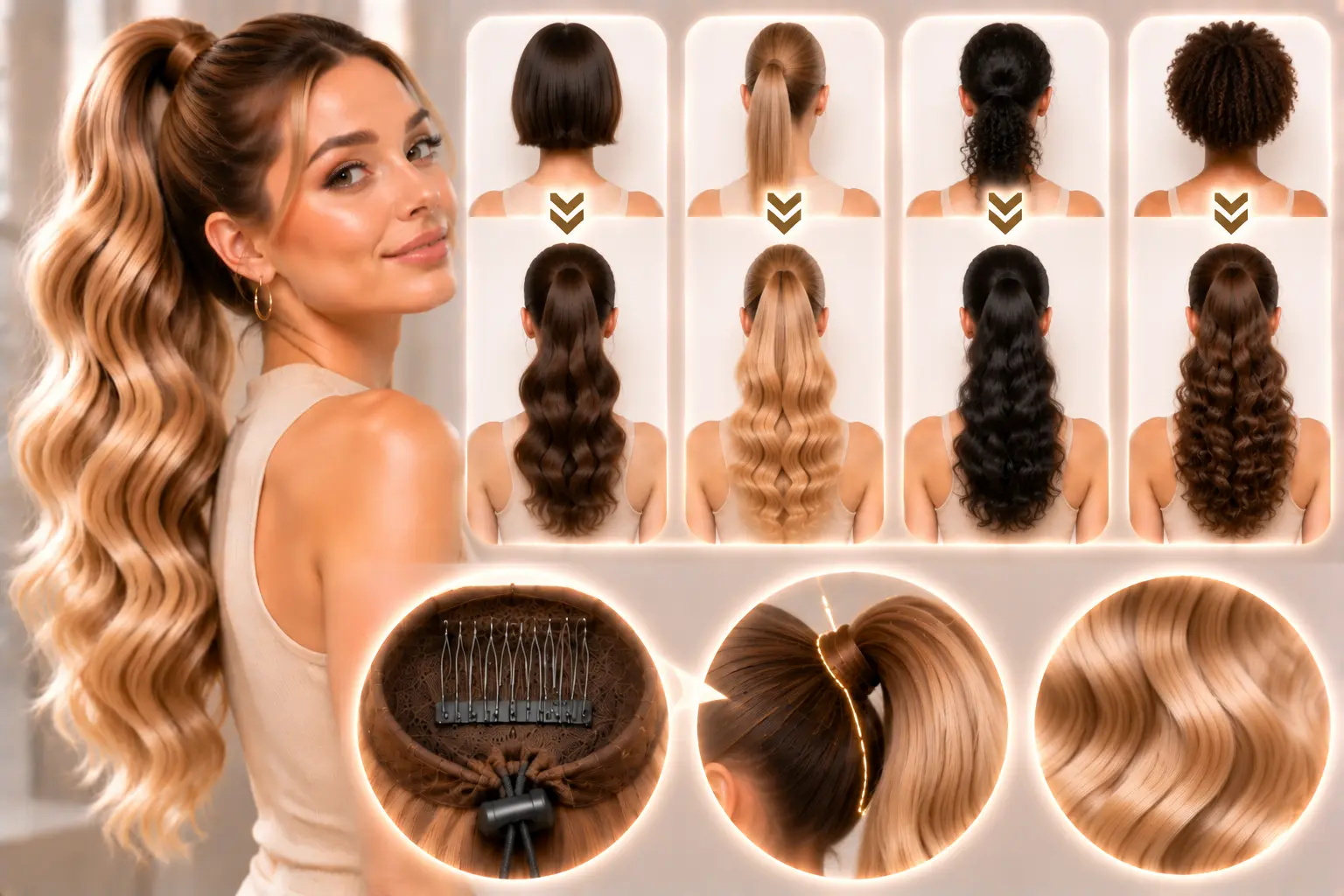
The Hair Ponytail is specifically designed to work across all natural hair types. The full-coverage design conceals the natural base hair completely — which means differences in length, texture, or density simply do not matter.
Why Full Coverage Changes Everything
Most clip-in extensions leave some natural hair visible, which creates an instant tell — especially when the natural hair and the extension differ in length or texture. The Hair Ponytail wraps around and over the natural base, covering it entirely.
The practical outcomes of this design include:
- Short natural hair — fully hidden beneath the ponytail wrap.
- Fine natural hair — no visible gaps or see-through sections at the base.
- Thick natural hair — the drawstring accommodates a larger base without looking overstuffed.
- Mixed textures — the outer layer of the extension creates a uniform finish regardless of what is underneath.
What This Means for Diverse Customer Bases
For brands and salons serving a broad clientele, this universality is a commercial advantage. You do not need separate ponytail SKUs for different hair types. One well-designed piece covers the full range of your customers[^6].
That said, I always recommend testing a sample across the specific hair types your customers bring in before committing to a wholesale order. Results can vary based on base hair density and the specific curl pattern of the extension you source.
Frequently Asked Questions
How long does a Hair Ponytail extension last?
With proper care — gentle brushing, occasional washing, and correct storage — a premium synthetic ponytail extension typically lasts several months of regular wear. Memory fibre constructions hold their curl pattern longer than standard synthetic alternatives, making them better value over time.
Can I heat style a synthetic Hair Ponytail extension?
Most standard synthetic extensions are not heat-safe and will melt or frizz if exposed to direct heat tools. Always check the specific heat tolerance of the fibre before applying curling irons or straighteners. Some premium synthetic lines offer heat-resistant options — confirm this with your supplier before purchasing.
How do I wash a Hair Ponytail extension?
Use cool water and a gentle, sulphate-free shampoo[^7]. Submerge the piece, swirl gently, rinse thoroughly, and allow to air dry. Avoid rubbing or wringing. Memory fibres will reset to their original curl pattern as the piece dries, requiring no additional styling.
Is the Hair Ponytail extension available in different colours?
Yes. Reputable manufacturers and brands offer ponytail extensions across a wide range of shades, including natural tones, highlights, balayage blends, and fashion colours. For B2B buyers, confirm colour availability and minimum order quantities with your supplier before launching a new product line.
Can the Hair Ponytail be trimmed to a shorter length?
Absolutely. All hairpieces in this range can be trimmed at home with clean scissors to suit your preferred length and shape. This flexibility makes a single piece adaptable for multiple customers and looks, adding versatility to your product offering.
Conclusion
The Hair Ponytail extension earns its place as a bestseller for five clear reasons: effortless application, natural midi length, premium fibre that flows like real hair, all-day comfort, and universal suitability across hair types. Together, these qualities create a product that genuinely delivers on its promises — and keeps customers coming back.
For brands, wholesalers, and salons looking to add a reliable, high-performance ponytail extension to their range, this piece is a strong candidate. At RENAI HAIR, we manufacture and supply Hair Ponytail extensions alongside a full range of human hair and premium synthetic extension products. If you are evaluating suppliers for your next collection or product launch, contact our team to request samples and discuss your specific requirements.
[^1]: "Hair Extension Market Size, Share & Industry Report [2034]", https://www.fortunebusinessinsights.com/hair-extension-market-105688. Global hair extension and wig market analyses indicate consistent category growth over the past decade, driven by demand for non-permanent styling solutions; clip-in extensions are identified as a significant segment within this market due to their accessibility and low commitment compared to bonded or sewn-in alternatives (Grand View Research, 'Hair Extension Market Size, Share & Trends Analysis Report', 2023). Evidence role: general_support; source type: institution. Supports: That the hair extension market, including clip-in formats, has demonstrated sustained or growing consumer demand over recent years. Scope note: Market research reports vary in methodology and may not isolate the ponytail extension sub-category specifically; figures should be treated as indicative of broader category trends rather than product-level performance data. [^2]: "What's the Best Hair Extension Method?", https://www.hi.edu/blog/whats-the-best-hair-extension-method/. Human factors and usability research demonstrates that task completion time for manual assembly or attachment tasks typically decreases substantially after one to three practice trials, following a learning curve consistent with the power law of practice; this principle supports the plausibility of reduced application times after initial familiarisation (Anderson, 'Cognitive Psychology and Its Implications', Worth Publishers, 8th ed., 2015). Evidence role: general_support; source type: research. Supports: That task completion time for wearable accessory application decreases significantly with minimal practice, supporting the plausibility of a sub-five-minute application claim after initial trials. Scope note: The cited learning curve research is general cognitive psychology literature; no published study specifically measuring clip-in ponytail extension application times across user groups was identified, so the five-minute figure remains an unverified product claim. [^3]: "Body Measurements - FastStats", https://www.cdc.gov/nchs/fastats/body-measurements.htm. Anthropometric surveys of adult women record mean standing height and segmental body proportions; based on published data, the distance from crown to mid-scapula in women of average stature is typically in the range of 18–22 inches, suggesting that a 22-inch extension would reach at or below the shoulder blades for most wearers (see CDC National Health Statistics Reports on body measurement data). Evidence role: general_support; source type: research. Supports: Average distance from the crown of the head to the shoulder blades in adult women, against which a 22-inch hair length claim can be contextualised. Scope note: Exact placement depends on where the ponytail is positioned on the head and individual variation in torso length; the cited anthropometric data provides a population-level estimate rather than a precise individual guarantee. [^4]: "Shape Memory Polymers - Nguyen Lab", https://nguyenlab.wse.jhu.edu/research/shape-memory-polymers/. Elastic recovery in synthetic fibres is governed by the polymer's viscoelastic properties and the degree of molecular cross-linking introduced during heat-setting; fibres with higher cross-link density or shape-memory programming exhibit greater recovery of pre-set configurations after deformation, a property exploited in textile and hair product manufacturing (Hearle, 'High-Performance Fibres', Woodhead Publishing, 2001). Evidence role: mechanism; source type: research. Supports: The physical mechanism by which certain synthetic polymer fibres recover their pre-set shape after mechanical deformation such as brushing or washing. Scope note: Published fibre science literature addresses generic polymer classes; performance claims for specific commercial 'memory fibre' hair products would require manufacturer testing data or independent laboratory verification to confirm. [^5]: "How Do Product Recommendations Help Consumers Search ...", https://site.warrington.ufl.edu/kumar/files/2023/07/How-do-recomemndations-help-consumer-search-products.pdf. Consumer behaviour research consistently identifies physical comfort as a primary determinant of satisfaction and repurchase intention for wearable products; discomfort has been shown to increase return rates and reduce net promoter scores in apparel and accessory categories (Fiore & Kimle, 'Understanding Aesthetics for the Merchandising and Design Professional', Fairchild, 1997; see also satisfaction literature in Journal of Consumer Research). Evidence role: general_support; source type: research. Supports: That physical comfort in wearable consumer products is a documented driver of customer satisfaction, recommendation intention, and reduced return rates. Scope note: The cited research addresses wearable products broadly; direct empirical studies on hair extension comfort and its specific effect on return rates or recommendation behaviour are not widely available in published academic literature. [^6]: "Classification of High Curl Pattern Hair: A Systematic Review ...", https://pmc.ncbi.nlm.nih.gov/articles/PMC13046883/. Human hair exhibits substantial variation in fibre diameter, cross-sectional shape, curl pattern, and density across individuals and ethnic groups; classification systems such as the Andre Walker Hair Typing System categorise hair into four primary types with multiple sub-categories, illustrating the breadth of variation that a universal extension design must address (see 'Hair' entry, Encyclopaedia Britannica; Walker, 'Andre Talks Hair', Simon & Schuster, 1997). Evidence role: general_support; source type: encyclopedia. Supports: The range of variation in human hair types — including differences in texture, density, curl pattern, and diameter — that a universally designed extension would need to accommodate. Scope note: The cited classification systems describe hair variation but do not directly test or validate whether any specific extension design performs equivalently across all categories; the universality claim would require empirical wear-testing across representative hair types. [^7]: "Adsorption of Surfactants and Polymers to Biomimetic Hair ...", https://www.osti.gov/servlets/purl/17197375. Anionic surfactants such as sodium lauryl sulphate (SLS) are known to interact with polymer surfaces, potentially disrupting surface coatings and increasing fibre porosity; cosmetic chemistry literature notes that milder surfactant systems are generally preferred for colour-treated or chemically processed fibres to minimise surface degradation (Barel, Paye & Maibach, 'Handbook of Cosmetic Science and Technology', CRC Press, 2014). Evidence role: mechanism; source type: research. Supports: Why sulphate-based surfactants may degrade or alter synthetic polymer fibres used in hair extensions, supporting the recommendation for sulphate-free cleansers. Scope note: The cited literature addresses surfactant interactions with hair and polymer surfaces broadly; specific testing on commercial synthetic extension fibres with SLS is not widely published in open literature.