Why Do Hair Extensions Turn Orange/Brassy?
Hair extensions turn orange when pigments fade, minerals build up, or chemicals react with the hair color. This problem becomes worse in summer because clients swim more, apply sunscreen more often, and expose extensions to strong UV rays. I see this issue often in customer feedback, and the solution starts with better prevention and care education.
Hair extensions turn orange or brassy because UV exposure, sunscreen ingredients, hard water, chlorine, saltwater, iron, copper, and product residue can alter the color balance of processed human hair. Blonde, highlighted, and light brown extensions show discoloration fastest. Prevention includes UV protection, mineral control, gentle washing, and correct toning products.
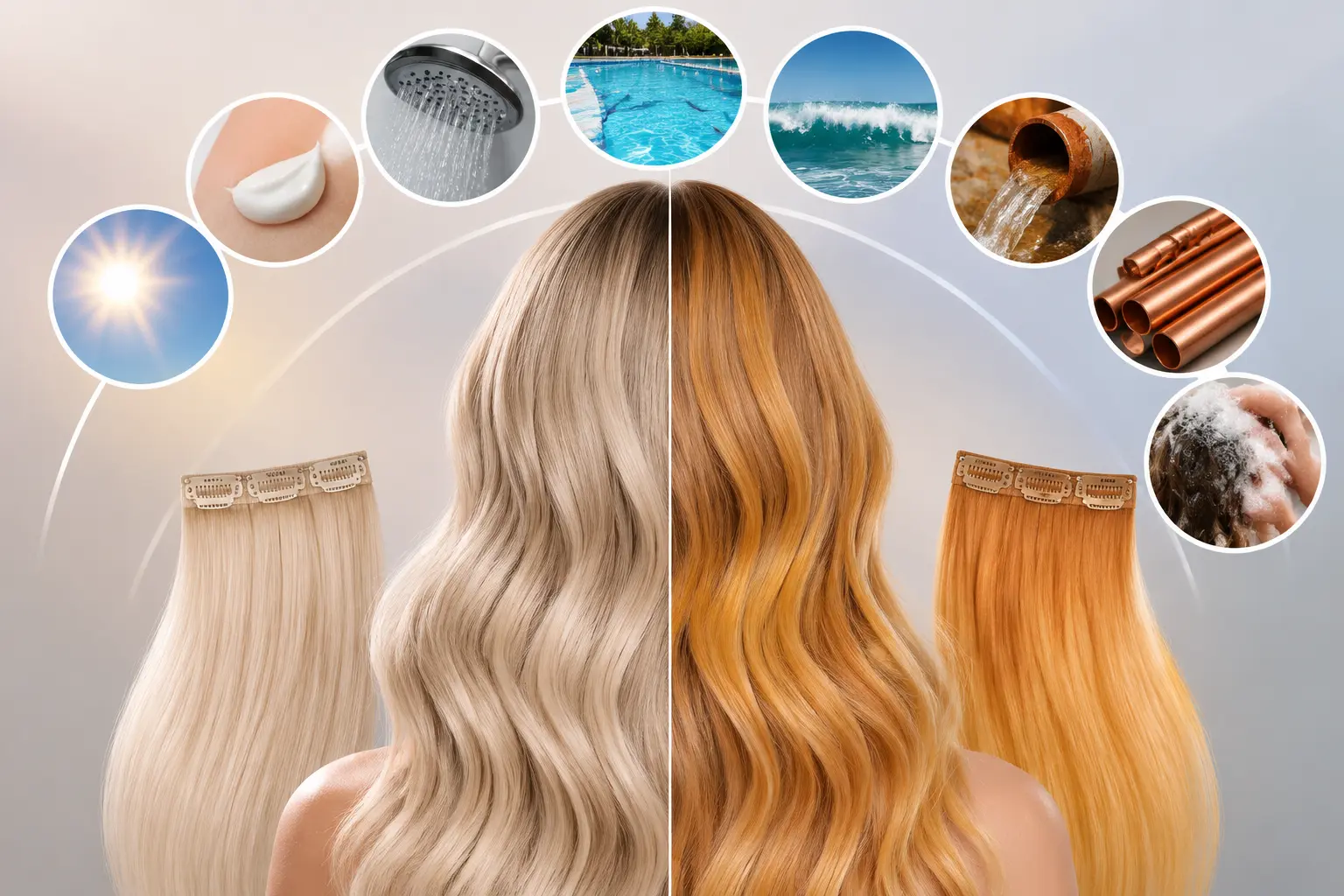
Most color complaints are not caused by one single mistake. They usually come from repeated exposure to sun, water, minerals, and cosmetic products. When I help B2B buyers or salon clients understand the cause first, they can prevent returns, reduce complaints, and protect the quality reputation of their hair extension line.
Why Do Hair Extensions Turn Orange After Sun Exposure?
Sun exposure looks harmless at first, but it can quietly weaken hair extensions and fade artificial color. Clients often notice the change after a beach trip, holiday, or long summer weekend. If they do not protect the hair early, dryness, tangling, and brassiness can appear together.
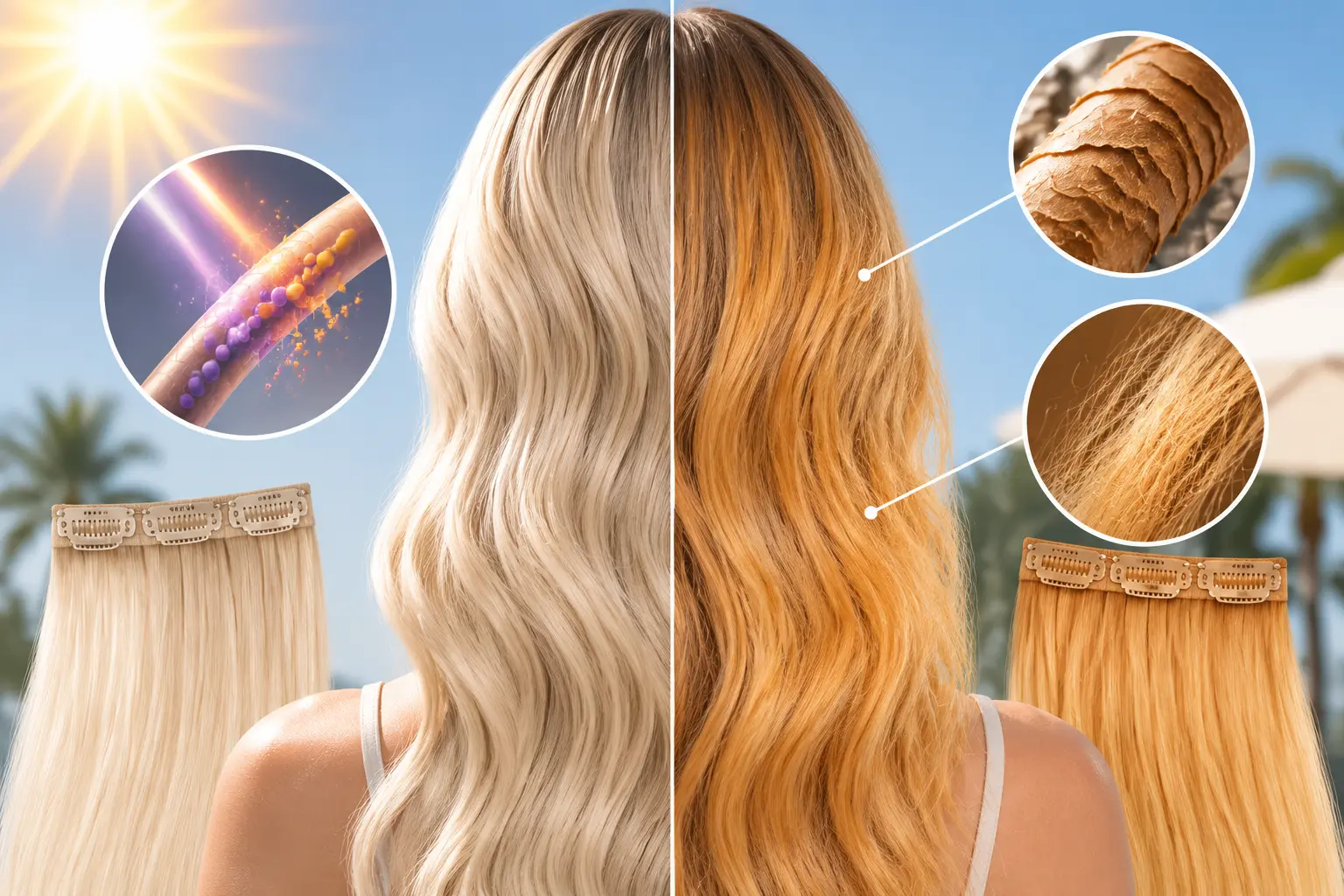
Hair extensions turn orange after sun exposure because UV radiation breaks down color molecules and reveals the warmer undertones underneath.[^1] Blonde and light brown extensions are especially vulnerable because they contain less visible pigment. Sunlight can also dry the hair, making the cuticle rougher and more likely to hold stains.
Why UV rays affect extension color
Human hair extensions are not growing from the scalp anymore. They cannot receive natural oil from the body, so they need more protection than natural hair.[^2] When UV rays hit colored extensions, they can gradually weaken the dye molecules. This fading can expose yellow, orange, red, or copper undertones.
In my experience working with hair extension buyers, summer complaints often increase for lighter colors such as:
- #60 platinum blonde
- #613 blonde
- Ash blonde shades
- Balayage blonde
- Light brown with highlights
- Rooted blonde colors
These colors are beautiful, but they are also less forgiving. A small shift in tone becomes visible very quickly.
What sun damage looks like
Sun damage does not always appear as bright orange immediately. It can show up in stages:
| Stage | What clients may notice | Likely cause |
|---|---|---|
| Early fading | Blonde looks warmer than before | UV exposure and washing |
| Medium brassiness | Hair looks yellow-orange or coppery | Pigment loss and dryness |
| Severe discoloration | Hair looks orange, peach, or uneven | UV plus chemicals or minerals |
| Texture damage | Hair feels dry, frizzy, or tangled | Cuticle stress and moisture loss |
This is why I always suggest that brands give clients simple summer care cards. Many end users do not know that hair extensions need sun protection just like skin does.
Practical prevention tips
I recommend these simple habits for salons, beauty supply stores, and extension brands to teach their customers:
- Wear a hat in strong sun. A hat gives physical protection and reduces direct UV exposure.
- Use a leave-in conditioner with UV protection. This helps reduce dryness and color fading.
- Avoid long sunbathing with loose extensions. A bun or braid reduces exposure.
- Hydrate the hair after outdoor activity. A lightweight leave-in conditioner can help restore softness.
- Avoid overheating the hair after sun exposure. Flat irons and curling wands can worsen dryness.
I often tell clients that prevention is cheaper than color correction. Once extensions become dry and brassy, repair takes more time and may not fully restore the original tone.
For B2B buyers, this also matters during product evaluation. If your target market includes salons in sunny regions, beach cities, or vacation markets, you should test lighter shades for fading resistance and give clear aftercare instructions. A good supplier should also provide care guidance, not only ship the product.
Can Sunscreen Make Hair Extensions Turn Orange or Pink?
Sunscreen is one of the most overlooked causes of extension discoloration. Clients apply it to the neck, shoulders, back, and chest. Then their hair touches the skin repeatedly. Over time, certain sunscreen ingredients can transfer onto the extensions and create peach, pink, orange, or rusty tones.[^3]
Hair extensions can turn orange or pink when sunscreen ingredients such as Avobenzone and Octocrylene react with hair color, minerals, or water. Light blonde extensions are most affected. To reduce risk, clients should let sunscreen absorb fully, keep hair off the shoulders, or choose mineral sunscreens with zinc oxide or titanium dioxide.

Why sunscreen stains happen
Many clients assume sunscreen is safe for hair because it is safe for skin. That is not always true. Some chemical sunscreen filters are oil-based or reactive under certain conditions. When they touch light-colored extensions, they can leave a residue. If hard water or pool water is also involved, the discoloration can become stronger.
Two ingredients often discussed in extension care are:
- Avobenzone, also called Butyl Methoxydibenzoylmethane
- Octocrylene
These ingredients can be present in many common sunscreens. They may not damage every extension in the same way, but they can be risky for blonde, ash, silver, and highlighted shades.
How clients accidentally transfer sunscreen
The problem usually happens through contact, not direct application. I have seen complaints where the top of the hair looks normal, but the mid-lengths and ends near the shoulders turn peachy or orange. This pattern often points to sunscreen transfer.
Common transfer points include:
- Neck and shoulders
- Upper back
- Chest area
- Hands after applying sunscreen
- Beach towels with sunscreen residue
- Swimwear straps or cover-ups
Safer sunscreen habits for extension wearers
I suggest that brands and salons teach customers these rules:
- Apply sunscreen first and let it absorb. Clients should wait before letting the hair touch the skin.
- Keep extensions elevated. A high bun, ponytail, or braid reduces contact with sunscreen.
- Wash hands after sunscreen application. This prevents transfer while brushing or styling.
- Choose mineral-based sunscreen when possible. Zinc oxide and titanium dioxide sit on the skin as physical blockers.[^4]
- Avoid spraying sunscreen directly near the hair. Spray products spread easily and can land on extensions.
Chemical vs. mineral sunscreen for extension users
| Sunscreen type | Common active ingredients | Risk for extensions | Buyer education note |
|---|---|---|---|
| Chemical sunscreen | Avobenzone, Octocrylene, Oxybenzone | Higher risk of staining on light shades | Keep hair away from treated skin |
| Mineral sunscreen | Zinc oxide, Titanium dioxide | Lower risk, but residue is still possible | Let product dry before hair contact |
| Spray sunscreen | Varies by formula | Higher transfer risk | Avoid spraying near extensions |
| Tinted sunscreen | Iron oxides, pigments | May stain light hair | Test before use |
For professional brands, I recommend adding sunscreen warnings to aftercare materials, especially for blonde extension collections. This small step can reduce avoidable complaints. It also shows that your brand understands real-life use, not just factory production.
Does Hard Water Make Hair Extensions Turn Orange/Brassy?
Hard water is a quiet problem because clients use it every day. They may blame shampoo, color quality, or the supplier, but the real issue can be minerals in shower water. If the water contains iron, copper, calcium, or magnesium, extensions can become dull, dry, tangled, or brassy over time.
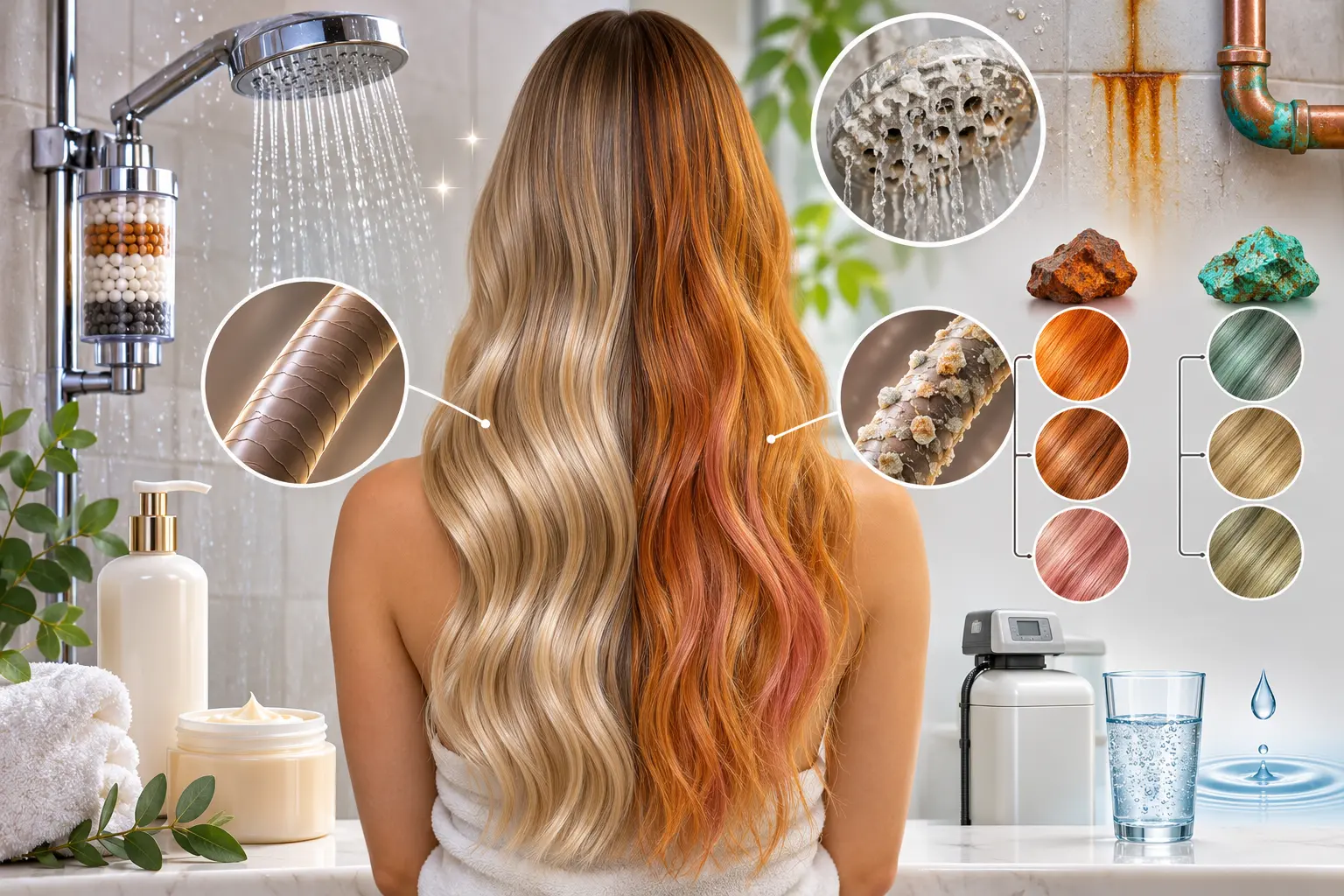
Hard water can make hair extensions turn orange or brassy because dissolved minerals attach to the hair shaft and alter the visible tone. Iron often creates orange, rusty, or pink discoloration, while copper can create greenish tones.[^5] Shower filters, water softeners, clarifying treatments, and proper conditioning help reduce damage.
What hard water does to extensions
Hard water contains a higher level of minerals.[^6] These minerals are not always dangerous to people, but they can be difficult for hair extensions. Since extensions have been collected, cleaned, colored, and processed before use, they may be more porous than natural hair.[^7] Porous hair absorbs and holds deposits more easily.
Hard water can cause:
- Color fading
- Orange or brassy tones
- Dryness
- Rough texture
- Tangling
- Loss of shine
- Product buildup
- Reduced movement
Clients often think they are using the wrong conditioner. Sometimes the conditioner is fine, but the water is leaving deposits faster than the product can manage.
Pool water, ocean water, and shower water
Hard water problems are not limited to swimming pools. Pool water contains chlorine and sometimes metals.[^8] Ocean water contains salt, which can remove moisture and make the cuticle feel rough.[^9] Home shower water can also carry minerals depending on the region.
| Water source | Main concern | Possible effect on extensions |
|---|---|---|
| Shower water | Calcium, magnesium, iron | Brassiness, dryness, buildup |
| Well water | Iron and other metals | Orange, rust, or pink tone |
| Pool water | Chlorine and copper | Dryness, fading, green or dull tone |
| Ocean water | Salt | Moisture loss, tangling, fading |
How to reduce hard water damage
I usually recommend a layered approach. One product alone may not solve the problem if the client lives in a hard water region.
Best options include:
- Install a water softener. This is the strongest long-term solution for homes with very hard water.
- Use a shower filter. This is more affordable and easier for most clients.
- Rinse hair after swimming. Fresh water helps remove chlorine or salt before it dries.
- Apply leave-in conditioner before and after swimming. This creates a protective layer and restores moisture.
- Use sulfate-free, paraben-free, and protein-free shampoos. Gentle formulas help clean without stripping the hair.
- Moisturize and seal after washing. Conditioner and leave-in products help smooth the cuticle.
Why hard water matters for B2B suppliers
For buyers, hard water complaints can look like product defects if aftercare is not explained clearly. I recommend that brands ask customers about local water conditions when investigating discoloration claims.
A useful complaint checklist includes:
- What color was purchased?
- How long was the hair worn before discoloration?
- Was the client swimming?
- What sunscreen did the client use?
- Does the client have well water or hard shower water?
- Was a clarifying or chelating shampoo used?
- Were purple or silver products used too often?
This approach helps protect both the client and the brand. It also keeps the conversation professional instead of emotional. In our business context, where consistent quality and long-term supply matter, good aftercare education supports customer trust.
How Do Mineral Deposits Change Blonde Hair Extensions?
Mineral deposits are frustrating because they build slowly and then appear suddenly. A client may love the hair for weeks, then notice green, orange, pink, or dull areas after repeated washing or swimming. Blonde extensions show these changes faster because every stain is more visible on a light base.
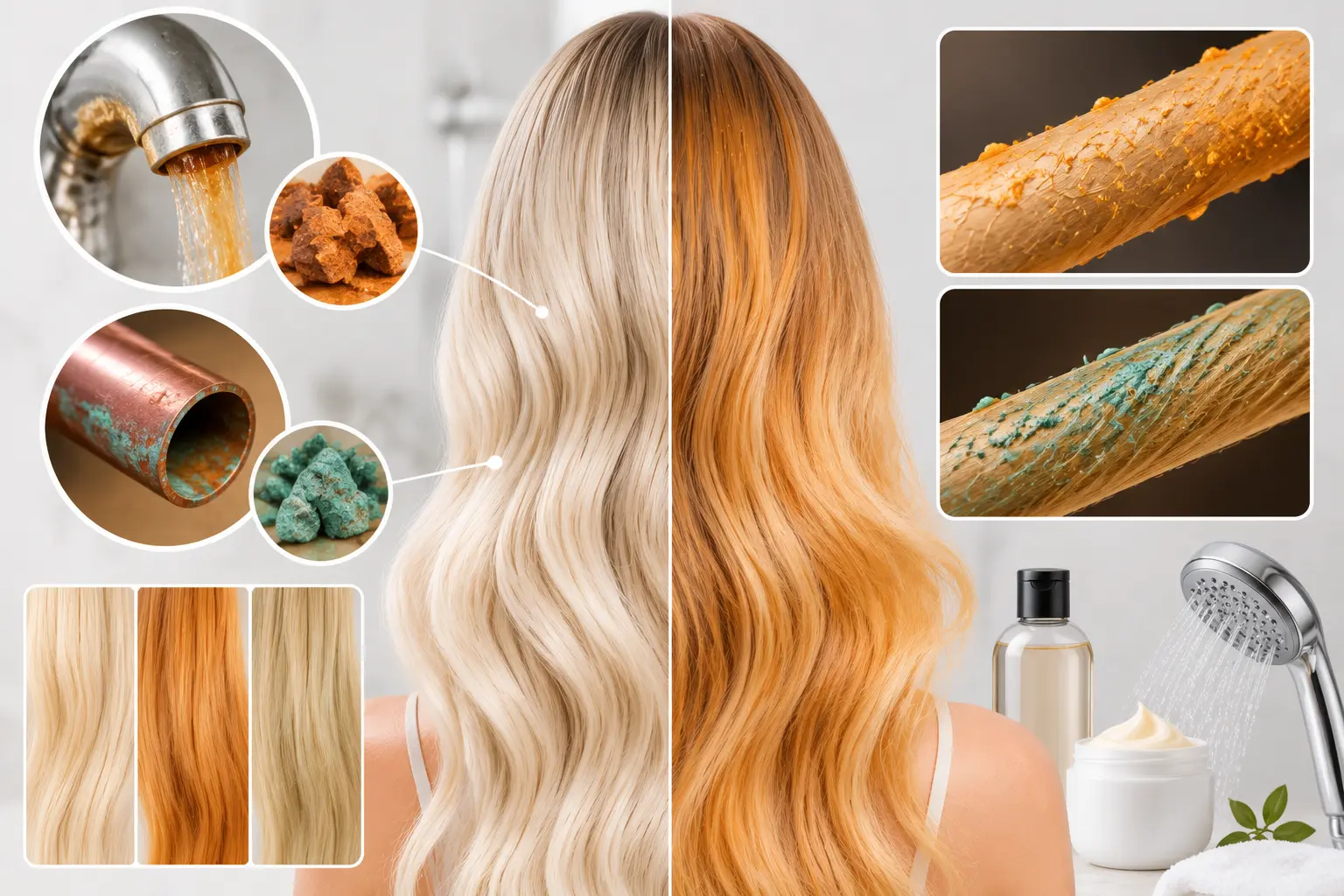
Mineral deposits change blonde hair extensions by coating the hair shaft with metals such as iron or copper. Iron can create orange, rusty, or pink tones, while oxidized copper can make blonde hair look green. Clarifying or chelating shampoo can help remove deposits, but deep conditioning is necessary afterward.
What mineral deposits are
Mineral deposits are buildups of inorganic materials that attach to the hair. They can come from pool water, well water, pipes, shower water, and environmental exposure. These deposits may react with hair color, especially on processed blonde or highlighted extensions.
The most important minerals to watch are:
- Iron: Can create orange, brassy, rusty, or pink tones.
- Copper: Can create green or dull tones, especially after oxidation.
- Calcium and magnesium: Can create dryness, stiffness, and product buildup.
Why blonde extensions are more susceptible
Blonde hair is like a white shirt. It shows every stain more clearly. Dark brown or black hair can also collect minerals, but the color change may be less visible. Blonde, ash blonde, silver, and platinum extensions reveal even a small amount of buildup.
Color-treated blonde hair can also be more porous. Porous hair has a more open cuticle structure. This means it can absorb water, minerals, oils, and residues more easily.
How to identify the likely mineral
| Visible color change | Possible mineral or cause | Suggested response |
|---|---|---|
| Orange or rusty | Iron in water | Chelating shampoo and water filter |
| Pink or peach | Sunscreen reaction, iron, or product residue | Clarify, check sunscreen ingredients |
| Green | Copper from pool or pipes | Chelating treatment and salon evaluation |
| Yellow-brassy | UV fading or mineral buildup | Purple/silver shampoo with caution |
| Dull gray or coated | Calcium/magnesium buildup | Clarifying wash and deep conditioner |
How to remove mineral buildup safely
A clarifying shampoo removes product buildup, oils, and some residue. A chelating shampoo is stronger because it targets minerals and metals. However, chelating shampoos can leave extensions dry if clients overuse them.
I suggest this general process:
- Detangle the extensions gently before washing.
- Use a clarifying or chelating shampoo according to the instructions.
- Rinse thoroughly.
- Apply a moisturizing conditioner.
- Use a leave-in conditioner after towel drying.
- Avoid heat styling immediately after treatment.
- Repeat only when needed, not daily.
For severe discoloration, I recommend professional color correction. A stylist can test a small section first and choose the right correction method. This is safer than trying multiple home remedies.
A note for buyers and salons
When I discuss blonde collections with wholesale clients, I always suggest they prepare clear care instructions before selling. The hair may be high quality, but customers still need to know how blonde extensions behave in real environments.
Good suppliers should support buyers with:
- Product care guidance
- Color maintenance suggestions
- Quality control before shipment
- Shade consistency checks
- Advice for complaint analysis
- Packaging inserts or aftercare cards
This is especially important for light shades because the margin for care mistakes is smaller.
How Can You Repair Discolored Hair Extensions and Prevent Brassiness?
Discolored extensions can create panic for clients. They may think the hair is ruined, and they may contact the salon or seller immediately. The best response is calm, practical, and based on color theory. The correction depends on whether the hair is orange, pink, green, yellow, or dull.
You can repair discolored hair extensions by identifying the unwanted tone, removing buildup if needed, and applying the correct pigment or toner. Orange tones usually need ash or blue-silver correction.[^10] Pink or peach tones may need gold balance. Green tones may need red or copper correction. Severe cases need a professional stylist.

Start with diagnosis before treatment
I do not recommend rushing into purple shampoo every time extensions look strange. Purple shampoo helps with yellow tones, but it may not fix orange, pink, or green discoloration. In some cases, it can make the color look muddy.
The first step is to identify the color shift:
| Problem tone | Possible correction direction | Product example |
|---|---|---|
| Yellow | Violet/purple | Purple shampoo or conditioner |
| Orange/copper | Blue or ash | Silver/blue-based toning product |
| Peach/pink | Gold or warm balance | Gold conditioner or salon toner |
| Green | Red/copper | Red or copper color correction |
| Dull/mineral-coated | Remove buildup first | Clarifying or chelating shampoo |
Use pigmented shampoo carefully
Pigmented shampoos can help maintain blonde tones, but they should not be overused. Too much purple or silver pigment can make extensions look gray, dull, or uneven. I usually suggest that clients use these products only when they notice brassiness, not every wash.
For blonde extensions:
- Silver or purple shampoo helps maintain ash, platinum, or icy tones.
- Blue-based products can help reduce orange warmth.
- Gold products may help balance peach or pink discoloration in some cases.
- Red or copper correction may be needed for green tones.
Clients should always test a small hidden section first. This is especially important for high-value human hair extensions.
When hair color correction is needed
Sometimes shampoo is not enough. If the color has shifted strongly, a stylist may need to apply a toner or demi-permanent color. I recommend professional evaluation for:
- Strong orange discoloration
- Pink or peach staining from sunscreen
- Green tones from copper
- Uneven color bands
- Extensions that feel dry and rough
- Expensive or premium hair sets
A professional can check porosity, strand strength, and color history before applying chemicals. This reduces the risk of further damage.
What clients should avoid
Many clients search online and find home remedies. Some may suggest vinegar, baking soda, ketchup, lemon juice, or dish soap. I understand why people try these methods, but I recommend caution. These remedies are not always tested for extension hair, and they can cause dryness, fading, or matting.
Clients should avoid:
- Applying perfume directly to hair
- Spraying sunscreen near the extensions
- Sleeping with wet hair
- Using high heat without protection
- Overusing purple shampoo
- Using harsh clarifiers too often
- Trying multiple home remedies in one day
Summer care checklist for clients
I like giving customers a simple “dos and don’ts” list because it is easy to remember.
Do:
- Rinse hair after swimming.
- Protect hair from UV rays.
- Use gentle, sulfate-free hair products.
- Apply leave-in conditioner before beach or pool days.
- Use a shower filter in hard water areas.
- Keep hair in a bun or braid when applying sunscreen.
Don’t:
- Do not apply perfume directly to hair.
- Do not let sunscreen sit on extensions.
- Do not overheat the hair.
- Do not swim repeatedly without rinsing.
- Do not ignore early brassiness.
- Do not use strong treatments without testing first.
For brands and distributors, this education can reduce customer complaints. It can also help sales teams answer questions with confidence. At RENAI HAIR, our business focuses on stable human hair extension quality, strict shipment quality control, and professional support. However, even good hair needs correct care after sale. That is why buyer education is part of long-term product success.
Frequently Asked Questions
Why do blonde hair extensions turn orange faster than dark extensions?
Blonde hair extensions turn orange faster because they have less visible pigment and show stains more easily. UV exposure, iron in water, sunscreen residue, and color fading are more noticeable on light shades. Dark extensions can also fade, but the change is usually less obvious.
Can purple shampoo fix orange hair extensions?
Purple shampoo works best on yellow tones, not strong orange tones. Orange usually needs blue, ash, or silver-blue correction. If the extensions are very orange, pink, or uneven, I recommend asking a professional stylist to test and correct the color safely.
Can sunscreen really turn hair extensions pink or orange?
Yes, some sunscreen formulas can contribute to pink, peach, or orange discoloration, especially on blonde extensions. Ingredients such as Avobenzone and Octocrylene[^11] are often linked with staining complaints. Clients should keep hair away from sunscreen-treated skin and consider mineral sunscreen options.
Is hard water bad for human hair extensions?
Hard water can be bad for human hair extensions because minerals can build up on the hair shaft. This buildup may cause dryness, dullness, tangling, and brassiness. A shower filter, water softener, clarifying shampoo, and moisturizing conditioner can help reduce the problem.
Should clients try home remedies for discolored extensions?
Clients should be careful with home remedies because extension hair may react differently from natural growing hair. Vinegar, baking soda, lemon juice, or dish soap can dry or damage the hair. I suggest testing a small section first or asking a professional stylist for severe discoloration.
Conclusion
Hair extensions turn orange or brassy because summer care mistakes, UV exposure, sunscreen transfer, hard water, mineral deposits, and pigment fading can all affect the final color. The best solution is not only correction, but prevention through clear aftercare education. If you sell, distribute, or use professional human hair extensions, I recommend giving every client simple care guidance before problems appear. For stable-quality human hair extension supply and B2B product support, contact RENAI HAIR to discuss your next collection.
[^1]: "Photoaggravation of Hair Aging - PMC - NIH", https://pmc.ncbi.nlm.nih.gov/articles/PMC2938585/. Studies of hair photodamage report that ultraviolet radiation can degrade melanin and cosmetic colorants in hair fibers, producing fading and shifts in visible tone. Evidence role: mechanism; source type: paper. Supports: UV exposure contributes to photodegradation of hair pigments and colorants, causing fading and changes in apparent tone.. Scope note: Most studies examine natural or dyed hair fibers generally, so the evidence is contextual rather than specific to commercial hair extensions. [^2]: "Hair Washing Guide: Do's and Don'ts", https://brownbeautybarberschool.edu/news/hair-washing-guide-dos-and-donts/. Dermatologic literature describes scalp sebum as a lipid secretion that coats and lubricates hair shafts, a process absent from detached hair fibers such as extensions. Evidence role: mechanism; source type: paper. Supports: Sebum from the scalp contributes to lubrication and surface conditioning of growing hair shafts.. Scope note: The source should support the role of sebum in natural hair; the extension-care implication is inferred from the absence of scalp attachment. [^3]: "Avobenzone", https://en.wikipedia.org/wiki/Avobenzone. Chemical studies of avobenzone report interactions with metal ions, including complex formation that can produce visible coloration, offering a plausible mechanism for warm-toned staining when sunscreen residues contact mineral-contaminated fibers. Evidence role: mechanism; source type: paper. Supports: Avobenzone can interact with metal ions and form colored complexes or residues that provide a plausible mechanism for orange or rusty staining.. Scope note: The evidence is chemical and mechanistic; it does not directly test staining on human hair extensions under consumer-use conditions. [^4]: "FDA's regulatory actions on over-the-counter sunscreen", https://www.fda.gov/drugs/understanding-over-counter-medicines/questions-and-answers-fdas-regulatory-actions-over-counter-sunscreen. Dermatology and regulatory sources classify zinc oxide and titanium dioxide as inorganic sunscreen filters that protect skin by reflecting, scattering, and absorbing ultraviolet radiation. Evidence role: definition; source type: institution. Supports: Zinc oxide and titanium dioxide are inorganic sunscreen filters commonly described as mineral or physical blockers.. Scope note: Modern sources note that these filters also absorb some UV radiation, so the phrase 'physical blockers' is a simplified description. [^5]: "Pseudo Green Hair - PMC - NIH", https://pmc.ncbi.nlm.nih.gov/articles/PMC9069904/. Research and water-chemistry references associate iron oxides with orange-brown rust staining and copper deposition or oxidation with green discoloration of light-colored hair. Evidence role: mechanism; source type: research. Supports: Iron compounds are associated with rust-colored staining, and copper deposition or oxidation is associated with green discoloration of light hair.. Scope note: The evidence may come from water and pool chemistry rather than controlled tests on hair extensions specifically. [^6]: "Hardness of Water | U.S. Geological Survey", https://www.usgs.gov/water-science-school/science/hardness-water. Water-quality authorities define hard water as water with elevated dissolved mineral content, particularly calcium and magnesium ions. Evidence role: definition; source type: government. Supports: Hard water contains relatively high concentrations of dissolved minerals, principally calcium and magnesium.. [^7]: "Effects of excessive bleaching on hair: comparative analysis of ...", https://pmc.ncbi.nlm.nih.gov/articles/PMC11652465/. Hair-fiber studies show that chemical treatments such as bleaching and dyeing can disrupt the cuticle and increase porosity, making fibers more prone to absorbing water and residues. Evidence role: mechanism; source type: paper. Supports: Chemical and cosmetic processing can damage the hair cuticle and increase porosity or water uptake.. Scope note: The evidence supports processed hair generally; extension porosity also depends on sourcing, manufacturing, and prior treatment history. [^8]: "Home Pool and Hot Tub Water Treatment and Testing", https://www.cdc.gov/healthy-swimming/about/home-pool-and-hot-tub-water-treatment-and-testing.html. Public-health and pool-maintenance guidance identifies chlorine as a common pool disinfectant and notes that metals such as copper may be present through source water, corrosion, or chemical additives. Evidence role: general_support; source type: government. Supports: Pool water is treated with chlorine-based disinfectants and can contain metals such as copper from algaecides, source water, or corrosion.. Scope note: This supports pool-water constituents, not the frequency or severity of extension discoloration after swimming. [^9]: "Morphological degradation of human hair cuticle due to ...", https://pubmed.ncbi.nlm.nih.gov/27318298/. Hair-fiber research on aqueous salt exposure indicates that saline conditions can affect water balance and surface properties of hair, which is consistent with reports of dryness and rough texture after seawater contact. Evidence role: mechanism; source type: paper. Supports: Saltwater exposure can alter the moisture balance and surface feel of hair fibers, contributing to dryness or roughness.. Scope note: Direct evidence on consumer hair extensions may be limited; the support is based on human hair fiber behavior. [^10]: "Mastering Color Theory for Hair Stylists", https://cosmetologyandspaacademy.edu/hair-color-theory-for-stylists/. Cosmetology education materials apply complementary color theory to hair coloring, identifying blue-based or ash tones as corrective choices for reducing orange or copper warmth. Evidence role: mechanism; source type: education. Supports: Complementary color theory places blue opposite orange, explaining why blue or ash-based toners are used to reduce orange warmth in hair.. Scope note: Actual results depend on hair porosity, underlying pigment, product formulation, and prior chemical history. [^11]: "Avobenzone | C20H22O3 | CID 51040 - PubChem - NIH", https://pubchem.ncbi.nlm.nih.gov/compound/Avobenzone. Regulatory sunscreen monographs identify avobenzone and octocrylene as active ultraviolet-filtering ingredients used in sunscreen formulations. Evidence role: definition; source type: government. Supports: Avobenzone and octocrylene are recognized sunscreen active ingredients used as ultraviolet filters.. Scope note: This supports their identity and use in sunscreens, not by itself the claim that they directly stain hair extensions.