How to Detangle Matted Hair and Tips to Prevent Tangling?
To detangle matted hair safely, I always start by slowing down because rushing can turn a small knot into breakage[^1]. Matted hair feels frustrating, looks dull, and can make even good-quality human hair extensions seem ruined. The right moisture, tools, and technique can loosen knots while protecting the hair’s strength and smooth finish.
To detangle matted hair, saturate the tangled area with conditioner or detangling spray[^2], let it soften for 20–30 minutes, then separate the knot gently with your fingers. After that, use a wide-tooth comb from the ends upward in small sections. Avoid dry brushing, pulling, or using high heat on severe tangles.

Matted hair can happen to natural hair, wigs, toppers, and human hair extensions. I have seen it appear after sleep, washing, travel, friction, or poor aftercare. Below, I will break down what matted hair looks like, why it happens, how to fix it, and how to prevent it.
What Does Matted or Frizzy Hair Extensions Look Like?
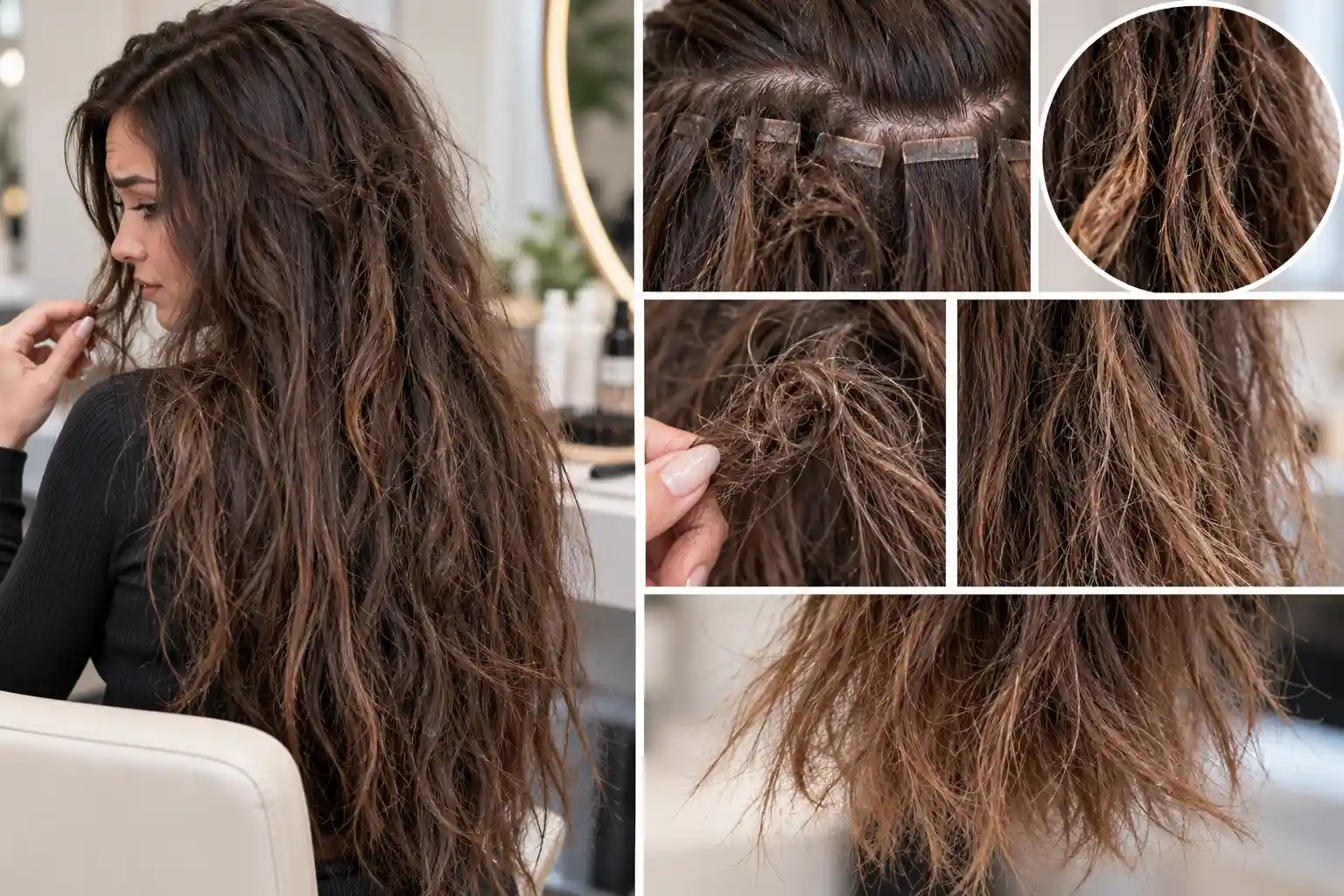
Matted or frizzy hair extensions can make a customer worry that the hair quality is poor. I understand that concern because tangling is visible and stressful. However, the appearance of frizz or matting can come from care habits, product buildup, dryness, friction, or processing history.
Matted hair extensions usually look dull, clumped, dry, and hard to separate. Individual strands stick together, form knots, or twist into rough sections. Frizzy extensions may look puffy at the ends, uneven through the mid-lengths, or tangled near the roots, tapes, wefts, or bonded areas.
How I Identify Matted Hair Before It Gets Worse
When I inspect hair, I do not only look at shine. I also check movement, strand separation, and resistance when combing. Good human hair should move naturally when clean and moisturized. If the hair moves as one rough block, matting has started.
Common signs include:
- Visible clumps where strands gather together
- Dry or rough ends that catch on nearby strands
- Knots near attachment points, such as tape, weft, bead, or keratin bonds
- Uneven texture, especially after washing or sleeping
- Frizz halo around the surface of the hair
- Resistance when finger-combing
- Dull finish even after brushing
For hair extensions, matting often appears in predictable places. The nape area is one of the most common zones because collars, scarves, pillows, and natural movement create friction.[^3] I usually tell salon clients and B2B buyers to pay close attention to this area during wear tests.
Matted Hair vs. Normal Tangling
Not every tangle is a serious mat. Normal tangling is usually loose and easy to remove with a wide-tooth comb. Matted hair feels compact, tight, and sometimes almost felted together.
| Hair Condition | What It Looks Like | How Serious It Is | Best First Step |
|---|---|---|---|
| Light tangling | A few strands catch together | Low | Finger-comb with leave-in spray |
| Frizz | Puffy, dry, rough surface | Low to medium | Add moisture and smooth cuticle |
| Knots | Small tight sections | Medium | Isolate and condition |
| Matting | Dense clumps or locked strands | High | Saturate, wait, and detangle slowly |
| Severe matting | Large hardened sections | Very high | Seek professional help |
For human hair extensions, buyers should also distinguish between aftercare-related tangling and quality-related tangling. Hair that tangles immediately after minimal handling may need closer review. Hair that tangles after swimming, sleeping wet, heavy oil buildup, or lack of brushing may be an aftercare issue.
At RENAI HAIR, we focus on stable quality control before shipment, but I still recommend that buyers run their own wear tests. A supplier can provide hair samples, product details, and quality inspection records, but real market feedback from stylists and end users is also important.
Why Do You Need to Detangle Matted Hair Before It Gets Worse?
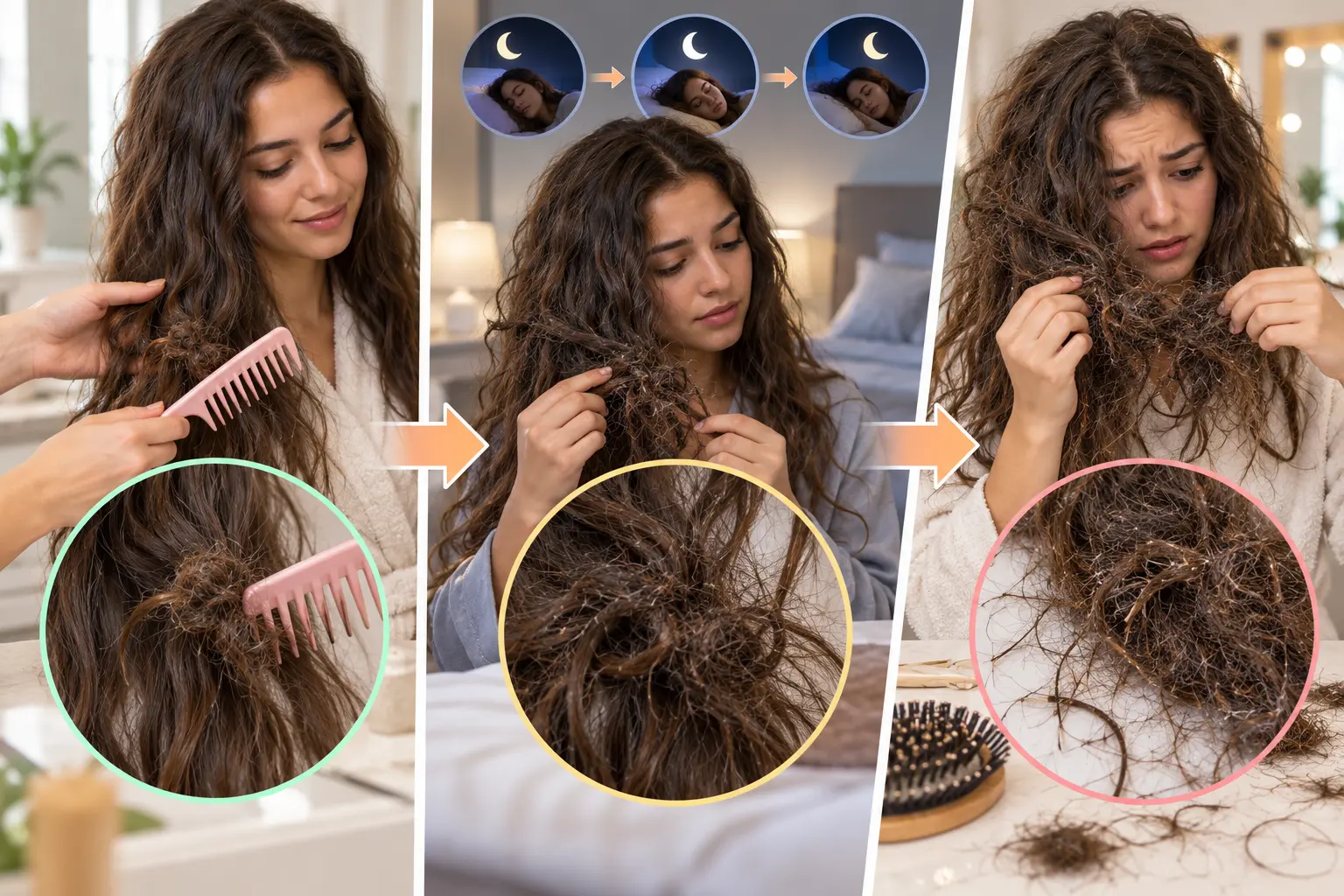
You need to detangle matted hair early because tight knots can trap more strands every day[^4]. I have seen small tangles become dense mats after only a few nights of sleeping without brushing. Once the hair locks together, breakage risk increases quickly.
You should detangle matted hair as soon as possible to reduce breakage, shedding, dryness, and customer dissatisfaction. Early detangling needs less force, less product, and less time. If you wait too long, the strands can tighten, twist, and become difficult to separate without cutting.
Why Matted Hair Becomes Harder to Fix Over Time
Hair tangling is a chain reaction. One rough strand catches another strand. Then those strands catch more hair. Friction, sweat, product buildup, and dryness make the knot tighter. If the hair is curly, long, processed, or fragile, the process can move even faster.
Several hair types are more prone to tangling:
-
Thin or brittle hair
Fine strands are easier to bend, snap, and wrap around nearby strands.[^5] Broken ends also create rough surfaces that catch quickly. -
Naturally curly hair
Curly strands do not lie in one straight direction. The curves can interlock, especially when the hair is dry or not separated often.[^6] -
Long hair
Longer strands have more surface area, so they touch and wrap around each other more often.[^7] -
Processed hair
Bleaching, coloring, perming, and heat styling can weaken the cuticle.[^8] A raised cuticle increases friction. -
Hair extensions
Extensions do not receive scalp oils like growing hair.[^9] They need more intentional moisture and care.
The Role of Hair Cuticle Condition
The cuticle is the outer layer of the hair. When cuticles lie flatter, the hair feels smoother. When cuticles are raised or damaged, hair feels rough. Rough strands grip each other, which increases tangling.[^10]
This is why Remy hair and cuticle intact hair are often preferred in professional human hair extensions. In general, aligned cuticles reduce friction compared with mixed-direction hair.[^11] However, buyers should verify supplier claims through samples, tests, and consistent batch checks.
For B2B hair extension brands, this matters because tangling complaints can affect:
- Return rates
- Customer reviews
- Salon trust
- Repeat purchases
- Brand reputation
- Product line planning
When Matting May Signal a Product or Care Issue
I like to evaluate tangling with a practical checklist:
| Question | What It May Indicate |
|---|---|
| Did the hair tangle before washing? | Possible quality or storage issue |
| Did it tangle after heavy conditioner or oil? | Product buildup may be involved |
| Did it mat near the nape? | Friction and sleeping habits may be the cause |
| Did it tangle after bleaching or coloring? | Processing damage may be involved |
| Did many customers report the same issue? | Supplier consistency should be reviewed |
One isolated tangling case does not always prove poor quality. Still, repeated complaints across multiple customers, colors, or batches should be investigated. I recommend keeping sample records, batch photos, and washing test notes when evaluating human hair suppliers.
How Do You Detangle Matted Hair Step by Step?
To detangle matted hair step by step, I use moisture first, fingers second, and tools last. This order matters because dry knots resist movement. If I pull too soon, I can stretch, snap, or shed hair that could have been saved.
The safest way to detangle matted hair is to apply conditioner or detangling spray, let it sit, divide the hair into small sections, loosen the mat with your fingers, then comb from the ends upward. Work slowly and rinse only after the knot is fully separated.

Step 1: Do Not Brush Dry Matted Hair
Dry brushing is one of the fastest ways to cause breakage. I know it feels natural to grab a brush immediately, but a tight mat needs slip before pressure. “Slip” means the strands can slide past each other with less friction.
Use one of these first:
- Detangling spray
- Moisturizing conditioner
- Leave-in conditioner
- Diluted conditioner in a spray bottle
- A small amount of coconut oil or olive oil for very dry ends
Avoid using too much heavy oil near tape-ins, keratin bonds, or adhesive areas because oil can weaken attachment points.
Step 2: Saturate the Matted Area
Apply product directly to the knot and the surrounding hair. The surrounding area matters because loose strands around the mat can join the knot during detangling.
I usually recommend waiting 20–30 minutes after applying conditioner. For severe matting, waiting longer can help. Covering the section with a plastic cap may keep moisture in place.
Step 3: Isolate the Knot
Use clips to separate the matted section from the rest of the hair. This prevents the knot from spreading. If the hair is installed as extensions, support the attachment point with one hand. This reduces tension on the scalp or bond.
For salon work, I suggest dividing the hair into:
- Nape section
- Left side
- Right side
- Crown
- Front hairline
This keeps the work organized.
Step 4: Use Your Fingers First
Fingers are more sensitive than combs. I can feel where the hair is locked and where it is ready to separate. Start at the outer edge of the mat, not the center. Pulling from the center can tighten the knot.
Use this motion:
- Pinch the mat gently.
- Find a few loose strands at the edge.
- Slide them out slowly.
- Add more conditioner if the hair feels dry.
- Continue until the mat becomes thinner.
Step 5: Comb From Ends to Roots
Once the mat is loosened, use a wide-tooth comb. Start at the ends and move upward in small steps. Never start at the root and drag downward because that pushes knots into tighter knots.
Best tools include:
| Tool | Best For | Caution |
|---|---|---|
| Fingers | Severe mats and fragile hair | Takes more time |
| Wide-tooth comb | Medium tangles and wet hair | Use slowly |
| Detangling brush | Loose knots and final smoothing | Avoid aggressive brushing |
| Rat-tail comb | Tiny knots only | Can break hair if used too early |
Step 6: Rinse and Recondition
After you detangle matted hair, rinse with cool or lukewarm water. Then apply conditioner again. This final conditioning step helps smooth the cuticle and reduce immediate re-tangling.
For extensions, always follow the supplier’s care instructions. Some products are not suitable for tape-ins, keratin bonds, or specific weft constructions. When in doubt, consult a stylist before using oils, masks, or clarifying shampoos.
How Can You Prevent Tangling in Human Hair Extensions?
You can prevent tangling in human hair extensions by keeping the hair clean, moisturized, separated, and protected from friction. I always remind customers that extensions need care because they do not receive natural scalp oil like growing hair does.
To prevent tangling, brush human hair extensions daily, use sulfate-free moisturizing products, sleep with the hair dry and loosely tied, avoid excessive heat, and keep conditioner away from adhesive bonds. Regular maintenance appointments also help prevent root matting, shedding, and friction-related knots.

Daily Habits That Prevent Knots
Prevention is much easier than repair. A few minutes of daily care can save hours of detangling later. I suggest a simple routine because most customers will not follow complicated instructions for long.
A practical daily care routine:
- Brush hair gently in the morning.
- Separate extension rows or bonds with fingers.
- Apply light leave-in conditioner to dry mid-lengths and ends.
- Tie hair loosely before sleep.
- Use a silk or satin pillowcase.
- Keep hair dry before going to bed.
- Avoid sleeping with wet extensions.
- Brush before washing, not only after washing.
Washing Habits That Reduce Matting
Washing technique is a major factor. Many people rub hair in circles like fabric. That movement creates tangles. Instead, shampoo should move downward with the hair direction.
Better washing steps:
- Brush before washing.
- Wet the hair in a downward direction.
- Apply shampoo mainly to the scalp or attachment area as appropriate.
- Smooth foam down the lengths.
- Do not pile hair on top of the head.
- Rinse thoroughly.
- Apply conditioner to mid-lengths and ends.
- Rinse well to avoid buildup.
- Blot with a towel instead of rubbing.
Product residue can make hair sticky. Sticky hair attracts more tangles. If hair feels coated after washing, a stylist may recommend occasional clarifying. However, clarifying products can be drying, so they should be used carefully.
Extension-Specific Prevention Tips
Different extension methods need different care.
| Extension Type | Tangling Risk Area | Prevention Tip |
|---|---|---|
| Genius Weft | Nape and row area | Brush rows and keep wefts separated |
| Machine Weft | Underlayers | Avoid friction and heavy buildup |
| Hand Tied Weft | Row attachment | Do not pull aggressively near stitching |
| Tape In Hair | Tape tabs | Avoid oil and conditioner near adhesive |
| Keratin/Prebonded Hair | Bonds | Separate bonds daily with fingers |
| Clip In Hair | Clips and nape | Remove before sleeping |
| Halo Hair | Nape wire area | Brush before and after wearing |
| Hair Topper | Base and clips | Clean gently and dry fully |
For B2B brands, prevention education is part of product success. A high-quality product can still receive poor reviews if customers do not understand care. I recommend including a care card with every order and training salon partners to explain maintenance clearly.
At RENAI HAIR, our customers often ask for product solutions for different markets. Some markets prefer silky straight textures, while others prefer body wave, curly, or colored hair. Each texture needs care instructions that match its structure. Curly hair, for example, needs more moisture and less dry brushing.
What Products and Tools Help Detangle Matted Hair Safely?
The right products help detangle matted hair by adding slip, moisture, and control. The wrong tools can make the knot tighter. I prefer gentle products first and stronger cleansing only when buildup is clearly part of the problem.
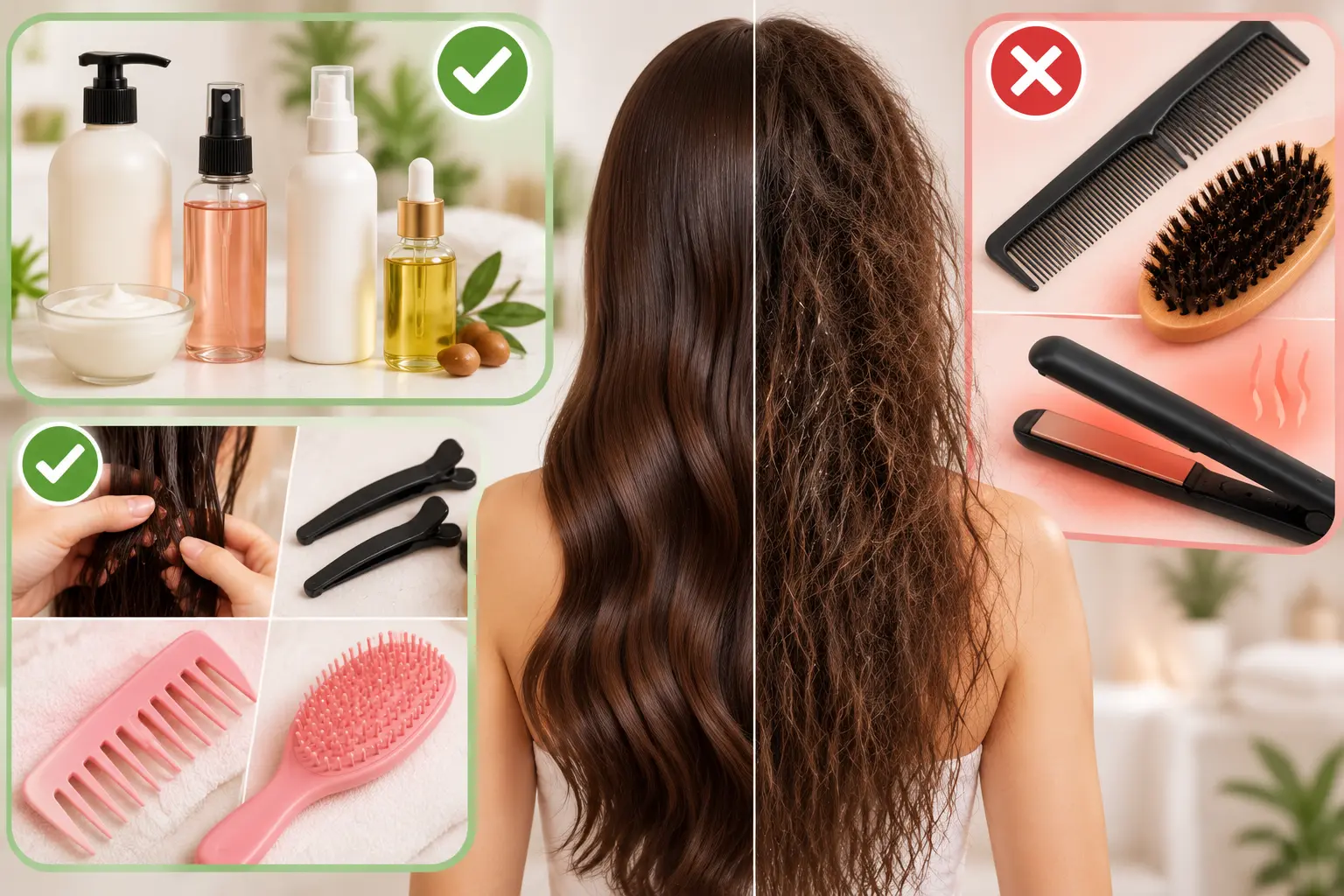
The best products for matted hair are moisturizing conditioner, detangling spray, leave-in conditioner, and light natural oils used carefully. The best tools are fingers, sectioning clips, a wide-tooth comb, and a flexible detangling brush. Avoid fine combs, harsh bristles, and high heat on tight mats.
Product Types That Add Slip
Slip is the main goal when you need to detangle matted hair. The product should help strands glide apart instead of locking together.
Useful options include:
- Rinse-out conditioner: Good for wet detangling and post-wash smoothing.
- Leave-in conditioner: Helpful for ongoing dryness and daily softness.
- Detangling spray: Convenient for light to medium knots.
- Hair mask: Useful for dry, processed, or coarse hair.
- Coconut oil or olive oil: Helpful in small amounts for dry ends, but not ideal near adhesives.
- Silicone serum: Can smooth frizz, but buildup should be monitored.
I do not suggest using random household oils or thick butters on extensions without testing. Some ingredients coat the hair heavily and attract dust. Others make tape or bonds slip.
Tool Selection Matters
A tool should match the severity of the tangle.
| Situation | Best Tool | Why It Helps |
|---|---|---|
| Tight mat | Fingers | Highest control and lowest force |
| Medium knot | Wide-tooth comb | Separates strands without too much tension |
| Light tangling | Detangling brush | Smooths quickly |
| Root separation | Fingers or loop brush | Protects bonds and wefts |
| Final styling | Paddle brush | Adds polish after detangling |
I always hold the hair above the knot while combing. This reduces pulling on the scalp, weft, tape, or bond. For installed extensions, this is especially important because pulling can cause discomfort or shedding.
When to Stop and Ask a Professional
Sometimes, the safest decision is to stop. If the hair is severely matted close to the scalp or attachment points, a professional stylist should evaluate it. A trained stylist can decide whether to detangle, remove, reinstall, or trim the hair.
Professional help is wise when:
- The mat is close to the scalp.
- The client feels pain during detangling.
- Extensions are pulling on natural hair.
- Tape or bonds are slipping.
- The hair is severely dry or gummy.
- The knot does not loosen after conditioning.
- The client may have scalp sensitivity.
For wholesale buyers and salon owners, tool and product recommendations should be part of customer support. A simple “how to care for your human hair extensions” guide can reduce complaints and help customers get better wear time from the product.
How Should Buyers Evaluate Hair Quality to Reduce Tangling Complaints?
Buyers should evaluate hair quality before large orders because tangling complaints can become expensive. I have seen brands focus only on color charts and packaging, but wear performance matters more. Smooth movement, cuticle condition, and batch consistency all affect customer satisfaction.
To reduce tangling complaints, buyers should test hair samples for washing, brushing, heat styling, shedding, color stability, and wear simulation. They should verify supplier claims, review quality control standards, and compare multiple batches before scaling orders. Professional evaluation is useful for application-specific decisions.
Practical Tests Before Bulk Purchasing
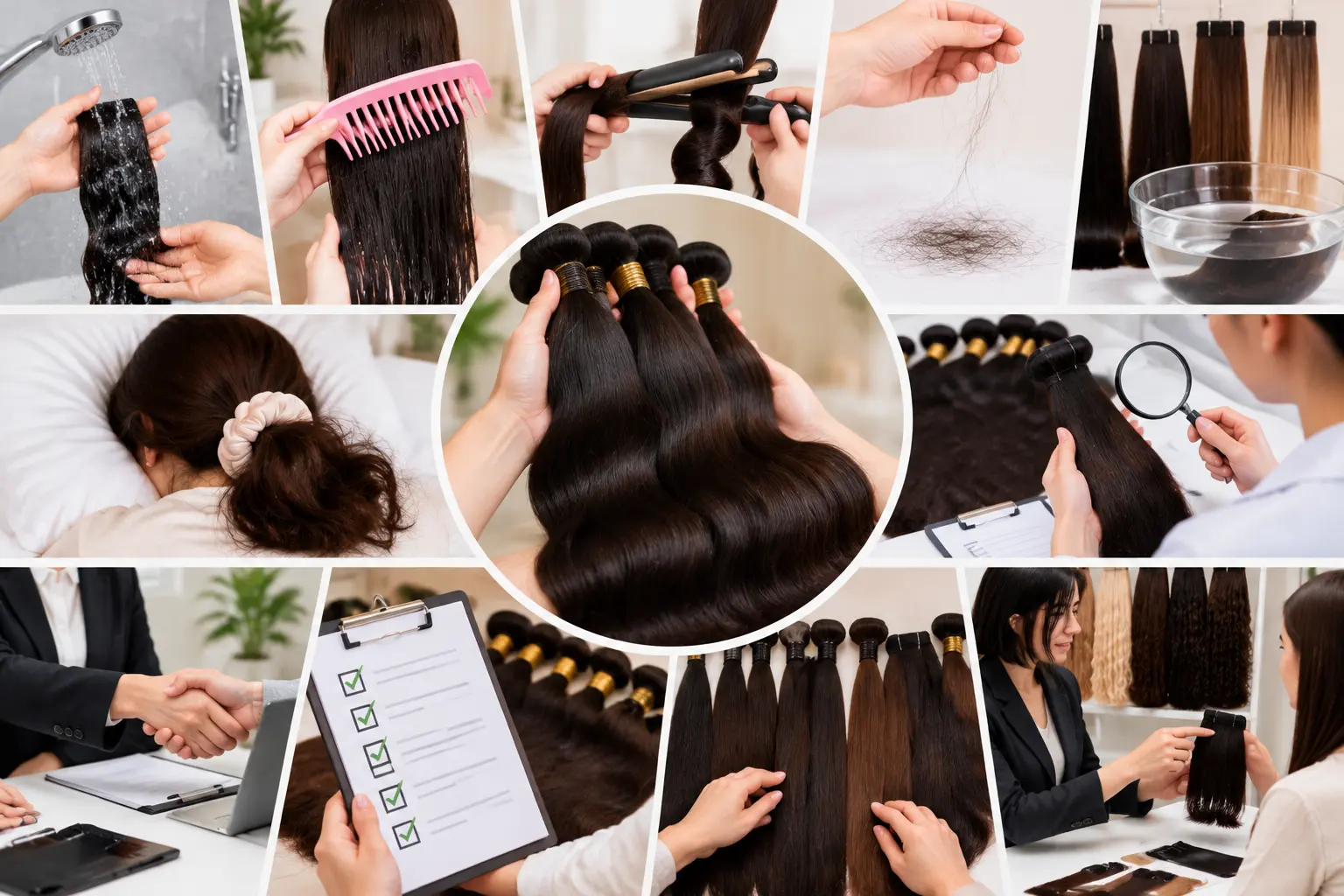
A sample can look beautiful on day one. The real question is how it behaves after washing, drying, brushing, and styling. I recommend structured testing because casual touching is not enough.
A basic buyer test plan can include:
-
Initial inspection
Check length, weight, color, odor, weft construction, and strand alignment. -
Comb test
Comb from ends upward and note resistance, shedding, and breakage. -
Wash test
Wash with a standard gentle shampoo and conditioner. Observe tangling during and after washing. -
Air-dry test
Let hair dry naturally. Check frizz, wave pattern, and cuticle roughness. -
Heat test
Use moderate heat and observe smoothness, smell, and elasticity. -
Wear simulation
Rub the hair lightly against fabric to simulate friction at the nape. -
Repeat test
Repeat washing several times. Some issues appear after the second or third wash.
What Buyers Should Ask Suppliers
For B2B sourcing, clear questions help avoid misunderstandings. I suggest asking suppliers for details, not vague promises.
Useful questions include:
- Is the hair Remy or cuticle intact?
- What origin or grade description is used?
- What processing is used for color or texture?
- How is the hair inspected before shipment?
- Can the supplier provide pre-shipment photos or videos?
- Can the supplier support custom lengths and colors?
- What aftercare guidance is recommended?
- What is the policy for quality feedback?
Certifications, inspection records, and quality claims should be treated as documents to verify. Buyers should review them carefully and request clarification when needed.
Why Supplier Consistency Matters
One good bundle is not enough for a brand. Professional buyers need repeatable quality. If one batch performs well and the next batch tangles quickly, customer trust can decline.
At RENAI HAIR, we manufacture and supply products such as Genius Weft, Flex Weft, Machine Weft, Hand Tied Weft, Tape In Hair, Keratin Hair, Clip In Hair, Halo Hair, Ponytail, and Hair Topper products. From my perspective, stable quality control and careful inspection before shipment are essential for long-term B2B cooperation.
However, I still encourage buyers to test samples based on their own market needs. A salon that sells blonde tape-ins may have different expectations from a wholesaler selling dark machine wefts. Product selection should match the customer base, styling habits, climate, and price position.
Frequently Asked Questions
Can I detangle matted hair without cutting it?
Yes, you can often detangle matted hair without cutting it if the knot is not too tight or damaged. Saturate the area with conditioner, wait 20–30 minutes, then use your fingers and a wide-tooth comb. Severe mats may need professional help.
Should I detangle matted hair wet or dry?
You should not brush matted hair completely dry. Lightly damp hair with conditioner or detangling spray usually gives better slip. However, soaking fragile hair can make it stretch[^12]. Work gently and support the hair above the knot.
Why do human hair extensions tangle at the nape?
Human hair extensions often tangle at the nape because that area has constant friction from collars, scarves, sweat, and pillows. The nape is also easy to miss during brushing. Daily separation and loose nighttime braiding can reduce this problem.
What should I avoid when trying to detangle matted hair?
Avoid dry brushing, pulling from the roots, using fine-tooth combs too early, applying high heat, or ripping through knots. These actions can cause breakage, shedding, and damage to extension attachment points.
How can salons reduce customer complaints about tangling?
Salons can reduce tangling complaints by choosing consistent hair suppliers, testing samples, installing extensions correctly, and teaching aftercare. A printed care card, maintenance schedule, and product recommendations can help customers prevent matting at home.
Conclusion
Learning how to detangle matted hair is mostly about patience, moisture, and the right technique. You should soften the knot first, separate strands with your fingers, comb from the ends upward, and prevent future tangling with daily care. For hair extension brands, wholesalers, and salons, product quality and customer education both matter. If you are sourcing stable human hair extensions for your market, contact RENAI HAIR to discuss samples, product options, colors, lengths, and wholesale solutions.
[^1]: "Hair breakage during combing. III. The effects of bleaching ...", https://pubmed.ncbi.nlm.nih.gov/17728947/. Studies of hair-fiber mechanics show that combing forces and repeated grooming can produce tensile and surface damage, supporting the caution that forceful detangling may convert knots into breakage. Evidence role: mechanism; source type: paper. Supports: Combing and grooming forces can mechanically damage hair fibers, especially when resistance is high.. Scope note: Most studies measure controlled combing or tensile stress rather than real-life severe matting. [^2]: "On Hair Care Physicochemistry: From Structure and ... - PMC", https://pmc.ncbi.nlm.nih.gov/articles/PMC9921463/. Cosmetic-science research reports that conditioning agents can lower hair-fiber friction and reduce combing force, providing a mechanistic basis for applying conditioner or detangling spray before separating tangles. Evidence role: mechanism; source type: paper. Supports: Conditioning agents can reduce friction and combing forces in hair fibers.. Scope note: The evidence generally concerns laboratory hair tresses and may not directly quantify effects on dense mats. [^3]: "Systems Approach to Human Hair Fibers - PMC", https://pmc.ncbi.nlm.nih.gov/articles/PMC6393780/. Hair-fiber and dermatology literature identifies friction and repeated mechanical contact as contributors to tangling and matting, which contextualizes why high-contact areas such as the nape may be especially vulnerable. Evidence role: general_support; source type: paper. Supports: Friction and repeated mechanical contact contribute to hair tangling and mat formation.. Scope note: The source may support friction as a mechanism without ranking the nape as the most common site. [^4]: "Plica Neuropathica as a Presenting Rare Dermatologic ... - PMC", https://pmc.ncbi.nlm.nih.gov/articles/PMC10386835/. Dermatology reports on acquired hair matting describe tangled hair fibers becoming compacted into larger masses, supporting the claim that untreated knots can progressively trap more strands. Evidence role: mechanism; source type: paper. Supports: Hair matting can progress as tangled fibers compact and incorporate additional strands.. Scope note: Clinical reports often involve severe or unusual matting and may not directly represent ordinary extension tangles. [^5]: "Effect of Oil Application, Age, Diet, and Pigmentation on the ...", https://pmc.ncbi.nlm.nih.gov/articles/PMC5387873/. Research on human hair mechanical properties links fiber diameter with tensile and bending behavior, supporting the view that finer strands may be more vulnerable to deformation and breakage. Evidence role: mechanism; source type: paper. Supports: Hair-fiber diameter is related to mechanical behavior, including bending and breakage susceptibility.. Scope note: The evidence supports mechanical susceptibility but may not directly measure wrapping around adjacent strands. [^6]: "The what, why and how of curly hair: a review - PMC", https://pmc.ncbi.nlm.nih.gov/articles/PMC6894537/. Studies of hair morphology and curvature indicate that curved fibers interact differently from straight fibers, providing a mechanistic basis for curly strands interlocking during tangling. Evidence role: mechanism; source type: research. Supports: Hair curvature affects fiber interactions and can contribute to tangling behavior.. Scope note: The evidence may address curl geometry and combing behavior rather than directly observing every type of mat. [^7]: "Effect of fiber entanglement in chopped glass fiber reinforced ...", https://pmc.ncbi.nlm.nih.gov/articles/PMC10782114/. Research on fiber entanglement and hair-combing behavior supports the general principle that longer fibers have more opportunities for contact, friction, and wrapping interactions. Evidence role: general_support; source type: research. Supports: Longer fibers have greater opportunity for contact and entanglement.. Scope note: The support is partly extrapolated from general fiber-entanglement mechanics rather than a direct clinical study of long hair. [^8]: "Effects of excessive bleaching on hair: comparative analysis ... - PMC", https://pmc.ncbi.nlm.nih.gov/articles/PMC11652465/. Reviews in dermatology and cosmetic science describe bleaching, coloring, permanent waving, and heat exposure as causes of cuticle disruption and reduced hair-fiber integrity. Evidence role: expert_consensus; source type: paper. Supports: Chemical treatments and heat can damage the hair cuticle and alter fiber integrity.. [^9]: "Physiology, Sebaceous Glands - StatPearls - NCBI Bookshelf", https://www.ncbi.nlm.nih.gov/books/NBK499819/. Educational dermatology sources explain that sebaceous glands associated with hair follicles secrete sebum that coats scalp hair, supporting the distinction between growing hair and detached extensions. Evidence role: definition; source type: education. Supports: Sebum is produced by sebaceous glands associated with hair follicles and can coat the hair shaft.. Scope note: The source establishes sebum physiology; the extension-care implication follows from extensions being detached from follicles. [^10]: "Assessment of hair surface roughness using quantitative ...", https://pubmed.ncbi.nlm.nih.gov/28722291/. Hair-surface studies show that cuticle disruption increases roughness and combing resistance, supporting the mechanism by which damaged strands catch on one another and tangle more readily. Evidence role: mechanism; source type: paper. Supports: Cuticle damage increases surface roughness and can raise friction or combing resistance.. [^11]: "Investigation of scale effects and directionality dependence ...", https://pubmed.ncbi.nlm.nih.gov/16675116/. Studies of the directional friction effect in human hair show that cuticle scale orientation influences friction, supporting the general claim that aligned cuticles can reduce inter-fiber catching compared with mixed orientations. Evidence role: mechanism; source type: paper. Supports: Hair cuticle scale orientation produces directional friction effects.. Scope note: The evidence supports the physics of cuticle orientation, not the quality claims of any specific extension supplier. [^12]: "Comparing hair tensile testing in the wet and the dry state - PMC", https://pmc.ncbi.nlm.nih.gov/articles/PMC9544838/. Hair-fiber mechanical studies show that water absorption alters tensile properties and increases extensibility, supporting the caution that fragile wet hair may stretch during detangling. Evidence role: mechanism; source type: paper. Supports: Water absorption changes hair-fiber mechanical properties, including elasticity and tensile behavior.. Scope note: The source supports changes in fiber mechanics under wet conditions but does not establish a single safe moisture level for all hair types.