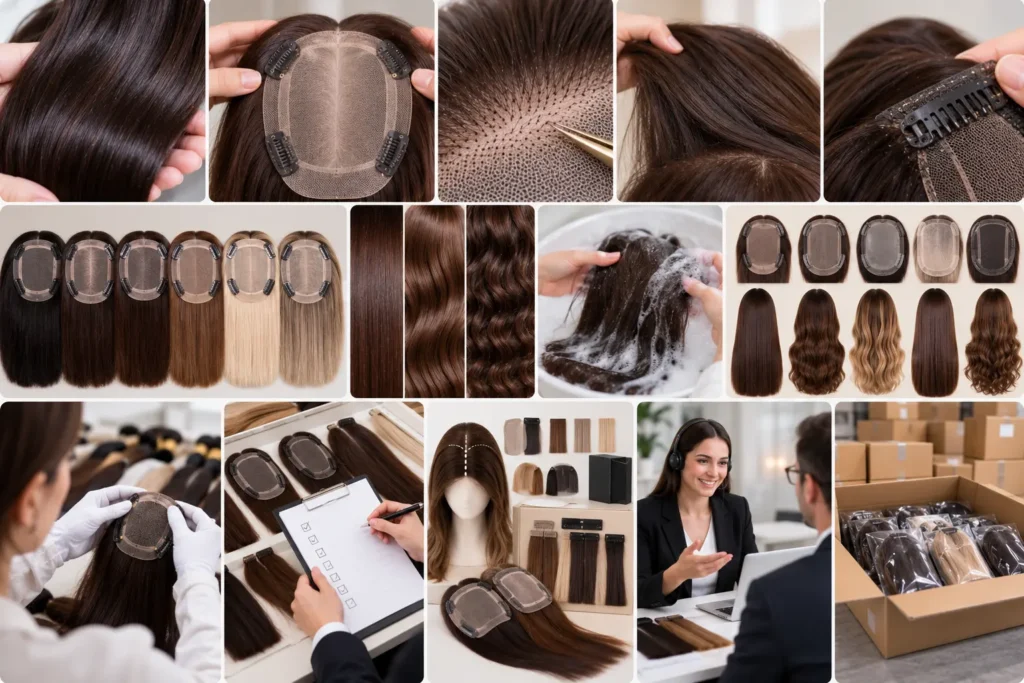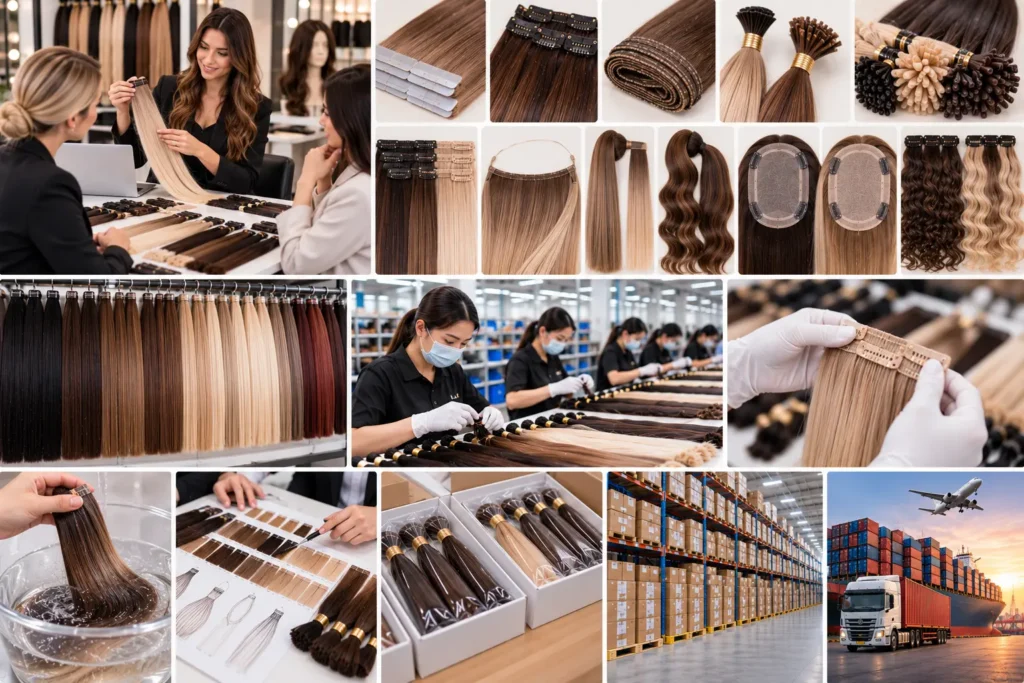

Hair Topper Wholesale: How to Choose Human Hair Toppers for Your Business
Hair topper wholesale can feel complicated when your customers expect natural coverage, lightweight comfort, and consistent quality. If you choose the wrong base, density, or supplier, returns and complaints can quickly damage trust. I use this guide to break down the practical buying factors that help professional hair businesses choose more confidently.
Hair topper wholesale buyers should choose human hair toppers by checking hair quality, base construction, base size, density, color range, attachment method, and supplier consistency. The best topper is not always the fullest one. It is the one that blends naturally, feels comfortable, and fits the customer’s coverage needs.
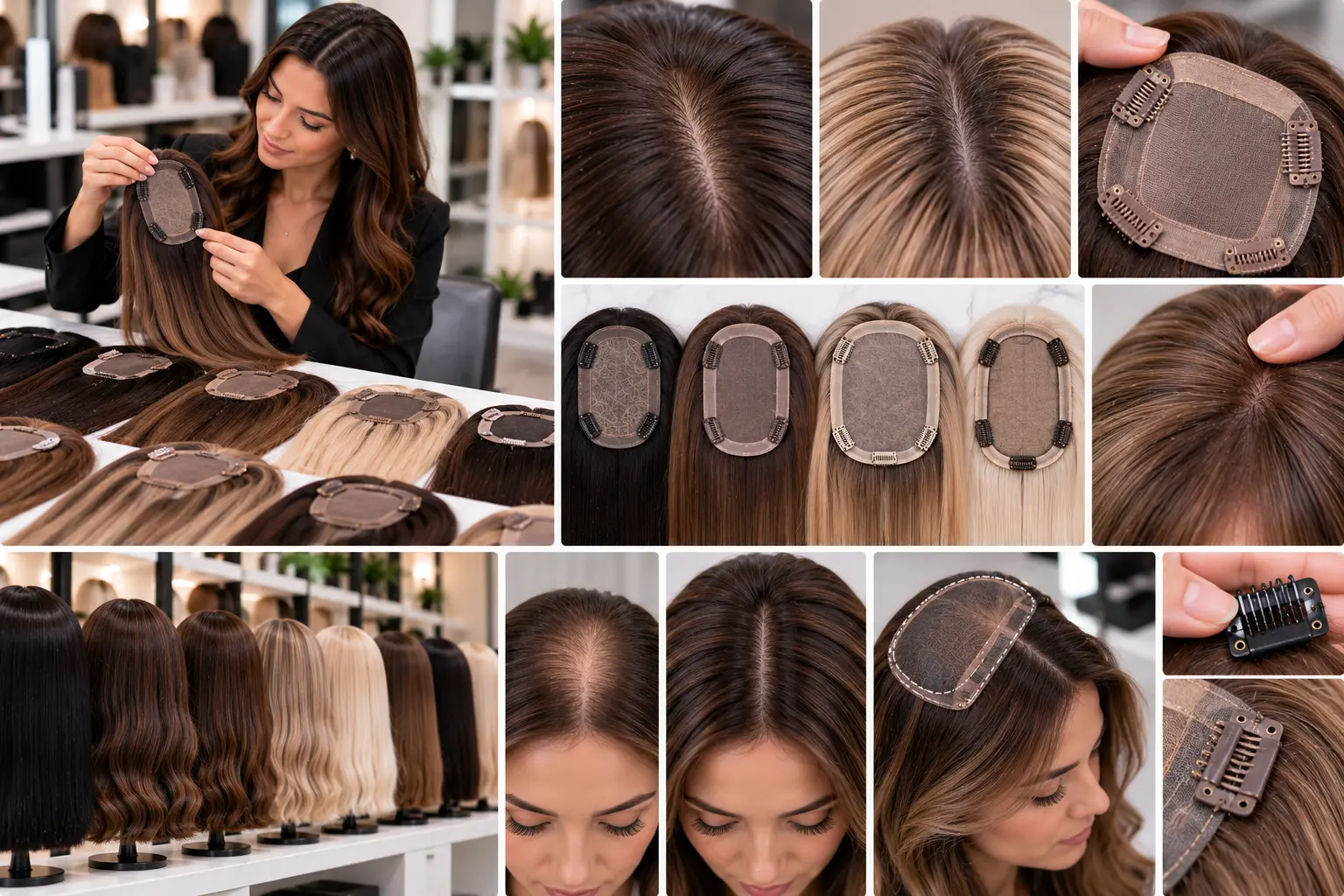
The human hair topper market keeps growing because more customers want coverage and volume without wearing a full wig.[^1] However, a topper is a technical product. I always recommend evaluating both the hair and the construction before adding any style to a wholesale catalog.
What Is Hair Topper Wholesale and Why Is Demand Growing?
Hair topper wholesale is becoming more relevant because many customers want targeted coverage instead of a full-head solution. The challenge is that toppers must blend with existing hair, so small quality issues become visible fast. I see this category as a high-opportunity product, but only when buyers understand fit, finish, and function.
Hair topper wholesale means sourcing hairpieces in bulk for salons, distributors, online stores, and hair replacement businesses. A hair topper covers a specific area on the top of the head and blends with the wearer’s natural hair.[^2] Buyers should select toppers by coverage area, base design, density, hair quality, and color match.
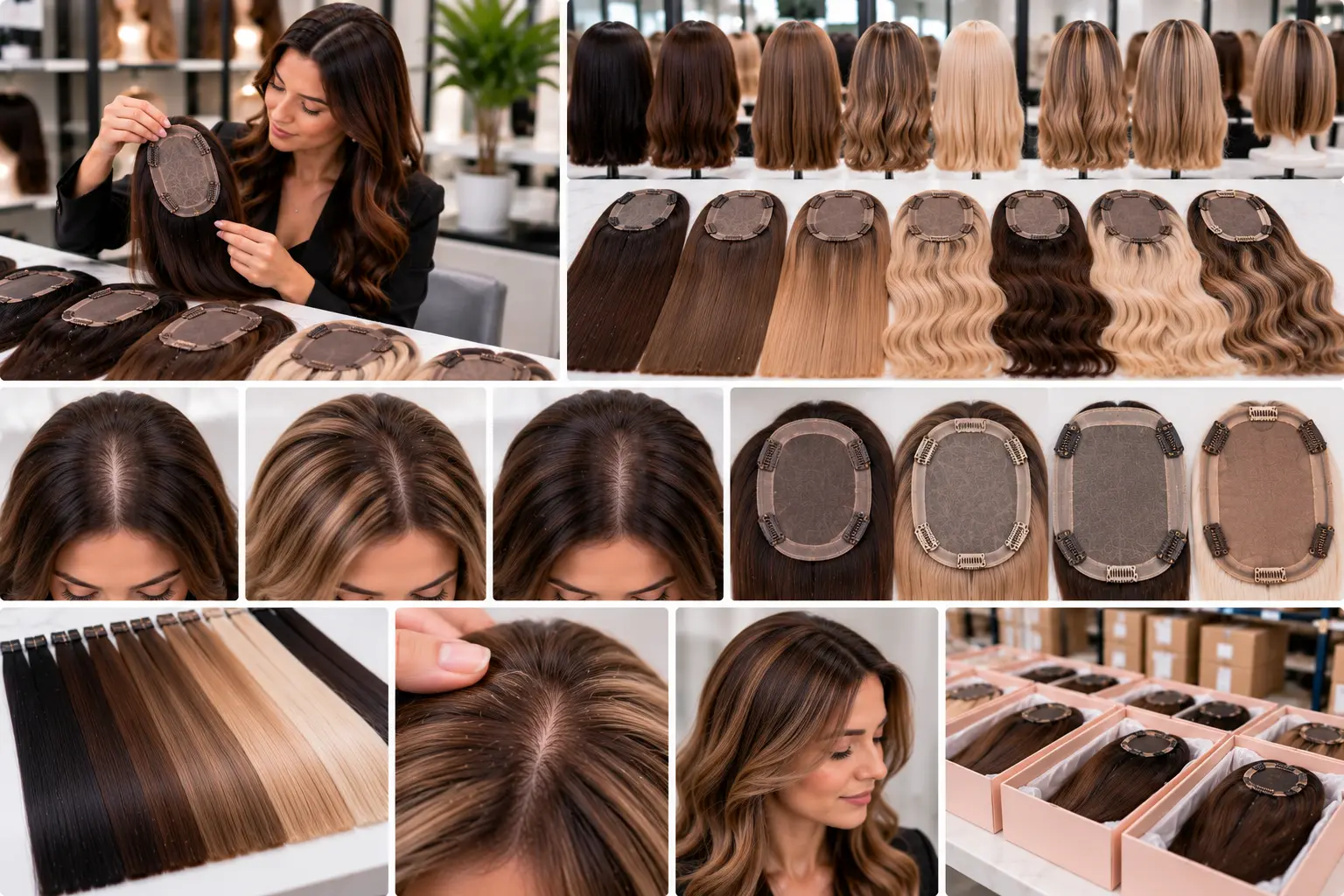
What a hair topper does
A hair topper is a wearable hairpiece designed to cover a targeted area on the top of the head. Unlike a full wig, a topper does not cover the entire scalp. It works with the customer’s existing hair to create the appearance of:
- More volume
- More density
- Better top coverage
- Added length
- A more balanced hairstyle
I often describe toppers as a middle category between extensions and wigs. They are not only for adding length, and they are not always meant to replace all natural hair. Their main value is targeted improvement.
Why the market is expanding
The demand for human hair toppers has increased because customers want solutions that feel lighter and look more natural. Many people do not want the coverage or heat of a full wig. They may only need support at the crown, part line, or top area.[^3]
For B2B buyers, this creates useful opportunities:
| Buyer Type | Typical Topper Need | Best Wholesale Focus |
|---|---|---|
| Salons | Natural coverage for consultations | Popular colors, moderate densities, easy attachment |
| Hair replacement studios | Custom fitting and blending | Multiple base sizes, premium construction |
| Distributors | Broad market coverage | Wide catalog and stable repeat supply |
| Online hair brands | Clear product listings | Accurate photos, size charts, color options |
| Beauty supply stores | Ready-to-sell products | Common lengths, simple packaging, competitive pricing |
Why toppers are more demanding than standard extensions
A topper sits on a visible part of the head. The base, knots, parting area, and color blend are all easy to notice. This means wholesale buyers should not evaluate only the hair strand quality. They should also inspect the full product.
When I review a topper sample, I look at these points first:
- Does the hair move naturally?
- Does the base sit flat?
- Does the color match the product photo?
- Do the clips feel secure but not bulky?
- Does the density look realistic from the front and crown?
For professional buyers, the goal is not simply to buy “more hair.” The goal is to source a reliable human hair topper collection that helps customers feel confident and helps the business reduce service problems.
How Should Hair Topper Wholesale Buyers Compare Human Hair and Synthetic Toppers?
Hair topper wholesale buyers often start with one big choice: human hair or synthetic fiber. This decision affects price, styling, customer education, and positioning. If a business chooses the wrong category for its target customers, the product may look good at first but fail during daily use.
Human hair toppers usually offer more natural movement and more styling flexibility than synthetic toppers.[^4] Synthetic toppers may be convenient and lower priced, but heat resistance and appearance vary by fiber. Professional buyers should choose based on target customer expectations, retail price level, styling needs, and after-sale support capacity.
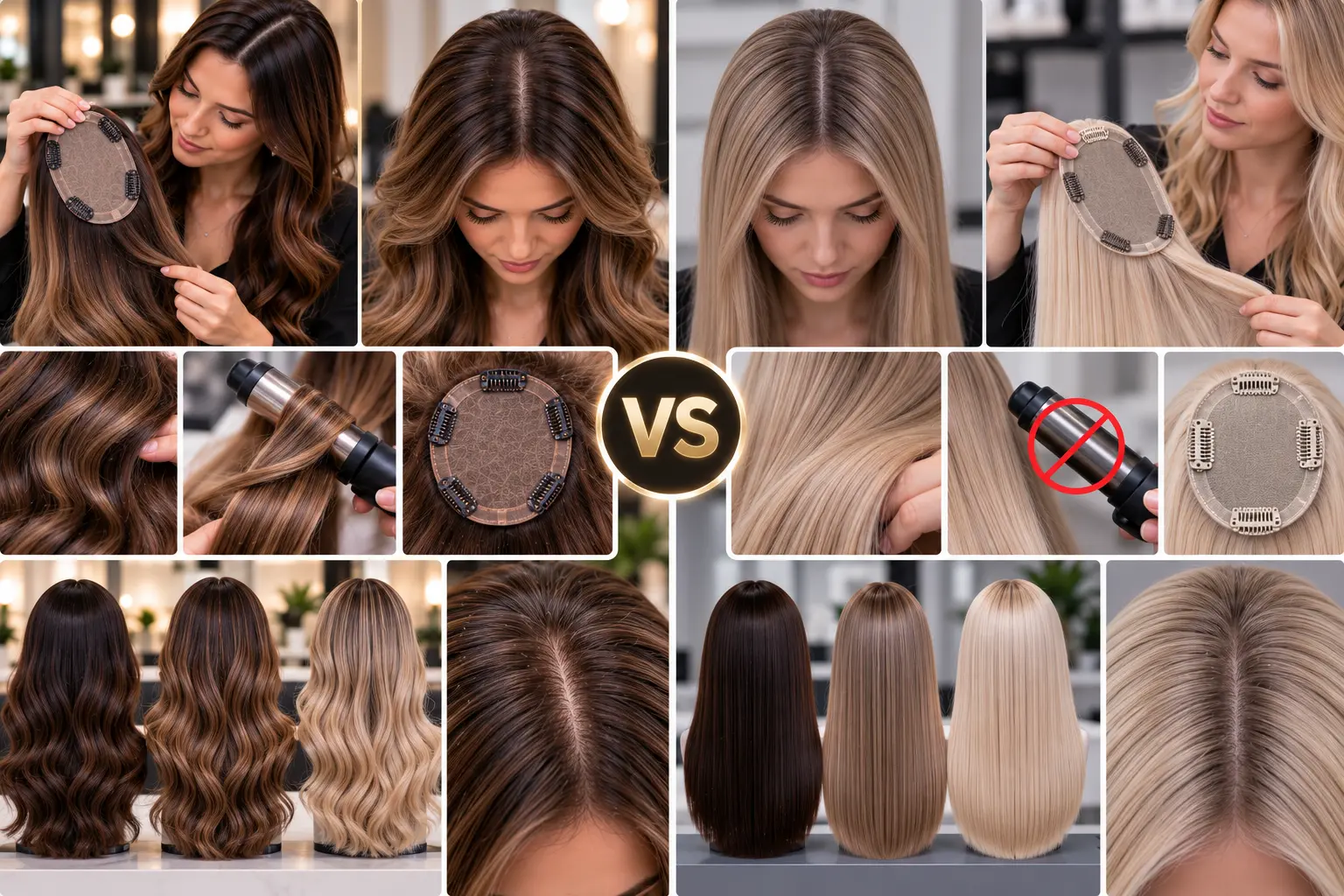
Human hair toppers
Human hair toppers are often preferred by salons, hair replacement professionals, and premium hair brands because they can look and move more like natural hair. Depending on the exact hair quality, processing, and care instructions, human hair may be washed, blow-dried, curled, or straightened in ways similar to biological hair.
For my business context at RENAI HAIR, we focus on 100% Human Hair, Remy Hair, and Cuticle Intact Hair product development and supply. I still advise buyers to verify product specifications on each order because terms like “Remy” and “cuticle intact” should be supported by supplier transparency, sample testing, and consistent quality control.
Key advantages of human hair toppers include:
- Natural movement when the wearer walks or styles the hair
- Better blending with existing human hair
- More color and styling possibilities, depending on processing
- Higher perceived value for professional salons and brands
- Better fit for premium consultations
However, human hair toppers also require education. Customers need to understand washing, heat styling, storage, brushing, and product care. A buyer should prepare care cards, stylist training, or product videos if selling to end users.
Synthetic hair toppers
Synthetic toppers may be useful for businesses that want lower entry pricing or pre-styled products. Some synthetic fibers hold their shape well and need less daily styling. However, synthetic hair varies widely. Some fibers cannot tolerate heat. Some fibers appear shiny under bright light. Some may tangle or frizz differently from human hair.
A buyer should ask these questions before choosing synthetic toppers:
- What is the fiber type?
- Is the fiber heat-resistant?
- What heat temperature is allowed?
- Does the style return after washing?
- How long does the topper usually last with normal use?
- Does the supplier provide care instructions?
Human hair vs synthetic topper comparison
| Factor | Human Hair Topper | Synthetic Topper |
|---|---|---|
| Appearance | Usually more natural | Varies by fiber quality |
| Styling flexibility | Higher, depending on specs | Limited or fiber-dependent |
| Price level | Higher | Usually lower |
| Maintenance | Requires proper care | Often easier day to day |
| Heat styling | Often possible with care | Must verify heat resistance |
| Best for | Salons, premium brands, stylists | Budget lines, ready-style products |
For B2B procurement, I would not say one option is always better. I would ask, “Who is your customer?” If your customers want premium styling, natural movement, and professional customization, human hair toppers wholesale is usually the stronger category. If your customers want a simple low-cost solution, synthetic may have a place in your assortment.
Which Hair Topper Wholesale Base Construction Should I Choose?
Hair topper wholesale decisions depend heavily on base construction because the base controls comfort, coverage, ventilation, parting, and front appearance.[^5] A topper with beautiful hair can still disappoint if the base is bulky, scratchy, or hard to blend. I always treat the base as a quality-control priority.
Buyers should choose hair topper base construction by matching the base material to the customer’s coverage needs and styling expectations. Common options include lace, mono, silk-style, and combination bases. Important factors include base size, ventilation, parting area, density, clip placement, front finish, and overall comfort.
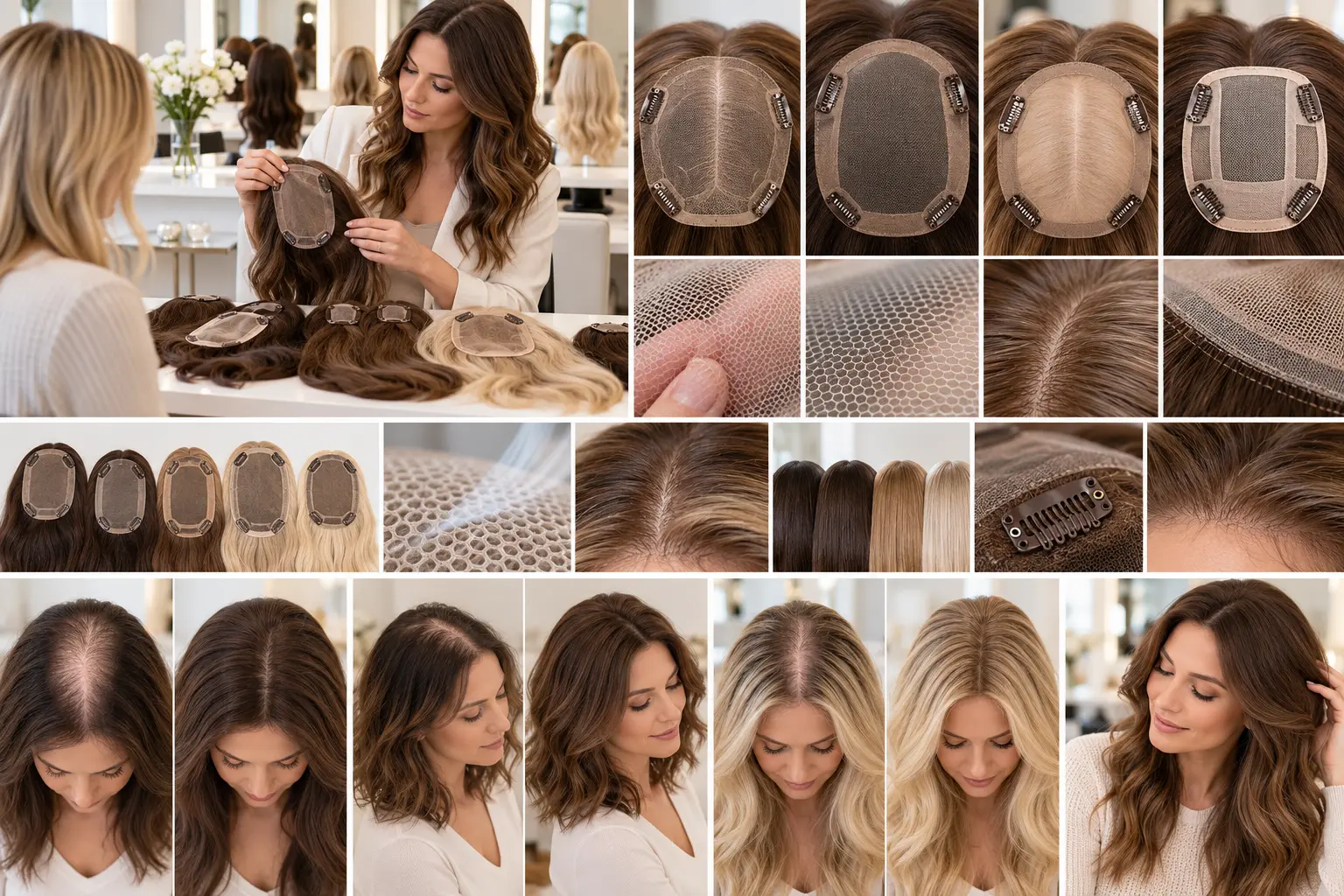
Common base types
Different topper bases serve different needs. Buyers should request clear specifications and close-up photos before confirming a bulk order.
| Base Type | Common Benefit | Buyer Consideration |
|---|---|---|
| Lace base | Lightweight and breathable | May require careful handling |
| Mono base | Natural scalp-like parting | Can cost more than basic bases |
| Silk-style base | Smooth appearance at parting area | May feel thicker than lace |
| Combination base | Balances comfort and durability | Specs vary by design |
| Wefted section base | Can add volume efficiently | May be less natural at parting |
Why base construction matters
The base is the part of the topper that touches the customer’s head. It affects comfort during long wear. It also affects whether the topper lies flat and blends well with existing hair.
When I inspect topper construction, I usually check:
- Base edge finish: The edges should not feel rough or bulky.
- Ventilation direction: Hair should fall naturally from the base.
- Parting area: The part should look believable for the intended customer.
- Clip position: Clips should support security without pulling too much.[^6]
- Stitching: The work should look clean and stable.
- Front appearance: The front should not look heavy or obvious.
- Density transition: Hair should not look unnaturally thick at the hairline.
How to match base type to customer needs
A customer who wants breathable daily wear may prefer a lace or lightweight combination base.[^7] A customer who wants a realistic part may prefer mono or silk-style construction. A customer who needs more volume may accept a slightly stronger structure if it gives better coverage.
For salons, I usually suggest starting with a practical range instead of too many complex designs. For example:
- Small base topper for part line volume
- Medium base topper for crown coverage
- Larger base topper for broader top coverage
- Premium base option for clients who need a more realistic part
This approach helps a salon explain options without overwhelming customers. It also helps distributors build a clear catalog. In hair topper wholesale, the best base is not the most expensive base. The best base is the one that fits the customer’s actual coverage area, comfort expectation, and styling routine.
How Do I Select Base Size, Density, and Color for Human Hair Toppers?
Base size, density, and color can make or break a topper sale. A high-quality human hair topper may still look wrong if it is too dense, too small, or poorly matched. I have seen buyers focus on length first, but professional results usually start with coverage and blending.
Buyers should select base size by coverage area, density by natural blending needs, and color by the wearer’s existing hair. A wholesale collection should include several base dimensions, realistic density options, and core colors such as black, brown, blonde, rooted shades, highlights, and dimensional blends.
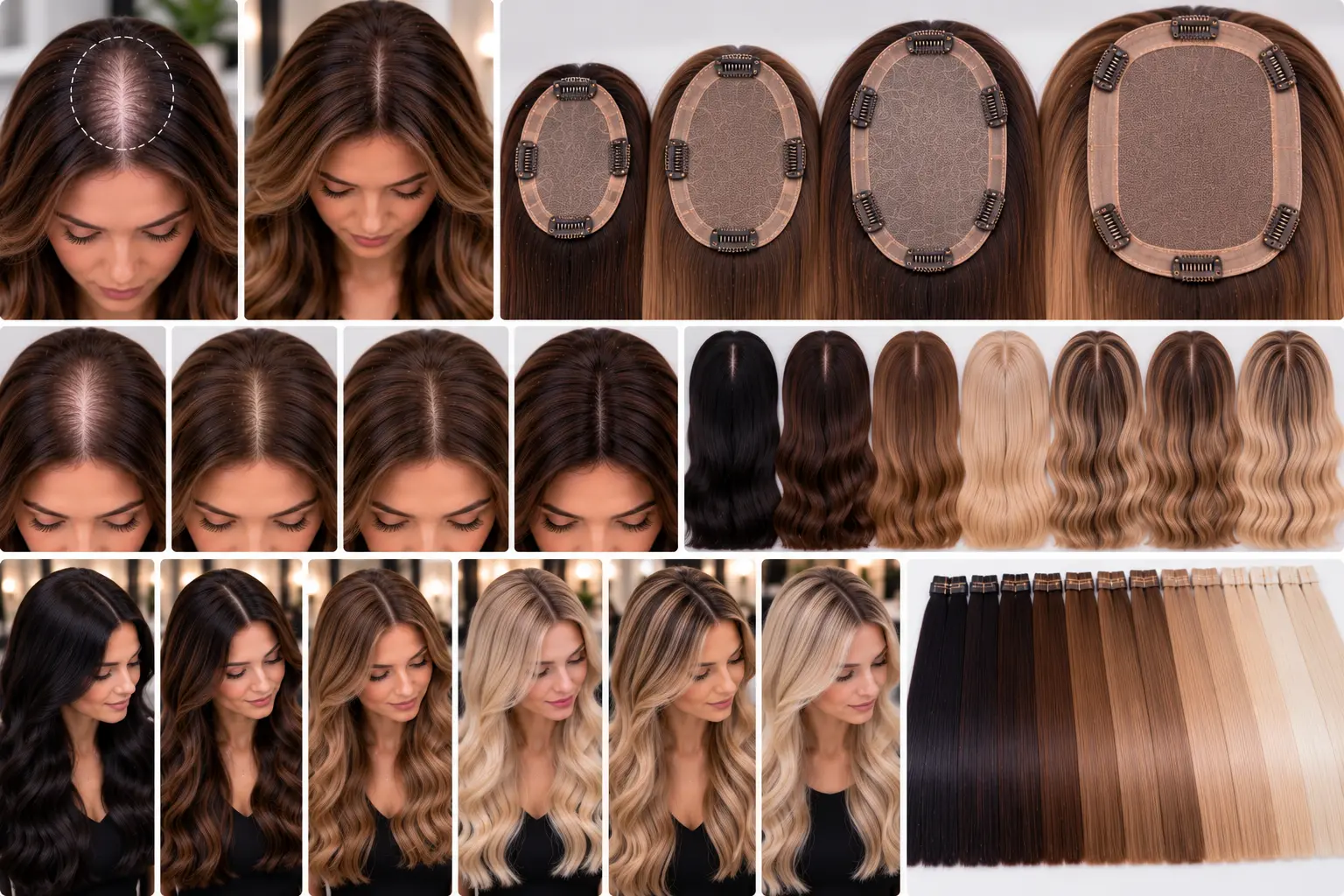
Choosing the right base size
Base size determines how much area the topper covers. A smaller base can help with targeted volume near the part line. A larger base can cover more of the crown and top area.
Wholesale buyers should ask suppliers for exact measurements, such as:
- 3" x 5"
- 4" x 5"
- 5" x 5"
- 6" x 6"
- 7" x 8"
- Custom dimensions, if available
Product pages should show dimensions clearly. I prefer listings that include both inches and centimeters because B2B customers often sell into different markets.
A clear size chart helps salons avoid consultation mistakes:
| Customer Need | Possible Base Direction | Notes |
|---|---|---|
| Light part line volume | Small base | Best for subtle fullness |
| Crown density support | Medium base | Common salon option |
| Wider top coverage | Larger base | Needs careful blending |
| Custom hair replacement | Custom base | Requires professional fitting |
Choosing hair topper density
Density affects how full the topper looks. Many new buyers assume higher density is better. I disagree. Too much density can make a topper hard to blend, especially if the customer has fine or low-density natural hair.[^8]
A natural topper should match the wearer’s existing hair as much as possible. The density should support coverage without creating a “cap” effect.
Common density positioning may include:
- Light density: More natural for fine hair or subtle volume
- Medium density: Good for many salon customers
- Medium-heavy density: Useful for clients who want fuller styling
- Custom density: Best for specialized hair replacement work
Choosing color selection
Color matching is especially important for toppers because the product sits near the customer’s own hair. A mismatch is easy to see around the sides and back.
A professional wholesale range may include:
- Black
- Natural black
- Dark brown
- Medium brown
- Light brown
- Dark blonde
- Light blonde
- Rooted shades
- Highlighted shades
- Balayage or dimensional blends
- Grey blends, depending on market demand
I also recommend physical color rings whenever possible. Photos are useful, but lighting, screens, and editing can affect color perception.[^9] For online brands, product photos should show the topper in natural light, indoor light, and close-up detail.
Why length is not the only selling point
Length matters, but it should come after base, density, and color. A long topper that does not blend will not satisfy the customer. A shorter topper with accurate color and natural density may create a better result.
For B2B buyers, I suggest building a balanced assortment:
- Start with popular base sizes
- Add core colors
- Choose natural densities
- Offer two or three lengths
- Expand into rooted and highlighted shades after testing demand
This method reduces inventory risk and gives your sales team a clear way to guide customers.
What Should I Check Before Choosing a Hair Topper Wholesale Supplier?
Choosing a hair topper wholesale supplier is not just about getting a low unit price. If quality changes between orders, your business absorbs the complaints. I always look for suppliers who can explain specifications clearly, support sample testing, and maintain reasonable consistency over repeat production.
Before choosing a hair topper wholesale supplier, buyers should check hair quality, base construction, color consistency, product range, customization ability, packaging options, quality control process, and communication speed. A reliable supplier should provide clear specifications, realistic samples, and stable follow-up support for salons, distributors, and private-label brands.

Hair quality
Hair quality should be evaluated before and after washing. A topper may look beautiful out of the package, but the real test starts after handling, washing, drying, and styling.
I recommend checking:
- Softness before washing
- Smoothness after washing
- Tangling level
- Shedding level
- Hair movement
- Dry ends
- Color fading
- Odor
- Response to heat styling, within recommended limits
If the supplier describes the product as Remy Hair or Cuticle Intact Hair, buyers should still test samples and confirm order specifications. These terms matter, but professional procurement should rely on verification, not only claims.
Base construction and finishing
A good supplier should understand topper structure. They should be able to explain the base material, size, clip design, density, parting area, and ventilation.
Ask for:
- Close-up base photos
- Inside construction photos
- Clip and stitching details
- Density information
- Parting area details
- Available customization options
Color consistency
Color consistency is critical for wholesale businesses. Customers expect repeat orders to match previous purchases as closely as possible. Human hair is a natural material, and some variation can occur, especially with complex colors.[^10] However, suppliers should have clear color standards and quality checks.
Professional buyers can ask:
- Does the supplier use color rings?
- Can they match previous order colors?
- How do they control rooted shades?
- How do they manage highlighted blends?
- Can they provide batch photos before shipment?
Product range and customization
A strong supplier should support your market position. A salon may need selected styles. A distributor may need a broader collection. A private-label brand may need packaging, color development, or custom base specifications.
At RENAI HAIR, our product work covers human hair extensions and topper solutions, including different lengths, colors, textures, and product designs. For any professional buyer, I still suggest discussing exact specifications before ordering because each market has different customer expectations.
Useful supplier capabilities include:
- Multiple base sizes
- Multiple lengths
- Core and fashion colors
- Custom density
- Private-label packaging
- Sample support
- Product development support
- Clear pre-shipment inspection
A supplier is part of your product reputation. If they communicate clearly before the order, they are more likely to help when your business needs adjustments later.
Why Should I Sample Test Hair Toppers Before a Wholesale Order?
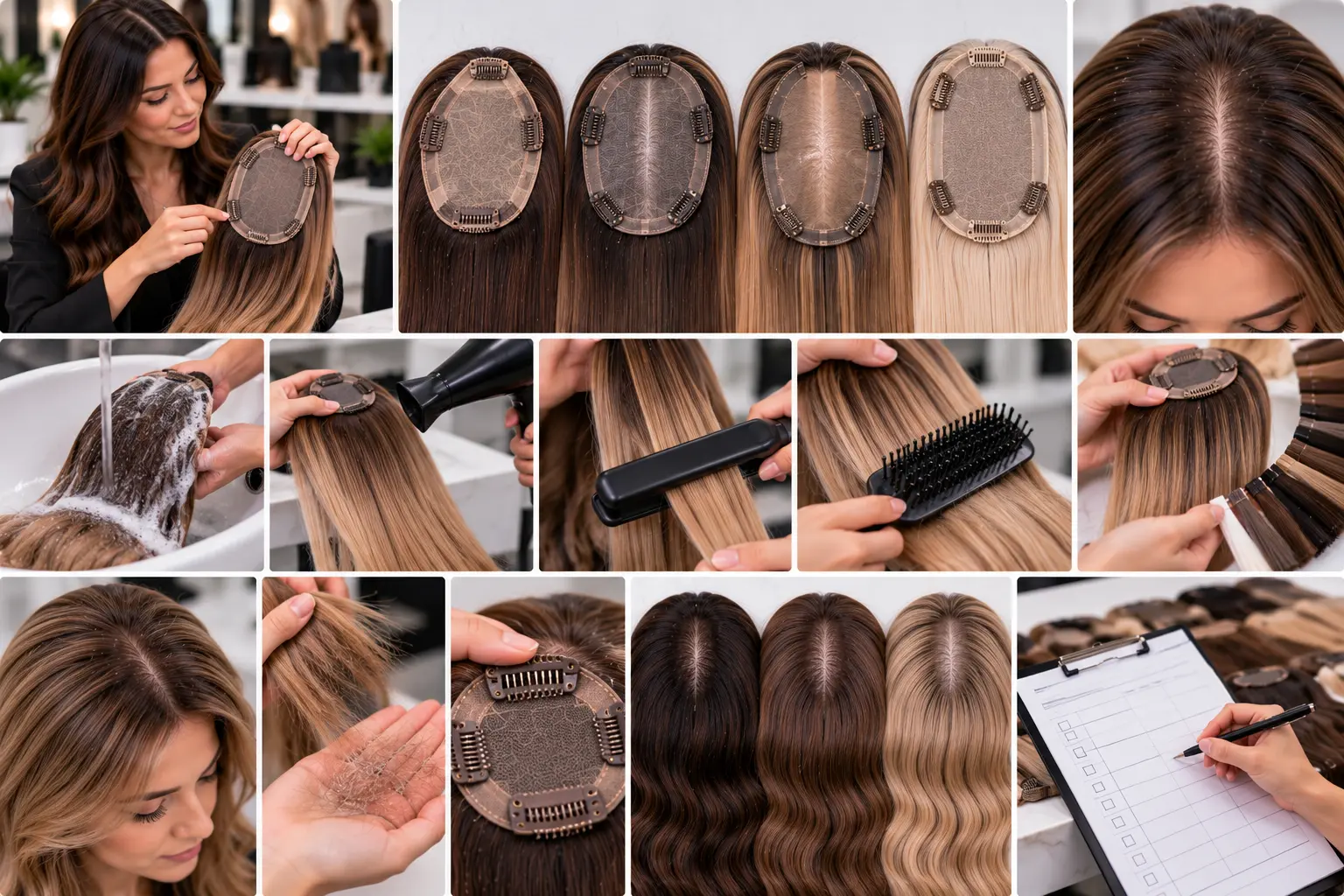
Sample testing protects your business from costly mistakes. A topper can look good in a catalog photo, but photos cannot show comfort, shedding, clip security, or post-wash behavior.[^11] I always prefer testing a small order before making a larger hair topper wholesale commitment.
Wholesale buyers should sample test hair toppers to verify hair quality, base comfort, color accuracy, density, shedding, styling response, clip security, and overall construction. Testing helps compare suppliers fairly and reduces risk before bulk purchasing. Buyers should document results after washing, drying, styling, and natural-light inspection.
What to test first
A sample test should be structured. If a buyer only opens the package and touches the hair, the test is not complete. I recommend creating a simple internal checklist so every sample is judged the same way.
Test these areas:
-
Initial appearance
- Does the topper match the product description?
- Is the color close to the requested shade?
- Does the density look balanced?
-
Base comfort
- Does the base feel soft enough?
- Do the edges sit flat?
- Are clips placed in practical positions?
-
Hair performance
- Does the hair tangle easily?
- Does the hair shed during brushing?
- Does the hair remain smooth after washing?
-
Styling performance
- Does the topper part naturally?
- Does it blow-dry well?
- Does it hold a curl or smooth finish, if appropriate?
-
Natural-light review
- Does the color look accurate outside?
- Does the shine look natural?
- Does the topper blend with sample hair or a model?
A practical sample testing table
| Test Item | Why It Matters | Pass/Concern Notes |
|---|---|---|
| Washing | Shows real hair behavior | Check dryness, tangling, color runoff |
| Blow-drying | Tests styling response | Look for frizz or uneven texture |
| Brushing | Shows shedding and strength | Record shedding level |
| Clip security | Affects daily wear | Clips should hold without bulk |
| Parting | Affects realism | Part should look natural |
| Base comfort | Affects customer satisfaction | Edges should not irritate |
| Color in daylight | Affects match accuracy | Check under natural light |
Why documentation matters
Supplier comparison becomes easier when you document the process. I suggest taking photos and short videos at each stage. Use the same lighting and the same test process for each supplier. This creates a fair comparison and helps your team explain decisions.
For distributors, documentation also helps train sales teams. For salons, it helps stylists understand which topper works best for which client. For online brands, it helps build accurate product descriptions.
When to approve a bulk order
A sample does not guarantee every bulk order will be perfect, but it reduces risk. Before approving production, buyers should confirm:
- Final base size
- Hair length
- Hair color
- Density
- Texture
- Clip type
- Packaging
- Labeling
- Quantity
- Quality standard
- Pre-shipment inspection process
I recommend starting with a controlled first wholesale order. After customer feedback and internal testing, your business can expand the catalog with more sizes, shades, and custom options.
Frequently Asked Questions
What is the difference between a hair topper and a wig?
A hair topper covers a targeted area, usually on the top or crown, and blends with the wearer’s existing hair. A wig covers most or all of the scalp. Toppers are often lighter and more focused on volume, density, or partial coverage.
Are human hair toppers suitable for salons?
Yes, human hair toppers can be suitable for salons because they allow cutting, blending, and styling flexibility, depending on the product specifications. Salons should still test samples, train stylists, and explain care instructions clearly to customers before selling or fitting toppers.
What should I check before buying hair toppers wholesale?
You should check hair quality, base construction, base size, density, color options, clip security, shedding, tangling, packaging, and supplier consistency. I also recommend washing and styling samples before placing a larger wholesale order.
Can hair toppers be customized?
Yes, customization may be available depending on the manufacturer. Buyers can ask about base size, length, color, density, texture, packaging, labels, and private-label options. Custom orders usually require clear specifications, sample approval, and production lead time.
How many colors should a wholesale hair topper collection include?
A starter collection can focus on core shades such as black, dark brown, medium brown, light brown, blonde, and rooted colors. As demand grows, buyers can add highlighted shades, dimensional blends, grey blends, and custom colors based on market feedback.
Conclusion
Hair topper wholesale works best when buyers evaluate the full product, not only the hair length or price. The right human hair topper should combine natural hair movement, suitable base construction, realistic density, accurate color, and stable supplier quality. I recommend starting with samples, documenting tests, and building a focused assortment before scaling. If you are sourcing human hair toppers for a salon, distributor, or private-label brand, contact RENAI HAIR to discuss product specifications, samples, and wholesale cooperation.
[^1]: "Female pattern hair loss: Current treatment concepts - PMC", https://pmc.ncbi.nlm.nih.gov/articles/PMC2684510/. Market and epidemiological sources report growth in the broader wigs and hairpieces sector and substantial prevalence of hair thinning, which provides contextual support for increased demand for partial-coverage products such as toppers. Evidence role: statistic; source type: research. Supports: The source should support growth in the wigs, hairpieces, or hair-extension market and connect demand to hair-loss coverage, volume, or partial-hair solutions.. Scope note: Most neutral sources may track wigs, hairpieces, extensions, or alopecia prevalence broadly rather than isolating human hair toppers as a separate product category. [^2]: "Hair Toppers for Women", https://www.americanhairloss.org/non-surgical-hair-replacement/toppers/. Reference definitions of partial hairpieces describe them as hair additions intended to cover a limited area of the scalp while integrating with existing hair, supporting the article’s distinction between toppers and full wigs. Evidence role: definition; source type: encyclopedia. Supports: The source should define a topper or partial hairpiece as a hairpiece that covers a limited scalp area and is integrated with the wearer’s own hair.. Scope note: Terminology varies across cosmetology, medical-wig, and retail contexts, so a source may use related terms such as partial wig, hairpiece, or hair system rather than topper. [^3]: "Female pattern hair loss: Current treatment concepts - PMC", https://pmc.ncbi.nlm.nih.gov/articles/PMC2684510/. Dermatology literature on female pattern hair loss describes thinning that commonly involves the central part, crown, or frontal–vertex scalp, providing medical context for partial coverage at the top of the head. Evidence role: mechanism; source type: paper. Supports: The source should explain that common forms of patterned hair loss often affect the crown, central part, or top scalp.. Scope note: This evidence supports the anatomical pattern of hair thinning, not the commercial performance of any specific topper product. [^4]: "Synthetic vs Human Hair Wigs: Pros and Cons", https://www.dimpleshair.com/a/blog/synthetic-vs-human-hair-wigs-pros-cons?srsltid=AYCX9vK_JGzJYLEz165z3VE4FSS7kkGf_pX8pq4eTo-cxu030xxUBbEX. Cosmetic-science and fiber studies distinguish keratin-based human hair from synthetic fibers in heat response and styling behavior, supporting the general claim that human hair pieces can offer broader styling flexibility. Evidence role: general_support; source type: paper. Supports: The source should compare human hair and synthetic hair fibers in terms of heat response, styling behavior, appearance, or mechanical properties.. Scope note: Movement and natural appearance also depend on processing, density, construction, and maintenance, so fiber type alone does not prove the quality of a finished topper. [^5]: "What Type of Wig Cap Is Best for You?", https://www.breastcancer.org/treatment-side-effects/hair-loss/wigs/cap-types. Cosmetology and cranial-prosthesis training materials describe cap construction, lace, monofilament, and base materials as factors affecting ventilation, fit, and the appearance of the parting area. Evidence role: mechanism; source type: education. Supports: The source should describe how wig or hairpiece cap materials and construction influence ventilation, fit, scalp comfort, and visual realism.. Scope note: Educational sources may describe standard industry practice rather than provide controlled experimental measurements for each base type. [^6]: "Involvement of Mechanical Stress in Androgenetic Alopecia", https://pmc.ncbi.nlm.nih.gov/articles/PMC4639964/. Dermatology reviews of traction alopecia identify repeated mechanical tension on hair shafts and follicles as a cause of hair loss, supporting the need for secure attachments that do not create excessive pulling. Evidence role: mechanism; source type: paper. Supports: The source should explain that sustained traction or mechanical tension on hair can contribute to traction alopecia or hair breakage.. Scope note: The evidence concerns traction generally and may not evaluate the exact clip designs used in modern toppers. [^7]: "1 Mono Base for Crown Extension, Monofilament Closure ...", https://www.amazon.com/Topper-volumiser-Thinning-Toupee-extension/dp/B07ZVWBR2K. Training materials on wig and hairpiece construction commonly identify lace and lightweight cap designs as more ventilated structures, which supports their use where breathability is a priority. Evidence role: mechanism; source type: education. Supports: The source should support that lace or lightweight/open cap constructions allow more airflow than denser cap constructions.. Scope note: Breathability in daily wear also depends on base size, hair density, adhesives or clips, climate, and individual scalp sensitivity. [^8]: "How to Choose the Right Hair Density for Your Men's ...", https://www.superhairpieces.com/blog/how-to-choose-the-right-hair-density-for-your-mens-hair-system-a-stylists-guide/?srsltid=AYCX9vJRA9jC6TxTk_ScetwKipQZhUIJPBvx_vDn153hU1ksRuz7Wuoz. Cosmetology guidance on hairpiece fitting emphasizes matching density and texture to the wearer’s existing hair to achieve a natural transition, supporting the warning against excessive density. Evidence role: expert_consensus; source type: education. Supports: The source should support that hairpiece density should be selected to match or harmonize with the wearer’s existing hair for a natural appearance.. Scope note: This supports professional fitting logic rather than providing a quantitative density threshold for all customers. [^9]: "The Eye of the Beholder: How Lighting Affects Our Color ...", https://www.nist.gov/blogs/taking-measure/eye-beholder-how-lighting-affects-our-color-perception. Color-science literature shows that color appearance depends on illumination, viewing conditions, and display characteristics, supporting the article’s caution that photographs may not reliably convey exact hair shade. Evidence role: mechanism; source type: paper. Supports: The source should explain that perceived color changes with illumination, viewing conditions, display calibration, or image processing.. Scope note: Color-science evidence is general and does not measure the exact error rate for online hair-topper product images. [^10]: "The diversity of the human hair colour assessed by visual ...", https://pubmed.ncbi.nlm.nih.gov/27506896/. Studies of human hair fibers describe natural variation in pigmentation, diameter, and structural properties, providing a mechanistic basis for batch-to-batch and shade variation in processed human hair products. Evidence role: mechanism; source type: paper. Supports: The source should support that human hair varies in pigment, diameter, structure, or response to chemical treatment, which can lead to shade variation.. Scope note: Such studies explain why variation can occur but do not define an acceptable commercial tolerance for wholesale topper colors. [^11]: "ISO 2859-1", https://chemistry.unt.edu/~tgolden/courses/iso2859-1.pdf. Quality-control standards and textile-testing guidance distinguish visual inspection from physical and performance testing, supporting the article’s point that photographs alone cannot verify wear comfort, shedding, attachment security, or washing behavior. Evidence role: general_support; source type: institution. Supports: The source should support the broader quality-control principle that physical inspection and performance testing are needed to evaluate product attributes not visible in photographs.. Scope note: General quality-control standards support the testing approach but may not be written specifically for hair toppers.