
How to blend hair extensions with short hair
To blend hair extensions with short hair, I first look at coverage, thickness, color, and styling direction. Short layers can stick out, create visible gaps, and make extensions look disconnected.[^1] The solution is to choose fuller extensions, place them strategically, and finish everything with careful cutting, styling, and brushing.
To blend hair extensions with short hair, choose thick double drawn extensions, match or mix colors carefully, place the wefts where they cover short layers, and style the natural hair and extensions together. I usually recommend 18-inch, 20-inch, or 22-inch clip in hair extensions for most short-hair transformations.
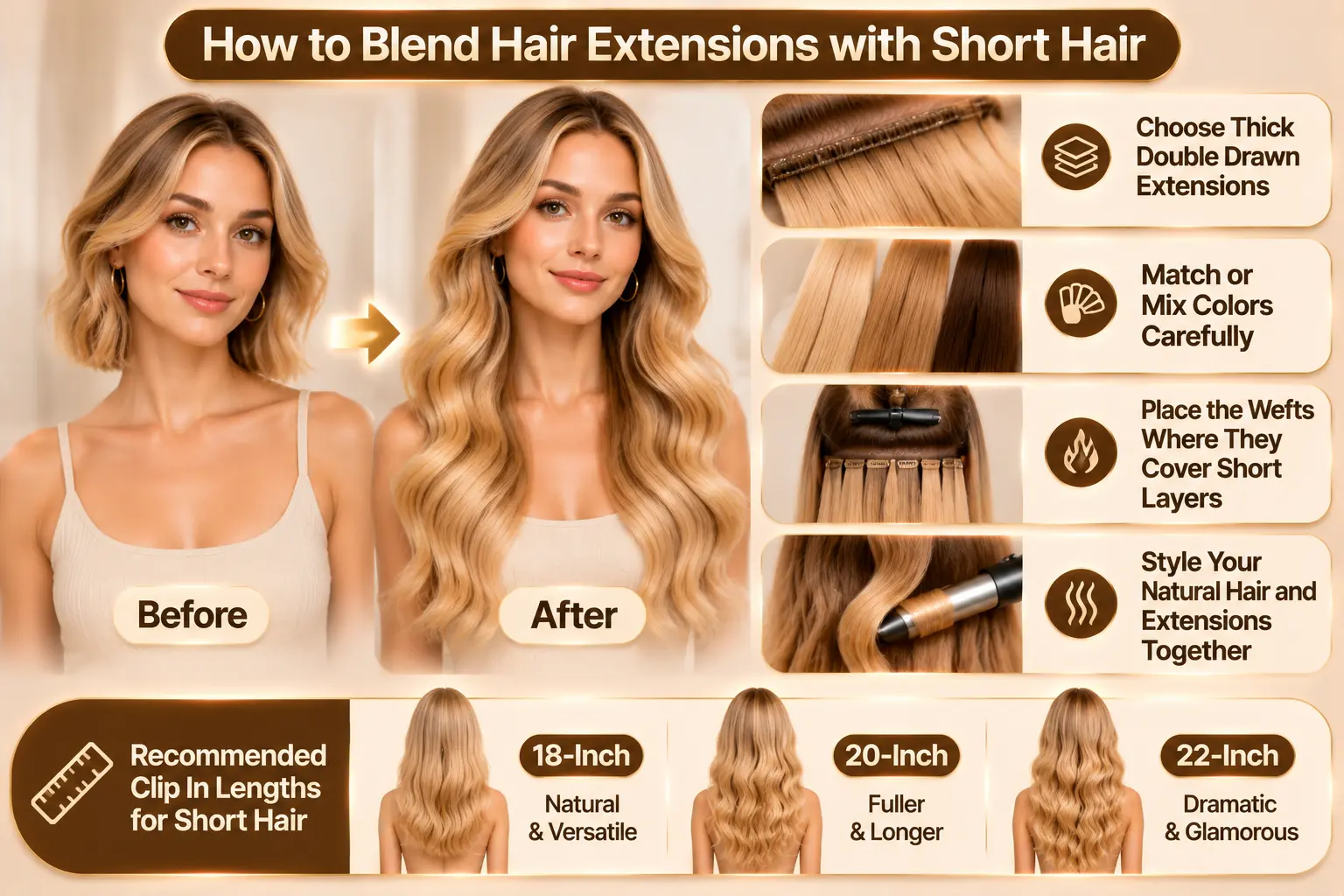
Short hair needs more support than medium or long hair because the natural ends are easier to see. I have seen even high-quality hair look obvious when the set is too thin. So, before I think about curls or waves, I start with the right extension structure.
How do I choose the right extensions to blend hair extensions with short hair?
Short hair can look bulky near the natural ends and thin near the extension ends. That contrast makes blending difficult. I solve this first by choosing extensions with enough density from top to bottom, because styling alone cannot fix a set that is too thin.
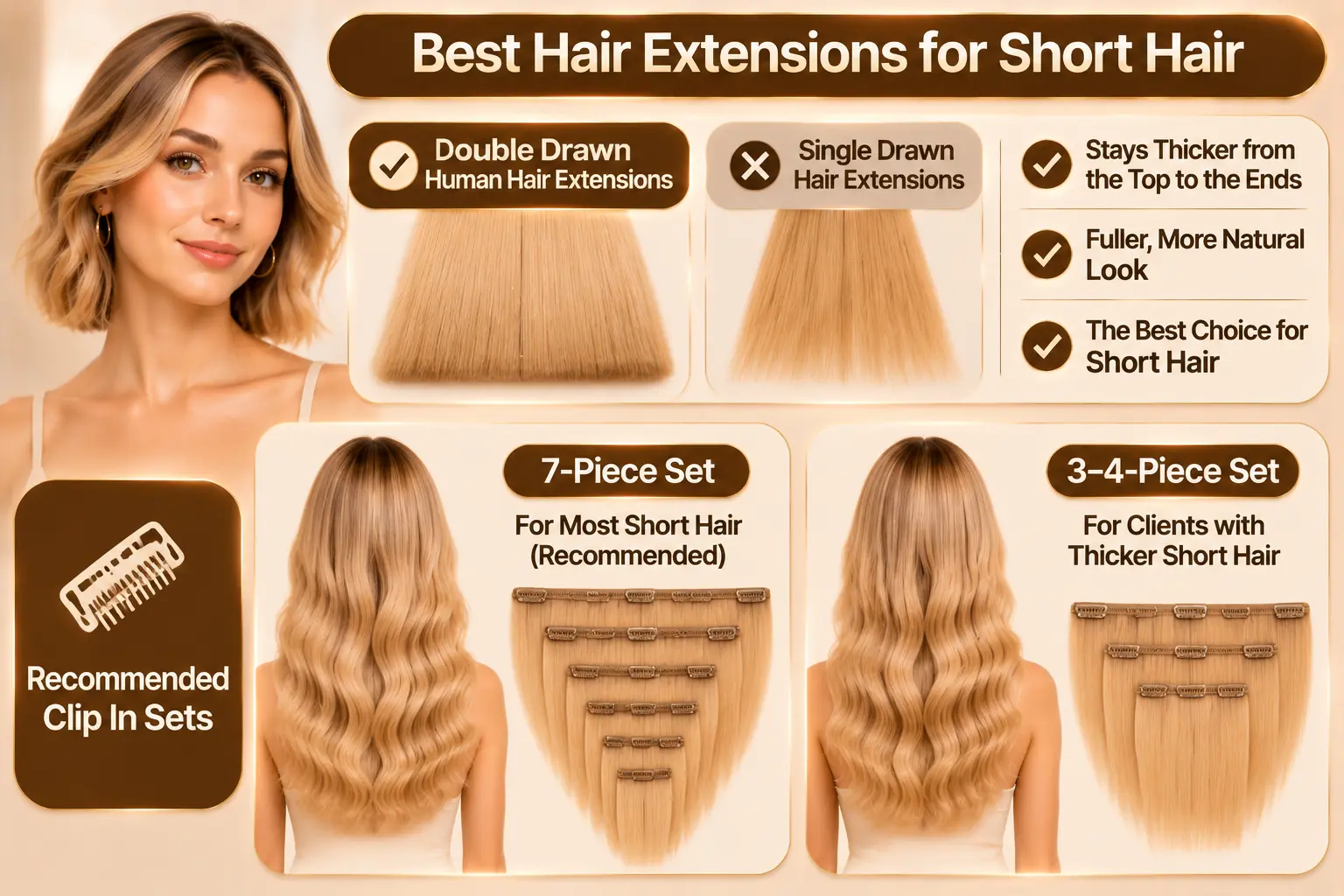
The best choice is usually double drawn human hair extensions[^2] because they stay thicker from the top to the ends. For short hair, I recommend fuller clip in sets, often 7 pieces, or 3–4 pieces if the client’s short hair is already thick enough.
Why double drawn hair matters
When I help clients or buyers evaluate hair extensions for short hair, I pay close attention to the end thickness. Short natural hair creates a visible line. If the extension ends are wispy, the contrast becomes stronger. Double drawn hair helps reduce that contrast because more strands are similar in length.
In simple terms:
- Single drawn hair has more short strands mixed in.
- Double drawn hair has a fuller look from top to bottom.
- Cuticle intact Remy hair usually performs better after styling, washing, and reuse.
- Thin ends can make short hair look disconnected from the extensions.
For short hair, I usually prefer a fuller set because the goal is not only length. The goal is coverage. The shorter the natural hair is, the more coverage the extensions need to hide the blunt layers.
How many pieces should I choose?
A 7-piece clip in hair extension set is a good starting point for many short-hair clients. It gives enough weft placement options around the head. This makes it easier to cover the short layers and create a soft transition.
However, I do not always recommend the same amount for every person. If the client has short hair that is not too thin, 3–4 pieces of clip in hair may be enough. If the hair is very blunt, thick, or cut above the shoulders, more pieces usually give a better result.
| Short Hair Type | Suggested Clip In Pieces | Main Reason |
|---|---|---|
| Thin short hair | 5–7 pieces | Adds body without leaving gaps |
| Medium short hair | 4–7 pieces | Balances coverage and comfort |
| Thick blunt short hair | 7 pieces or more | Covers strong natural hair lines |
| Short layered hair | 4–6 pieces | Blends layers more easily |
What length works best?
For most short-hair blending, I suggest:
- 18 inch clip in hair extensions
- 20 inch clip in hair extensions
- 22 inch clip in hair extensions
These lengths usually create a noticeable transformation without looking too extreme. If a client loves longer hair, longer extensions can also work. But I always remind buyers that the longer the extension, the more important density becomes[^3]. A very long but thin set may make short hair look more obvious.
From a supplier evaluation point of view, I also check whether the factory can keep length, weight, and end fullness consistent across repeat orders. At RENAI HAIR, we focus on 100% human hair, Remy hair, and cuticle intact hair options, but I always encourage buyers to verify samples, inspect bulk orders, and test the hair under real styling conditions.
What installation method helps blend hair extensions with short hair?
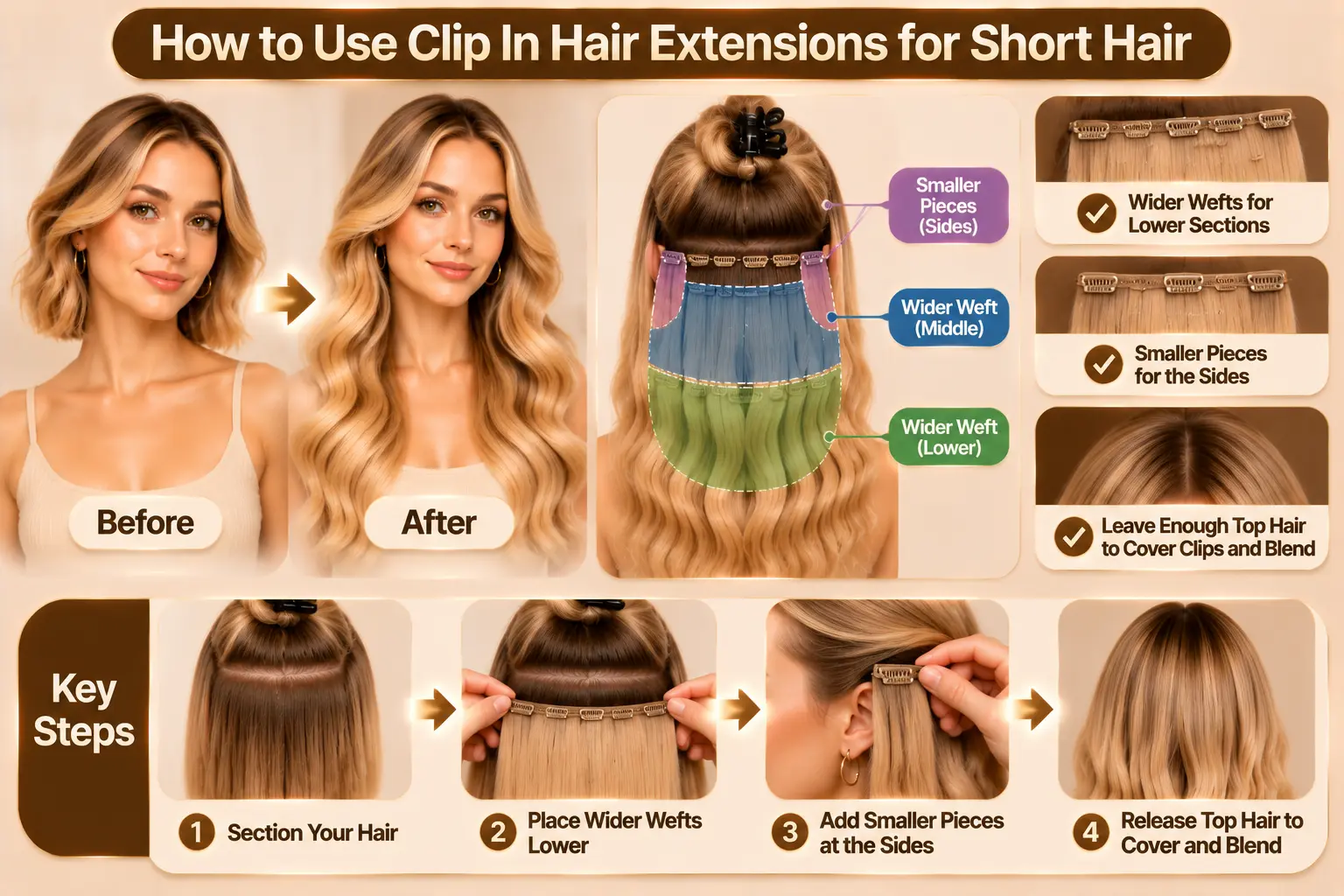
Short hair can expose clips, weft edges, or uneven sections if the installation is rushed. This is frustrating because even good hair can look unnatural. I prevent this by sectioning carefully, placing wefts below the visible crown area, and keeping enough natural hair on top.
Clip in hair extensions are often the easiest method for short hair because they allow flexible placement. I usually place wider wefts lower on the head, smaller pieces near the sides, and leave enough top hair to cover clips and blend the short layers.
Why clip ins work well for short hair
Clip in hair extensions are practical because they are removable, adjustable, and easy to reposition.[^4] This matters for short hair because every head shape and haircut behaves differently. A client with a blunt bob needs a different layout than a client with short layers.
I like clip ins for several reasons:
- They allow fast testing before a permanent method.
- They help stylists adjust placement during the appointment.
- They work well for special occasions and content shoots.
- They let the client remove the hair before sleeping[^5].
- They make it easier to mix two shades for dimension.
For B2B buyers, clip ins are also useful because they are easy to demonstrate in salons and beauty supply stores. A stylist can show the customer how coverage changes with different piece counts, lengths, and colors.
Basic placement guide
The goal is to create a foundation that hides short pieces without creating a bulky head shape. I usually follow this general approach:
-
Create a low horizontal section near the nape.
I place a smaller weft here if the client has enough hair to cover it. -
Add wider wefts through the middle back.
This area usually needs the most volume and length. -
Use side pieces carefully.
Short side layers are often the most visible, so I avoid placing clips too high. -
Leave enough hair at the crown.
The top layer must cover the clips and soften the transition. -
Check the profile and back view.
I always check the blend from multiple angles, not only from the front.
Common installation mistakes
Short hair leaves less room for error. I see a few mistakes often:
| Mistake | What Happens | Better Approach |
|---|---|---|
| Placing wefts too high | Clips become visible | Keep top section thicker |
| Using too few pieces | Short hair line shows | Add more coverage pieces |
| Choosing thin ends | Extensions look stringy | Use double drawn hair |
| Ignoring the sides | Front blend looks uneven | Add small side pieces |
| Skipping final brush-through | Hair separates into layers | Brush gently after clipping |
I also remind professional buyers that installation performance depends on product design. The clip strength, weft flexibility, hair weight, and return hair management all affect the customer experience. For procurement, I would request samples and check whether the clips hold firmly without pulling the natural hair.
How should I style natural hair and extensions for a seamless blend?
Short hair can separate from extensions when the textures do not match. Straight short hair over curled extensions, or curled short hair over straight extensions, creates a clear line. I solve this by styling both parts in the same direction and with the same finish.
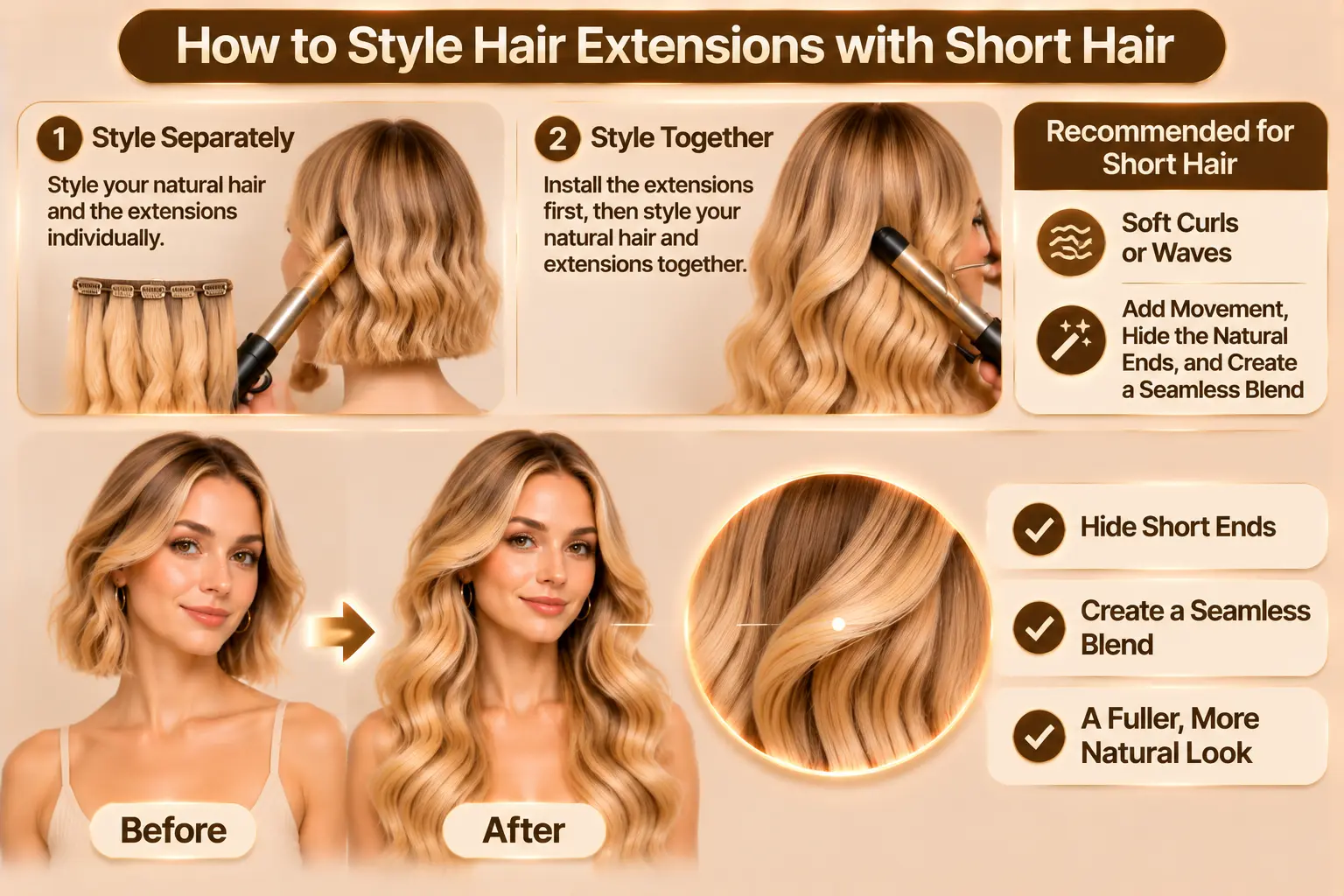
You can style natural hair and extensions separately, or you can style them together after installation. For short hair, I often prefer soft curls or waves because movement helps hide the natural ends and creates a more seamless blend[^6].
Styling separately vs. styling together
There are two good ways to style short hair with extensions.
Option one: style separately.
You can curl or straighten the natural hair first. Then you can style the extensions to mimic the same texture. This is useful if the client is new to extensions or if the extensions are being prepared before installation.
Option two: style together.
You can clip in the extensions and then curl or straighten all the hair together. This often creates the most natural result because the natural strands and extension strands move in the same pattern.
I usually tell clients to choose based on comfort. If they are working with a stylist, styling together is often easier. If they are getting ready at home, styling separately may feel more controlled.
Why curls and waves help short hair blend
Straight hair can be beautiful, but it is less forgiving. A blunt short haircut may show through straight extensions. Curls and waves help because they break up the visible line between the natural hair and the added hair.
Good options include:
- Loose waves for everyday wear
- Soft curls for a fuller salon look
- Face-framing bends to hide short side layers
- Textured ends to avoid a heavy bottom line
I often recommend a medium barrel curling iron or soft heat styling method. Buyers and salons should always test heat tolerance according to the supplier’s care instructions. Human hair extensions can usually be heat styled, but heat protection and temperature control still matter.[^7]
Why hair quality affects styling results
If the client wants the extensions to look good after repeated styling, I suggest choosing Remy cuticle intact hair extensions when budget allows. The cuticle direction helps reduce tangling, and the hair usually feels smoother after washing and styling.
From a manufacturing and procurement perspective, this is important. Two extension sets may look similar in photos, but they may behave differently after:
- Washing
- Curling
- Straightening
- Brushing
- Coloring tests
- Salon installation
- Customer wear testing
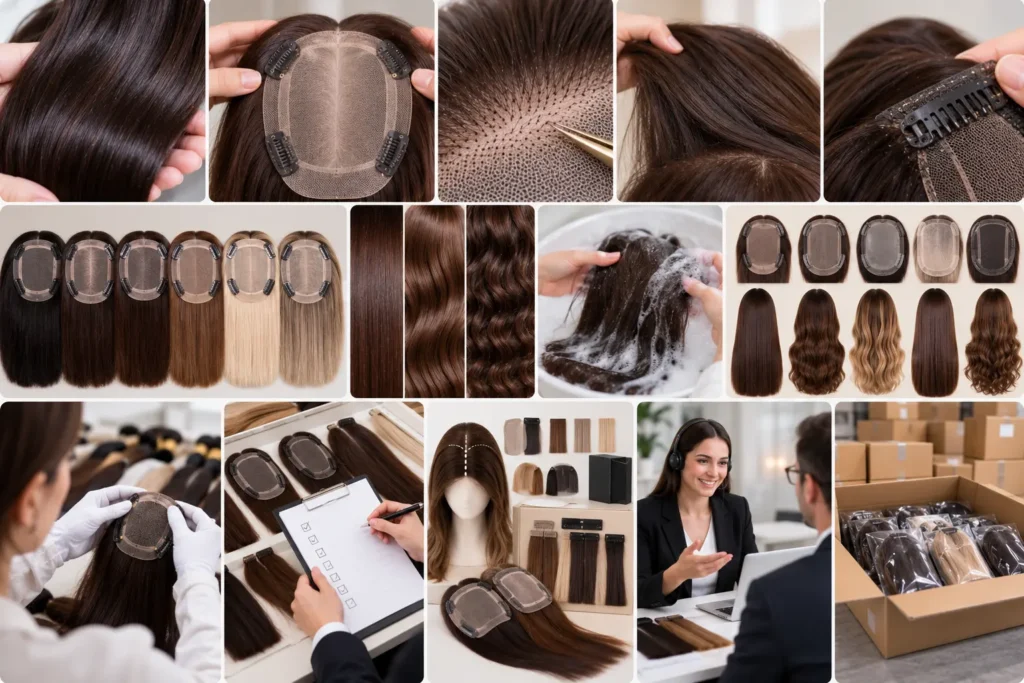
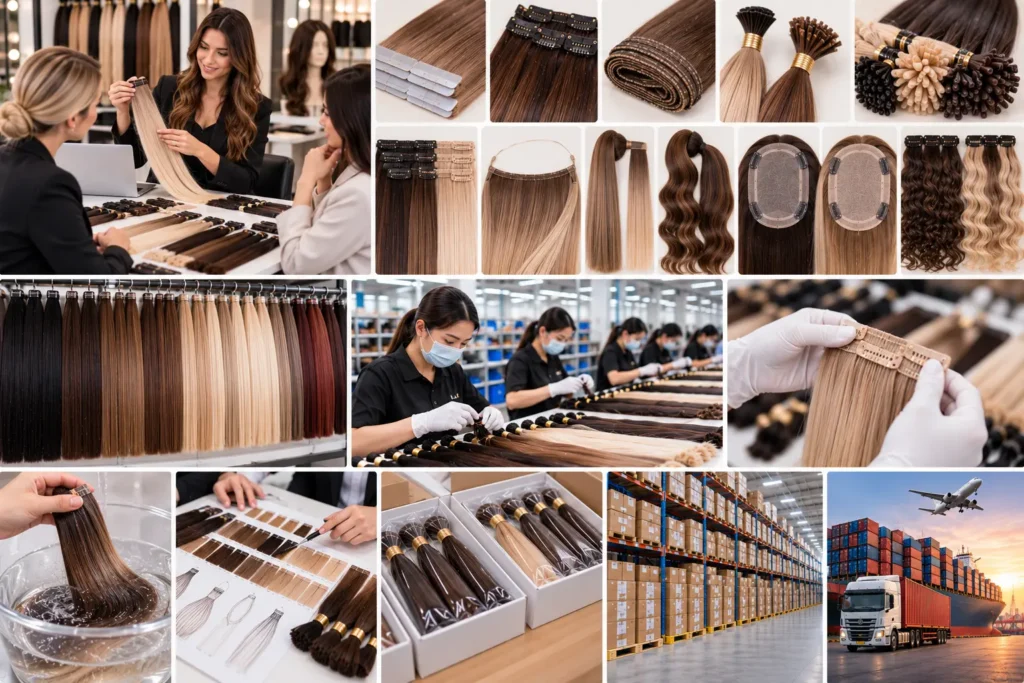
At RENAI HAIR, we work with human hair extension products such as clip ins, tape ins, wefts, halo hair, ponytails, and toppers. When buyers source for short-hair blending, I suggest they test the hair exactly as the end customer will use it. A sample should be curled, brushed, washed, and worn before a bulk order is confirmed.
How can color matching help blend hair extensions with short hair?
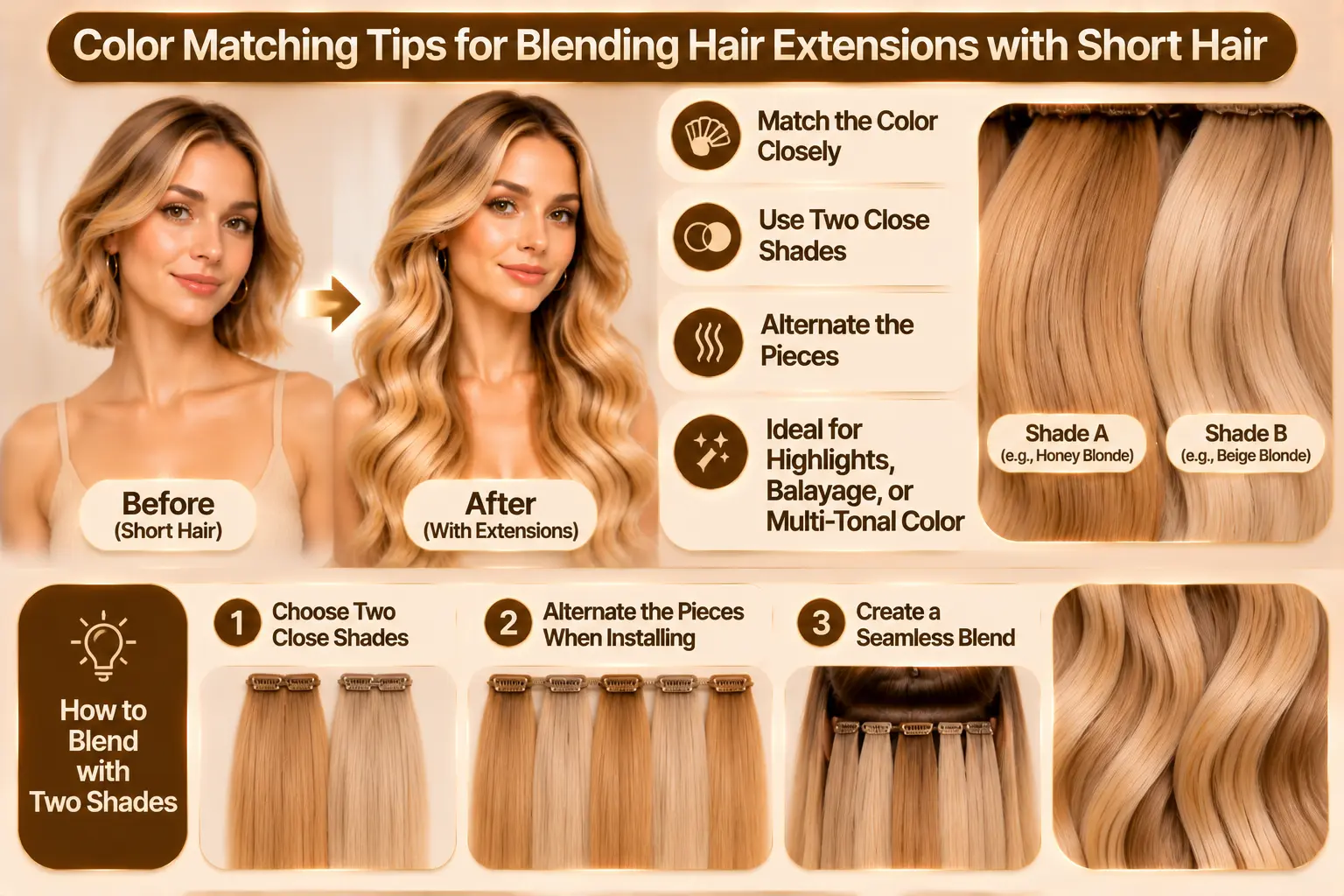
Short hair often exposes color differences near the roots, sides, and ends. A small mismatch can make extensions look obvious, especially in daylight. I reduce this risk by matching the dominant shade first, then adding a second shade for depth if needed.
Color matching helps blend hair extensions with short hair because it softens the line between the natural hair and the extensions. I often use two close shades and alternate the pieces, especially when the client has highlights, balayage, or multi-tonal color.
Why one flat color may not be enough
Many people do not have one solid hair color. Natural hair often has lighter ends, darker roots, and subtle tones through the middle.[^8] Salon-colored hair can be even more dimensional. If the extension color is too flat, the blend may look artificial.
For short hair, this matters more because the natural hair sits on top of the extensions. If the top layer is ash brown and the extension is warm brown, the difference can show quickly.
I usually check color in three areas:
- Root or top layer color
- Mid-length color
- End color
For clip ins, I usually match the mid-lengths and ends more than the roots because clip ins sit under the top layer. But I still check the root area to make sure the overall tone makes sense.
How to use two colors
Mixing two shades is one of my favorite ways to create a natural blend. The trick is to alternate the colors rather than placing all of one shade on one side.
For example:
| Natural Hair Look | Extension Strategy |
|---|---|
| Dark brown with lighter ends | Mix dark brown and medium brown |
| Blonde highlights | Mix two blonde tones |
| Balayage | Use rooted or ombre extensions |
| Warm brunette | Avoid overly ash colors |
| Cool blonde | Avoid golden extensions unless intentional |
When I use two colors, I place them in a way that creates movement. I do not want obvious stripes. I want soft variation. This is especially helpful when the client’s short hair has layers, because the different tones help the eye move through the hair instead of stopping at the natural ends.
Texture also affects color perception
Texture changes how color appears.[^9] Straight hair reflects light in a clean sheet, so color mismatches show more clearly. Wavy hair reflects light in different directions, so shades can blend more softly.
That is why I often pair color mixing with light waves. The result looks more natural, especially in photos and under salon lighting.
For B2B buyers, color range is a major supplier selection point. A strong supplier should provide consistent shades, new color development, and clear color communication. I always suggest that buyers check physical color rings and production samples, not only online photos. Screens can distort color. Lighting can distort color.[^10] A real sample gives the buyer a better basis for purchasing decisions.
What should B2B buyers check when sourcing extensions to blend hair extensions with short hair?
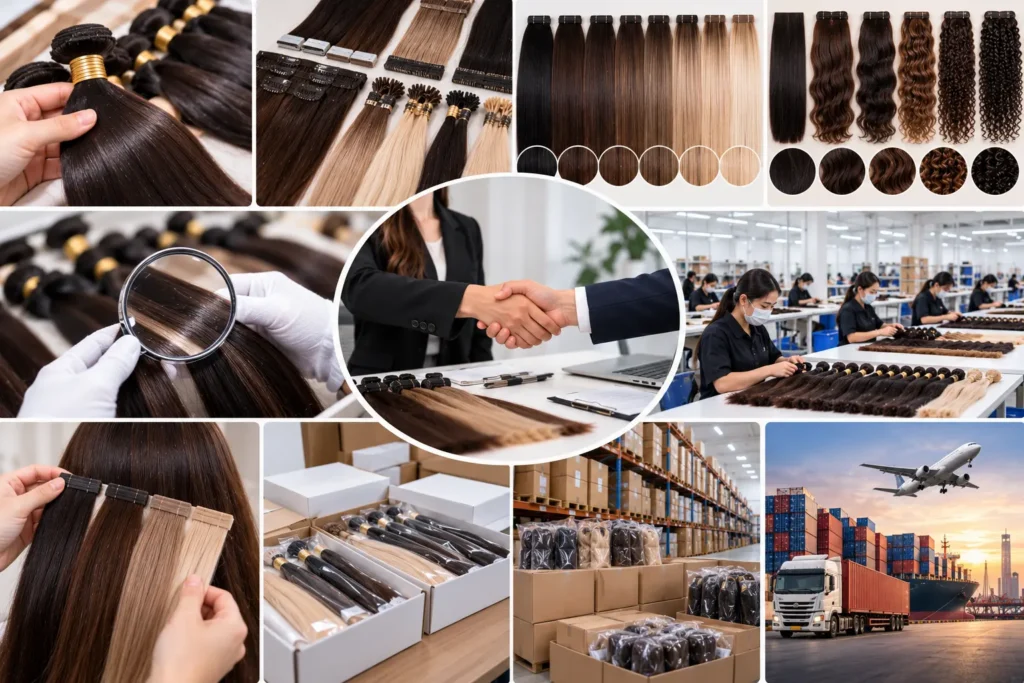
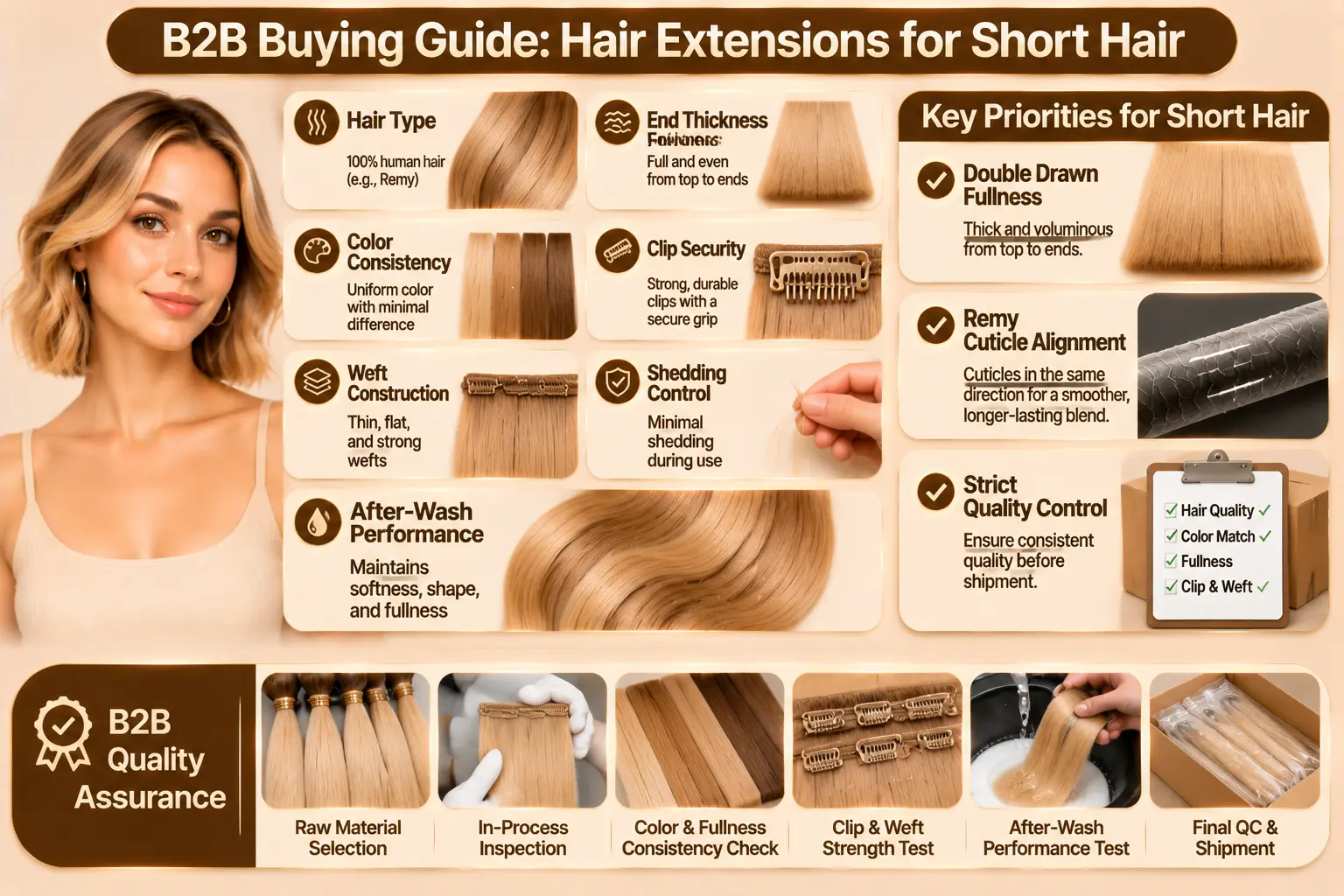
Short-hair blending creates higher expectations for density, color, and construction. If the product is inconsistent, salons and retailers receive complaints quickly. I manage this risk by checking samples, testing repeat quality, and confirming whether the supplier understands professional extension use.
B2B buyers should check hair type, end thickness, color consistency, clip security, weft construction, shedding control, and after-wash performance. For short hair, I place extra importance on double drawn fullness, Remy cuticle alignment, and quality control before shipment.
Product specifications to evaluate
When buyers source clip in hair extensions for short hair, I suggest reviewing both the beauty result and the technical construction. A set may look good in a product photo, but it must also perform during installation.
Key specifications include:
- Hair origin and processing level
- Remy or cuticle intact structure
- Double drawn or single drawn ratio
- Set weight and piece count
- Length options such as 18, 20, and 22 inches
- Color range and color accuracy
- Clip strength and comfort
- Weft thickness and flexibility
- Shedding and tangling performance
- Packaging and labeling requirements
For short hair, the most important specification is often fullness from top to end. If the buyer is selling to salons, the stylist will notice thin ends immediately. If the buyer is selling online, the customer will notice after installation.
Quality control checks before bulk orders
I recommend a practical testing process before placing a large order.
| QC Step | What I Check | Why It Matters |
|---|---|---|
| Visual inspection | Color, length, fullness | Confirms product appearance |
| Weight check | Set weight and piece consistency | Prevents underfilled sets |
| Comb test | Shedding and tangling | Predicts customer experience |
| Wash test | Texture after washing | Shows real durability |
| Heat styling test | Curl and straighten response | Confirms styling performance |
| Clip test | Grip and comfort | Affects daily wear |
| Blend test | Use on short hair mannequin or model | Confirms actual use case |
I like this process because it keeps the discussion objective. Instead of only saying “the hair feels good,” the buyer can compare measurable details across suppliers.
Supplier selection considerations
A reliable supplier should support long-term brand growth, not only one-time purchasing. For professional buyers, I suggest asking:
- Can the supplier provide stable repeat quality?
- Can the supplier develop new colors?
- Can the supplier support different lengths and weights?
- Can the supplier inspect goods before shipment?
- Can the supplier communicate clearly when specifications change?
- Can the supplier produce private label packaging if needed?
In my business context at RENAI HAIR, we serve hair extension brands, wholesalers, importers, distributors, beauty supply companies, salons, and stylists. We focus on human hair products such as Genius Weft, Flex Weft, Machine Weft, Hand Tied Weft, Tape In Hair, Keratin Hair, Clip In Hair, Halo Hair, Ponytail, Hair Topper, and related tools.
Still, I always encourage buyers to conduct their own sample review and professional evaluation. Hair extension results depend on the customer’s haircut, hair density, styling skill, and maintenance habits. A good supplier can provide stable quality, but a stylist or qualified professional should evaluate the best application for a specific client.
Frequently Asked Questions
Can very short hair blend with extensions?
Yes, very short hair can blend with extensions, but it needs enough coverage, density, and styling. I usually recommend fuller double drawn extensions and soft waves. If the hair is extremely short or very blunt, a stylist may need to cut and customize the extensions.
Are clip in extensions good for short hair?
Clip in extensions are good for short hair because they allow flexible placement. I can move the pieces to cover short layers and create volume where needed. A 7-piece set is often useful, while 3–4 pieces may work for thicker short hair.
What length extensions look natural on short hair?
For many short-hair clients, 18-inch, 20-inch, and 22-inch extensions look natural when the density is full enough. Longer lengths can also work, but they need better end thickness and more careful blending to avoid a disconnected look.
Should I curl or straighten extensions to blend short hair?
I usually prefer curls or soft waves because they hide short natural ends better than very straight styles. However, straight styles can work if the haircut is layered, the color match is accurate, and the extensions are thick enough from top to bottom.
Why do my extensions look obvious with short hair?
Extensions often look obvious with short hair because the set is too thin, the color does not match, the pieces are placed too high, or the natural hair is not styled with the extensions. A stylist can trim, layer, and blend the extensions for a better result.
Conclusion
To blend hair extensions with short hair, I start with the right foundation: double drawn fullness, enough pieces, accurate color, and high-quality human hair. Then I focus on placement, styling, and gentle brushing to connect the natural hair with the extensions. For salons, brands, and wholesalers, consistent sourcing matters just as much as styling skill. If you are developing a professional clip in hair extension line, contact RENAI HAIR to discuss samples, colors, lengths, and custom product options.
[^1]: "The Definitive Guide to Hairstyles Short Layered Hair", https://www.news.climate.columbia.edu/short-layered-haircuts. Cosmetology training materials describe extension blending as dependent on the client’s existing cut, layering, and placement, which supports the article’s point that short layers can create visible discontinuities; the source gives contextual technique guidance rather than testing this exact hairstyle. Evidence role: general_support; source type: education. Supports: A cosmetology education source should support that haircut structure, layering, and placement affect whether extensions blend naturally.. Scope note: Contextual support from cosmetology education, not direct experimental proof of short-layer visibility. [^2]: "What "Double Drawn" Hair Extensions Actually Mean Explained", https://www.facebook.com/GreatLengthsUSA/videos/we-talk-a-lot-about-how-our-strands-are-double-drawn-but-what-does-that-actually/883370247880970/. A professional hair-extension glossary defines double drawn hair as hair that has been sorted to contain a higher proportion of full-length strands, supporting the article’s use of the term to describe fuller ends; the definition does not by itself prove superior outcomes for every short-hair client. Evidence role: definition; source type: other. Supports: A neutral glossary or professional cosmetology reference should define double drawn hair as hair sorted so more strands are closer to the same length, resulting in fuller ends.. Scope note: Definition-level support; it does not independently verify the article’s styling recommendation. [^3]: "Hair extensions for fullness vs length: which do you prefer?", https://www.facebook.com/groups/BiloelaCommunityNoticeandDiscussionBoard/posts/3335755529965610/. Professional extension-training materials commonly treat length, weight, and density as linked design variables for natural-looking extension work, supporting the article’s claim that longer lengths require more attention to fullness; the support is instructional rather than based on controlled visual-perception testing. Evidence role: general_support; source type: education. Supports: A professional cosmetology or extension-training source should explain that extension length, weight, and density must be balanced to maintain a natural-looking result.. Scope note: Contextual professional guidance, not a quantitative study of density thresholds. [^4]: "Artificial hair integrations", https://en.wikipedia.org/wiki/Artificial_hair_integrations. General hair-extension references describe clip-in extensions as temporary pieces attached with small clips, supporting the article’s statement that they can be removed and repositioned; such references define the method but do not assess its suitability for every short haircut. Evidence role: definition; source type: encyclopedia. Supports: A general reference should identify clip-in extensions as temporary hair extensions attached with clips and removable by the wearer or stylist.. Scope note: Definition-level support only. [^5]: "Traction alopecia: the root of the problem - PMC", https://pmc.ncbi.nlm.nih.gov/articles/PMC5896661/. Dermatology guidance notes that extensions and tension-bearing hairstyles can contribute to hair breakage or traction alopecia, supporting the precaution of removing temporary clip-ins before sleep; the source addresses traction risk generally rather than testing overnight clip-in use specifically. Evidence role: expert_consensus; source type: institution. Supports: A dermatology source should support that hair extensions and tight or tension-creating styles can contribute to hair breakage or traction alopecia, making removal of temporary clips a reasonable precaution.. Scope note: Contextual dermatology support; it does not directly study sleeping in clip-in extensions. [^6]: "Hair Texture Guide: Styling Tips For Every Hair Texture", https://cosmetologyandspaacademy.edu/hair-texture-guide-styling-tips/. Cosmetology styling guidance describes waves and curls as techniques that soften lines and integrate layered sections, supporting the article’s claim that soft movement can help conceal short natural ends; the evidence is professional technique guidance rather than a controlled comparison of straight and curled extension styles. Evidence role: general_support; source type: education. Supports: A cosmetology source should support that curled or waved styling can soften visible lines and help blend layers or extensions.. Scope note: Technique-based support, not direct experimental evidence. [^7]: "Establishment of Heat‐Damaged Model for Hair - PMC - NIH", https://pmc.ncbi.nlm.nih.gov/articles/PMC12308778/. Studies of thermal styling show that repeated or high-temperature heat exposure can damage human hair fibers and cuticle structure, supporting the article’s caution about heat protection and temperature control; the evidence concerns human hair generally rather than every extension-processing method. Evidence role: mechanism; source type: paper. Supports: A hair-science paper should show that heat styling can alter or damage human hair fibers, especially at higher temperatures or repeated exposure.. Scope note: Mechanistic support from hair-fiber studies, not a brand- or product-specific test. [^8]: "Photoaggravation of Hair Aging - PMC - NIH", https://pmc.ncbi.nlm.nih.gov/articles/PMC2938585/. Research on hair weathering and photodegradation shows that environmental exposure can alter melanin and hair color over time, supporting the observation that ends may differ from newer growth near the roots; the evidence explains a common mechanism but does not quantify how often this occurs in extension clients. Evidence role: mechanism; source type: paper. Supports: A hair-science paper should support that UV exposure, weathering, or melanin changes can alter hair color, especially in older exposed hair at the ends.. Scope note: Mechanistic support; prevalence in salon clients is not directly measured. [^9]: "Investigation into the scattering of light by human hair", https://pubmed.ncbi.nlm.nih.gov/20706415/. Optical studies of human hair appearance show that fiber alignment, surface reflection, gloss, and scattering influence perceived color, supporting the article’s statement that texture changes how color appears; the evidence is about visual mechanisms rather than extension matching specifically. Evidence role: mechanism; source type: paper. Supports: A paper on hair optics should support that gloss, fiber alignment, curvature, and scattering affect the way hair color is perceived.. Scope note: Mechanistic optics support, not a direct study of extension color matching. [^10]: "Color appearance depends on the variance of surround colors", https://pubmed.ncbi.nlm.nih.gov/9382808/. Color-science standards and calibration guidance describe color appearance as dependent on illumination and display reproduction, supporting the article’s caution that screens and lighting can distort perceived extension color; the source provides a general color-perception principle rather than hair-specific validation. Evidence role: mechanism; source type: institution. Supports: A color-science institution or standards source should support that perceived color depends on illuminant conditions and display reproduction, so screen images may not match physical samples.. Scope note: General color-science support, not specific to hair extensions.