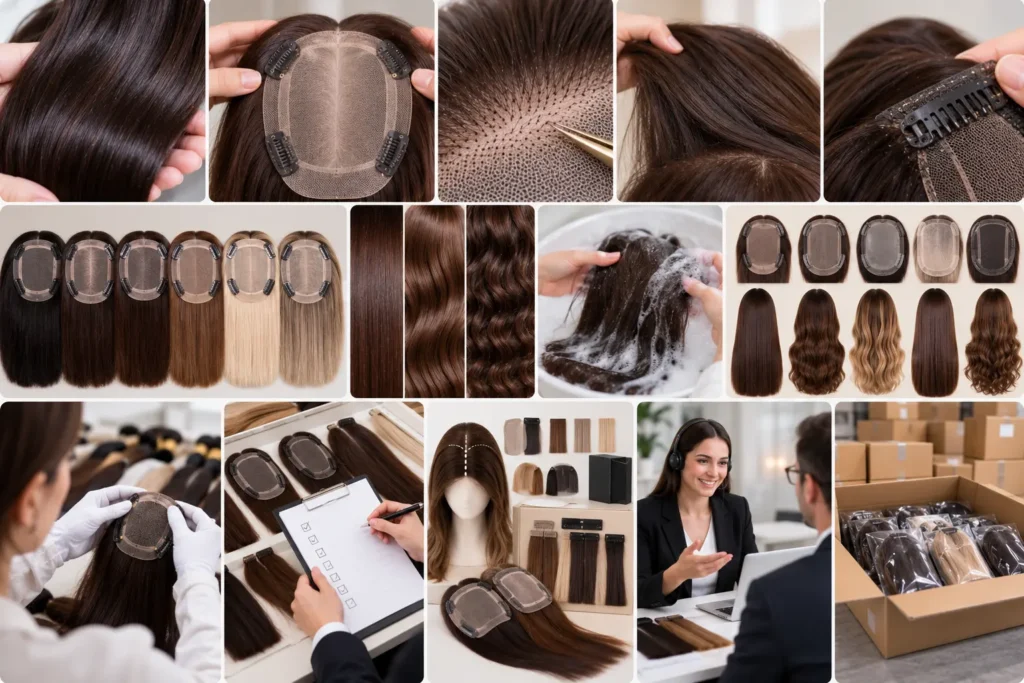
Hair topper for hair loss
Millions of people struggle with hair loss, and the emotional toll it takes is real.[^1] Thinning patches and visible bald spots can shake your confidence every single morning. A hair topper for hair loss offers an immediate, non-surgical solution — one that looks natural, fits your lifestyle, and works with the hair you already have.
A hair topper for hair loss is a hairpiece that covers thinning areas or bald spots on the top and crown of the head.[^2] Unlike full wigs, toppers integrate with your existing hair for a seamless, natural appearance.[^3] They come in several base constructions — including monofilament, silk base, and fishnet — each designed to address different coverage needs and hair loss patterns.
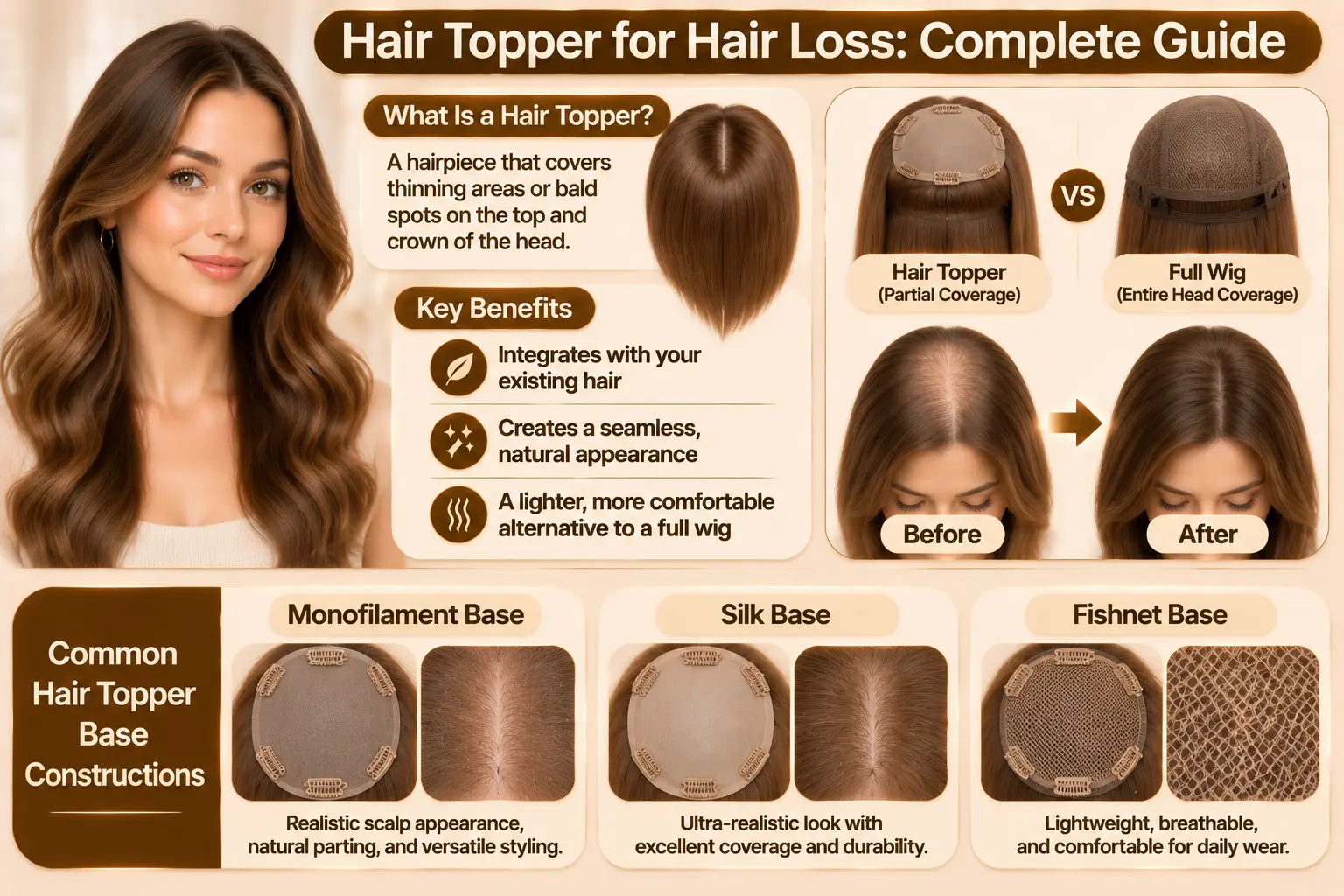
Understanding which type of topper is right for you takes more than a quick search. Base size, base construction, attachment method, and hair quality all play critical roles. The sections below break each of these factors down so you can evaluate options with confidence.
What types of hair toppers work best for hair loss?
Choosing the wrong topper type is one of the most common mistakes buyers make. The wrong base construction can look artificial, sit unevenly, or fail to blend with your natural hair. Knowing the difference before you buy — or before you stock a product line — saves time, money, and frustration.
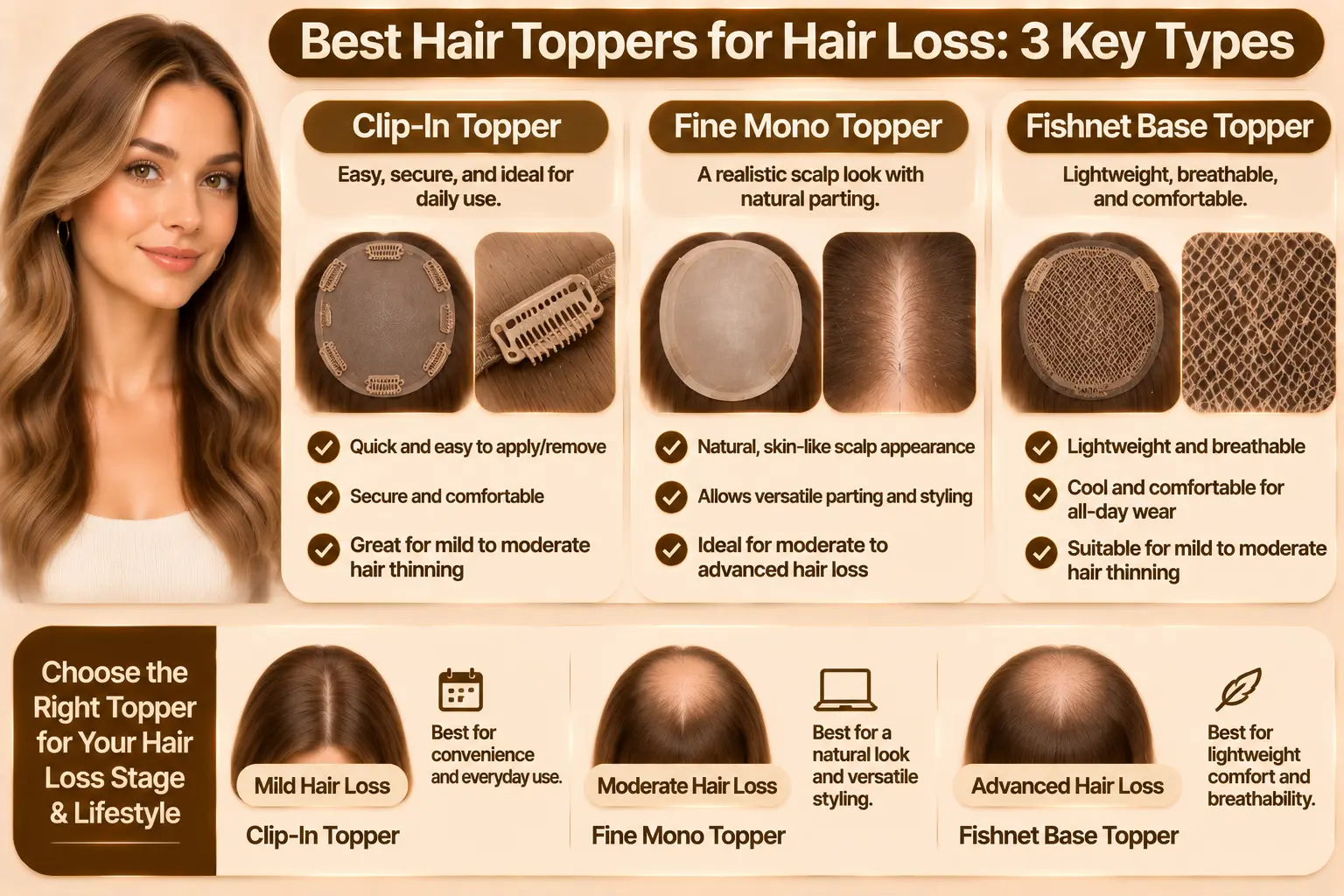
The best hair toppers for hair loss fall into three main categories: clip-in toppers for easy daily use, fine mono toppers for a realistic scalp appearance, and fishnet base toppers for lightweight breathable coverage.[^4] Each type serves a different hair loss stage and lifestyle need.
Clip-In Hair Toppers
Clip-in toppers are the most accessible entry point for anyone new to hair toppers. I find that most first-time buyers gravitate toward this style because it requires no adhesives, no salon visits, and no long-term commitment.
How they work:
- Pressure-sensitive clips are sewn along the perimeter of the topper base
- The clips grip your natural hair for a secure hold throughout the day[^5]
- Most users can attach and remove a clip-in topper in under five minutes
Who they suit best:
- People with early-stage thinning or a widening part
- Anyone who wants a daily-use solution they can take on and off
- Buyers who prefer flexibility without chemical bonding
From a product standpoint, clip-in toppers are typically available with lace, mono, or silk bases. The base determines how natural the scalp looks, while the clips determine security. For salon and retail buyers, clip-in toppers tend to have the broadest appeal and the fastest turnover.
Fine Mono Hair Toppers
Fine monofilament — often called "fine mono" — is one of the most respected base materials in the hair topper category. The ultra-thin mesh mimics the appearance of a real scalp[^6], making it nearly impossible to detect at close range.
Key characteristics of fine mono toppers:
| Feature | Detail |
|---|---|
| Base material | Ultra-thin nylon or polyester monofilament mesh |
| Hair attachment | Each strand individually hand-tied to the base |
| Scalp appearance | Natural skin-like look through the mesh |
| Durability | High, with proper care |
| Breathability | Moderate to good |
Fine mono toppers are especially well suited for individuals with moderate to significant hair loss — situations where the scalp is visible and a solid or less breathable base would look unnatural. Because each hair is individually knotted, the hair moves naturally in any direction, which is a major visual advantage.[^7]
From a quality control standpoint — something I pay close attention to at RENAI HAIR — the density of the knots and the tightness of the mesh weave are two of the most important factors to inspect before committing to a supplier.
Fishnet Base Toppers
Fishnet base toppers use an open-weave mesh structure that is lighter and more breathable than standard mono bases.[^8] The 6×7 fishnet hair topper in particular has grown steadily in popularity, especially among users in warmer climates or those who wear toppers for extended periods.
Advantages of fishnet toppers:
- Maximum breathability — the open structure allows airflow to the scalp
- Lightweight feel — less material on the head means more comfort over time
- Natural movement — the flexible base conforms to head shape
- Ideal for sensitive scalps — less contact friction compared to solid bases
The tradeoff is that fishnet bases require more careful handling. The open weave can stretch or distort if mishandled, and the knots may be more exposed than on a tighter mono base. For buyers evaluating fishnet toppers, always request a sample and inspect the knot security under magnification.
What base sizes should you choose for a hair topper?
Sizing is where many buyers — and end users — make costly mistakes. A topper that is too small leaves hair loss visible around the edges. A topper that is too large covers healthy hair unnecessarily and can look bulky or unnatural.
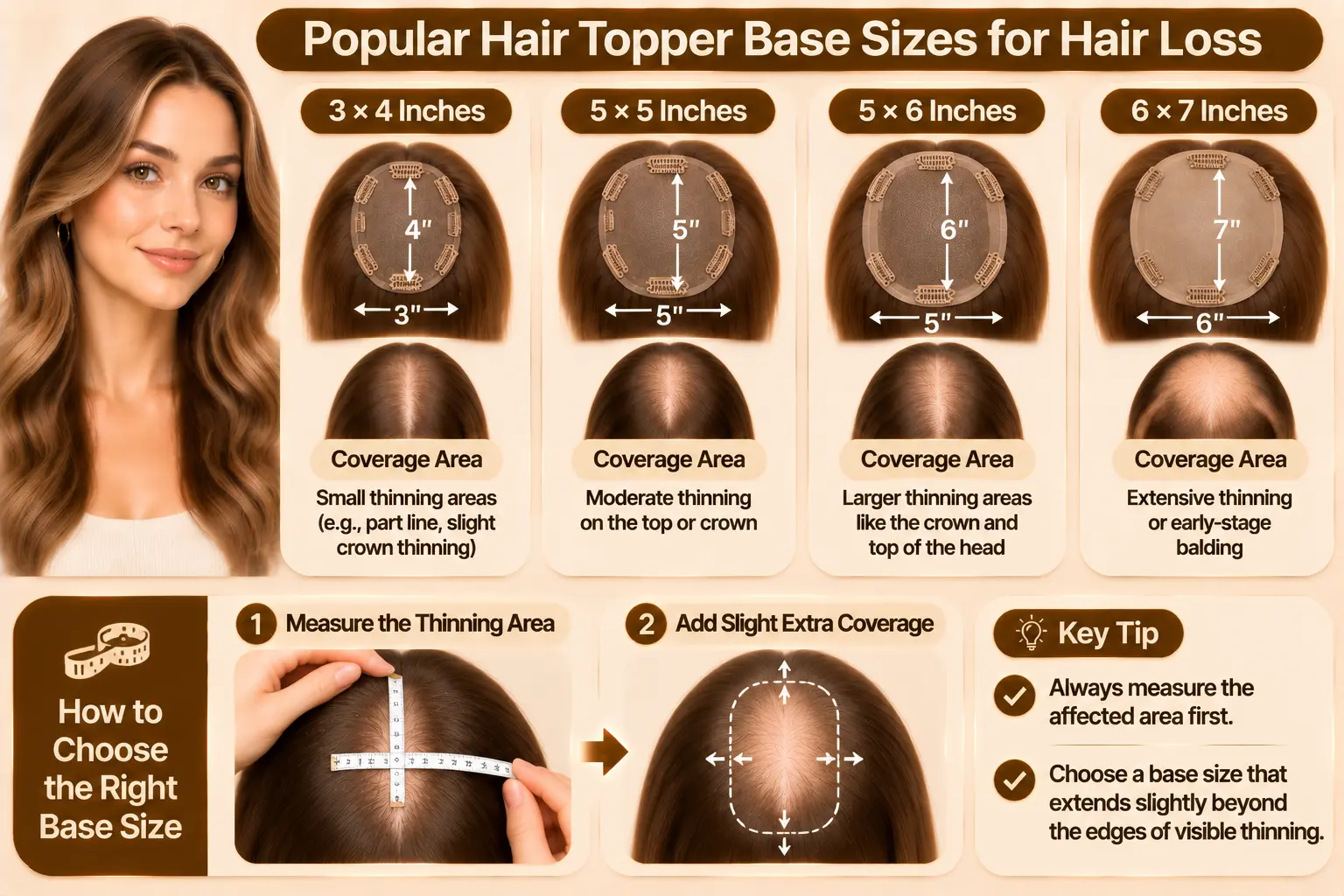
The most popular hair topper base sizes for hair loss are 5×5, 3×4, 5×6, and 6×7 inches. The right size depends on the dimensions of the thinning or balding area. Always measure the affected area before selecting a base size — coverage should extend slightly beyond the edges of visible thinning.[^9]
How to Measure for a Hair Topper
Getting the sizing right is straightforward if you follow a consistent process. Here is the measurement method I recommend:
- Identify your thinning zone — use a mirror or have someone help you locate where thinning is most visible
- Measure front to back — from the front hairline to the back edge of the thinning area, in inches
- Measure side to side — across the widest point of the thinning zone
- Add 0.5–1 inch on each side — this buffer ensures full coverage without looking oversized
Popular Base Sizes and Their Best-Fit Applications
| Base Size | Dimensions (inches) | Best For |
|---|---|---|
| 3×4 silk base topper | 3" front-to-back, 4" side-to-side | Mild thinning, widening part |
| 5×5 mono hair topper | 5" × 5" | Medium crown thinning |
| 5×6 mono base hair topper | 5" × 6" | Wider coverage across the crown |
| 6×7 fishnet hair topper | 6" × 7" | Extensive thinning, large coverage area |
Silk Base vs. Mono Base: Which Is More Realistic?
This is one of the most common questions I hear from buyers sourcing toppers for the first time.
A silk base topper has a layered construction where hair is knotted below the top silk layer, creating the illusion that hair grows directly from the scalp. The result is the most realistic scalp appearance available. However, silk bases are heavier than mono bases and require more skilled construction — which affects both price and sourcing options.
A fine mono base topper achieves a similar effect at lower weight and cost, though a trained eye can sometimes detect the mesh at very close range.
Bottom line: For clients prioritizing absolute realism and budget is secondary, recommend silk base. For everyday wearers balancing realism with comfort and value, fine mono is the stronger choice.
How do you match a hair topper to natural hair?
Even a high-quality topper fails its job if it doesn't blend with the wearer's natural hair. Mismatched color, texture, or density creates a visible line between the topper and the natural hair — the opposite of what a topper is meant to achieve.
To match a hair topper to natural hair, compare the topper's color, texture, and density to the wearer's existing hair at the root and mid-shaft. 100% Remy human hair toppers are the easiest to blend because they can be colored, heat-styled, and treated just like natural hair.[^10]

Key Matching Factors
1. Color Matching
Color is the most visible factor. Most reputable manufacturers offer toppers in a wide range of shades, from natural blacks and browns to blondes and highlighted tones. For difficult-to-match colors, a 100% human hair topper can be professionally toned or colored by a stylist.
- Always compare color in natural light, not artificial lighting
- Order color swatches before committing to bulk purchases
- For wholesale buyers, request a color ring from your supplier
2. Texture Matching
Hair texture — whether straight, wavy, or curly — must align with the wearer's natural hair. Remy human hair toppers with intact cuticles behave most like natural hair and respond predictably to heat styling tools.
3. Density Matching
Density refers to how thick or full the topper appears. A topper that is too dense will look obviously different from fine natural hair. Most manufacturers offer light, medium, and heavy density options. For hair loss clients, medium density is often the safest starting point.
Frequently Asked Questions
Can a hair topper completely cover bald spots?
Yes, a properly sized hair topper can fully cover bald spots on the top and crown of the head. Choose a base size that extends at least half an inch beyond the edges of the bald area. Fine mono and silk base toppers provide the most natural-looking coverage over exposed scalp.
Are human hair toppers better than synthetic for hair loss?
Human hair toppers are generally preferred for hair loss because they blend more naturally with existing hair, can be heat-styled to match any texture, and have a longer usable lifespan.[^11] Synthetic toppers cost less but cannot withstand heat and are harder to blend seamlessly.
How long does a human hair topper last?
With proper care, a high-quality 100% Remy human hair topper can last 12 to 24 months with daily use. Lifespan depends heavily on the quality of the base construction, how often the topper is washed, and whether heat tools are used responsibly.
Should I see a doctor before using a hair topper?
A hair topper addresses the cosmetic appearance of hair loss but does not treat the underlying cause. If your hair loss is sudden, patchy, or accompanied by other symptoms, consult a dermatologist or healthcare professional before or alongside using a topper.
What is the difference between a hair topper and a wig?
A hair topper covers only the top and crown area and integrates with your existing natural hair around the sides and back. A wig covers the entire head. Toppers are typically preferred by individuals with partial hair loss who want to preserve a natural look.
Conclusion
A hair topper for hair loss is one of the most effective, non-invasive solutions available for women dealing with thinning hair, widening parts, or visible bald spots. Choosing the right topper means understanding base construction — fine mono, silk base, or fishnet — selecting the correct base size for your coverage area, and matching the topper's color, texture, and density to your natural hair. Always prioritize 100% Remy human hair for the most seamless, versatile results.
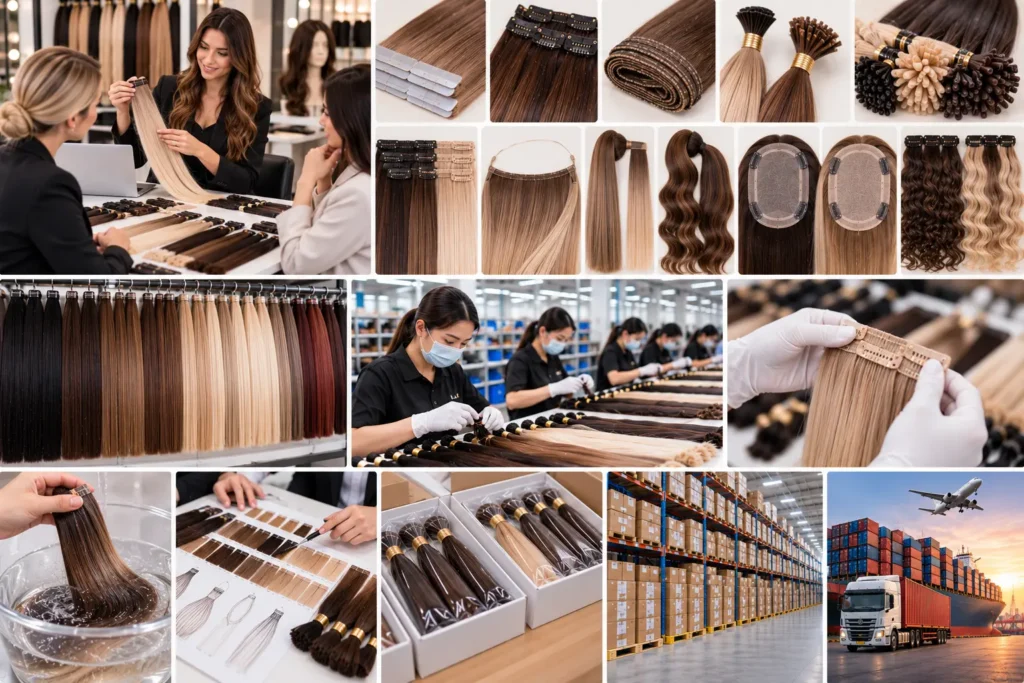
If you are a brand, wholesaler, or salon buyer looking for consistent quality and reliable supply, RENAI HAIR manufactures a full range of human hair toppers across all major base types and sizes. Contact our team to request samples, color swatches, or a custom product consultation.
[^1]: "The psychological impact of alopecia - PMC - NIH", https://pmc.ncbi.nlm.nih.gov/articles/PMC1261195/. A peer-reviewed study on alopecia prevalence and quality of life reports that hair loss is common and is associated with measurable psychosocial burden; however, the study may address alopecia broadly rather than the specific subgroup considering hair toppers. Evidence role: statistic; source type: paper. Supports: A peer-reviewed epidemiology or quality-of-life study should support both the common occurrence of hair loss and its association with anxiety, distress, reduced confidence, or lower quality of life.. Scope note: The support is likely contextual because most studies examine hair loss generally, not hair topper users specifically. [^2]: "Toupée", https://en.wikipedia.org/wiki/Toup%C3%A9e. A neutral reference on hairpieces or cranial prostheses defines partial hairpieces as coverings for localized hair loss rather than full-head replacements; the terminology may vary by source, with some using terms such as partial wig, hairpiece, or cranial prosthesis. Evidence role: definition; source type: encyclopedia. Supports: A neutral reference should define hairpieces or partial wigs as devices used to cover localized hair loss and distinguish them from full-head wigs.. Scope note: The source may not use the exact commercial term 'hair topper.' [^3]: "Toupee vs Wig: Key Differences and How to Choose", https://www.hairclub.com/blog/toupee-vs-wig/. An institutional guide to wigs and hairpieces distinguishes full wigs from partial hairpieces that supplement remaining hair; the source supports the functional distinction but may not evaluate whether the result is visually seamless in every wearer. Evidence role: definition; source type: institution. Supports: An institutional guide should support the distinction between full wigs and partial hairpieces used with remaining hair.. Scope note: The naturalness of the appearance depends on fitting, color matching, density, and styling. [^4]: "Monofilament Wigs | Natural-Looking Parts & Realistic Scalp", https://www.headcovers.com/collections/monofilament-wigs?srsltid=AYCX9vJho8AbG_eugQjTlfY5gPCc8DG1ToQ2rSlez-Evb0XW93QCKUAB. A neutral hairpiece education source describes monofilament and mesh constructions as common wig or hairpiece base types with differing effects on scalp appearance and ventilation; the source may not endorse the article's exact three-category buying framework. Evidence role: general_support; source type: institution. Supports: A neutral wig or hairpiece education source should describe common base constructions such as monofilament and mesh and explain their differences in appearance, comfort, or attachment.. Scope note: The article's category grouping is partly editorial and may not match all industry taxonomies. [^5]: "Clip-In Extensions", https://www.bellamihair.com/collections/clip-ins. A hairpiece fitting guide explains that clip-in partial hairpieces are secured by small clips attached to the wearer’s existing hair; the source supports the attachment mechanism but may not verify all-day security for every hair type. Evidence role: mechanism; source type: institution. Supports: A neutral hairpiece or patient-support guide should explain that clip-in hairpieces are held by clips fastened to existing hair.. Scope note: Hold time and comfort depend on hair density, clip placement, and user activity. [^6]: "What Type of Wig Cap Is Best for You?", https://www.breastcancer.org/treatment-side-effects/hair-loss/wigs/cap-types. A wig education source describes monofilament cap construction as producing a more natural scalp appearance by allowing individually attached hairs to appear as if emerging from the scalp; the source supports the visual mechanism but does not prove invisibility in all lighting or viewing conditions. Evidence role: mechanism; source type: institution. Supports: A neutral wig education source should explain that monofilament bases allow the scalp or scalp-colored base to show through, creating a more natural scalp appearance.. Scope note: Realism varies with base color, knotting, density, wearer scalp tone, and styling. [^7]: "Monofilament Wigs | Natural-Looking Parts & Realistic Scalp", https://www.headcovers.com/collections/monofilament-wigs?srsltid=AYCX9vKXj-xncoBjR8EGnN8xgcuLx8O7o1bigKd1e9cyn009H7G2ACpt. A wig construction guide states that monofilament or hand-tied caps use individually attached hairs, allowing more flexible parting and movement than fixed wefted construction; the source supports the mechanism but not a universal visual superiority claim. Evidence role: mechanism; source type: institution. Supports: A hairpiece or wig construction guide should support that hand-tied monofilament caps permit hair to move or be parted in multiple directions.. Scope note: The degree of natural movement depends on hair quality, density, knotting, and styling. [^8]: "Investigation of the air permeability of fabric weaves to ... - PMC", https://pmc.ncbi.nlm.nih.gov/articles/PMC12062212/. Textile research on woven or mesh structures shows that increased fabric openness is associated with greater air permeability; this supports the breathability rationale for open-weave topper bases but does not directly test fishnet hair toppers against monofilament bases. Evidence role: mechanism; source type: paper. Supports: A textile or materials source should support the general principle that more open mesh structures increase air permeability and reduce material coverage.. Scope note: The evidence is contextual unless the source specifically compares hairpiece base materials. [^9]: "How to Measure for a Hair Topper: 5 Sizes Explained (+ My ...", https://www.youtube.com/watch?v=5_6YglbswwA. A hairpiece fitting guide recommends measuring the area of hair loss and choosing a base that covers the affected region with sufficient margin for blending or attachment; the source supports the fitting principle but may not specify the same numerical allowance. Evidence role: general_support; source type: institution. Supports: A fitting guide should support measuring the area of hair loss and selecting a partial hairpiece that covers beyond the thinning zone.. Scope note: Exact margins can vary by attachment method, hairstyle, and remaining hair density. [^10]: "Human vs. Synthetic Hair: Unraveling the Differences and ...", https://coilstolocsstore.com/pages/synthetic-wigs-vs-human-hair-wigs?srsltid=AYCX9vJMkyd5xFdY8WhboKMZzBFxUeMWGEKhsaCDpaGB98dy-WgU1PVb. A neutral wig-care guide states that human hair wigs can generally be heat styled and professionally colored in ways that many synthetic wigs cannot; this supports the styling rationale for human-hair toppers but does not prove that every Remy topper will blend easily with every wearer’s hair. Evidence role: general_support; source type: institution. Supports: A neutral wig or cancer-support guide should support that human hair wigs or hairpieces can be heat styled and colored more readily than most synthetic hairpieces.. Scope note: Blendability also depends on color match, cut, density, texture, and stylist skill. [^11]: "Synthetic vs Human Hair Wigs: Which Fiber Type Is Right ...", https://www.breastcancer.org/treatment-side-effects/hair-loss/wigs/fiber-type-synthetic-vs-human. An institutional guide comparing human-hair and synthetic wigs notes that human hair often offers more natural movement, greater styling flexibility, and longer potential service life, while requiring more maintenance and higher cost; the source supports the comparison but not an absolute preference for all hair-loss users. Evidence role: expert_consensus; source type: institution. Supports: A patient-support or medical institution guide should support common differences between human hair and synthetic wigs regarding appearance, heat styling, maintenance, and longevity.. Scope note: Preference depends on budget, maintenance tolerance, climate, and desired style.