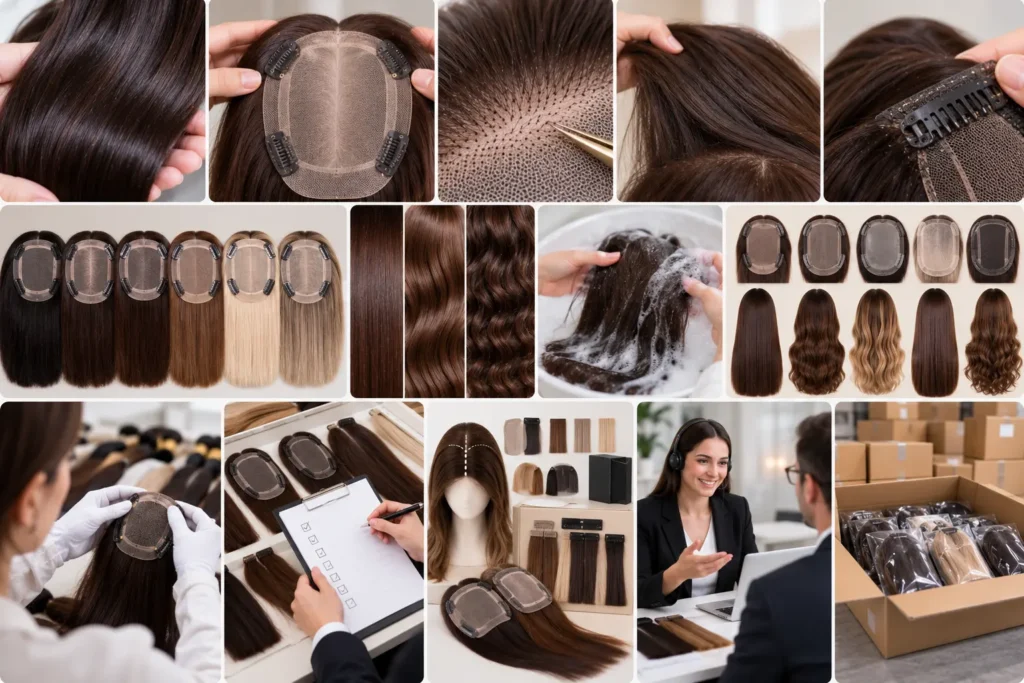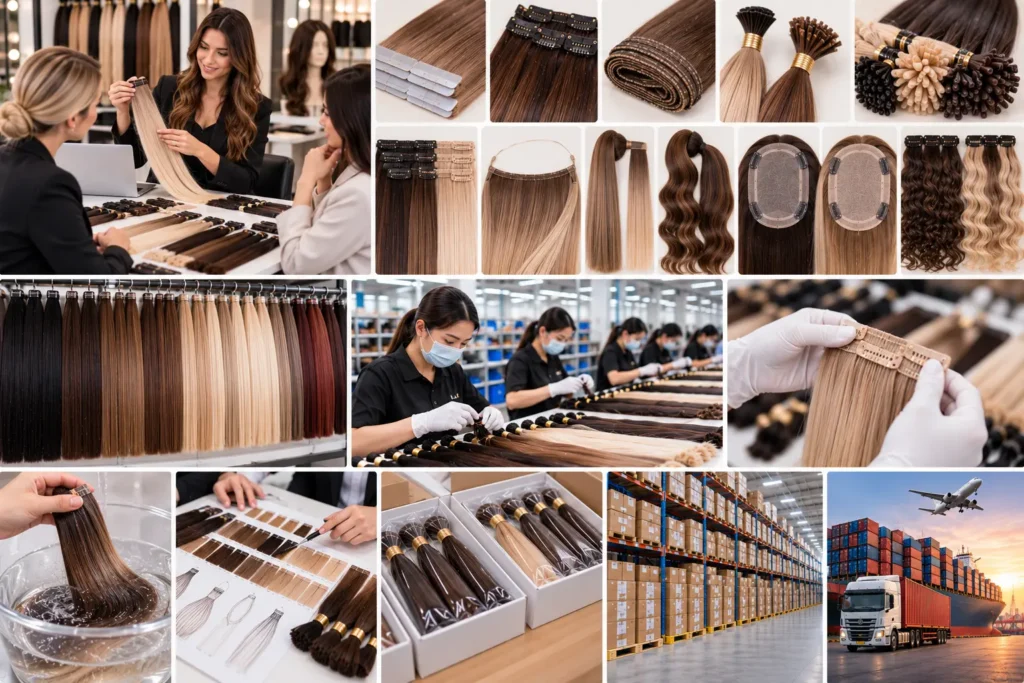

How long does it take to process an order of hair extensions?
An order of hair extensions can feel simple on paper, but production timing quickly becomes a problem when product types, colors, quantities, and holiday schedules are not planned early. Delays can affect launch dates, salon promotions, and wholesale commitments. The solution is to estimate processing time before confirming the purchase order.
Generally, an order of hair extensions takes about 30 days to process, but the realistic range is often 30–70 days.[^1] Timing depends on product type, quantity, number of colors, raw hair availability, customization requirements, factory capacity, and peak seasons such as Chinese New Year or Christmas.[^2] Buyers should confirm timelines with the supplier before ordering.

A clear delivery estimate helps both the buyer and supplier avoid pressure later. I have seen buyers focus only on price and product photos, then become surprised when color variety or packaging needs add weeks. The better approach is to understand what actually happens inside the production schedule.
What is the normal processing time for an order of hair extensions?
When buyers ask about lead time, they often expect one fixed answer. That can create confusion because an order of hair extensions is not a single standard product. Different items require different production steps, and every added color or specification can increase the total processing time.
A normal human hair extensions order usually takes around 30 days to process. Simple repeat orders with limited colors may stay close to this timeline. More complex orders, especially those with several product types, many shades, or custom packaging, may require 45–70 days before shipment.
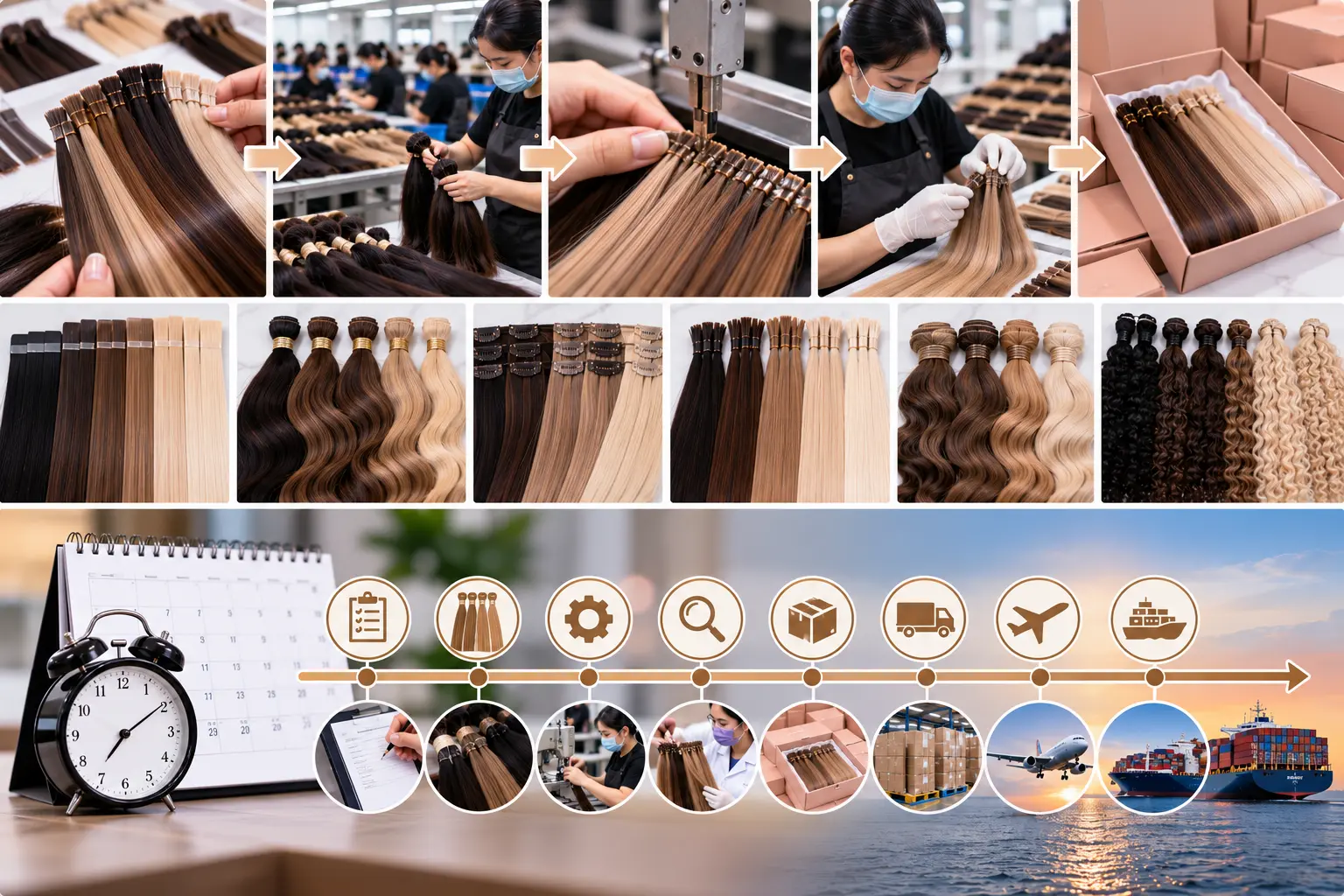
Why 30 days is a common baseline
For many B2B buyers, 30 days is a practical average for a regular human hair order. This timeline usually assumes:
- The supplier has access to suitable raw human hair.
- The buyer chooses common colors and lengths.
- The order quantity is not unusually large.
- The factory schedule has available capacity.
- Packaging and labeling requirements are already confirmed.
- The product has been made before, or the supplier has similar experience.
At RENAI HAIR, the business context is focused on 100% Human Hair, Remy Hair, and Cuticle Intact Hair products. These products require more careful sorting, processing, coloring, and quality control than synthetic or low-grade mixed hair products.[^3] So, processing time should not be judged only by quantity. The production method matters.
Simple order vs. complex order
A simple wholesale order may include one product type, a few lengths, and several standard colors. A complex order may include Genius Weft, Tape In Hair, Clip In Hair, Keratin Hair, and multiple color rings at the same time.
| Order type | Example | Estimated processing time |
|---|---|---|
| Simple repeat order | 1 product type, 3–5 colors | Around 30 days |
| Moderate custom order | 2 product types, 8–10 colors | Around 30–45 days |
| Complex color order | 2+ product types, 15–20 colors | Around 50–70 days |
| Peak season order | Any order near major holidays | Add extra buffer |
The reason is simple. Every color needs planning, coloring, drying, matching, checking, and packing.[^4] If the buyer selects many shades, the factory cannot treat the order as one batch. The order becomes several smaller production jobs inside one purchase order.
What buyers should ask before paying the deposit
I always recommend that B2B buyers ask direct questions before confirming a production schedule:
- Is all raw hair available now?
- How many days are needed for coloring?
- Will all colors be produced at the same time?
- Is this timeline before or after final packaging?
- Does the estimate include quality inspection?
- Is the shipping date or factory completion date being quoted?
This final point is important. Some suppliers quote the production completion date. Others quote the estimated shipping date. A buyer should confirm the meaning because these dates are not always the same.
A realistic lead time is not just about speed. It is about whether the supplier can produce stable quality within the promised schedule.
Why does an order of hair extensions take longer when there are many colors?
Color selection looks like a marketing decision, but it becomes a production decision once the order reaches the factory. An order of hair extensions with many shades needs more batch separation, color matching, drying time, inspection, and packing control. This is why color variety can extend lead time.
An order with many colors usually takes longer because each shade must be processed, matched, checked, and packed separately. For example, a 2,000-piece order with 10 colors may take 30–45 days, while a similar 2,000-piece order with 20 colors may take 50–70 days.
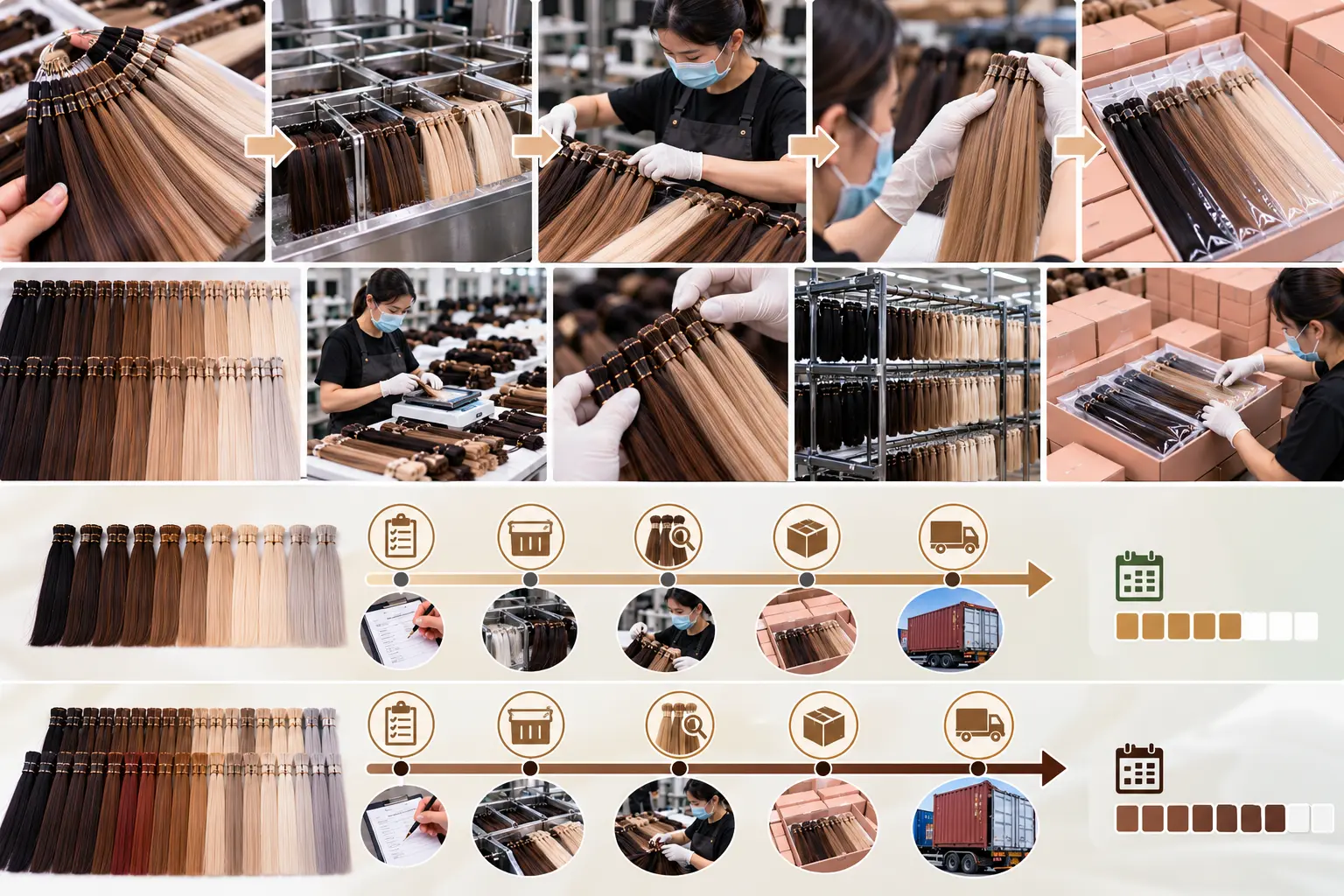
Why color quantity affects the schedule
Many new buyers think the total quantity is the most important factor. Quantity matters, but color count can matter just as much[^5]. A 2,000-piece order in one or two colors is very different from a 2,000-piece order across 20 shades.
For example:
| Order details | Quantity | Colors | Product types | Estimated time |
|---|---|---|---|---|
| Virgin Remy natural human hair order | 2,000 pcs | 10 colors | Clip In + Tape In | 30–45 days |
| Similar wholesale order | 2,000 pcs | 20 colors | Clip In + Tape In | 50–70 days |
Both orders have the same quantity and the same two product types. However, the second order has twice as many colors. That creates more production work because each color requires separate control.
The hidden steps behind each color
Each shade may need several checks before it can be accepted. These checks are important for B2B buyers because inconsistent colors can create complaints from salons, stylists, and end customers.
Common color-related production steps include:
- Raw hair selection based on quality and suitability for coloring
- Color processing according to shade requirement
- Tone adjustment for blonde, brown, black, balayage, ombre, or highlighted shades
- Color matching against the buyer’s sample or color chart
- Drying and resting time after processing
- Quality inspection for softness, tangling, shedding, and color consistency
- Sorting and labeling to avoid mixed shades in packing
Some shades also need more careful handling. For example, light blonde colors usually require more processing than dark natural shades.[^6] Highlight, piano, balayage, and rooted colors may need additional manual work. This can increase lead time, especially when the buyer requires stable color matching across different product types.
How buyers can reduce delays from color planning
A buyer does not always need fewer colors. Sometimes a wide color range is important for a brand. But the buyer should plan the color structure in a way that supports production.
Helpful steps include:
-
Start with core selling colors.
A new brand may not need 30 shades in the first order. It can begin with best-selling colors and expand later. -
Separate launch colors from test colors.
Core shades can be ordered in larger quantities. Trend colors can be tested in smaller quantities. -
Approve a color ring before bulk production.
This reduces misunderstandings and helps the factory match expectations. -
Avoid changing colors after deposit.
Color changes during production can reset part of the schedule. -
Confirm color names and codes in writing.
A written order sheet prevents confusion between similar shades.
In my experience, the smoothest wholesale hair extension projects are usually not the simplest ones. They are the ones with the clearest color plan.
How do product types affect an order of hair extensions?
Product type is one of the biggest lead-time factors. An order of hair extensions may include wefts, tape-ins, clip-ins, keratin tips, halos, ponytails, or toppers. Each product uses different labor, materials, and inspection points, so the factory must schedule them differently.
Different hair extension products require different production steps.[^7] Machine Weft may follow one workflow, while Tape In Hair, Clip In Hair, Hand Tied Weft, Keratin Hair, or Hair Toppers require additional materials and manual assembly. The more product types included, the more coordination time the supplier needs.
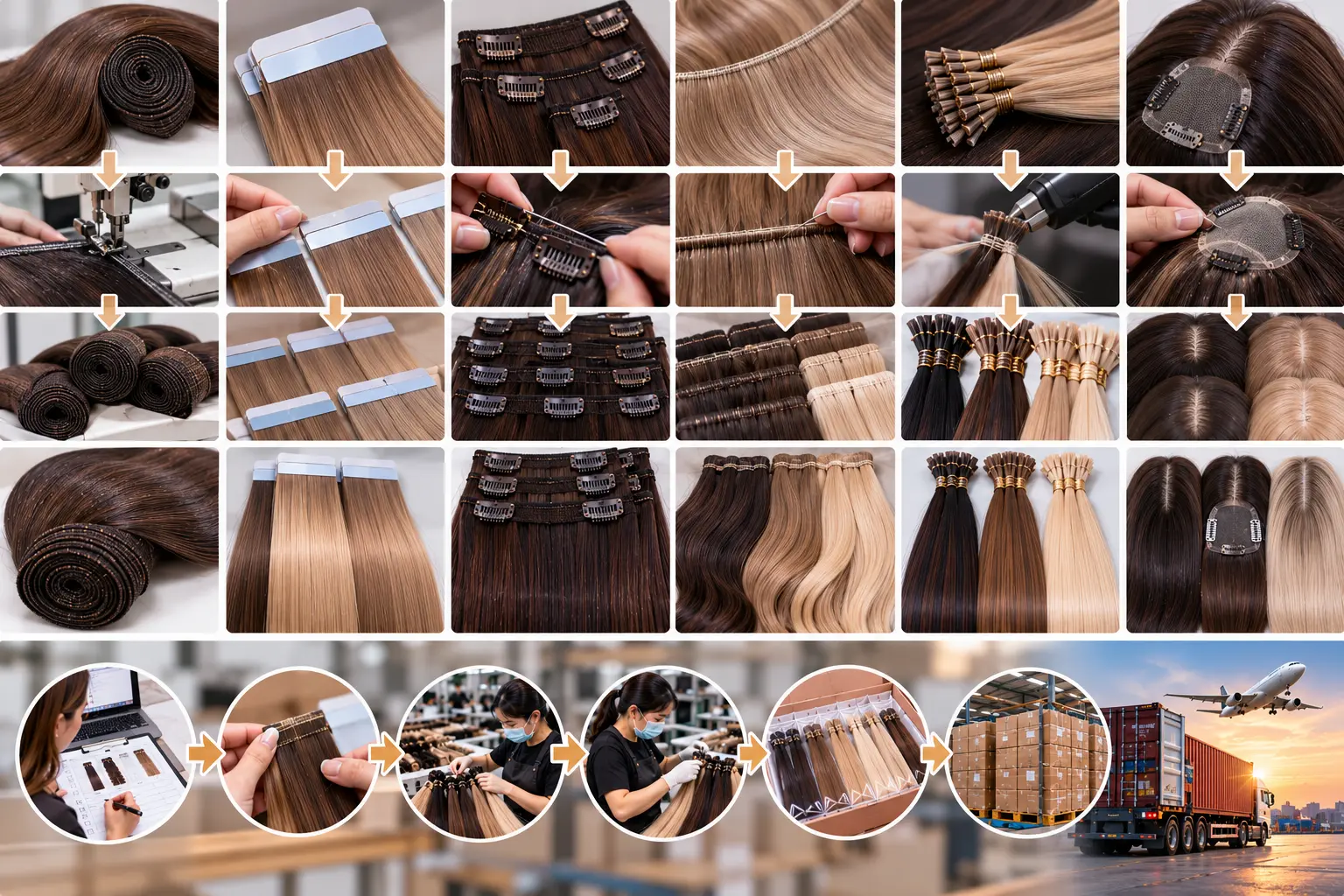
Common product types and lead-time impact
RENAI HAIR’s product range includes Genius Weft, Flex Weft, Machine Weft, Hand Tied Weft, Tape In Hair, Keratin/Prebonded Hair, Clip In Hair, Halo Hair, Ponytail, Hair Topper, and extension tools. These products are not produced in exactly the same way.
| Product type | Production complexity | Lead-time consideration |
|---|---|---|
| Machine Weft | Medium | Efficient for larger batches |
| Hand Tied Weft | Higher | More manual work and careful handling |
| Genius Weft / Flex Weft | Medium to high | Requires stable construction and finishing |
| Tape In Hair | Medium to high | Tape quality, tab size, and adhesive placement matter |
| Clip In Hair | Medium | Clips, sewing, and set structure must be checked |
| Keratin / Prebonded Hair | Higher | Tip shape, bond quality, and weight consistency matter |
| Halo Hair | Medium | Wire structure and fit need attention |
| Ponytail | Medium | Cap/base, clips, and wrapping details matter |
| Hair Topper | Higher | Base construction, density, and hair direction require control |
Why mixed product orders take longer
For example, a buyer may order:
- Tape In Hair in 12 colors
- Clip In Hair in 12 colors
- Genius Weft in 8 colors
- Ponytails in 5 colors
- Private-label packaging for all products
This is not one production job. It is several production jobs connected by one shipping plan. Each product has its own materials, workers, quality standards, and packing method.
Product-specific inspection matters
B2B buyers should pay attention to product-specific QC because the same hair quality can still fail if the construction is wrong.
For example:
- Tape In Hair should be checked for adhesive placement, tab shape, shedding, and residue risk.
- Clip In Hair should be checked for clip strength, sewing stability, and set weight.
- Weft Hair should be checked for weft thickness, return hair control, shedding, and flexibility.
- Keratin Hair should be checked for tip shape, bond strength, and strand weight.
- Hair Toppers should be checked for base size, density, hair direction, and comfort.
A professional buyer should request product samples or pre-production confirmation when launching a new product line. A supplier can estimate timelines more accurately when the buyer provides detailed specifications.
A practical way to plan mixed product orders
I usually suggest that buyers divide product planning into three groups:
-
Core products
These are the main selling items, such as Tape In Hair or Weft Hair. -
Support products
These help expand the catalog, such as Clip In Hair, Ponytail, or Halo Hair. -
Development products
These include new colors, new constructions, or Hair Toppers that require testing.
This method helps buyers avoid placing too much pressure on one production cycle. It also gives the supplier a better chance to maintain consistent quality.
When should buyers place an order of hair extensions before peak season?
Peak season can change everything. Even a well-prepared order of hair extensions may take longer when the factory has limited production space, workers are preparing for holidays, or many customers are placing urgent orders at the same time. Late planning often causes avoidable stress.
Buyers should place hair extension orders earlier before peak seasons, especially before Chinese New Year and Christmas. If the supplier is located in China, production may slow down around Chinese New Year. Buyers should add several extra weeks of buffer to protect launch plans and inventory flow.

Why Chinese New Year affects production
Chinese New Year is one of the most important timing factors for buyers working with China-based suppliers. Many factories, logistics companies, and material suppliers reduce operations or close for a period.[^9] Even before the holiday begins, production capacity can become tight because many customers want orders completed before the break.
A buyer should not only look at the official holiday dates. The real impact often starts earlier and ends later because:
- Workers may travel before the holiday.[^10]
- Factories may stop accepting new urgent orders.
- Raw material suppliers may reduce availability.
- Logistics companies may become fully booked.
- Production lines may need time to restart after the holiday.
This means an order placed too close to Chinese New Year may face a longer lead time than usual.
Christmas and year-end demand
Christmas can also create pressure. Hair extension brands, beauty supply stores, and salons often prepare for holiday promotions. Many buyers want inventory before November or early December. If too many orders arrive at the same time, factories must prioritize based on deposit date, order clarity, material availability, and production capacity.
For buyers, the safest approach is to plan backward from the required delivery date.
Simple planning timeline
| Target sales period | Suggested order planning |
|---|---|
| Christmas sales | Confirm bulk order several months before the season |
| New Year promotions | Avoid last-minute December production requests |
| Pre-Chinese New Year shipment | Confirm details early and add buffer time |
| Spring product launch | Discuss production before the holiday disruption |
| New color launch | Allow extra time for samples and color approval |
How to discuss peak season with suppliers
A buyer should ask the supplier specific questions instead of only asking, “Can you ship quickly?”
Better questions include:
- What is your latest order confirmation date before Chinese New Year?
- When will your factory stop production?
- When will normal production restart?
- Can you reserve production capacity after deposit?
- Does the quoted time include inspection and packaging?
- Which products or colors may take longer during peak season?
I prefer this kind of direct conversation because it makes the order plan more realistic. It also helps the supplier explain constraints before the buyer commits to a launch date.
Inventory strategy for B2B buyers
Wholesale buyers should consider keeping safety stock for best-selling colors and lengths.[^11] This is especially important for professional salons and hair extension brands that cannot afford stockouts.
A simple safety-stock plan may include:
- Best-selling shades such as natural black, dark brown, medium brown, and popular blonde tones
- Core lengths such as 18", 20", 22", and 24"
- Main product types such as Tape In Hair, Weft Hair, and Clip In Hair
- Extra stock before major holidays or seasonal campaigns
This does not mean buyers should overstock everything. It means they should protect their strongest SKUs first.
How can buyers help suppliers process an order of hair extensions faster?
Many delays do not come from production alone. An order of hair extensions can slow down when specifications are unclear, color names are inconsistent, packaging files are late, or payment confirmation is delayed. Buyers can reduce lead time by preparing complete order information before production starts.
Buyers can help suppliers process orders faster by confirming product type, length, color, quantity, hair grade, packaging, labeling, and shipping requirements before paying the deposit. Clear order sheets, approved samples, and stable specifications reduce back-and-forth communication and help the factory schedule production more efficiently.[^12]

Prepare a complete order sheet
A strong purchase order should include all important details. I like using a simple spreadsheet because it removes guesswork.
A useful order sheet should include:
- Product name
- Hair type, such as Remy Hair or Cuticle Intact Hair
- Texture, such as straight, body wave, or curly
- Length
- Color code
- Quantity per SKU
- Weight per pack or set
- Packaging requirement
- Label or barcode requirement
- Special notes
- Required delivery date
If a buyer sends only screenshots or mixed messages, the supplier must spend extra time confirming details. This may not seem serious at first, but it can delay production planning.
Confirm samples before bulk production
Samples are especially important for new buyers, new colors, or new product constructions. A sample cannot guarantee that every future batch will be identical, but it gives both sides a reference point.
Buyers should check:
- Hair softness and feel
- Color accuracy
- Thickness from top to end
- Shedding and tangling performance
- Tape, clip, weft, or keratin construction
- Packaging quality
- Label accuracy
For application-specific decisions, such as choosing the right extension method for a salon market, buyers should consult qualified professionals, stylists, or technical educators. A supplier can support product options, but final market suitability depends on the buyer’s customers, installation habits, and positioning.
Avoid changing the order after production starts
Changes are sometimes necessary, but they usually affect timing. If a buyer changes colors, lengths, product types, or packaging after production begins, the supplier may need to adjust materials or restart part of the workflow.
Common changes that cause delays include:
- Adding new colors
- Changing from standard packaging to private label packaging
- Modifying weight per pack
- Changing tape size or clip type
- Revising labels or barcodes
- Increasing quantity after capacity has already been scheduled
A buyer should treat the confirmed order sheet as the production reference. If changes are needed, both sides should update the lead time in writing.
Communicate realistic priorities
If everything is urgent, nothing is truly prioritized. Buyers should tell the supplier which SKUs matter most. For example, if the buyer needs best-selling Tape In Hair colors first, the supplier may be able to arrange partial shipment if production allows.
Possible priority strategies include:
- Ship core colors first.
- Ship one product type first.
- Split packaging and product production schedules.
- Prepare repeat-order SKUs earlier.
- Reserve new color development for a second order.
A supplier should not promise unrealistic speed at the cost of quality. Buyers should also be careful with suppliers who quote very short lead times for complex human hair orders without asking detailed questions.
Frequently Asked Questions
How long does a small hair extensions order take?
A small hair extensions order may still take around 30 days if it requires custom colors, specific lengths, or private-label packaging. If the supplier has ready stock, shipment may be faster. Buyers should confirm whether the order is stock-based or made-to-order.
Does a repeat order process faster than a first order?
A repeat order can process faster because the supplier already understands the product details, color standards, and packaging requirements. However, timing still depends on raw hair availability, factory capacity, quantity, and season. Buyers should not assume the same lead time without confirmation.
Why do blonde hair extensions often take longer?
Blonde hair extensions may take longer because lighter colors usually require more careful processing, tone control, and inspection. The supplier must protect hair quality while reaching the required shade. Complex blonde, highlighted, rooted, or balayage colors may need additional production time.
Should I order before Chinese New Year?
Yes. Buyers working with China-based suppliers should order well before Chinese New Year. Production capacity becomes tight before the holiday, and factories need time to restart afterward. Early planning helps protect inventory, launch dates, and wholesale delivery commitments.
Can private-label packaging delay my order?
Private-label packaging can delay an order if artwork, labels, barcodes, bags, boxes, or inserts are not approved early. Buyers should finalize packaging files before bulk production whenever possible. Packaging should be included in the lead-time discussion, not treated as a separate last-minute detail.
Conclusion
An order of hair extensions usually takes around 30 days to process, but complex orders can take 45–70 days or more. Product type, color count, quantity, custom packaging, factory capacity, and peak seasons all affect the final timeline. Buyers should confirm specifications early, approve samples, and discuss holiday schedules before placing a purchase order. If you are planning a wholesale human hair extensions order, contact RENAI HAIR to review your product list, color plan, and estimated production schedule.
[^1]: "China's Leading Supplier for Hair Extensions: Prices, ...", https://alvinhair.com/chinas-leading-supplier-for-hair-extensions-prices-moqs-lead-time/. The cited source reports typical production or order-processing lead times for made-to-order human hair extension products, providing a benchmark for the 30–70 day range stated here. Evidence role: statistic; source type: other. Supports: The source should document typical made-to-order lead times for wholesale human hair extensions or comparable human-hair products.. Scope note: Neutral public datasets on hair-extension lead times may be limited, so the evidence may come from trade documentation rather than peer-reviewed research. [^2]: "Variety and volume dynamic management for value ...", https://digitalcommons.calpoly.edu/cgi/viewcontent.cgi?article=1099&context=it_fac. Operations-management literature identifies product variety, capacity constraints, material availability, customization, and demand fluctuations as common determinants of manufacturing lead time. Evidence role: general_support; source type: education. Supports: The source should explain that manufacturing lead time is influenced by factors such as product complexity, capacity, material availability, customization, and demand seasonality.. Scope note: This supports the production-planning mechanism generally rather than proving the exact effect size for hair extensions. [^3]: "Quantifying the effects of repeated dyeing: Morphological ...", https://pmc.ncbi.nlm.nih.gov/articles/PMC11417257/. Educational cosmetology sources describe human hair fibers as having cuticle structures and processing responses that differ from synthetic fibers, which contextualizes why sorting, coloring, and quality-control steps may be more demanding for cuticle-intact human hair products. Evidence role: definition; source type: education. Supports: The source should explain the structural and processing differences between human hair products and synthetic hair products, including the role of the cuticle.. Scope note: The source would support the technical rationale, not a quantified comparison of factory labor time. [^4]: "TEXTILE DYEING", https://cottonworks.com/wp-content/uploads/2018/01/Dyeing_Booklet.pdf. Research on dyeing and color-quality control describes coloration as a batch process requiring formulation, processing, drying or fixation, color matching, and inspection, supporting the claim that multiple shades add distinct production-control steps. Evidence role: mechanism; source type: research. Supports: The source should describe dyeing or coloration as a batch-controlled process involving color formulation, processing, drying, matching, and inspection.. Scope note: The evidence is likely to be drawn from textile or hair-color science and may not directly observe hair-extension factories. [^5]: "Why Focusing on Lead Time, Not Just Efficiency and Cost ...", https://interpro.wisc.edu/lead-time-drives-manufacturing-success/. Manufacturing research links product variety and product-mix complexity to increased scheduling, setup, and coordination burdens, which supports treating color count as a major lead-time factor in batch production. Evidence role: mechanism; source type: paper. Supports: The source should show that product variety or product mix can increase scheduling complexity, setup/changeover requirements, or lead time in batch manufacturing.. Scope note: The literature supports the general manufacturing mechanism rather than ranking color count against quantity in hair-extension production specifically. [^6]: "Effects of excessive bleaching on hair: comparative analysis of ...", https://pmc.ncbi.nlm.nih.gov/articles/PMC11652465/. Hair-fiber and cosmetic-chemistry literature explains that producing lighter blonde shades commonly involves oxidative lightening of melanin, providing a technical basis for the statement that such colors require additional processing compared with darker shades. Evidence role: mechanism; source type: paper. Supports: The source should explain that achieving lighter hair colors requires oxidative bleaching or melanin removal, which adds processing compared with darker shades.. Scope note: The source supports the chemical mechanism but may not quantify added lead time in commercial extension manufacturing. [^7]: "Comparing Wefts, Tape-Ins, I-Tips, Keratin & More", https://lacedhair.com/blogs/stories/the-best-hair-extension-methods-comparing-wefts-tape-ins-i-tips-keratin-more?srsltid=AYCX9vILk0Jidyu9N7Q_s_LpTV3ufv9Ou0fw06nYAyyt67PbMyJdRKrs. Cosmetology education materials distinguish weft, tape-in, clip-in, and keratin-bonded extensions by their attachment structures and application methods, supporting the claim that different product types entail different production steps. Evidence role: definition; source type: education. Supports: The source should describe the main types of hair extensions and their distinct attachment or construction methods.. Scope note: Such sources usually describe product construction and use, not factory workflow timing in detail. [^8]: "CIRP Annals - Manufacturing Technology - personal.umich.edu", https://www-personal.umich.edu/~ykoren/uploads/Product_variety_and_manufacturing_complexity_in_assembly_lines.pdf. Supply-chain and manufacturing studies associate product-mix complexity with increased coordination, scheduling, and information-processing requirements, which supports the claim that mixed product orders require more supplier coordination. Evidence role: general_support; source type: paper. Supports: The source should connect product mix or order complexity with greater coordination and scheduling requirements in manufacturing or supply chains.. Scope note: The support is contextual and does not specifically measure coordination time for hair-extension purchase orders. [^9]: "Chinese New Year and its Impact on Global Supply Chain", https://ctl.mit.edu/news/chinese-new-year-and-its-impact-global-supply-chain. Institutional supply-chain sources document that the Spring Festival period in China is commonly associated with factory closures, worker travel, and logistics disruptions, supporting the article’s warning about reduced operations around Chinese New Year. Evidence role: historical_context; source type: institution. Supports: The source should document that Chinese New Year/Spring Festival is associated with business closures, factory shutdowns, worker travel, or logistics slowdowns in China.. Scope note: The source would establish the seasonal disruption generally, not the exact shutdown period for any individual supplier. [^10]: "Chunyun", https://en.wikipedia.org/wiki/Chunyun. Chinese government and transport sources describe the Spring Festival travel rush as a major annual movement of people before and after Chinese New Year, supporting the claim that worker travel can affect labor availability before the holiday. Evidence role: historical_context; source type: government. Supports: The source should document the Spring Festival travel rush in China and its timing before Chinese New Year.. Scope note: The source supports the travel pattern broadly and does not verify staffing levels at a specific hair-extension factory. [^11]: "Understanding safety stock and mastering its equations", https://web.mit.edu/2.810/www/files/readings/King_SafetyStock.pdf. Inventory-management literature defines safety stock as buffer inventory held to reduce the risk of stockouts under demand or lead-time uncertainty, supporting the article’s discussion of protecting best-selling SKUs. Evidence role: expert_consensus; source type: education. Supports: The source should explain that safety stock is used to buffer demand or lead-time uncertainty and reduce stockout risk.. Scope note: The principle is general and does not specify optimal safety-stock levels for hair-extension wholesalers. [^12]: "Improve Supply Chain Efficiency Without Losing Resilience", https://www.rfgen.com/blog/supply-chain-efficiency/. Manufacturing and supply-chain research shows that accurate order information and stable specifications reduce coordination errors, rework, and scheduling disruption, supporting the claim that clear order sheets and approved samples help factories plan production more efficiently. Evidence role: mechanism; source type: paper. Supports: The source should show that accurate order information and stable specifications reduce coordination problems, rework, or scheduling disruption in manufacturing.. Scope note: The evidence supports the information-flow mechanism generally rather than providing hair-extension-specific production data.