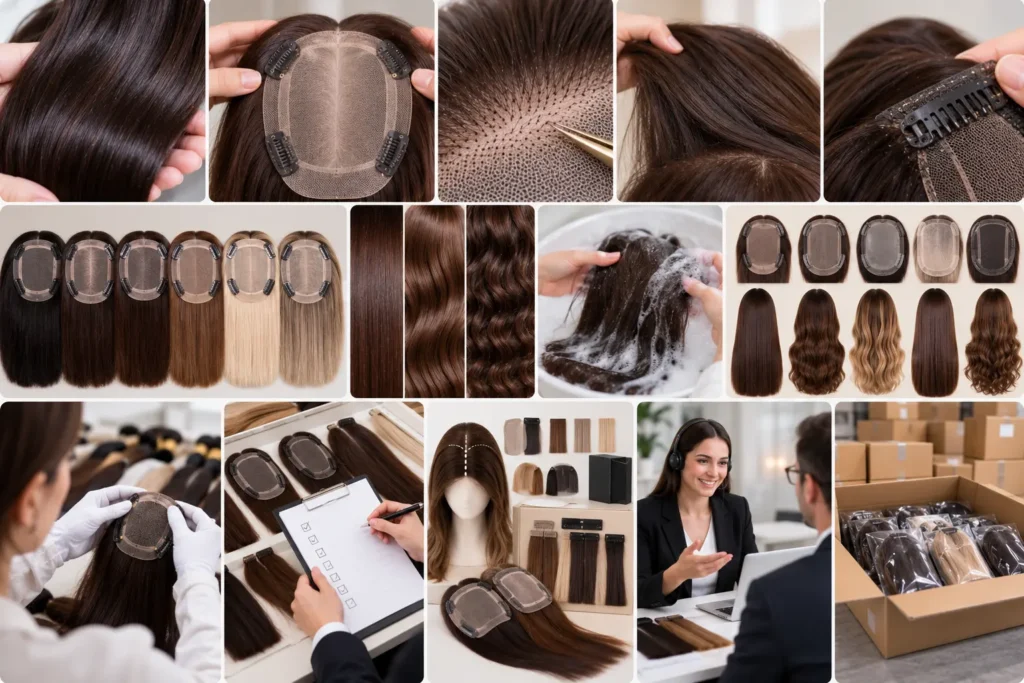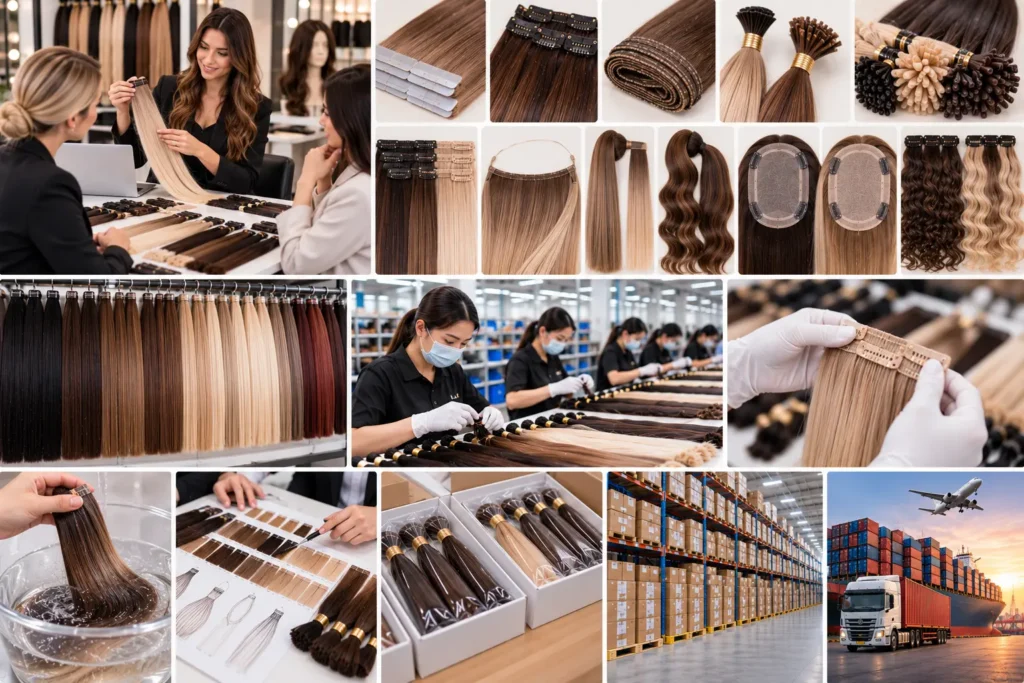

How to Choose the Most Suitable Hair Extensions?
Hair extensions can transform your look, but the wrong choice can feel heavy, look unnatural, or require more maintenance than expected. I have seen many buyers focus only on length or price, then struggle with blending, shedding, or repeat purchases. The right choice starts with method, hair quality, color, lifestyle, and supplier reliability.
The most suitable hair extensions are the ones that match your wearing method, natural hair condition, desired length, color, budget, and maintenance habits. For long-term value, I recommend choosing high-quality human hair, confirming color with samples, and working with a reliable brand or supplier that provides consistent quality control.
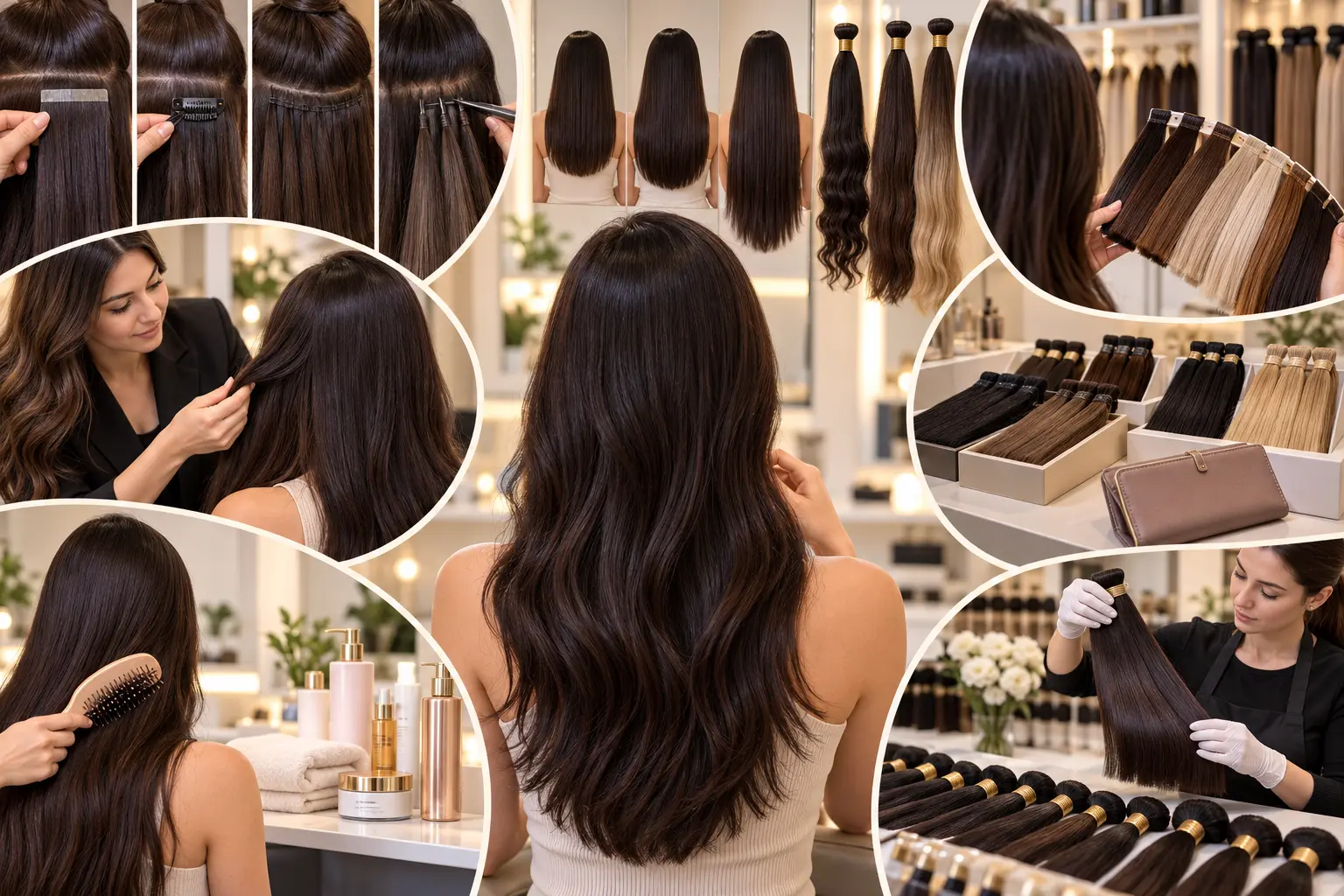
A good decision does not come from one factor. It comes from balancing comfort, appearance, durability, and support after purchase. Below, I will break down the key points I usually review when helping customers evaluate a new hair extension product line.
Which Hair Extensions Fit Your Wearing Method?
Choosing the wrong wearing method can turn beautiful hair into a frustrating daily routine. I often see customers love the final look but dislike the installation time or maintenance. The best method should match your lifestyle, salon access, styling habits, and how long you want the result to last.
The best hair extensions method depends on how often you want to wear them, whether you can visit a professional stylist, and how much daily care you accept. Clip-ins are best for temporary wear, while tape-ins, sew-ins, and fusion extensions are better for semi-permanent salon applications.[^1]
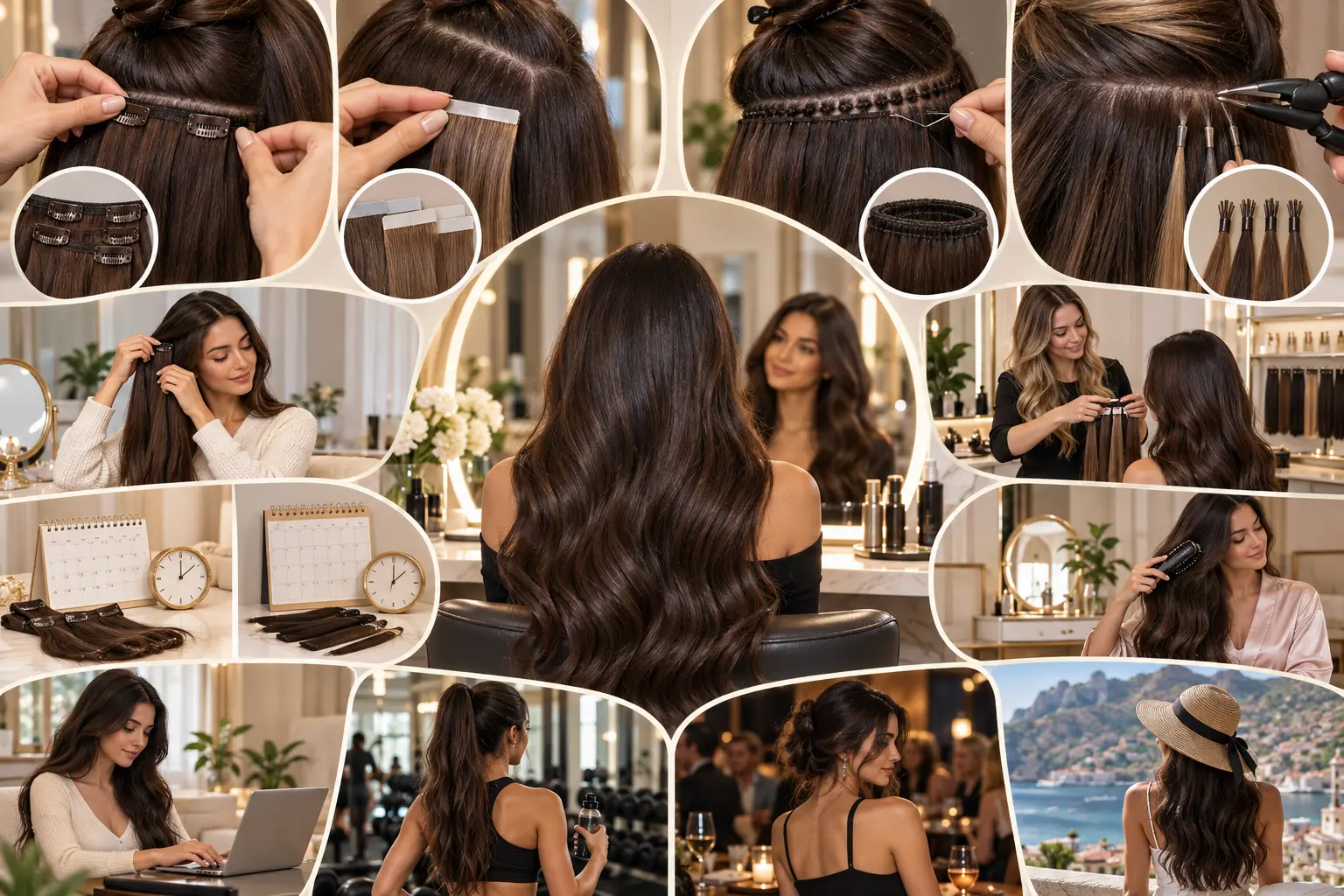
Common wearing methods
Different hair extensions serve different needs. I like to compare them by installation difficulty, wearing time, comfort, and maintenance.
| Method | Best For | Installation | Typical Wear Time | Key Consideration |
|---|---|---|---|---|
| Clip-in Hair | Temporary styling, events, beginners | At home | Daily removal | Easy to use but not for sleeping |
| Tape-in Hair | Natural flat look, salon clients | Professional | 6–8 weeks[^2] | Needs adhesive care |
| Sew-in / Weave | Thick or textured hair, long wear | Professional | 6–10 weeks | Can feel tight if installed poorly |
| Fusion / Pre-bonded Hair[^3] | Long-term individual strand effect | Professional | 3–5 months | Requires careful removal |
| Halo Hair | Quick volume without bonds | At home | Daily removal | Best for simple length and volume |
| Genius Weft / Flex Weft | Salon weft installation | Professional | Varies by method | Thin, flexible, and comfortable |
How I think about the choice
I always start with one simple question: Do you want temporary beauty or long-term wear?
If you want a style for weekends, photoshoots, weddings, or social events, I usually suggest clip-in hair extensions or halo hair extensions. These options are easy to remove and do not require glue, tape, or heat. They also work well for customers who are new to extensions and want to test length or volume before committing to a salon method.
If you want a more natural everyday look, I usually look at tape-in hair extensions or weft extensions. Tape-ins sit flat against the scalp, so they can blend well with fine to medium hair. Weft methods, such as machine weft, hand tied weft, Genius Weft, and Flex Weft, are popular with salons because they can create fullness across the head.
For longer-term individual strand results, fusion or pre-bonded hair extensions may be suitable. These use keratin or adhesive bonds to attach small strands to natural hair. The result can look very natural, but application and removal should be handled by a trained professional.[^4]
I always remind buyers that the most comfortable method on paper may not be the best method for every scalp or natural hair condition.
For B2B buyers, I suggest building your product range around customer behavior:
- Beauty supply stores often need clip-ins, ponytails, and tape-ins.
- Professional salons often need wefts, tape-ins, and keratin tips.
- Hair extension brands often need multiple methods in matching colors.
- Stylists often prefer consistent weight, clean wefts, and predictable coloring.
The right wearing method reduces complaints, improves repeat orders, and makes the final user feel more confident.
How Do You Choose Hair Extensions by Hair Quality?
Poor hair quality can ruin the customer experience even when the method is correct. Hair that tangles, sheds, smells, or loses shine quickly creates returns and bad reviews. I always treat hair quality as the foundation because it affects appearance, durability, and customer trust.
The best hair extensions are usually made from high-quality human hair, preferably Remy Hair or Cuticle Intact Hair when the application requires premium performance. Buyers should check softness, cuticle direction, shedding, color processing, and factory quality control before placing repeat orders.
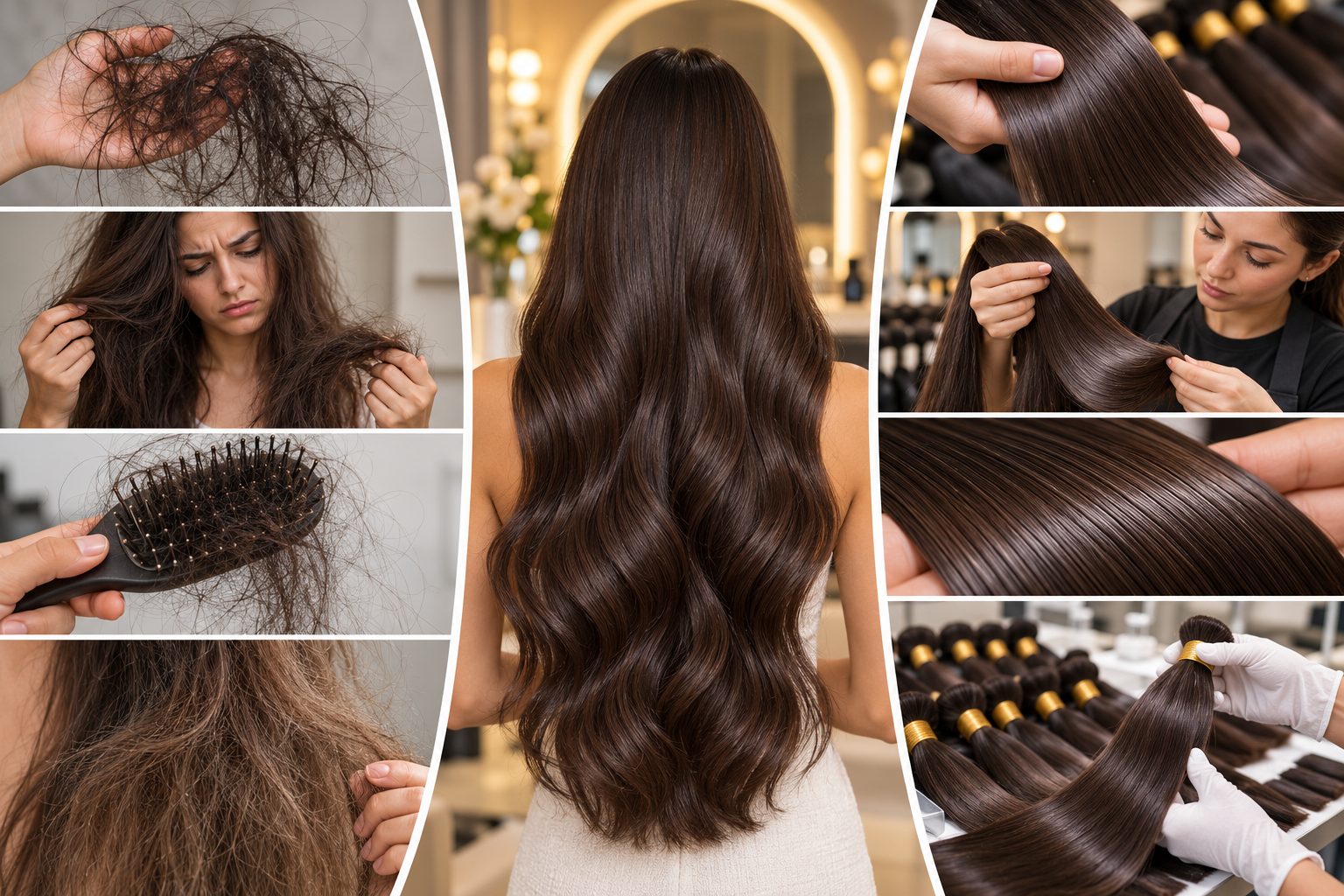
Main quality grades to understand
Hair extension quality terms can be confusing. I prefer to explain them in practical terms instead of using only marketing labels.
| Hair Type | Meaning | Buyer Benefit | What to Verify |
|---|---|---|---|
| 100% Human Hair | Hair made from real human hair | Natural look and heat styling ability | Fiber test, burn test, supplier documentation |
| Remy Hair | Hair with cuticles aligned in one direction | Less tangling and smoother feel | Cuticle direction and washing test |
| Cuticle Intact Hair | Hair with preserved cuticle layer | Premium longevity and natural movement | Microscopic or professional inspection |
| Non-Remy Hair | Mixed cuticle direction, often processed | Lower cost | Tangle risk after washing |
| Synthetic Hair | Artificial fiber | Low price, fashion use | Heat resistance and shine level |
Practical quality checks I use
When I evaluate hair extensions, I do not rely only on a label. I check how the hair behaves.
I usually look at:
- Tangle resistance after washing
- Shedding from weft, tape, or bond areas
- Color consistency from root to tip
- Hair ratio from top to ends
- Chemical smell after unpacking
- Softness after air drying
- Performance after heat styling
- Packaging condition after transport
High-quality human hair extensions often last 1 to 2 years with proper care, depending on the hair source, processing method, wearing method, and daily maintenance. I do not treat that as a guaranteed result for every user because styling habits vary. However, in my experience, better raw material and stricter production control usually create longer product life.
Why Remy and cuticle direction matter
Hair naturally has cuticles, like tiny scales on the surface. When cuticles run in the same direction, the strands move more smoothly against each other. This reduces friction, matting, and tangling.[^5] That is why Remy Hair extensions are usually preferred for premium lines.
Cuticle Intact Hair is often positioned as a higher-end option because the cuticle layer remains more complete. This can help maintain a natural shine and texture. For buyers, the key is not just hearing the term. The key is asking the supplier how they source, process, wash, color, and inspect the hair.
For B2B procurement
If you buy for a brand, salon chain, or wholesale business, I recommend sample testing before bulk orders. A simple internal test can include:
- Wash the sample 3–5 times.
- Air dry without silicone spray.
- Comb from ends to roots.
- Check shedding after brushing.
- Compare color under daylight and indoor light.
- Test curl retention or straightening response.
- Record performance before approval.
At RENAI HAIR, we focus on 100% Human Hair, Remy Hair, and Cuticle Intact Hair products. I still encourage buyers to test samples because every market has different expectations for thickness, softness, color tone, and price level.
What Hair Extensions Length, Weight, and Volume Should You Choose?
Length looks exciting in photos, but it can create problems if the weight and natural hair density do not match. Very long hair extensions need more care and may feel heavy.[^6] I always tell customers to choose a length that supports both the desired look and daily comfort.
The right hair extensions length depends on your natural hair length, target style, and maintenance routine. Longer extensions usually need more grams, more brushing, and more conditioning.[^7] For a natural result, choose a length that blends smoothly and does not overload your own hair.
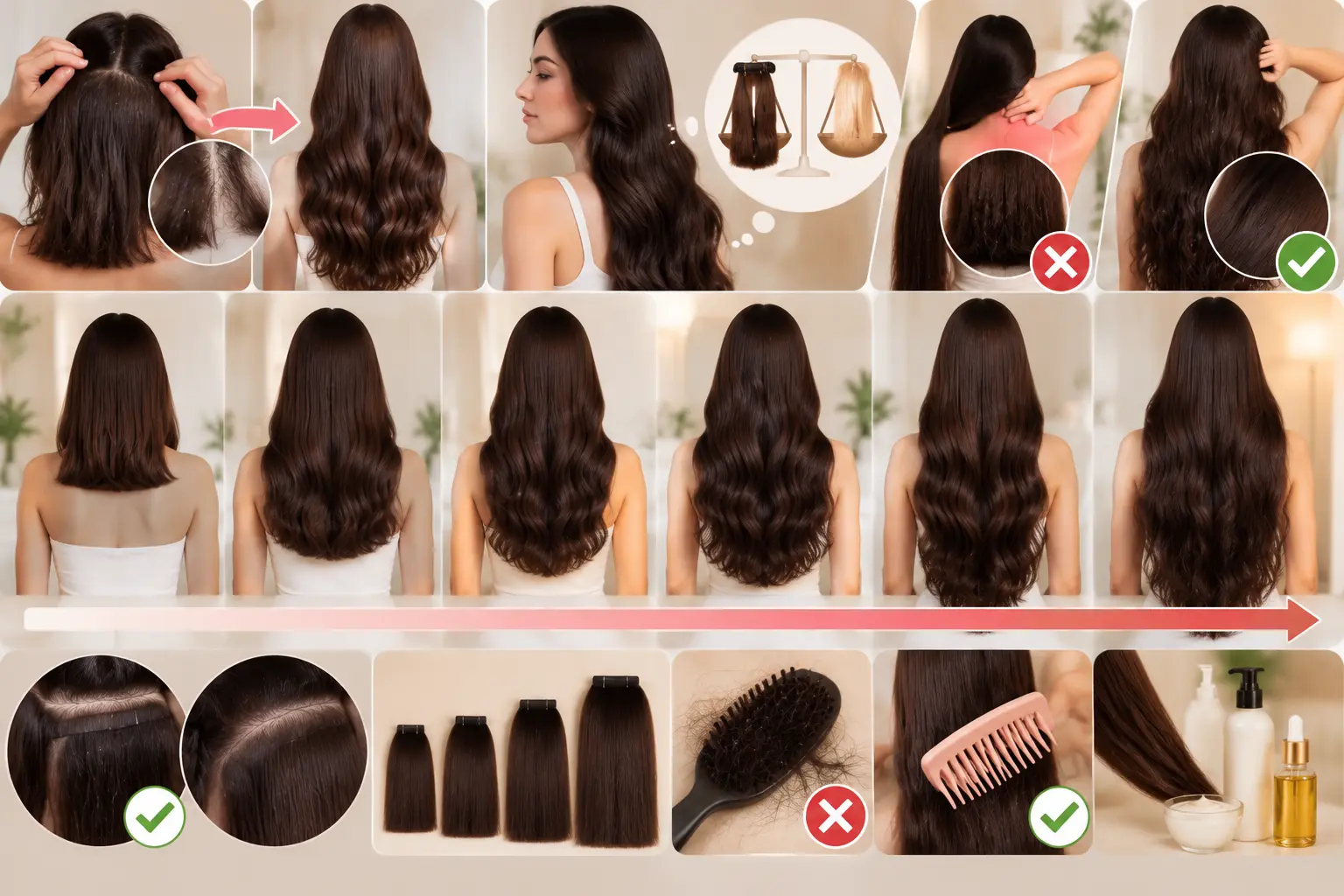
Length guide for common looks
| Extension Length | Visual Result | Best For | Maintenance Level |
|---|---|---|---|
| 12–14 inches | Shoulder to collarbone area | Natural volume, subtle length | Low to medium |
| 16–18 inches | Mid-length, everyday style | Popular salon looks | Medium |
| 20–22 inches | Long, glamorous style | Fashion and beauty clients | Medium to high |
| 24 inches and above | Extra-long statement look | Photoshoots, premium styling | High |
Why weight matters
I often see buyers ask for “longer” before they ask for “enough grams.” That can create thin ends. A 24-inch set needs more hair than a 16-inch set because the visual density must carry through a longer length.
For example, if a customer wants full long hair, a lightweight set may look good near the roots but thin near the ends. This is especially important for weft hair extensions, clip-in sets, and tape-in packs.
A useful rule is simple:
- Fine natural hair usually needs less weight.
- Medium natural hair needs balanced weight.
- Thick natural hair needs more grams for blending.
- Short blunt haircuts need extra volume to hide the line.
- Very long extensions need more density toward the ends.
Length and lifestyle
Longer hair extensions can be beautiful, but they require more daily care. Users need to brush carefully, avoid sleeping with wet hair, use suitable conditioner, and reduce friction. If someone exercises daily, swims often, or styles with heat tools every morning, I usually recommend a practical length instead of the longest option.
I once worked with a buyer who planned to launch only 24-inch products because the photos looked luxurious. After testing, they realized many salon clients wanted 18-inch and 20-inch options for daily wear. The brand later added medium lengths and improved repeat orders. That experience reminded me that product planning should follow real customer habits, not only social media trends.
Product planning for brands and wholesalers
For B2B buyers, I suggest carrying a balanced length range. A practical starting mix may include:
- 16 inches for natural everyday customers.
- 18 inches as a core bestseller.
- 20 inches for longer salon looks.
- 22 inches for premium long styles.
- 24 inches for statement looks and special demand.
The best mix depends on your market. North American and European customers often request a wide color and length range. Salon-focused buyers may need consistent stock in the most requested shades, such as natural black, dark brown, medium brown, blonde, balayage, and rooted colors.
When you choose hair extensions, do not think only about the longest result. Think about how the product feels after eight hours of wear, after washing, and after several weeks of styling.
How Should You Match Hair Extensions Color and Texture?
Even premium hair can look unnatural if the color match is wrong. A small shade difference may stand out in sunlight, photos, or curled styles. I always recommend color matching carefully because blending is one of the biggest factors in a natural result.
The best way to match hair extensions is to compare the extension color with the mid-lengths and ends of your natural hair, not only the roots. If your hair has multiple tones, choose highlighted, lowlighted, balayage, or rooted colors for a softer and more natural blend.
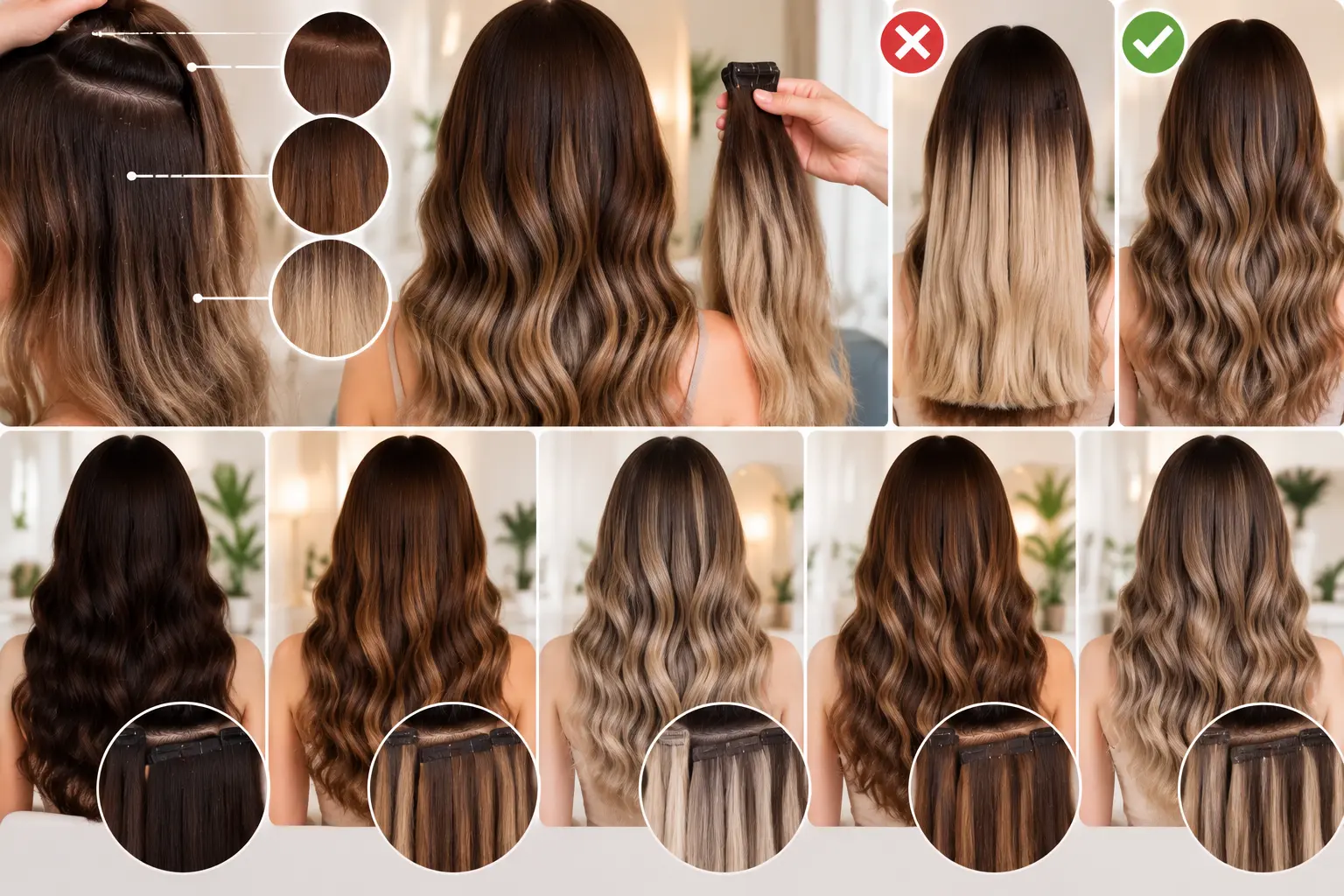
Why roots are not always the best match
Many people compare hair extensions to the root color first. That can be misleading. Natural hair often becomes lighter toward the ends because of sun exposure[^8], coloring, or previous salon work. Since extensions blend mostly with the mid-lengths and ends, those areas are usually more important.
I recommend checking color in:
- Natural daylight
- Indoor warm light
- Indoor cool light
- Photos with flash
- Straight and curled styling
A color can look perfect under one light and slightly different under another.[^9] That is why color rings and sample strands are useful.
Choosing solid, highlighted, and balayage colors
| Color Type | Best For | Natural Effect |
|---|---|---|
| Solid Color | One-tone natural hair | Clean and simple match |
| Highlight Color | Hair with lighter streaks | Adds movement and dimension |
| Lowlight Color | Hair with darker depth | Helps blend multi-tonal hair |
| Balayage Color | Darker root with lighter ends | Soft salon-inspired finish |
| Rooted Color | Visible darker root area | Natural grow-out effect |
| Piano Color | Mixed strands in different tones | Strong dimension and texture |
If the natural hair has several tones, I usually avoid a flat single color unless the match is exact. Multi-tonal hair extensions often blend better because they reflect light in a more natural way.
Texture matching
Color is not the only blending factor. Texture matters too. Straight extensions may not blend well with naturally wavy hair unless the customer styles both together. Wavy hair extensions can create a softer blend for customers who usually wear curls or waves.
Common texture choices include:
- Straight
- Body wave
- Natural wave
- Deep wave
- Curly
- Custom texture options
For professional brands, texture consistency is important. If one batch has a loose body wave and the next batch has a tighter wave, customers may notice. For this reason, buyers should confirm texture standards with suppliers.
Using color samples
RENAI HAIR provides free color card samples so buyers can check shades and evaluate quality before ordering. I consider this step especially useful for brands, wholesalers, and salons because color names can vary between suppliers.
For example, one supplier’s “#60 platinum blonde” may look cooler or warmer than another supplier’s version. The same issue can happen with #613 blonde, #1B natural black, #2 dark brown, or balayage shades.
Before placing a large order, I suggest checking:
- The color card under multiple lighting conditions
- The color match against your target market’s popular shades
- The consistency between sample and bulk order
- The quality of light colors after washing
- The tone stability after heat styling
Good color matching reduces returns, increases customer satisfaction, and makes hair extensions look more natural in real life.
How Do You Evaluate Hair Extensions Brands and Suppliers?
A beautiful product sample is only the beginning. A reliable supplier must deliver consistent quality, accurate color, stable packaging, and clear after-sales support. I have seen buyers lose time and money when they choose only by price instead of evaluating the full supply relationship.
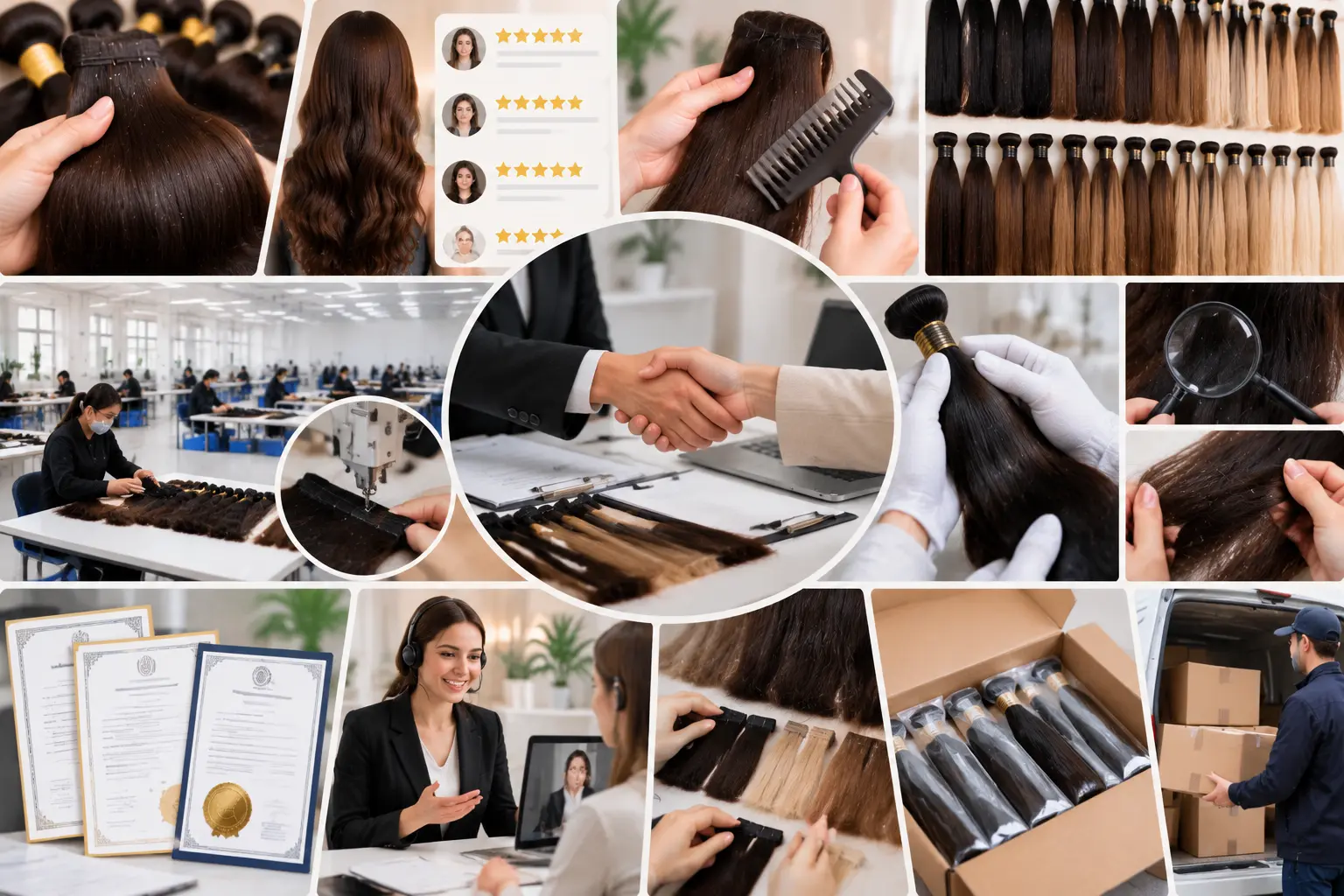
To evaluate hair extensions brands and suppliers, compare product quality, customer reviews, sample performance, color range, production stability, quality control, certifications, communication, and after-sales service. For B2B purchasing, buyers should verify documents, test samples, and confirm production standards before placing bulk orders.
Well-known retail brands
Several brands are popular in the consumer market, including Goo Goo Hair, Beauty Works, Bellami, Sunny Hair, Halo Couture, and Bombay Hair. These brands are well known because they usually offer strong product presentation, customer service, and after-sales support for individual consumers.
For personal buyers, choosing a recognized brand can reduce risk. Established brands often provide clearer guidance on color, length, installation, and returns. However, I still recommend checking recent reviews, product details, and care instructions because every product line can differ.
What B2B buyers should evaluate
For wholesale, salon, and private label buyers, supplier evaluation needs to go deeper. A supplier must support repeated orders, not just one successful sample.
I recommend reviewing these points:
| Evaluation Area | What to Check | Why It Matters |
|---|---|---|
| Hair Quality | Remy status, cuticle condition, softness, shedding | Determines product life and reviews |
| Product Range | Weft, tape-in, keratin, clip-in, halo, topper | Supports market expansion |
| Color Range | Natural, blonde, balayage, rooted, custom colors | Helps brands serve more customers |
| QC Process[^10] | Incoming inspection, production inspection, final inspection | Reduces defects and returns |
| Packaging | Private label, barcode, inserts, box strength | Improves brand presentation |
| Lead Time | Sampling time and bulk order schedule | Supports inventory planning |
| Communication | Response speed and technical clarity | Reduces mistakes |
| After-Sales | Defect handling and replacement policy | Protects long-term cooperation |
How I assess a supplier relationship
When I speak with serious buyers, I prefer to discuss real business needs first. I ask about target customers, price range, main colors, preferred methods, and expected order frequency. This helps match the product to the market.
For example, a salon client may value thin, flexible wefts and stable blonde shades. A beauty supply distributor may care more about attractive packaging, fast-moving colors, and consistent stock. A new private label brand may need product development support, logo packaging, and small-batch testing.
At RENAI HAIR, we manufacture products such as Genius Weft, Flex Weft, Machine Weft, Hand Tied Weft, Tape In Hair, Keratin/Prebonded Hair, Clip In Hair, Halo Hair, Ponytail, Hair Topper, and related hair extension tools. I mention this not as a substitute for buyer testing, but as context for how I think about product matching.
Certifications and claims
Buyers should treat certificates, test reports, and sourcing claims as documents to verify. If a supplier says the hair is Remy, cuticle intact, chemical-free, or ethically sourced, buyers should ask for supporting information and conduct practical product testing.[^11]
For application-specific decisions, especially for salon systems, adhesive use, scalp sensitivity, or chemical coloring, I recommend consultation with qualified professionals. A manufacturer can provide product information and samples, but stylists and trained specialists should evaluate suitability for individual wearers.
A strong supplier helps you reduce risk, improve repeat purchase rates, and build a more stable hair extensions business.
Frequently Asked Questions
What type of hair extensions are best for beginners?
Clip-in hair extensions are often best for beginners because they are easy to apply and remove at home. They do not require glue, tape, heat, or salon installation. I recommend them for customers who want temporary length or volume before trying semi-permanent methods.
How long do human hair extensions usually last?
High-quality human hair extensions can often last 1 to 2 years with proper care. The actual lifespan depends on hair quality, wearing method, washing routine, heat styling, coloring, and storage. Remy Hair and Cuticle Intact Hair usually perform better than heavily processed lower-grade hair.
Should hair extensions match my roots or ends?
Hair extensions should usually match your mid-lengths and ends because that is where blending happens most. Roots can be darker than the rest of the hair. If your natural hair has several tones, highlighted, lowlighted, balayage, or rooted colors may create a more natural result.
Are tape-in hair extensions better than clip-ins?
Tape-ins are better for semi-permanent daily wear, while clip-ins are better for temporary styling. Tape-ins require professional installation and maintenance every few weeks. Clip-ins can be applied at home and removed daily, so they are more flexible for occasional use.
How can B2B buyers test hair extension quality before bulk orders?
B2B buyers should request samples, wash them several times, check shedding, test tangling, compare colors in different lighting, and evaluate packaging. I also recommend checking supplier communication, production lead time, quality control process, and after-sales policy before placing repeat orders.
Conclusion
Choosing the most suitable hair extensions means balancing wearing method, hair quality, length, color, lifestyle, and supplier reliability. I recommend starting with your real needs, then testing samples before making a final decision. For brands, wholesalers, distributors, and salons, stable quality matters as much as style. If you are developing or expanding a human hair extensions product line, contact RENAI HAIR to request samples, color cards, and a product recommendation based on your market.
[^1]: "Artificial hair integrations", https://en.wikipedia.org/wiki/Artificial_hair_integrations. An encyclopedic overview of artificial hair integration describes clip-in extensions as removable pieces and tape-in, sew-in, and bonded or fusion systems as attached methods used for longer wear, supporting the article's method classification. Evidence role: definition; source type: encyclopedia. Supports: An overview source should define common hair-extension methods and distinguish removable clip-ins from bonded, taped, sewn, or fusion methods that are worn for longer periods.. Scope note: This would support the terminology and general distinction, not prove which method is best for a specific wearer. [^2]: "Hair Extensions 101: Everything You Need to Know", https://brownbeautybarberschool.edu/news/hair-extensions-101-everything-you-need-to-know/. Cosmetology training materials commonly note that tape-in extensions require periodic repositioning or maintenance after several weeks of wear, providing contextual support for the 6–8 week interval. Evidence role: general_support; source type: education. Supports: A cosmetology or professional education source should support that tape-in extensions commonly need salon maintenance after several weeks as natural hair grows.. Scope note: The exact timing varies with hair growth, adhesive type, oil exposure, and care routine. [^3]: "Exploring the Pros and Cons of Fusion Hair Extensions", https://www.perfectlocks.com/blogs/all-tressed-up/pros-and-cons-fusion-hair-extensions?srsltid=AYCX9vJTrPc5ODZF97nmdK2u1ZJeGc2o4D7ksupJGrE_i0q_D0sqwqzM. A general reference on artificial hair integration identifies fusion or pre-bonded extensions as individual-strand systems attached with bonding material, supporting the article's description of the method. Evidence role: definition; source type: encyclopedia. Supports: A neutral overview should describe fusion or pre-bonded extensions as individual strands attached with keratin or adhesive bonds.. Scope note: This supports the method definition, not comparative safety or durability claims. [^4]: "All hairstyles are not created equal: What the dermatologist ...", https://pubmed.ncbi.nlm.nih.gov/27114262/. Dermatology guidance links tight or improperly managed extensions and weaves with traction-related hair damage, supporting the caution that complex extension systems should be managed by trained professionals. Evidence role: expert_consensus; source type: institution. Supports: A dermatology or professional health source should support that extensions can contribute to hair damage when installed, worn, or removed improperly.. Scope note: The source would support the safety rationale generally and may not address every fusion product design. [^5]: "Friction Dynamics of Straight, Curly, and Wavy Hair", https://pubmed.ncbi.nlm.nih.gov/38692901/. Hair-fiber research shows that the cuticle scale structure contributes to directional friction between hair shafts, supporting the mechanism by which aligned cuticles may reduce tangling and matting. Evidence role: mechanism; source type: paper. Supports: A hair-fiber science paper should explain that cuticle scale orientation affects frictional behavior and fiber interaction.. Scope note: The mechanism supports the principle but does not independently verify the cuticle alignment of any specific extension product. [^6]: "Traction Alopecia: Clinical and Cultural Patterns - PMC", https://pmc.ncbi.nlm.nih.gov/articles/PMC8530059/. Dermatology literature on traction alopecia identifies sustained tension from hairstyles, weaves, and extensions as a risk factor for hair damage, supporting the caution that heavier or longer extensions may increase strain. Evidence role: mechanism; source type: paper. Supports: A dermatology review should support that added tension from extensions or weaves can contribute to traction-related hair loss or scalp discomfort.. Scope note: The source would support a general biological risk mechanism, not quantify the safe weight for an individual wearer. [^7]: "Hair Extensions 101: Everything You Need to Know", https://brownbeautybarberschool.edu/news/hair-extensions-101-everything-you-need-to-know/. Professional cosmetology guidance describes extension length, density, and maintenance as interrelated factors, providing contextual support for the claim that longer extensions generally require more hair and more care. Evidence role: general_support; source type: education. Supports: A cosmetology education source should support that longer extension styles require adequate density and more detangling or conditioning care.. Scope note: The source may not prescribe exact gram amounts because density needs vary by head size, haircut, and natural hair thickness. [^8]: "Photoaggravation of Hair Aging - PMC - NIH", https://pmc.ncbi.nlm.nih.gov/articles/PMC2938585/. Studies of human-hair photodegradation show that ultraviolet radiation can alter melanin and hair color, supporting the statement that sun exposure may lighten exposed hair lengths and ends. Evidence role: mechanism; source type: paper. Supports: A hair photochemistry paper should support that ultraviolet radiation and sunlight can degrade hair pigments and alter hair color.. Scope note: The source supports the photochemical mechanism, while actual color change depends on baseline pigment, prior coloring, and exposure history. [^9]: "A Standard for Lighting Color Preference?", https://www.nist.gov/news-events/news/2017/03/standard-lighting-color-preference. Color science research on illuminants and metamerism shows that two materials can appear matched under one light source and differ under another, supporting the recommendation to check extension color in multiple lighting conditions. Evidence role: mechanism; source type: research. Supports: A color science source should explain that illuminants affect perceived color and can cause metameric mismatches.. Scope note: This supports the optical principle generally and is not specific to hair-extension dyes. [^10]: "ISO 9001 Reduces Complaints with Quality Management System", https://www.linkedin.com/posts/global-compliance-certification_iso9001-customersatisfaction-qualitymanagement-activity-7497821355128815616-BTxV. ISO quality-management guidance emphasizes controlled processes, monitoring, and product conformity as means of improving consistency and customer satisfaction, supporting the article's emphasis on supplier quality-control processes. Evidence role: general_support; source type: institution. Supports: An institutional quality-management standard should support the role of controlled processes and inspection in product conformity and customer satisfaction.. Scope note: The standard supports general quality-management principles rather than documenting defect rates in the hair-extension industry specifically. [^11]: "OECD Due Diligence Guidance for Responsible Supply ...", https://www.oecd.org/en/publications/2016/04/oecd-due-diligence-guidance-for-responsible-supply-chains-of-minerals-from-conflict-affected-and-high-risk-areas_g1g65996.html. Supply-chain due-diligence guidance emphasizes verification of supplier claims, documentation, and risk controls, supporting the recommendation that buyers seek evidence and test products before relying on sourcing or quality statements. Evidence role: expert_consensus; source type: institution. Supports: A due-diligence or claim-substantiation source should support verifying supplier claims and documentation before purchasing.. Scope note: This supports the procurement principle generally and does not validate any specific hair-origin or Remy-hair certification.