
How to Compare Hair Extension Quotations
Comparing hair extension quotations can feel overwhelming when every supplier presents pricing differently. Without a clear framework, you risk overpaying for mediocre hair — or choosing the cheapest quote only to face quality complaints from your customers. Understanding the core pricing components helps you decode any quotation and make confident sourcing decisions.
To compare hair extension quotations effectively, you need to break each quote into its core components: hair quality (raw material grade), hair length, product type, and hair weight/width. The most significant price drivers are hair quality and the weight per piece. By standardizing these variables across quotes, you can make true apples-to-apples comparisons and identify the best value for your business.
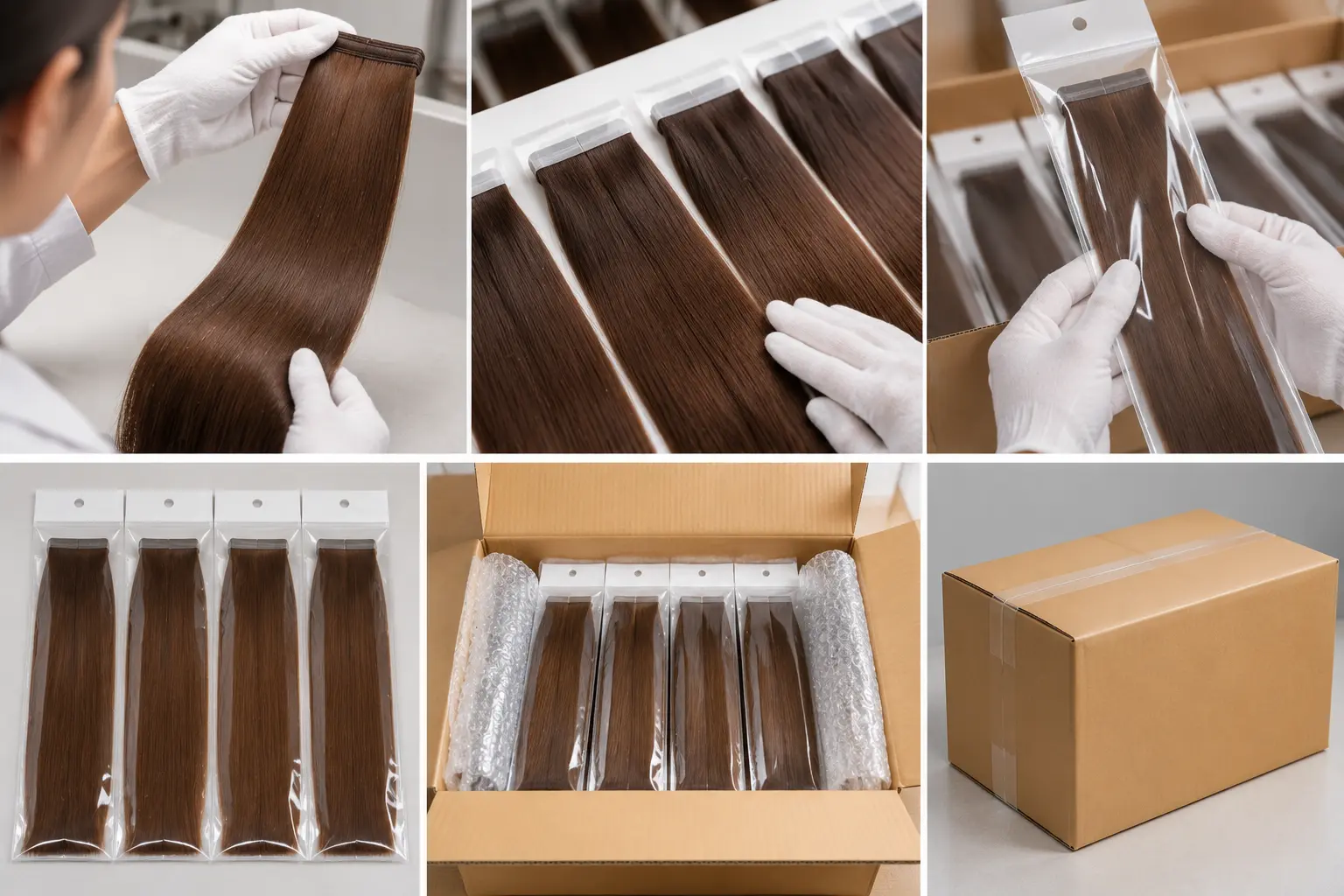
The challenge is that suppliers don't always label these components the same way. Some emphasize product type, others highlight origin or hair grade. In the sections below, I'll walk you through each pricing factor, explain why raw material quality matters most, and share the framework I use to help our B2B clients evaluate competing offers with clarity.
What Are the Core Components of a Hair Extension Quotation?
Many buyers receive quotations that look completely different from one supplier to the next. This inconsistency makes direct comparison nearly impossible — unless you know what to look for beneath the surface numbers.
A standard hair extension quotation is built on four core components: hair quality (raw material grade), hair length, product type (processing method), and hair weight or width per piece. Each factor influences the final price, but they do so in different proportions.

Hair Quality (Raw Material Grade)
This is the single biggest price driver in any quotation. The quality of the raw hair material can account for 50–70% of the total price difference[^1] between two seemingly similar products. I'll break down the specific quality grades in the next section.
Hair Length
Longer hair is more expensive — this is straightforward. A 24-inch weft costs more than a 16-inch weft of the same quality because longer raw hair is scarcer and requires more careful processing. Most suppliers price in 2-inch increments (14", 16", 18", 20", 22", 24", etc.), and the price increase per increment tends to accelerate at longer lengths.
Product Type (Processing Method)
Different product types require different manufacturing processes, and processing costs vary accordingly. Here's a general comparison:
| Product Type | Processing Complexity | Relative Processing Cost |
|---|---|---|
| Machine Weft | Standard | Low–Medium |
| Genius Weft | High precision | Medium–High |
| Flex Weft | Specialized | Medium–High |
| Hand Tied Weft | Labor-intensive | High |
| Tape-In Extensions | Moderate | Medium |
| Keratin/Pre-bonded | Individual tip work | Medium–High |
| Clip-In Extensions | Multi-step assembly | Medium |
However, processing cost differences are relatively transparent across the industry. A hand tied weft will always cost more to produce than a machine weft — that's expected. The less transparent variable, and the one that truly separates quotations, is the raw material quality hidden behind generic labels.
Hair Weight and Width
This factor is often underestimated by buyers comparing quotations for the first time. For the same quality and length, a heavier or wider piece of hair will cost more. A weft that weighs 120 grams per pack costs more than one weighing 80 grams. Similarly, a wider tape-in piece uses more raw hair than a narrower one.
Pro tip: Always confirm the weight per pack or per piece when comparing quotes. A lower price might simply mean less hair per unit — not a better deal.
Why Does Hair Quality Create the Biggest Price Differences?
You've probably noticed that two suppliers can quote vastly different prices for what appears to be the same product — say, a 20-inch hand tied weft in color #4. The product type and length are identical. So where does the price gap come from? Almost always, it comes down to raw material quality.
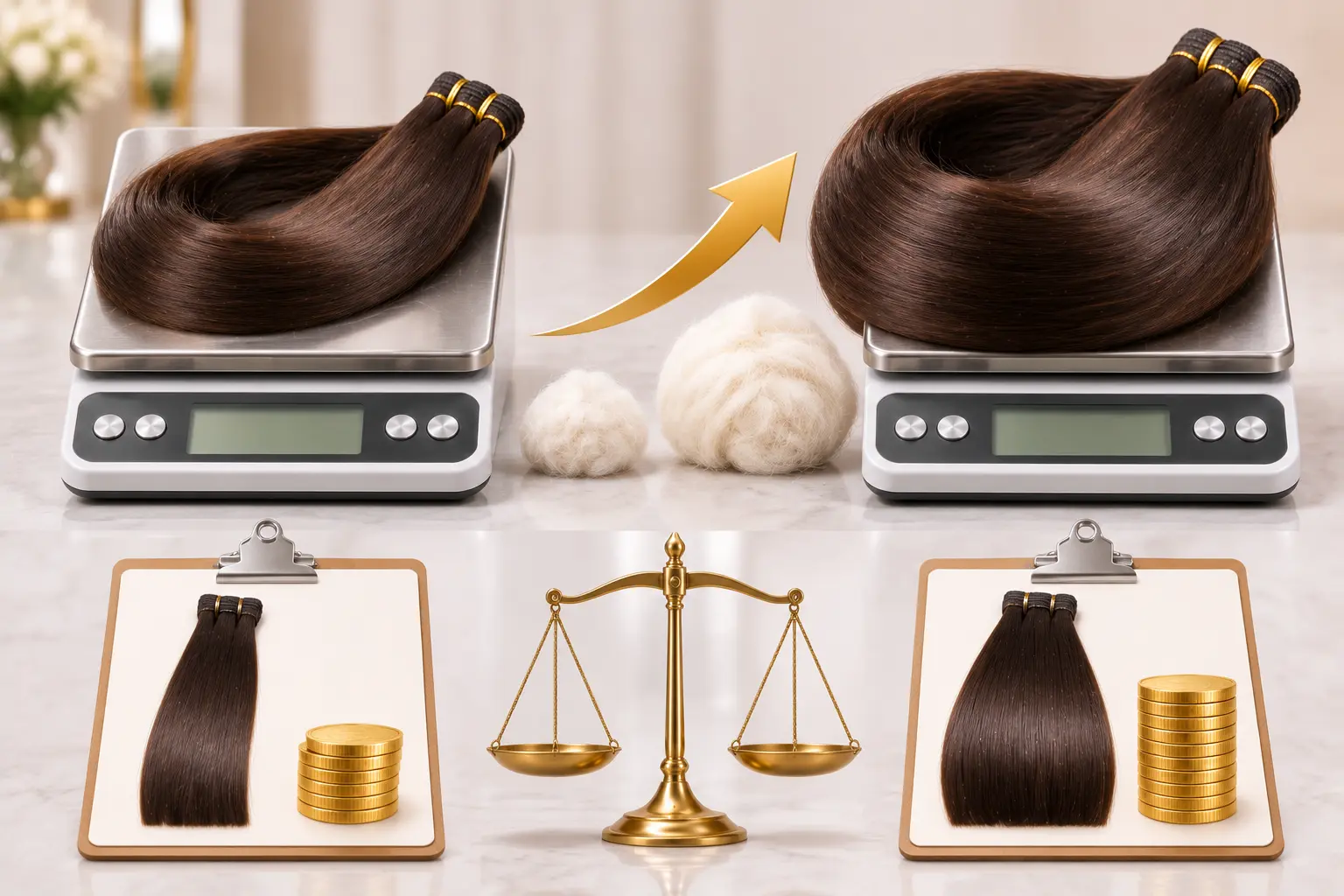
The hair extension market primarily distinguishes between two raw material grades: Remy hair (sourced from single-donor braids with intact, aligned cuticles) and virgin hair (sourced from collected hair balls of mixed origins). Remy hair commands a significantly higher price because of its superior quality, longevity, and tangle-free performance.
Understanding Remy Hair
Remy hair — sometimes written as "remy hair" or "cuticle intact hair" — represents the premium tier of raw materials in the hair extension industry. Here's what defines it:
- Single-donor origin (one donor): The hair comes from a single person's ponytail or braid, ensuring uniform texture, thickness, and natural taper from root to tip.
- 100% cuticle coverage: The hair cuticle layer remains fully intact and undamaged.
- Aligned cuticle direction: All cuticles face the same direction — from root to tip. This is critical because it prevents tangling, matting, and friction between strands.
Because of these characteristics, Remy hair products feel smoother, last significantly longer (often 12+ months with proper care)[^2], maintain their natural luster, and cause far fewer customer complaints. The sourcing process for genuine single-donor Remy hair is meticulous and limited in supply[^3], which directly drives the higher cost.
Understanding Virgin Hair (Collected Hair)
In industry terminology — particularly in the Chinese manufacturing context — "virgin hair" (倒顺发) refers to hair sourced from hair balls (头发球). These are collections of hair gathered from various sources: temple floors, combs, different donors, and sometimes even previously processed hair. Key characteristics include:
- Mixed donor origins: Hair comes from multiple people with different hair textures, thicknesses, and conditions.
- Inconsistent cuticle alignment: Since the hair is collected loose, cuticle directions are often mixed or partially stripped[^4].
- Variable quality: Depending on the supplier's sorting process, quality can range from acceptable to poor.
Important note: The term "virgin hair" is used differently in different markets. In Western consumer marketing, "virgin hair" often implies unprocessed, premium quality hair. In manufacturing and B2B trade, however, it typically refers to the collected hair grade described above. Always clarify the actual raw material source when you see this term on a quotation.
Price Impact Comparison
To illustrate how dramatically raw material quality affects pricing, here's a simplified example for a 20-inch machine weft:
| Factor | Remy Hair (Single Donor) | Virgin Hair (Collected) |
|---|---|---|
| Raw material cost | High | Low–Medium |
| Cuticle integrity | 100% intact, aligned | Partially intact, mixed |
| Tangle resistance | Excellent | Moderate–Poor |
| Product lifespan | 12+ months | 3–6 months |
| Customer return rate | Low | Higher |
| Typical price range | $$$ | $ – $$ |
The takeaway: when you see a quote that is 40–60% cheaper than another for the same product specs, the difference almost certainly lies in the raw material grade. Lower-tier hair requires acid baths or silicone coatings to appear smooth initially[^5], but these treatments wash out within weeks, leaving the end user with tangled, dry hair[^6].
How Does Hair Weight Per Piece Affect Your Quotation?
Buyers sometimes fixate on price per piece without considering how much hair that piece actually contains. This is a common oversight that can completely distort your quotation comparison.
Hair weight (measured in grams) directly determines quotation pricing. For the same hair quality and length, a heavier piece requires more raw material, so it costs more. When comparing quotations, always normalize pricing to a cost-per-gram or cost-per-ounce basis to ensure a fair comparison.

Why Weight Matters More Than You Think
In my experience working with B2B clients at RENAI HAIR, I've seen many first-time buyers compare quotes purely on a per-piece or per-pack basis. Supplier A quotes $50 per pack, Supplier B quotes $65. Supplier A looks cheaper — until you realize Supplier A's pack contains 80 grams and Supplier B's contains 120 grams.
Let's do the math:
| Metric | Supplier A | Supplier B |
|---|---|---|
| Price per pack | $50 | $65 |
| Weight per pack | 80g | 120g |
| Price per gram | $0.625/g | $0.542/g |
Supplier B is actually 13% cheaper on a per-gram basis — and your customers will notice the fuller, thicker result.
Standardize Before You Compare
Here's the framework I recommend to our wholesale and brand clients:
- Request exact weight specifications from every supplier. If a supplier cannot or will not confirm the weight per piece or per pack, that's a red flag.
- Calculate price per gram at the same length and quality tier.
- Confirm whether the weight is for dry or wet hair — some suppliers weigh hair slightly damp, which inflates the apparent weight.
- Consider your end customer's expectations. If you sell full-head sets, you need to know the total weight to meet your packaging promises.
Width Specifications for Wefts
For weft-based products (genius weft, hand tied weft, machine weft), width also matters:
- A wider weft uses more raw hair per linear inch.
- Some suppliers quote per piece at a standard width (e.g., 100cm), while others use narrower widths.
- Always confirm the width × weight combination to understand what you're actually paying for.
What Framework Should You Use to Compare Quotations Side by Side?
Even with all the knowledge above, the actual comparison process can feel chaotic when you have three to five quotations on your desk. You need a systematic approach.
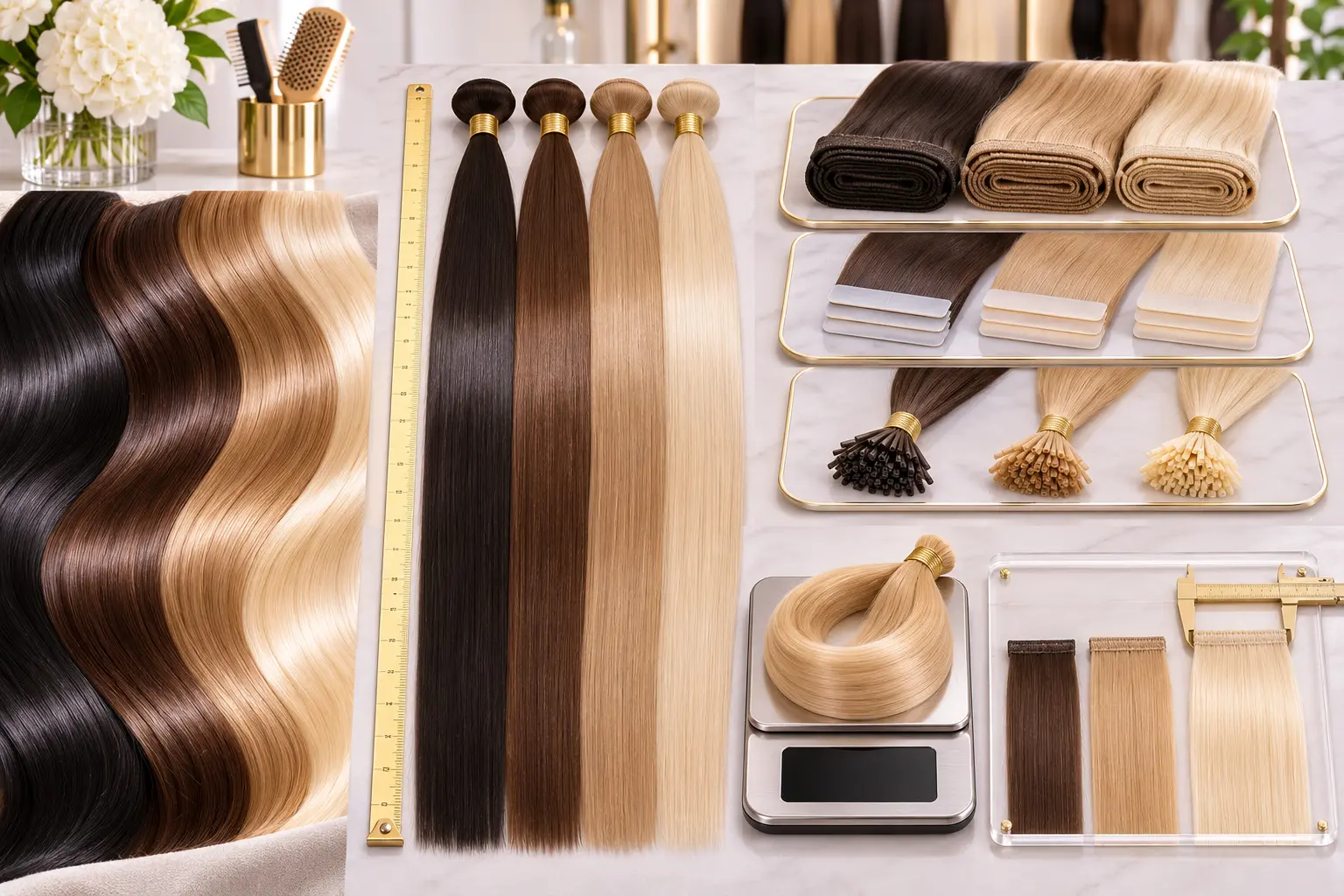
Create a standardized comparison matrix that normalizes every quotation to the same variables: hair quality grade, length, product type, weight per unit, and price per gram. This eliminates superficial price differences and reveals the true value each supplier offers.
Step-by-Step Comparison Process
Here's the exact process I walk our clients through:
Step 1: Request samples before committing. No amount of quotation analysis replaces physically examining the hair. Order sample pieces from your top two or three suppliers at the same specs.
Step 2: Build your comparison spreadsheet. Use these columns:
| Column | What to Record |
|---|---|
| Supplier | Company name |
| Hair Grade | Remy (single donor) / Virgin (collected) / Other |
| Origin Verification | Can they document the hair source? |
| Product Type | Genius weft, tape-in, etc. |
| Length | In inches |
| Weight per Unit | In grams |
| Width (for wefts) | In centimeters |
| Unit Price | In USD |
| Price per Gram | Calculated |
| MOQ | Minimum order quantity |
| Lead Time | Production + shipping |
| Color Range | Available colors |
| Customization | Custom colors, lengths, packaging |
| QC Process | Pre-shipment inspection details |
Step 3: Eliminate non-comparable quotes. If a supplier won't disclose the hair grade or weight, their quote cannot be meaningfully compared. Set it aside.
Step 4: Compare within the same quality tier. Never compare a Remy hair quote against a collected virgin hair quote — they are fundamentally different products serving different market segments.
Step 5: Factor in total cost of ownership. A cheaper product that generates higher return rates, more customer complaints, and faster reorder cycles may cost you more in the long run[^7]. Consider:
- Customer satisfaction and retention — premium hair keeps customers coming back
- Brand reputation risk — low-quality hair can damage your brand permanently
- Reorder frequency — longer-lasting hair means fewer reorders per customer per year, but higher per-unit margins
Red Flags in Quotations
Watch for these warning signs:
- Unusually low prices with no explanation of the hair grade used
- Vague descriptions like "premium quality" or "best hair" without specifying single-donor vs. collected
- No weight disclosure or refusal to provide weight per piece
- Inconsistent pricing across lengths that doesn't follow logical scaling
- No MOQ or extremely low MOQ — which may indicate the supplier stocks pre-made generic products rather than manufacturing to spec
Frequently Asked Questions
Why do two suppliers quote such different prices for the same hair extension product?
The most common reason is a difference in raw material grade. Remy hair (single-donor, cuticle-intact) costs significantly more than collected virgin hair. Product weight per unit can also vary. Always ask suppliers to specify the hair grade and weight per piece before comparing prices.
Should I always choose the cheapest hair extension quotation?
Not necessarily. The cheapest quotation often uses lower-grade raw materials that lead to tangling, shedding, and customer complaints. For B2B buyers building a brand, investing in higher-quality hair typically delivers better margins through customer retention and fewer returns.
What is the difference between Remy hair and virgin hair in manufacturing quotations?
In B2B manufacturing context, Remy hair comes from single donors with 100% intact, aligned cuticles. Virgin hair (倒顺发) typically refers to collected hair from mixed sources with inconsistent cuticle alignment. The terminology can differ from consumer marketing — always verify the actual raw material source with your supplier.
How can I verify the hair quality claimed in a quotation?
Request physical samples and conduct basic tests: check for tangling by running fingers from tip to root[^8], examine cuticle alignment under magnification[^9], and wash the sample to see if silicone coatings wash out. A qualified professional evaluation is recommended for application-specific decisions. Reputable manufacturers like RENAI HAIR welcome sample testing.
What minimum order quantities should I expect from quality hair extension manufacturers?
MOQs vary by manufacturer and product type. Machine wefts may start at 10–20 kg per color/length combination[^10], while hand tied wefts may require smaller quantities due to labor intensity[^11]. Established manufacturers typically have higher MOQs but offer better consistency. Discuss your volume needs directly with suppliers to find the right fit.
Conclusion
Learning how to compare hair extension quotations is one of the most valuable skills for any B2B buyer in the hair extension industry. The key takeaways are straightforward: break every quote into its core components — hair quality, length, product type, and weight per piece. Understand that raw material grade (Remy single-donor vs. collected virgin hair) drives the largest price differences. Always normalize pricing to a cost-per-gram basis at equivalent quality tiers. And never skip the sample testing step.
At RENAI HAIR, we're transparent about our raw material sourcing, product specifications, and pricing structure because we believe informed buyers make the best long-term partners. If you're evaluating suppliers for your hair extension brand or distribution business, reach out to our team for detailed quotations with full product specifications — we're happy to help you compare with confidence.
[^1]: "The dark side of beauty: an in-depth analysis of the health hazards and toxicological impact of synthetic cosmetics and personal care products - PMC", https://pmc.ncbi.nlm.nih.gov/articles/PMC11381309/. Industry analyses of manufacturing cost structures in beauty and personal care products indicate that raw material quality typically represents the dominant cost component in finished goods pricing. Evidence role: statistic; source type: research. Supports: the proportion of raw material costs in manufactured beauty products or hair extensions. Scope note: Data may reflect broader beauty product categories rather than hair extensions specifically [^2]: "Lifespan Guide: How Long Do Professional Hair Extensions Last?", https://salon144nj.com/lifespan-guide-how-long-do-professional-hair-extensions-last/. Consumer product research on hair extension durability suggests that high-quality extensions with intact cuticles can maintain usability for extended periods when properly maintained, though actual lifespan varies with care practices and usage patterns. Evidence role: general_support; source type: research. Supports: typical lifespan ranges for quality hair extensions under proper maintenance. Scope note: Specific 12-month figure may vary based on individual usage and maintenance protocols [^3]: "'Ethically murky territory': The complex world of harvesting human hair | by Kellie Scott", https://medium.com/@kelliescott1/ethically-murky-territory-the-complex-world-of-harvesting-human-hair-373918202fae. Trade analyses of the human hair market indicate that sourcing practices requiring specific quality standards face inherent supply limitations due to collection logistics and donor availability. Evidence role: general_support; source type: research. Supports: supply constraints in human hair sourcing for manufacturing. [^4]: "Nanoscale Molecular Characterization of Hair Cuticle Cells Using Integrated Atomic Force Microscopy–Infrared Laser Spectroscopy - PMC", https://pmc.ncbi.nlm.nih.gov/articles/PMC7747034/. Trichology research demonstrates that hair cuticle alignment and integrity significantly influence fiber friction, tangling behavior, and overall hair quality, with disrupted cuticle patterns increasing inter-fiber friction. Evidence role: mechanism; source type: research. Supports: how hair cuticle alignment and integrity affect hair fiber properties. [^5]: "On Hair Care Physicochemistry: From Structure and Degradation to Novel ...", https://pmc.ncbi.nlm.nih.gov/articles/PMC9921463/. Cosmetic chemistry literature documents various surface treatments for hair fibers, including silicone-based coatings and chemical processing methods, which temporarily modify surface properties and appearance. Evidence role: mechanism; source type: research. Supports: common chemical treatments applied to hair fibers in cosmetic processing. Scope note: Does not specifically address quality tiers or industry practices in hair extension manufacturing [^6]: "Comprehensive Review of Hair Dyes: Physicochemical Aspects, Classification, Toxicity, Detection, and Treatment Methods - PMC", https://pmc.ncbi.nlm.nih.gov/articles/PMC12268732/. Studies of cosmetic hair treatments indicate that surface-applied coatings, including silicones, are subject to gradual removal through washing and mechanical stress, with durability dependent on coating chemistry and bonding mechanisms. Evidence role: mechanism; source type: research. Supports: the temporary nature of surface coatings on hair fibers. Scope note: Specific timeframe of 'weeks' may vary based on coating type and washing frequency [^7]: "The costs of quality: an interactive model of appraisal, prevention and failures", https://pubmed.ncbi.nlm.nih.gov/10539405/. Quality management research establishes that total cost of ownership includes not only acquisition costs but also costs of poor quality, including returns, warranty claims, and customer dissatisfaction, which can exceed initial price savings from lower-quality alternatives. Evidence role: general_support; source type: research. Supports: the relationship between product quality and total cost of ownership. [^8]: "Investigation of scale effects and directionality dependence on friction and adhesion of human hair using AFM and macroscale friction test apparatus", https://pubmed.ncbi.nlm.nih.gov/16675116/. Trichological studies show that hair cuticle scales create directional friction, with movement against the cuticle direction (root to tip) producing significantly more resistance than movement with the cuticle direction, providing a basis for directional friction testing. Evidence role: mechanism; source type: research. Supports: how cuticle direction affects friction when hair is manipulated in different directions. [^9]: "Trends in the Forensic Examination of Hair - PMC - NIH", https://pmc.ncbi.nlm.nih.gov/articles/PMC12674478/. Analytical methods in trichology and materials science employ optical and electron microscopy to visualize hair cuticle structure, scale patterns, and surface integrity at magnifications revealing cellular-level detail. Evidence role: mechanism; source type: research. Supports: microscopic examination methods for hair cuticle structure. [^10]: "Wholesale Hair Extensions MOQ: How Minimum Orders Work by Color and Product", https://primehumanhair.com/resources/wholesale-hair-extensions-moq-guide. Manufacturing economics literature indicates that specialized production processes typically require minimum order quantities to achieve cost efficiency, with batch sizes varying based on setup costs, material handling, and production complexity. Evidence role: general_support; source type: research. Supports: typical minimum order quantities in specialized textile and beauty product manufacturing. Scope note: Does not provide specific figures for hair extension manufacturing [^11]: "The Rise of the Artisan Economy - Chapman Blogs", https://blogs.chapman.edu/demographics-and-policy/wp-content/uploads/sites/82/2026/10/Rise-of-Artisan-Economy_WEB.pdf. Manufacturing economics research shows that labor-intensive production methods have different cost structures than automated processes, with setup costs representing a smaller proportion of total costs, potentially enabling smaller economically viable batch sizes. Evidence role: general_support; source type: research. Supports: how production method affects minimum order economics.