
How to Switch Hair Extension Suppliers Without Losing Product Consistency
Switching hair extension suppliers feels risky — and for good reason. A single misstep in hair texture, color matching, or raw material quality can disrupt your entire product line and frustrate loyal customers. The challenge isn't finding a new supplier. It's making the transition without your end clients ever noticing a difference.
Switching hair extension suppliers without losing product consistency requires a structured evaluation process: verify raw material quality and product specs upfront, run controlled sample orders across your best-selling SKUs, conduct wash tests and salon trials, and allow at least six months of testing before scaling orders. This phased approach protects your brand while you build confidence in a new manufacturing partner.

The supplier transition process in the hair extension industry is longer and more involved than most buyers expect. The sections below break down each phase — from the first conversation with a new vendor to scaling up your purchase volume — so you can manage the switch with minimal risk.
Why Is Supplier Switching So Difficult in the Hair Extension Industry?
Most product categories allow relatively fast supplier transitions. Hair extensions do not. Buyers who underestimate this often find themselves managing customer complaints months after a switch that seemed to go smoothly at first.
Hair extension products have unusually high supplier stickiness. Variables like weft width, color formulation, raw material grade, and lead time all require one to two years of active collaboration before they stabilize reliably[^1]. A supplier that looks right on paper may still deliver inconsistent results in the first production cycles.

What Makes Hair Extensions Different From Other Products?
The core challenge is that hair is a natural raw material. No two batches of donor hair are identical. A supplier's ability to maintain consistency across batches depends on their sourcing discipline, cuticle alignment processes[^2], and color correction capabilities — none of which are visible in a product catalog.
Here are the specific variables that create supplier stickiness in hair extensions:
- Weft width and thickness — Even small deviations affect installation and customer satisfaction
- Color depth and tone matching — Color 4, for example, can look dramatically different across suppliers depending on their dyeing process and base hair color[^3]
- Raw material grade — The difference between standard human hair, Remy hair, and cuticle intact hair affects longevity and texture after washing[^4]
- Hair texture and softness — Influenced by both raw material sourcing and processing methods
- Lead time reliability — Consistent delivery windows matter as much as product quality for inventory planning
The practical implication: When you switch suppliers, you are not just changing a vendor. You are rebuilding a quality baseline from scratch. That takes time — and it requires a deliberate testing process to do it without disrupting your business.
How Do You Evaluate a New Hair Extension Supplier Before Placing Real Orders?
Rushing into full production orders with a new supplier is one of the most common — and costly — mistakes in this industry. The evaluation phase is not optional. It is the foundation of a successful transition.
Before committing to any volume, confirm the supplier's hair grade, product specifications, available colors, and raw material sourcing standards. These conversations reveal whether the supplier is capable of meeting your existing product standards — or whether you are starting a lengthy negotiation over basic requirements.

What Specifications Should You Confirm First?
Start with the following before requesting samples:
| Specification | What to Confirm |
|---|---|
| Hair grade | 100% Human Hair, Remy, or Cuticle Intact |
| Weft type | Genius Weft, Machine Weft, Hand Tied, Tape In, etc. |
| Available lengths | Range and actual measured lengths |
| Color range | Standard shades, available fashion colors, custom capability |
| Weft width | Consistent width per bundle |
| Lead time | Standard production turnaround and minimum order quantities |
| Quality control process | In-house QC procedures and documentation |
Why raw material grade matters most: From my experience working with international buyers, the single most common source of downstream complaints — tangling, dryness, excessive shedding after washing — traces back to raw material quality, not workmanship. A supplier who sources quality cuticle-aligned hair and processes it correctly will deliver a product that behaves consistently over time. One who doesn't will produce a product that looks acceptable on first inspection but deteriorates within weeks of installation.
Ask directly: Where is the hair sourced? How is cuticle alignment maintained through processing? What is the supplier's standard for rejecting raw material batches? A supplier who cannot answer these questions clearly is a supplier worth approaching cautiously.
How Should You Structure Your First Sample Order?
The first sample order is a controlled experiment. Its purpose is not to evaluate one product — it is to evaluate the supplier's color control, quality consistency, and delivery reliability before you expose your full product line to any risk.
The right approach: take one product type from your existing best-sellers and request samples in two to three of your most popular colors. This keeps the test focused while giving you enough data points to identify patterns.

Why Test Only One Product Type at First?
Testing too many SKUs in the first sample order creates noise. If you receive ten different products and four of them have issues, you cannot easily determine whether the problem is color-specific, product-specific, or a general quality control failure.
By testing one product type in two or three colors, you can:
- Isolate color consistency — Does Color 60 look the same across multiple bundles? Does it match your current supplier's output?
- Assess quality control discipline — Are the wefts clean, uniform in thickness, and free of loose hairs?
- Evaluate lead time accuracy — Did the sample arrive within the quoted window? Lead time performance on small orders often predicts performance on large ones.
What a good sample order evaluation looks like:
- Order the same product type you currently sell in your highest volume
- Request two to three of your most frequently reordered colors
- Document the quoted lead time and record the actual delivery date
- Inspect every unit against your current supplier's product — side by side if possible
- Photograph any deviations in color, width, or texture for your records
This documentation becomes your baseline for the next phase of evaluation.
What Quality Tests Should You Run on Hair Extension Samples?
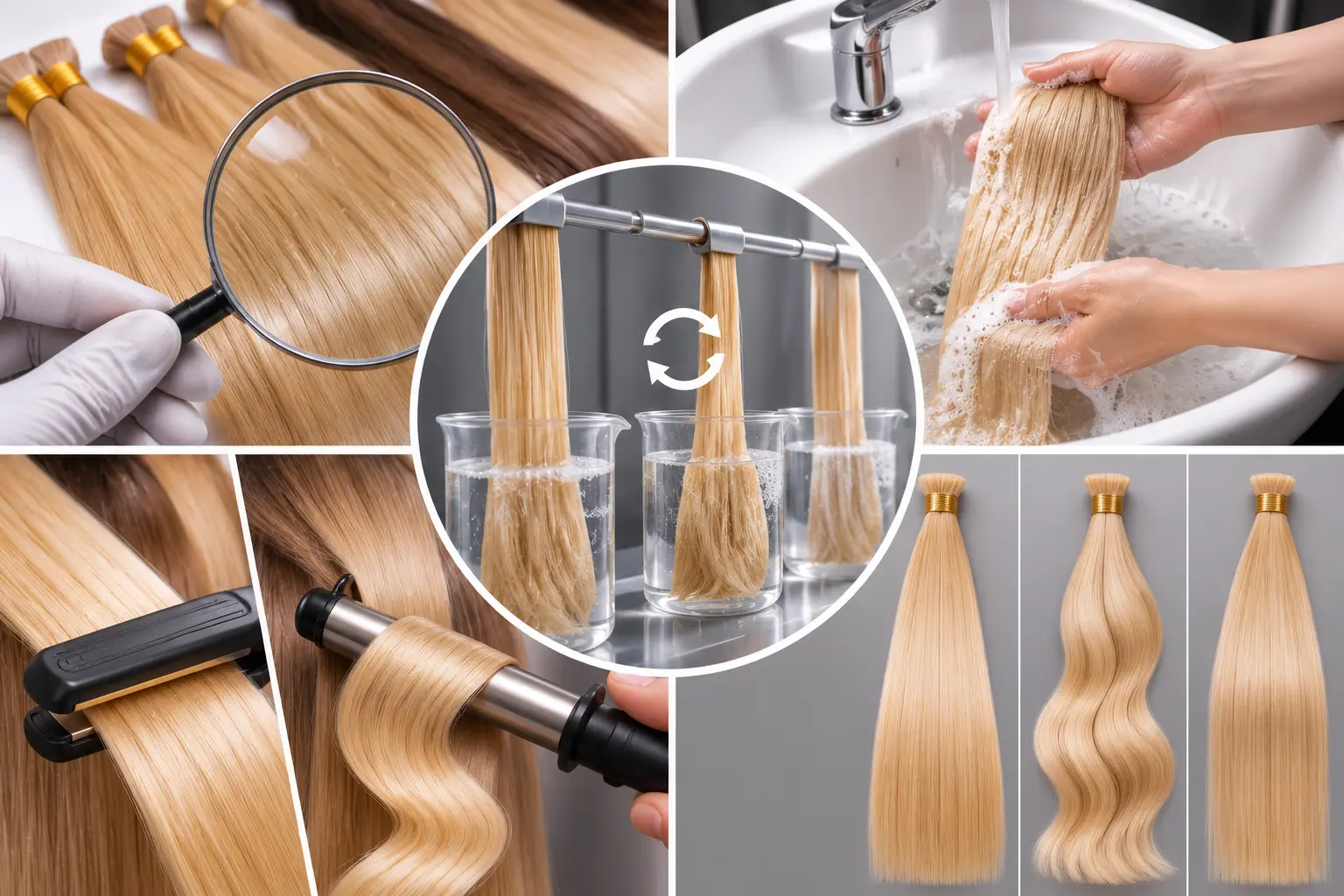
Visual inspection alone is not sufficient to evaluate hair extension quality. The real test of a hair extension product happens after repeated washing and styling — which is exactly how your end customers will use it.
A proper sample evaluation must include controlled wash testing. This is non-negotiable if you want to protect your brand reputation after a supplier transition.
How Do You Conduct a Proper Wash Test?
Your quality control team should run the following procedure on every new supplier's sample:
Standard wash test protocol:
- Wash the sample hair in lukewarm water[^5] using a standard sulfate-free shampoo[^6]
- Blow-dry to 80–90% dry, then allow to air finish
- Repeat this cycle a minimum of five to eight times
- Evaluate after each cycle for the following:
| Quality Indicator | What to Look For |
|---|---|
| Texture | Does the hair remain soft, or does it become dry and coarse? |
| Tangling | Does the hair tangle easily after washing? Does it comb through smoothly? |
| Color retention | Does the color fade, shift in tone, or become brassy? |
| Shedding | Does the weft shed excessively during washing or styling? |
| Cuticle integrity | Does the hair become rough or frizzy after multiple washes? |
What failure looks like: Dryness after the second or third wash is a strong indicator of over-processed hair or poor raw material quality[^7]. Tangling that doesn't resolve with conditioner suggests compromised cuticle alignment. Significant color shift in the first three washes points to unstable dye formulations[^8].
A product that passes visual inspection but fails wash testing will generate customer complaints within 30 to 60 days of sale[^9]. That is enough time for the complaints to damage your brand — but not enough time to trace the problem back to the supplier switch if you haven't documented your testing process.
Document every result. This record protects you if you need to raise quality disputes with the supplier later.
Should You Involve Salons in the Testing Process?
Internal wash testing tells you how the product performs under controlled conditions. Salon testing tells you how it performs in real life — on real clients, installed by professional stylists, and worn through daily routines.
Engaging trusted salon partners in your sample evaluation process is one of the most valuable steps you can take before committing to a new supplier. Stylists notice things that lab tests don't catch, and their feedback reflects what your end customers will actually experience.

How Do You Structure a Salon Trial?
Step 1: Select the right salon partners. Choose salons you already work with and trust. They need to understand they are evaluating a new supplier's product — and that their honest feedback matters. Avoid salons that will simply tell you what you want to hear.
Step 2: Provide installation-ready samples. Supply the salon with properly prepared samples in the same lengths and colors your clients typically request. Make sure the stylist installs the product under normal conditions — not as a rushed evaluation.
Step 3: Create a simple feedback framework. Ask stylists and clients to report on:
- Installation experience — Did the weft behave normally during application?
- Initial appearance — Did the color and texture match expectations?
- Wear experience — How did the hair look and feel after one week? After three weeks?
- Maintenance — Did the hair tangle, shed, or change texture during the wear period?
Step 4: Track feedback over time. A single installation is not enough. Collect follow-up feedback at two weeks and four weeks post-installation.
Salon feedback is especially valuable for catching color consistency issues that internal testing misses. A color that photographs beautifully may look slightly off in natural light — and experienced stylists will notice immediately.
How Long Should the Full Supplier Testing Period Last?
This is where many buyers make their most costly mistake: rushing to full production orders because early results look promising. The hair extension industry requires patience. A testing period that feels complete at three months may still have unresolved variables.
The minimum testing window before scaling orders is six months. If the product performs well through six months of sample testing, salon trials, and repeat wash evaluations — with no meaningful complaints from end clients — you can begin placing small-batch production orders with reasonable confidence.

What Does a Responsible Transition Timeline Look Like?
| Phase | Timeline | Key Activities |
|---|---|---|
| Supplier qualification | Weeks 1–4 | Confirm specs, raw material grade, color range |
| Sample order | Weeks 4–8 | Place initial sample in 1 product type, 2–3 colors |
| Internal quality testing | Weeks 8–16 | Wash tests, texture evaluation, color assessment |
| Salon trials | Weeks 12–24 | Install samples at partner salons, collect structured feedback |
| Small batch production | Month 6–12 | Place limited production orders if testing is successful |
| Scale-up | Month 12+ | Increase order volumes only after one full year with no quality issues |
Why one year before scaling? Hair extensions are a repeat-purchase product[^10]. Your clients buy again based on how their last set performed. Quality issues that emerge at month seven or eight — after a seemingly successful launch — can undo months of brand-building. The 12-month threshold exists to ensure you have seen the product through multiple purchase cycles and seasonal variations before you bet your volume on it.
From my experience, suppliers who push back against a phased evaluation process are often the ones who struggle with consistency at scale. A manufacturer confident in their quality welcomes this kind of structured testing.
Frequently Asked Questions
How many suppliers should I test simultaneously when looking to switch?
Testing one new supplier at a time produces cleaner data and requires less internal resource to manage properly. If you need to evaluate multiple suppliers, stagger the testing phases by at least four to six weeks so your QC team can focus on each evaluation properly. Running parallel tests increases the risk of mixing up samples and generating unreliable results.
Can I switch suppliers for one product type while keeping my current supplier for others?
Yes — and this is often the most practical approach. Transitioning one product category at a time reduces risk significantly. It also gives you a direct quality comparison between your existing supplier and the new one for the same type of product, which makes evaluation much more precise.
What should I do if the new supplier's colors don't match my current range?
Color matching is one of the hardest challenges in hair extension supplier transitions. If a new supplier's standard colors don't match your current range, ask whether they can provide custom color development. Many manufacturers can work from a color swatch or reference sample. Expect at least two to three development rounds before achieving a satisfactory match.
How do I evaluate a supplier's lead time reliability?
Track lead time from the sample order stage. Record the quoted turnaround and the actual delivery date for every order — including samples. Lead time discipline on small orders is a reasonable predictor of production order reliability[^11]. Ask the supplier directly about their peak season capacity and how they manage lead time during high-demand periods.
What certifications or quality documents should I request from a new supplier?
Request any available quality management certifications, product test reports, and raw material sourcing documentation. Treat all certificates as documents to be independently verified, not taken at face value. For application-specific decisions — particularly if your market has regulatory requirements for cosmetic or personal care products — consult a qualified professional for guidance on compliance.
Conclusion
Switching hair extension suppliers without losing product consistency is achievable — but it demands a disciplined, unhurried process. Confirm raw material quality and product specifications before you request a single sample. Test one product type in your best-selling colors first. Run proper wash tests through your QC team. Engage trusted salon partners for real-world feedback. And give the process at least six months before placing small production orders, and a full year before scaling volume.
The hair extension industry rewards patience at this stage. The brands that protect their product consistency through supplier transitions are the ones that have treated evaluation as an investment, not a formality.
If you are evaluating new hair extension suppliers and want to understand how we approach raw material quality, color consistency, and the sample process at RENAI HAIR, contact our team to start the conversation.
[^1]: "Supply chain management in times of crisis: a systematic review - PMC", https://pmc.ncbi.nlm.nih.gov/articles/PMC9362030/. Supply chain management research indicates that new supplier qualification in industries with high product variability commonly requires 12–24 months of iterative collaboration, sampling, and process adjustment before quality metrics stabilize (see supplier development literature in operations management journals). Evidence role: general_support; source type: research. Supports: Supplier qualification and stabilization in manufacturing industries typically requires extended evaluation periods, often exceeding one year, before consistent output is achieved. Scope note: General supply chain research supports extended qualification timelines but does not specifically address the hair extension industry. [^2]: "The structure of people's hair - PMC - NIH", https://pmc.ncbi.nlm.nih.gov/articles/PMC4201279/. The cuticle layer of human hair consists of overlapping scales oriented from root to tip; when hair fibers are assembled with inconsistent cuticle direction, the opposing scale patterns create friction that leads to tangling and matting (see descriptions of hair cuticle structure in dermatological and trichological references). Evidence role: mechanism; source type: encyclopedia. Supports: Hair cuticle scales are directionally oriented, and misalignment of cuticle direction in bundled hair fibers causes friction and tangling. Scope note: Most scientific literature addresses cuticle structure in the context of dermatology rather than hair extension manufacturing processes. [^3]: "How to Read the Hair Color Numbering System", https://www.garnierusa.com/hair-color-needs/hair-color-number-guide. Cosmetology education resources note that while the international hair color level system provides a general framework (1 = black to 10 = lightest blonde), actual color outcomes vary significantly between manufacturers due to differences in dye chemistry, base hair pigmentation, and processing time, meaning identical level numbers do not guarantee color matching across brands. Evidence role: mechanism; source type: education. Supports: Hair color numbering systems are not universally standardized across manufacturers, and the same level number can produce visually different results depending on base pigment, dye formulation, and processing conditions. Scope note: This is well-established knowledge in professional cosmetology but is not typically the subject of formal academic research papers. [^4]: "Hair Grades, Hair Classifications, Hair Grading, Hair Category, Hair Degree ...", https://www.youtube.com/watch?v=yb8-q7ZCZoI. Remy hair is an industry classification denoting human hair that has been collected and processed with the cuticle layer intact and uniformly aligned from root to tip, distinguishing it from non-Remy hair where cuticles may be stripped or randomly oriented (see industry and trichological glossaries). Evidence role: definition; source type: encyclopedia. Supports: Remy hair refers to hair collected with cuticles intact and aligned in the same direction, which reduces tangling and extends product lifespan compared to non-Remy processed hair. Scope note: There is no universally regulated standard for 'Remy' hair grading; the term is used as an industry convention rather than a formally certified classification. [^5]: "Hair Shaft Damage from Heat and Drying Time of Hair Dryer - PMC - NIH", https://pmc.ncbi.nlm.nih.gov/articles/PMC3229938/. Dermatological guidance and hair science literature recommend washing hair in lukewarm rather than hot water, as elevated temperatures can cause cuticle swelling and lifting, leading to increased porosity, frizz, and accelerated degradation of chemically processed hair fibers (Lee, Y. et al., 'Hair Shaft Damage from Heat and Drying Time of Hair Dryer,' Annals of Dermatology, 2011). Evidence role: mechanism; source type: paper. Supports: Lukewarm water is recommended for washing hair because excessively hot water can lift the cuticle layer, increase moisture loss, and accelerate damage to chemically treated fibers. Scope note: The cited research addresses heat damage broadly; the specific recommendation for lukewarm water in extension wash testing is a practical application of this principle rather than a formally validated test protocol. [^6]: "What ages hair? - PMC - NIH", https://pmc.ncbi.nlm.nih.gov/articles/PMC5419772/. Studies on surfactant effects on hair fibers demonstrate that sodium lauryl sulfate (SLS) and similar anionic surfactants can cause cuticle lifting, protein loss, and increased fiber roughness, supporting the use of milder surfactant systems for processed hair products (Gavazzoni Dias, M.F., 'Hair Cosmetics: An Overview,' International Journal of Trichology, 2015). Evidence role: mechanism; source type: paper. Supports: Sulfate-based surfactants can strip natural oils and damage the cuticle layer of hair fibers, making sulfate-free formulations preferable for maintaining hair extension quality. Scope note: Research focuses on surfactant effects on natural hair on the scalp; direct studies on processed hair extension fibers are limited. [^7]: "Quantifying the effects of repeated dyeing: Morphological, mechanical ...", https://pmc.ncbi.nlm.nih.gov/articles/PMC11417257/. Research on chemically treated hair demonstrates that repeated or excessive bleaching and dyeing degrades the cuticle layer and depletes internal lipids and proteins, resulting in reduced moisture retention, increased porosity, and a dry, rough texture (Robbins, C.R., Chemical and Physical Behavior of Human Hair, 5th ed., Springer, 2012). Evidence role: mechanism; source type: paper. Supports: Chemical over-processing of human hair damages the cuticle and cortex, reducing the fiber's ability to retain moisture and leading to dryness and brittleness. Scope note: The cited research addresses chemical damage mechanisms in general hair science; the specific threshold of 'second or third wash' as a diagnostic marker is an industry heuristic rather than a scientifically validated benchmark. [^8]: "Comprehensive Review of Hair Dyes: Physicochemical Aspects ... - PMC", https://pmc.ncbi.nlm.nih.gov/articles/PMC12268732/. Color fastness to washing is a standard quality metric in both textile and cosmetic hair dye evaluation; rapid color loss in early wash cycles indicates insufficient dye penetration into the cortex or inadequate oxidative coupling, resulting in surface-bound pigment that is easily removed (see ISO 105-C06 for textile wash fastness; Zviak, C., The Science of Hair Care, Marcel Dekker). Evidence role: mechanism; source type: paper. Supports: Rapid color fading or shifting during early wash cycles indicates poor dye penetration or unstable dye-fiber bonding, as established in both textile and cosmetic coloring science. Scope note: Formal wash fastness standards (e.g., ISO 105) are designed for textiles; their application to hair extension dye evaluation is analogous but not directly standardized for the hair extension industry. [^9]: "Strategies to Manage Customer Complaints - ScholarWorks", https://scholarworks.waldenu.edu/cgi/viewcontent.cgi?article=15012&context=dissertations. Consumer behavior research in personal care products indicates that quality-related complaints tend to cluster in the early weeks of product use, as initial performance degradation becomes noticeable through routine maintenance and wear patterns. Evidence role: general_support; source type: research. Supports: Quality defects in personal care and cosmetic products typically generate consumer complaints within the first one to two months of use as degradation becomes apparent through normal wear. Scope note: No specific published study was identified that documents a 30-to-60-day complaint window for hair extensions specifically; this timeline likely reflects practitioner experience rather than formal research. [^10]: "(PDF) A Study On Hair Extension Consumption Among Black Women", https://www.academia.edu/38311343/A_Study_On_Hair_Extension_Consumption_Among_Black_Women. Market research reports on the global hair extensions industry indicate sustained growth driven by repeat consumer demand, with the market valued at several billion USD and projected to continue expanding, reflecting the product category's recurring purchase nature (Grand View Research; Allied Market Research hair extensions market reports). Evidence role: general_support; source type: research. Supports: The hair extensions market is characterized by recurring consumer demand, with repeat purchases driven by product replacement cycles and brand loyalty. Scope note: Market sizing reports confirm the repeat-purchase nature of the category at an aggregate level but do not provide granular data on individual consumer repurchase rates. [^11]: "Design and optimization of dynamic reliability-driven order allocation ...", https://pmc.ncbi.nlm.nih.gov/articles/PMC11419634/. Supply chain management literature supports the use of trial or pilot orders as part of supplier evaluation frameworks, with on-time delivery performance during qualification phases serving as one predictor of operational reliability at scale (Handfield, R.B. et al., 'Supplier Assessment and Selection,' in Supply Chain Redesign, Prentice Hall). Evidence role: general_support; source type: research. Supports: Early-stage supplier performance metrics, including delivery reliability on trial orders, are used in supply chain management as indicators of long-term supplier capability. Scope note: Research supports trial-order evaluation as a useful signal but also notes that small-order performance does not always scale linearly, as capacity constraints and prioritization may differ at higher volumes.