
K-Tip, I-Tip and Nano Extensions: Choosing Strand Weight and Construction
Choosing the right strand weight and construction for K-Tip, I-Tip and nano extensions can feel overwhelming when you're sourcing for your brand or salon. A wrong choice means uncomfortable installs, client complaints, and returns eating into your margins. Understanding how each bond type differs in construction, weight, and regional demand helps you stock the right products and build lasting customer loyalty.
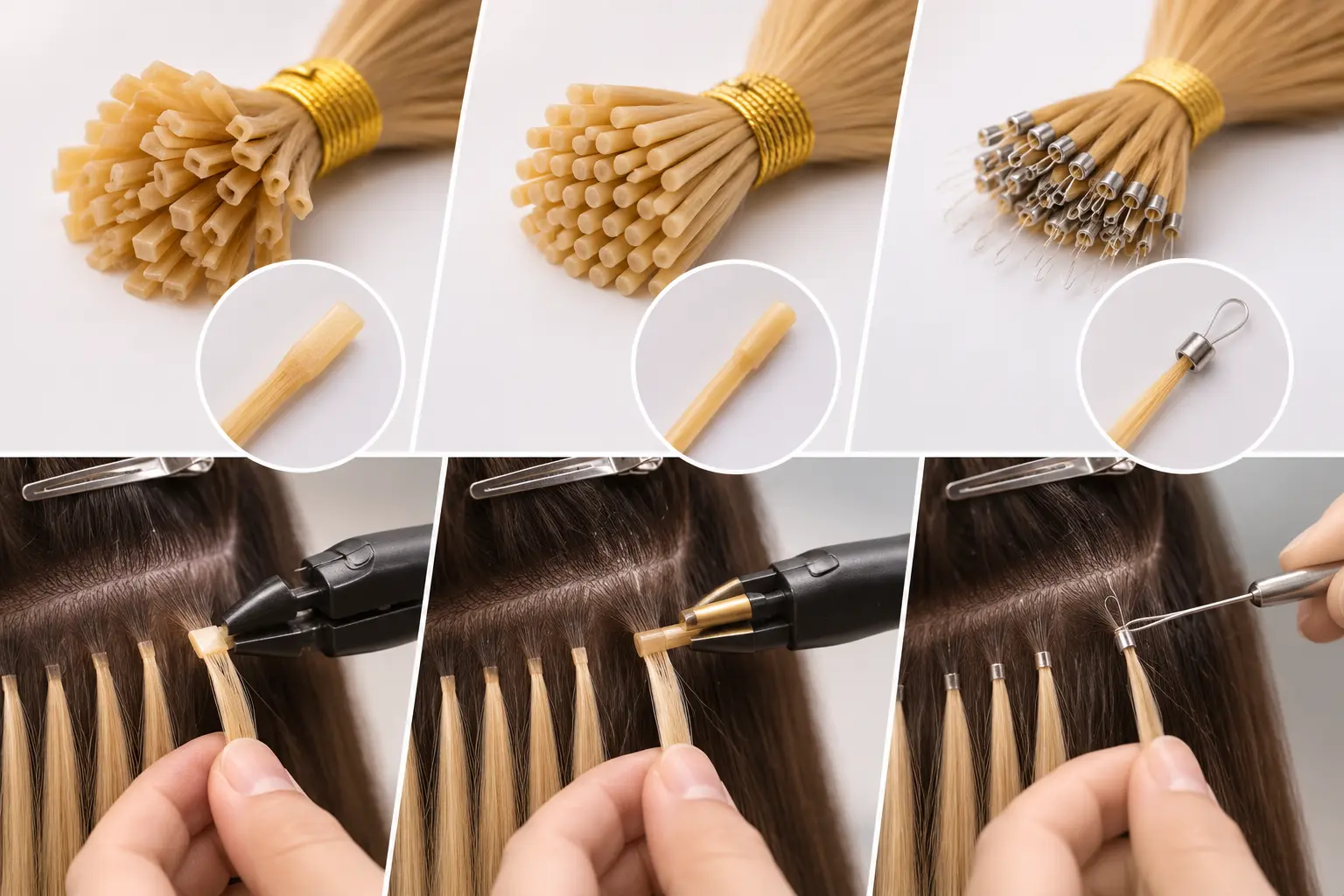
K-Tip extensions use a keratin bond shaped like a flat or angled tip, I-Tip extensions feature a stick-shaped keratin bond, and nano extensions use a tiny metal micro-ring instead of adhesive. The standard strand weight across all three is 1 gram per strand, packaged at 100 strands per bundle. Each type requires a different installation method — K-Tip and I-Tip need a heat fusion tool to melt the keratin bond, while nano ring extensions use a cold-fusion loop technique with no heat involved.
But strand weight and bond type are just the starting point. Regional preferences, client hair types, and installation workflows all shape which product sells best in your market. Below, I break down everything you need to know — from bond construction details to market-specific demand patterns — so you can make confident sourcing decisions.
What Makes K-Tip, I-Tip and Nano Extensions Different in Construction?
If you're new to prebonded hair extensions, the three bond types can look deceptively similar at first glance. But the construction differences are significant — they affect installation method, wear comfort, removal process, and ultimately which stylists and end consumers prefer them.
The core difference lies in the bond material and shape. K-Tip and I-Tip both use keratin-based hot fusion bonds, while nano extensions replace the adhesive entirely with a tiny copper or aluminum micro-ring.[^1] This single distinction changes the entire installation workflow and the tools required.
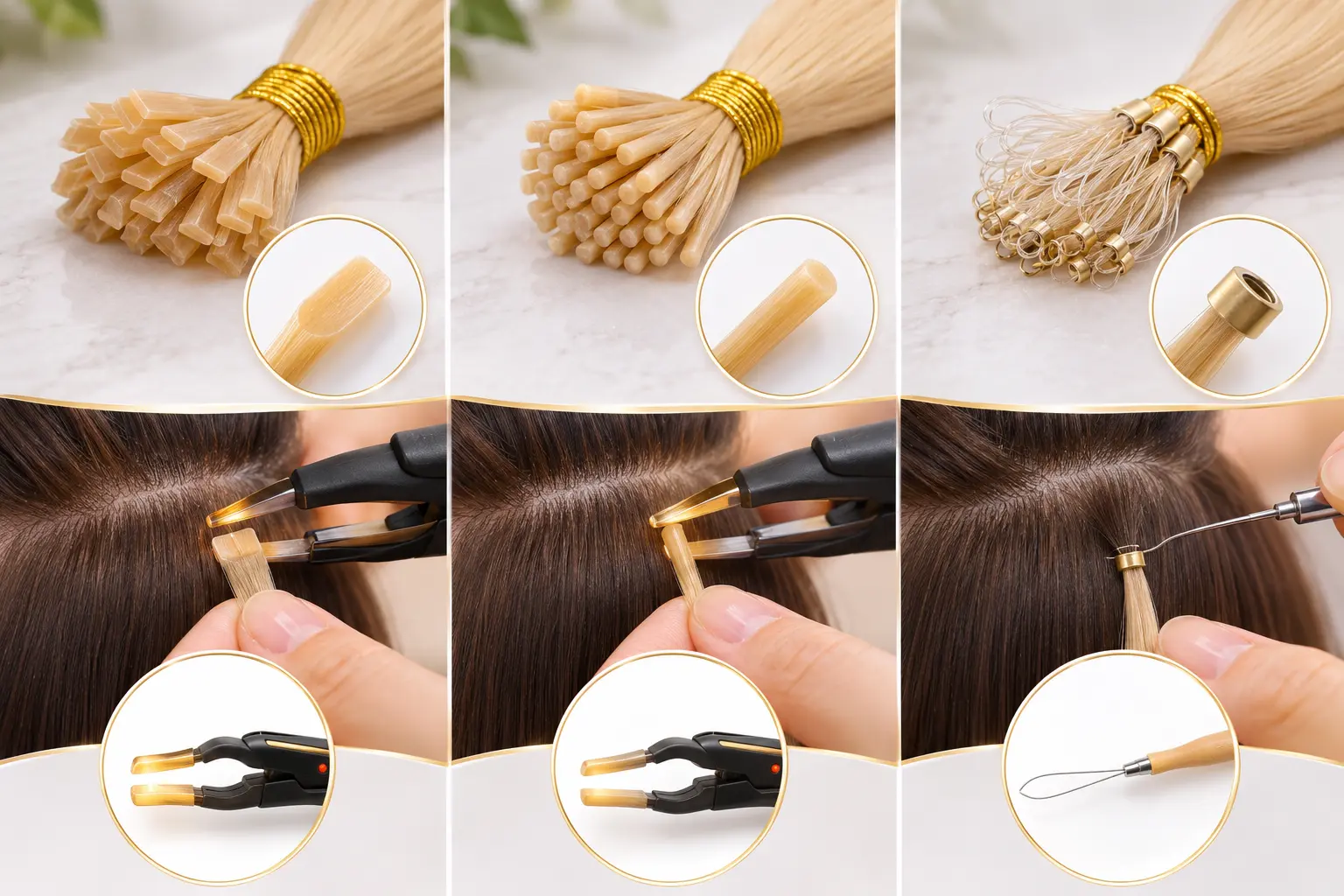
K-Tip Construction
K-Tip extensions — sometimes called "flat tip" or "nail tip" depending on the market — feature a keratin bond shaped into a flat, angled tip that resembles the letter K or a small nail head. The keratin is a protein-based polymer that melts at relatively low temperatures, typically between 150°C and 180°C.[^2]
During installation, the stylist uses a heat fusion connector tool (also called a keratin bonding iron) to melt the tip, then rolls and presses it around a small section of natural hair close to the root. Once cooled, the bond forms a firm, flat connection point.
Key construction characteristics of K-Tip extensions:
- Bond material: Keratin (protein-based hot-melt adhesive)
- Bond shape: Flat or angled, sits flush against the scalp
- Installation tool: Heat fusion connector / keratin bonding iron
- Removal: Keratin bond remover solution + crush-and-slide technique
- Comfort profile: Flat bond distributes weight evenly; less noticeable when sleeping
I-Tip Construction
I-Tip extensions — also called "stick tip" or "micro ring stick tip" — use the same keratin material but shaped into a narrow, cylindrical stick. The name comes from the straight "I" shape of the bond.
Here's what makes I-Tip versatile: while most I-Tips are designed for heat fusion installation (identical to K-Tip), some stylists also install them using micro rings without heat. In the heat fusion method, the stylist melts the keratin stick tip with a connector tool and molds it around natural hair. In the cold fusion method, the I-Tip strand is threaded through a micro ring, which is then clamped shut.
This dual-installation capability makes I-Tip a popular choice for distributors who serve both heat-fusion stylists and cold-fusion stylists.
Nano Ring Construction
Nano extensions take a completely different approach. Instead of a keratin adhesive, each strand features a tiny metal loop or ring pre-attached at the top. The ring is typically made of copper or aluminum, often lined with silicone for grip and comfort.
Installation requires no heat whatsoever.[^3] The stylist uses a nano ring tool (a small hook or loop threader) to pull natural hair through the nano ring, positions the strand, and then clamps the ring shut with pliers. This "cold fusion" method is favored by stylists and clients who want to avoid any heat damage to natural hair.
| Feature | K-Tip | I-Tip | Nano Extension |
|---|---|---|---|
| Bond Material | Keratin (hot-melt) | Keratin (hot-melt) | Metal micro-ring (copper/aluminum) |
| Bond Shape | Flat / angled | Cylindrical stick | Tiny ring loop |
| Installation Method | Heat fusion | Heat fusion (or micro ring) | Cold fusion (ring clamp) |
| Heat Required | Yes | Yes (usually) | No |
| Removal Method | Chemical remover + slide | Chemical remover + slide (or unclamp ring) | Unclamp ring |
| Bond Visibility | Low (flat profile) | Low to moderate | Very low (smallest bond) |
Pro tip for buyers: When sourcing, always confirm whether your supplier's I-Tip is designed for heat fusion, cold fusion, or both. The keratin formula and tip diameter may differ based on the intended installation method.
How Does Strand Weight Affect Extension Performance?
Strand weight is one of the most overlooked specifications in the prebonded extension market. Too heavy per strand, and the extensions pull on natural hair and cause discomfort. Too light, and you need significantly more strands to achieve fullness — increasing installation time and cost.
The industry standard for K-Tip, I-Tip and nano extensions is 1 gram per strand, with bundles typically packaged at 100 strands per pack[^4] (100 grams total). This 1g standard has become the global benchmark because it balances fullness, comfort, and installation efficiency for most hair types.

Why 1 Gram Per Strand Is the Standard
The 1-gram-per-strand specification isn't arbitrary. It reflects decades of market feedback from professional stylists worldwide. Here's why it works:
- Comfort: 1 gram creates enough tension to hold the bond securely without stressing the natural hair follicle. Heavier strands (1.5g+) can cause traction alopecia over time.[^5]
- Fullness: A typical full-head application uses 100–200 strands (100–200 grams)[^6], which provides natural density without bulk at the bond points.
- Installation speed: Uniform 1g strands allow stylists to work efficiently. Each strand covers a consistent section size.
- Versatility: The 1g weight works across fine, medium, and thick hair types. Stylists simply adjust the number of strands used.
Custom Weight Options
While 1g/strand is the dominant specification, I've worked with brands that request custom strand weights for niche markets. Some common customizations include:
| Strand Weight | Typical Use Case | Market Segment |
|---|---|---|
| 0.5g | Fine hair, baby-fine edges, nano rings | UK, Scandinavian markets |
| 0.8g | Lightweight feel, fine-to-medium hair | European salons |
| 1.0g | Standard full-head application | Global standard |
| 1.5g | Thick hair, volume applications | Limited demand |
At RENAI HAIR, our standard production runs at 1g/strand, 100 strands/pack. However, we accept custom weight orders for brands with specific market requirements. If your clientele primarily has fine or thin natural hair, a lighter strand weight like 0.5g or 0.8g may reduce the risk of bond visibility and traction discomfort — something worth discussing with your supplier during the product development stage.
Which Markets Prefer Which Bond Type?
Regional demand patterns for K-Tip, I-Tip and nano extensions vary significantly. If you're a distributor or brand owner expanding into new territories, understanding these preferences can save you from stocking the wrong inventory.
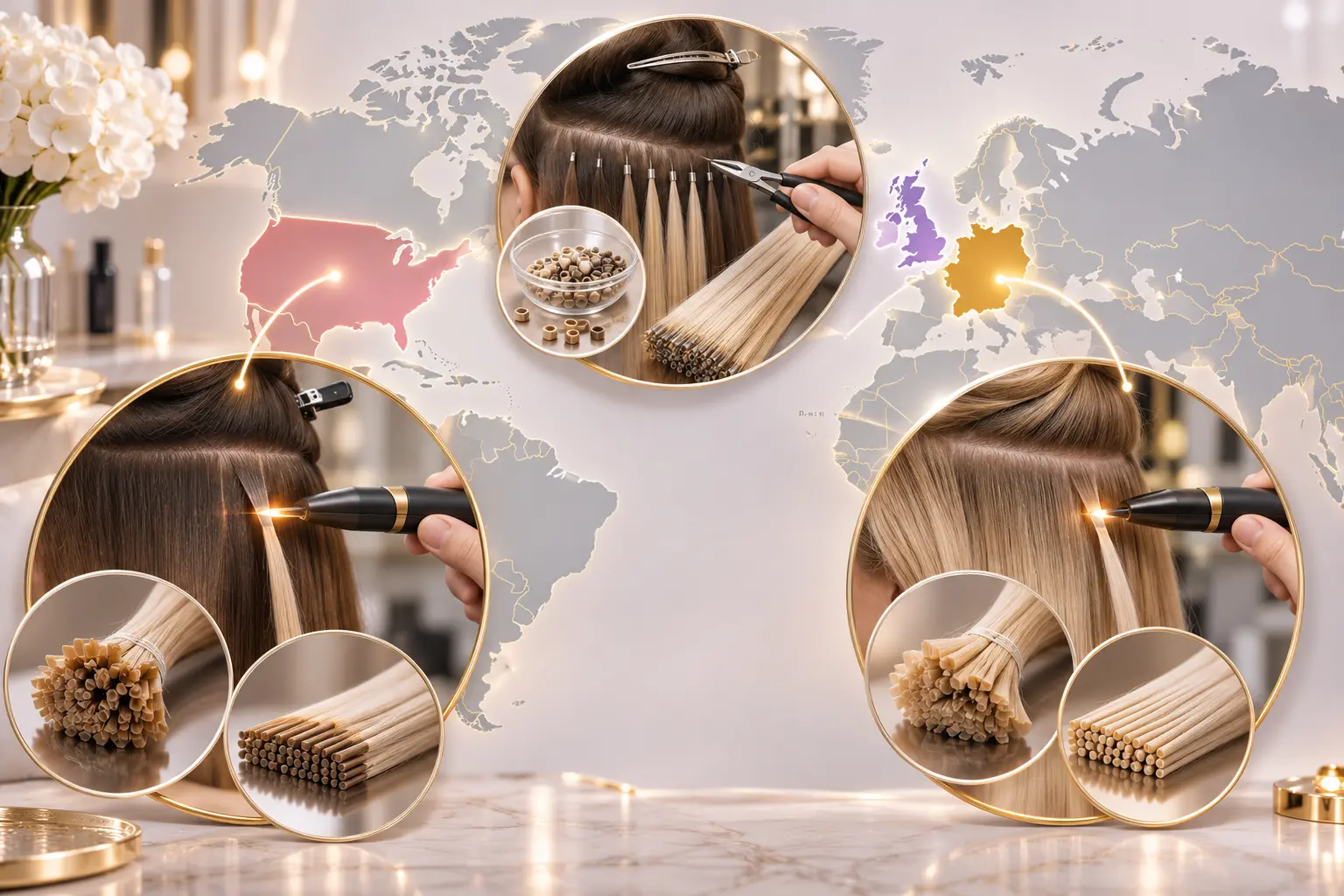
United States Market
The US market for prebonded extensions is heavily skewed toward K-Tip and I-Tip. American stylists have long been trained in heat fusion techniques, and the certification programs from major extension brands reinforce this preference. The US consumer also associates keratin bonds with premium, long-lasting installations.
Key demand drivers in the US:
- Salon culture: Heat fusion is taught in most extension certification courses
- Consumer perception: Keratin is viewed as a "natural" bonding material
- Retention expectations: US clients expect 3–6 month wear time, which keratin bonds deliver[^8]
- Hair texture diversity: The 1g standard weight accommodates the wide range of hair textures in the US market
Germany and Central Europe
Germany follows a similar pattern to the US, with strong demand for K-Tip and I-Tip extensions. German salons tend to be technically precise, and the heat fusion method appeals to their preference for structured, repeatable installation processes. I've noticed that German buyers are particularly detail-oriented about keratin quality — they want bonds that melt cleanly without residue and hold firmly for the full wear cycle.
United Kingdom Market
The UK market is a distinct outlier. Nano ring extensions are the dominant product type, and this preference is deeply embedded in the UK salon industry. Several factors drive this:
- Training ecosystem: UK extension training programs overwhelmingly teach nano ring and micro ring techniques
- Heat damage awareness: British consumers are highly conscious of heat damage, making cold-fusion methods more appealing
- Removal simplicity: Nano rings can be removed and re-applied without chemicals, which fits the UK preference for low-maintenance maintenance appointments
- Bond discretion: The nano ring is the smallest available bond[^9], which matters in the UK market where fine, Caucasian hair types are common
Other Regional Notes
- Australia and New Zealand: Mixed demand — both nano ring and I-Tip sell well, with nano gaining market share
- Middle East: K-Tip is preferred for thick, coarse hair types that benefit from the stronger keratin bond
- Russia and Eastern Europe: I-Tip is the traditional favorite, often installed with micro rings rather than heat
Sourcing insight: If you're building a product line for multiple markets, consider stocking K-Tip and I-Tip for North American and German distribution, and nano ring for UK channels. This avoids cross-market inventory mismatch.
How Should Buyers Evaluate Keratin Bond Quality?
Not all keratin bonds are created equal. Low-quality keratin can melt unevenly, leave sticky residue on natural hair, turn white or cloudy after installation, or fail prematurely — causing strands to slip out weeks before expected. For brands and distributors, bond quality directly affects your reputation and return rates.
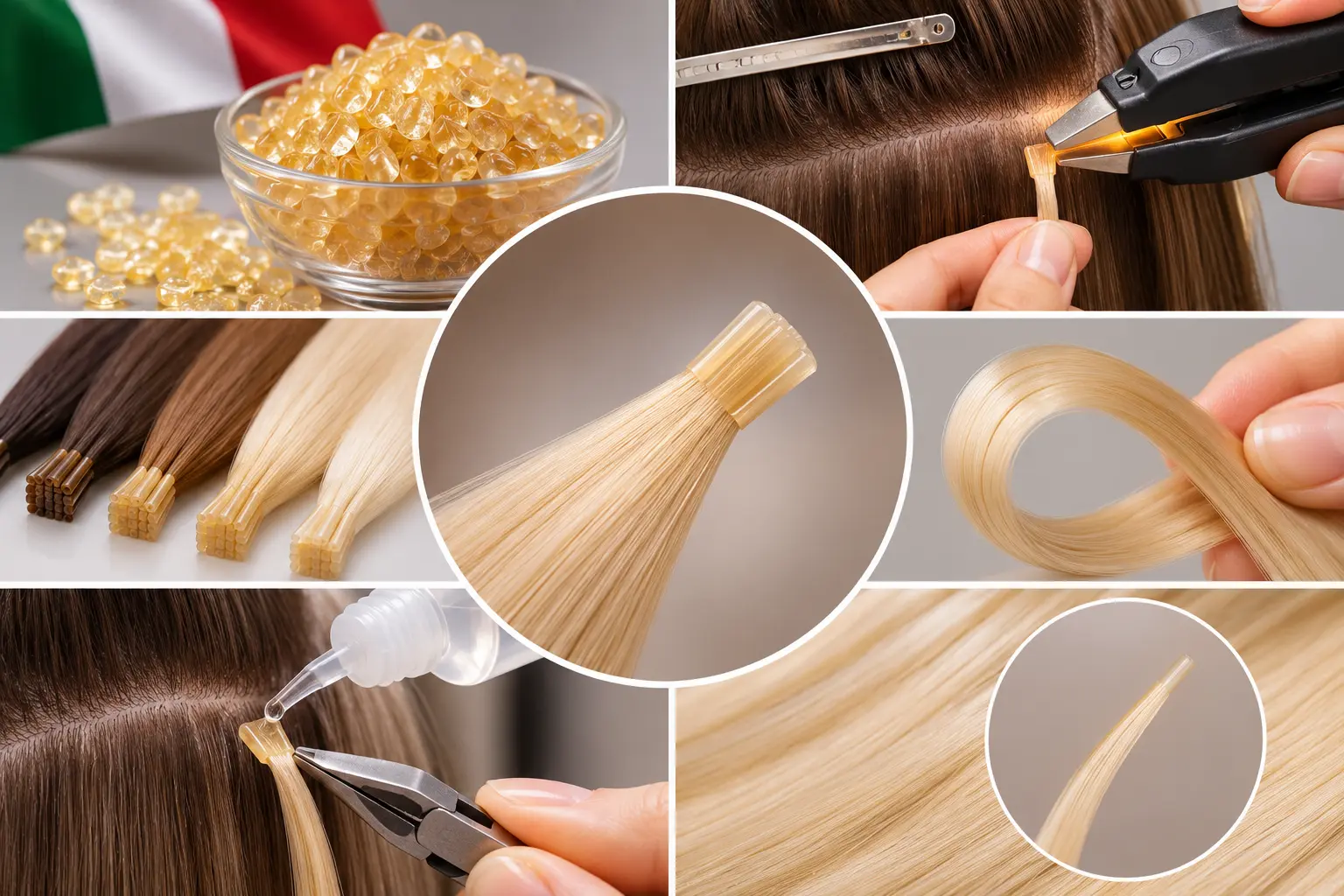
High-quality keratin bonds should melt evenly at consistent temperatures, form a smooth and discreet bond point, maintain flexibility without becoming brittle, and release cleanly with professional remover solution. The keratin should be Italian-grade or equivalent, with consistent color matching to the hair strand.
Key Quality Indicators
When evaluating keratin bonds from a potential supplier, I recommend assessing these specific characteristics:
1. Melt consistency Quality keratin melts smoothly at the target temperature range (150–180°C) without bubbling, smoking, or hardening too quickly. Ask your supplier for the exact melt point range and test samples with your preferred connector tool.
2. Bond flexibility after cooling Once cooled, the bond should retain slight flexibility — not feel rock-hard or glass-like. Brittle bonds crack and fail. Overly soft bonds slip. The ideal bond feels firm but slightly pliable when you press it between your fingers.
3. Color stability Keratin bonds should match the hair color and not turn white, cloudy, or yellowish after installation. This is especially important for darker shades where visible bond discoloration is a common complaint.
4. Clean removal Apply professional keratin remover to a test bond. Quality keratin dissolves or softens completely, allowing the strand to slide off with no sticky residue left on the natural hair. If residue remains, the keratin formula is substandard.
5. Bond size and shape uniformity In a 100-strand pack, every bond should be the same size, shape, and weight. Inconsistent bonds mean inconsistent installations — and frustrated stylists. At RENAI HAIR, every shipment goes through quality inspection before dispatch, including bond size and shape verification.
Questions to Ask Your Supplier
- What grade of keratin do you use? (Italian keratin is the industry benchmark[^10])
- What is the exact melt temperature range?
- Can you provide test samples for installation trials?
- What is your defect rate tolerance per pack?
- Do you inspect bond consistency before shipping?
What Should You Consider When Choosing Between the Three Types?
The choice between K-Tip, I-Tip and nano extensions isn't just about personal preference — it's a strategic business decision that affects your target market, pricing structure, salon partnerships, and inventory management.
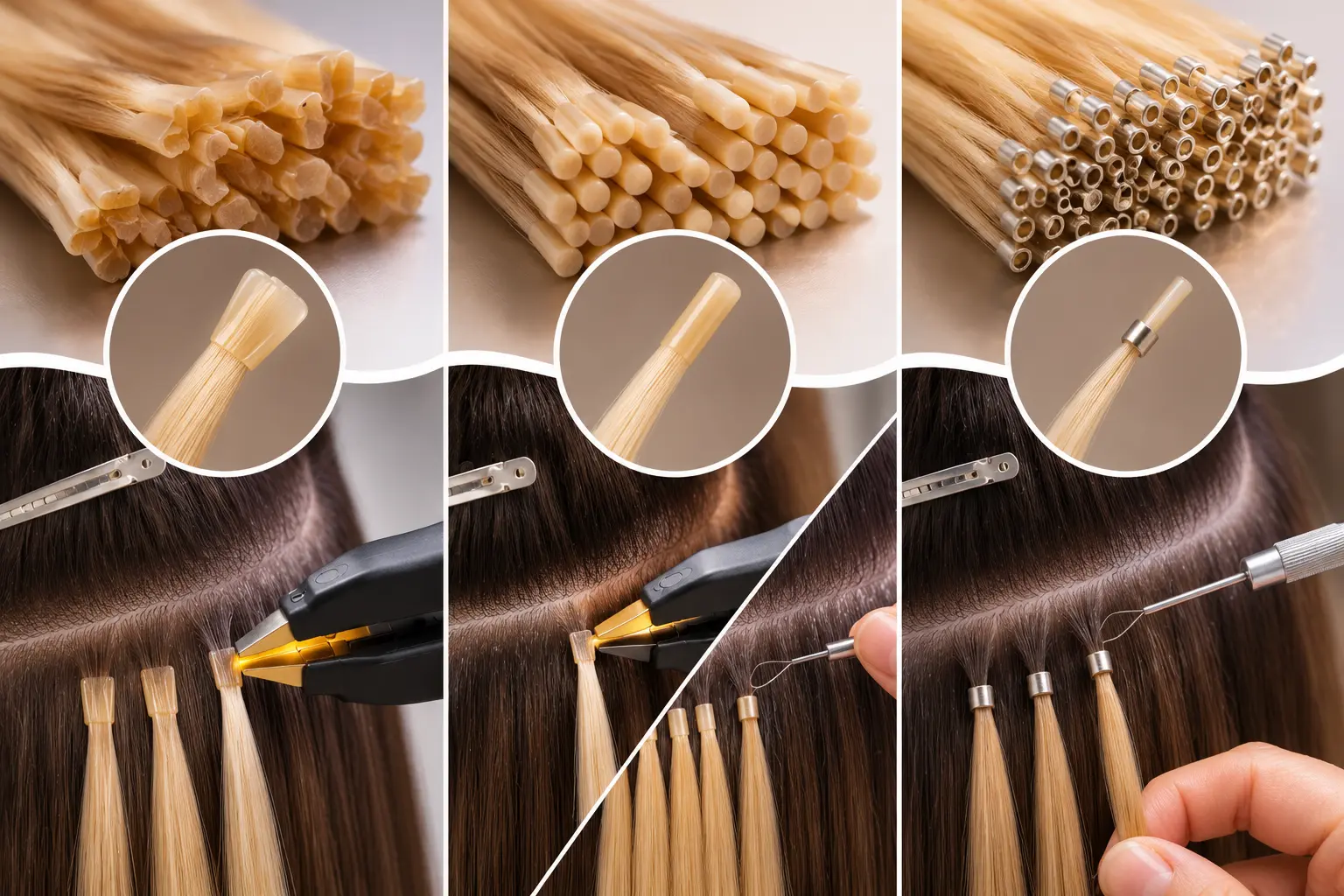
Choose K-Tip if your market favors heat fusion and your clients have medium-to-thick hair. Choose I-Tip for maximum installation versatility across heat and cold methods. Choose nano ring extensions if you serve the UK market or clients who prioritize no-heat, minimal-damage application.
Decision Framework for Buyers
Here's a practical framework I use when advising our wholesale clients:
| Decision Factor | K-Tip | I-Tip | Nano Ring |
|---|---|---|---|
| Primary market | US, Germany, Middle East | Global (versatile) | UK, Australia |
| Installation method | Heat fusion only | Heat or cold fusion | Cold fusion only |
| Best hair type fit | Medium to thick | All types | Fine to medium |
| Bond visibility | Low | Low to moderate | Very low |
| Removal complexity | Moderate (chemical) | Moderate (chemical or unclamp) | Simple (unclamp) |
| Reusability | No (new strand needed) | Partial (if micro ring method) | Yes (re-clamp possible) |
| Average price point | Mid-range | Mid-range | Slightly higher |
| Stylist skill level | Intermediate to advanced | Intermediate | Beginner to intermediate |
Stocking Strategy
For distributors serving multiple markets, I generally recommend:
- Core SKUs: Stock I-Tip as your base product — its dual-installation versatility makes it the safest inventory bet
- Market-specific additions: Add K-Tip for US/German channels and nano ring for UK/Australian channels
- Color range prioritization: Start with your top 10 selling colors across all three types before expanding the full color chart
- Length range: 16", 18", 20", and 22" cover approximately 85% of market demand[^11]
Frequently Asked Questions
Can K-Tip and I-Tip extensions be installed without heat?
K-Tip extensions require heat fusion — the flat keratin bond is specifically designed to be melted and pressed. I-Tip extensions, however, can sometimes be installed using micro rings without heat, depending on the tip diameter. Always confirm the intended installation method with your supplier before ordering.
How many strands are needed for a full head application?
A standard full-head application typically requires 100 to 200 strands (100–200 grams at 1g/strand). Fine hair may need 100–150 strands, while thick hair may require 150–200. The exact count depends on natural hair density, desired volume, and head size.
Are nano ring extensions more expensive than K-Tip or I-Tip?
Nano ring extensions are generally priced slightly higher per strand due to the additional metal ring component and the more labor-intensive assembly process.[^12] However, the price difference is marginal at wholesale volumes — typically 5–15% more than equivalent K-Tip or I-Tip products.
How long do prebonded extensions last before needing replacement?
With proper care and professional installation, K-Tip and I-Tip keratin bonds typically last 3 to 6 months. Nano ring extensions can last a similar duration, with the added advantage that the rings can often be unclamped, repositioned closer to the root, and re-clamped during maintenance appointments.
Can I order custom strand weights from RENAI HAIR?
Yes. While our standard specification is 1g/strand with 100 strands/pack, we accept custom orders for different strand weights including 0.5g and 0.8g per strand. Custom specifications require minimum order quantities — contact our team to discuss your specific requirements.
Conclusion
Choosing the right strand weight and construction for K-Tip, I-Tip and nano extensions comes down to understanding your market, your clients' hair types, and your stylists' preferred installation methods. The 1g/strand standard works globally, but regional preferences for bond type vary dramatically — heat fusion K-Tip and I-Tip dominate in the US and Germany, while nano ring extensions lead the UK market.
The key takeaway: match your product selection to your target market's installation culture, verify keratin bond quality through sample testing, and work with a supplier who can accommodate both standard and custom specifications.
At RENAI HAIR, we manufacture all three bond types in-house with consistent quality control, full color range availability, and the flexibility to customize strand weight, length, and packaging. If you're building or expanding your prebonded extension line, reach out to our team — we'll help you identify the right product mix for your specific market.
[^1]: "Nano Ring Human Hair Extensions Pre Bonded Keratin Fusion Stick Tip ...", https://www.amazon.com/Extensions-Keratin-Straight-Hairpiece-Highlighted/dp/B084R9WK4F. A cosmetology training source distinguishes keratin fusion extensions, which are attached by softening a keratin bond, from micro-ring or nano-ring extensions, which are held by a mechanically clamped ring rather than an adhesive. Evidence role: definition; source type: education. Supports: A cosmetology or hair-extension training source should define keratin fusion extensions and micro-ring or nano-ring extensions and distinguish adhesive fusion from mechanical ring attachment.. Scope note: Training materials may describe common practice rather than all product variants sold internationally. [^2]: "0.9 * 300 cm Keratin Glue Hot Melt Glue for Hair Extension, Transparent", https://us.amazon.com/Keratin-Glue-Melt-Extension-Transparent/dp/B0H6B1NLYV. Technical descriptions of keratin-bond hair extensions report that the bond is softened with a heated applicator, with commonly specified fusion temperatures in the approximate 150–180°C range. Evidence role: mechanism; source type: other. Supports: A technical source should support that keratin-based hair-extension bonding materials are softened or fused by heated tools in approximately this temperature range.. Scope note: The exact softening point depends on the adhesive formulation and tool calibration, so a cited source may support the range contextually rather than establish a universal standard. [^3]: "How to Install I-Tip Fusion Extensions Using the Cold Micro Bead Method", https://www.youtube.com/watch?v=nUm7eZP-Cbk. Cosmetology instruction on micro-ring and nano-ring extensions describes a cold mechanical attachment process in which hair is threaded through a small ring and clamped, rather than bonded with heat. Evidence role: mechanism; source type: education. Supports: A cosmetology source should explain that nano-ring or micro-ring extensions are installed by threading natural hair through a small ring and clamping it shut, without applying heat.. Scope note: This supports the standard installation method, not every hybrid or modified technique used by individual stylists. [^4]: "Saisifen U-tip Keratin Hair Extensions 100 Strands #33 Copper 24 Inches", https://www.amazon.com/Saisifen-Curlable-Extensions-Extension-Brazilian/dp/B0D7MLTQ16. Industry product documentation commonly lists prebonded hair extensions in 1 g strands and 100-strand packs, supporting the article's description of this as a prevalent commercial specification. Evidence role: general_support; source type: other. Supports: Industry catalog, import, or market documentation should show that 1 g strands and 100-strand packs are common specifications for prebonded extensions.. Scope note: Catalog evidence can establish common usage but cannot by itself prove a formal industry standard. [^5]: "Traction Alopecia: Clinical and Cultural Patterns - PMC", https://pmc.ncbi.nlm.nih.gov/articles/PMC8530059/. Dermatology reviews of traction alopecia identify sustained pulling from hairstyles and hair extensions as a cause of follicular injury and progressive hair loss. Evidence role: mechanism; source type: paper. Supports: Dermatology literature should support that sustained traction from hair extensions or similar hairstyles can damage follicles and cause traction alopecia.. Scope note: The medical literature supports the traction mechanism but may not specify a precise 1.5 g strand-weight threshold. [^6]: "Saisifen U-tip Keratin Hair Extensions 100 Strands #33 Copper 24 Inches", https://www.amazon.com/Saisifen-Curlable-Extensions-Extension-Brazilian/dp/B0D7MLTQ16. Hair-extension training materials commonly describe full-head prebonded applications as requiring roughly 100–200 individual strands, with the exact count adjusted for hair density and desired volume. Evidence role: general_support; source type: education. Supports: A training or cosmetology source should provide typical strand counts for full-head prebonded extension installations.. Scope note: The range is an instructional norm and varies by head size, hair density, extension length, and the stylist's sectioning method. [^7]: "About NSF TIP - Directorate for Technology, Innovation and ...", https://www.nsf.gov/tip/about-tip. Independent market research on hair-extension services and products reports regional variation in preferred attachment methods, providing context for differences between keratin-fusion and nano-ring demand across national markets. Evidence role: statistic; source type: research. Supports: Independent market research should document regional differences in demand or usage for keratin-bond and nano-ring hair extensions.. Scope note: Public market reports may aggregate categories differently and may not directly measure K-Tip, I-Tip, and nano-ring sales by country. [^8]: "Hair Extensions 101: Everything You Need to Know", https://brownbeautybarberschool.edu/news/hair-extensions-101-everything-you-need-to-know/. Professional hair-extension education sources commonly give keratin fusion extensions an expected wear period of several months, often in the three- to six-month range when professionally installed and maintained. Evidence role: general_support; source type: education. Supports: A professional education source should state the typical wear period for keratin fusion extensions and the role of maintenance.. Scope note: This supports a typical service-life range, not a guarantee for all clients or products. [^9]: "Nano vs. Microlink Hair Extensions: What's the Real Difference?", https://ellevenhair.ca/nano-vs-microlink-hair-extensions-whats-the-real-difference/. Hair-extension technical guidance describes nano rings as a smaller strand-by-strand attachment than conventional micro rings, supporting their characterization as a highly discreet bond type. Evidence role: definition; source type: education. Supports: A training or technical source should compare nano rings with micro rings or keratin bonds and describe nano rings as smaller or less visible.. Scope note: A source may support that nano rings are smaller than common alternatives without proving they are the smallest possible attachment in every product line. [^10]: "Italian VS Gel Keratin Glue for Fusion Hair Extensions", https://iloveslavichair.com/italian-vs-gel-keratin-glue-for-fusion-hair-extensions?srsltid=AYCX9vJk7MO9kSHXWiLZwZcwBz7KBjdJVvxgsSlzzxKA7UUZQxXpqsaD. Industry documentation frequently identifies Italian keratin as a reference material for prebonded hair-extension tips, supporting its role as a commonly cited quality benchmark. Evidence role: general_support; source type: other. Supports: Industry documentation should show that Italian keratin is commonly referenced as a premium or benchmark material for extension bonds.. Scope note: This would establish industry usage of the benchmark label, not independently prove superior performance over all other keratin formulations. [^11]: "Human hair extension Market Size, Trends, Growth | 2035", https://www.businessresearchinsights.com/market-reports/human-hair-extension-market-118223?srsltid=AYCX9vIa9uYa5HreuEsz2te7VdVZPrwKOh9cOzhVnbjQGNurc96UqZnO. Market data on hair-extension length preferences indicate that mid-to-long lengths such as 16–22 inches account for a large share of demand, contextualizing the article's stocking recommendation. Evidence role: statistic; source type: research. Supports: A market report or aggregated sales study should quantify demand by extension length and support the stated concentration of demand in these lengths.. Scope note: Unless the source reports the same 85% figure, it would support the direction of the claim rather than the exact percentage. [^12]: "Wholesale Price Human 100% Unprocessed Keratin Tip Nano Ring ...", https://elegant-hair.en.made-in-china.com/product/qZYtQDdPgCTE/China-Wholesale-Price-Human-100-Unprocessed-Keratin-Tip-Nano-Ring-Hair-Extension.html. Trade documentation for strand-by-strand hair extensions shows that nano-ring products incorporate a metal attachment component and are often priced above comparable keratin-tip strands. Evidence role: general_support; source type: other. Supports: Trade or manufacturing documentation should show that nano-ring extensions include additional hardware and tend to carry a higher unit price than comparable keratin-tip products.. Scope note: Price differences vary by hair grade, length, origin, order volume, and supplier, so the source may support a general tendency rather than a fixed premium.