Custom Hair Extension Colors: Solid, Mixed, T-Color, Rooted and Balayage
Choosing the wrong color type for your hair extension line can cost you clients, returns, and credibility. With so many color techniques now available — from simple solid shades to hand-painted balayage — buyers often struggle to understand what separates one color category from another. Understanding these distinctions helps you source smarter and build a stronger product range.
Hair extensions are typically produced in four main color categories: solid color, mixed (piano) color, T-color/ombre, and balayage. Each uses a different dyeing process, requires different production controls, and carries different minimum order quantities. Knowing which color type fits your market and your MOQ budget is the first step in building a commercially viable hair extension line.
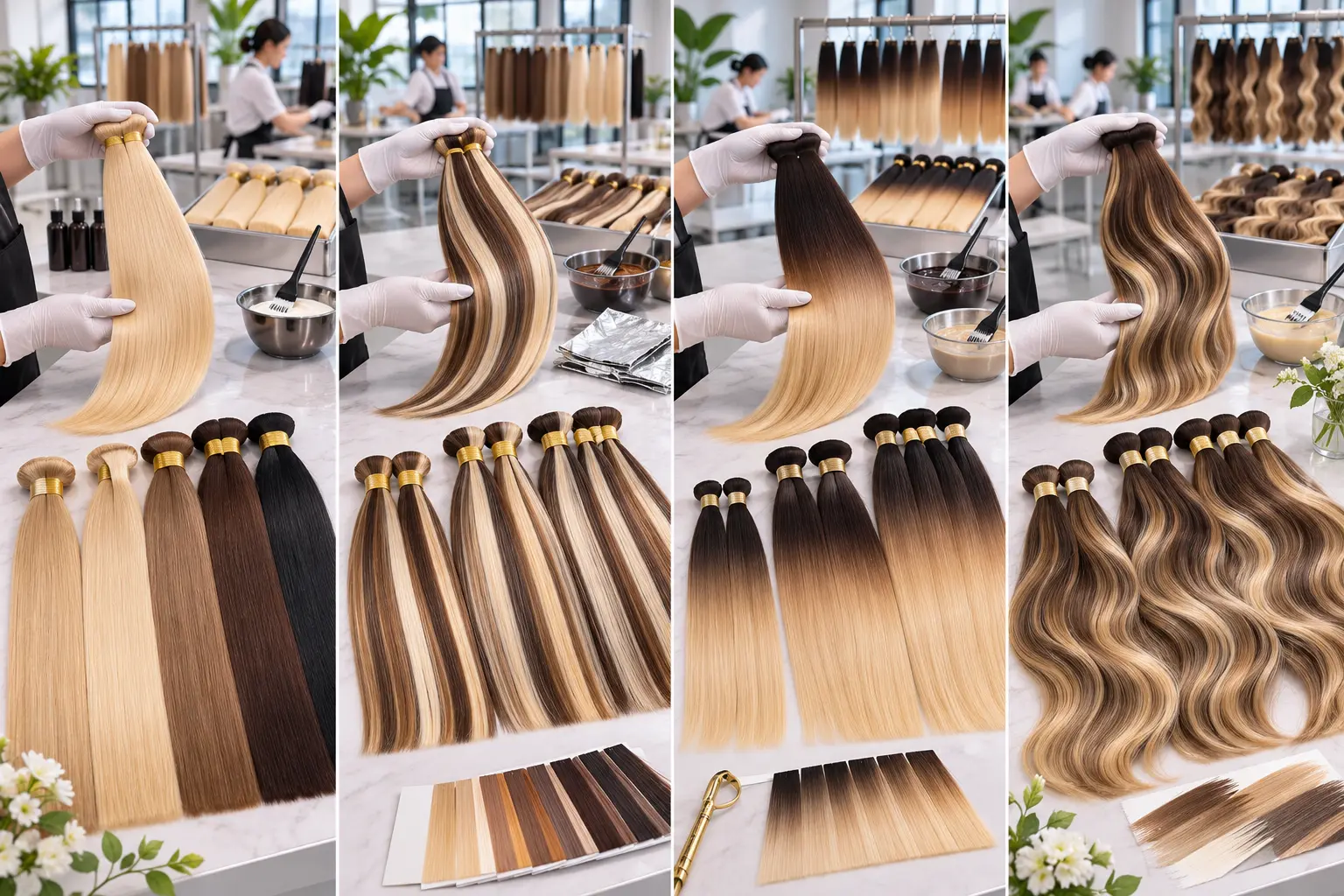
These four categories are not simply aesthetic choices. Each one reflects a different level of dyeing complexity, quality risk, and production commitment. The sections below break down how each color type works, what buyers should evaluate, and how MOQs reflect the real costs behind each process.
What Is Solid Color in Hair Extensions?
Most buyers start here. Solid color is the simplest and most commercially versatile hair extension color option — yet even "simple" colors can vary dramatically in execution quality.
Solid color means the entire hair weft or bundle is dyed to one consistent shade, from root to tip. The color should appear uniform throughout the product. Common examples include natural blacks and browns, blonde shades, and fashion colors. At RENAI HAIR, solid color products carry a minimum order of 100 grams per color.

Solid colors are the backbone of most wholesale and retail hair extension catalogs. Understanding what makes a solid color product reliable — and where quality breaks down — helps buyers make better sourcing decisions.
What Makes a Solid Color Consistent?
Consistency in solid color comes down to several controlled variables in the dyeing process:
- Starting hair color: Raw or virgin hair varies in its natural shade. Lighter raw hair accepts color more evenly.
- Pre-lightening: Darker hair often requires bleaching before the target color is applied. Aggressive bleaching damages the hair cuticle if not done carefully.
- Dye bath temperature and timing: Both must be held constant across the entire batch to prevent color variation within the same order.
- Rinsing and conditioning: Proper post-dye treatment affects how the color holds over time and how the hair feels.
Where Solid Color Quality Commonly Fails
I have seen buyers receive solid color wefts where the tips appear slightly lighter or the roots appear slightly darker — a sign of uneven dye penetration. This is especially common in longer lengths (20 inches and above), where the hair at different positions in the dye bath can receive different dye exposure[^1].
Key quality checkpoints for solid color orders:
| Checkpoint | What to Look For |
|---|---|
| Color uniformity | Root-to-tip consistency under natural and artificial light |
| Color fastness | Minimal bleeding when wet; stable shade after washing |
| Cuticle condition | Smooth, intact cuticles — not stripped or matted |
| Hair texture | Soft, natural feel — not brittle from over-processing |
| Batch-to-batch match | Consistent shade across multiple units in the same order |
Solid colors also offer the widest range of shade options. Standard color rings typically cover natural shades (#1, #1B, #2, #4, #6, #8, #60, #613) through fashion and specialty tones. For buyers building a broad catalog, solid colors are where most SKUs live.
What Is Mixed Color (Piano Color) in Hair Extensions?
A flat, single-shade product can look artificial on some clients. Mixed color — also called piano color — solves that problem by layering two or more shades into a single product.
Mixed color (piano color) hair extensions blend two or more individually colored hair strands in a set ratio to create a multi-dimensional, natural-looking result. The name "piano" comes from the alternating light-and-dark strands, like piano keys. Like solid color, mixed color products at RENAI HAIR carry a minimum order of 100 grams per color combination.
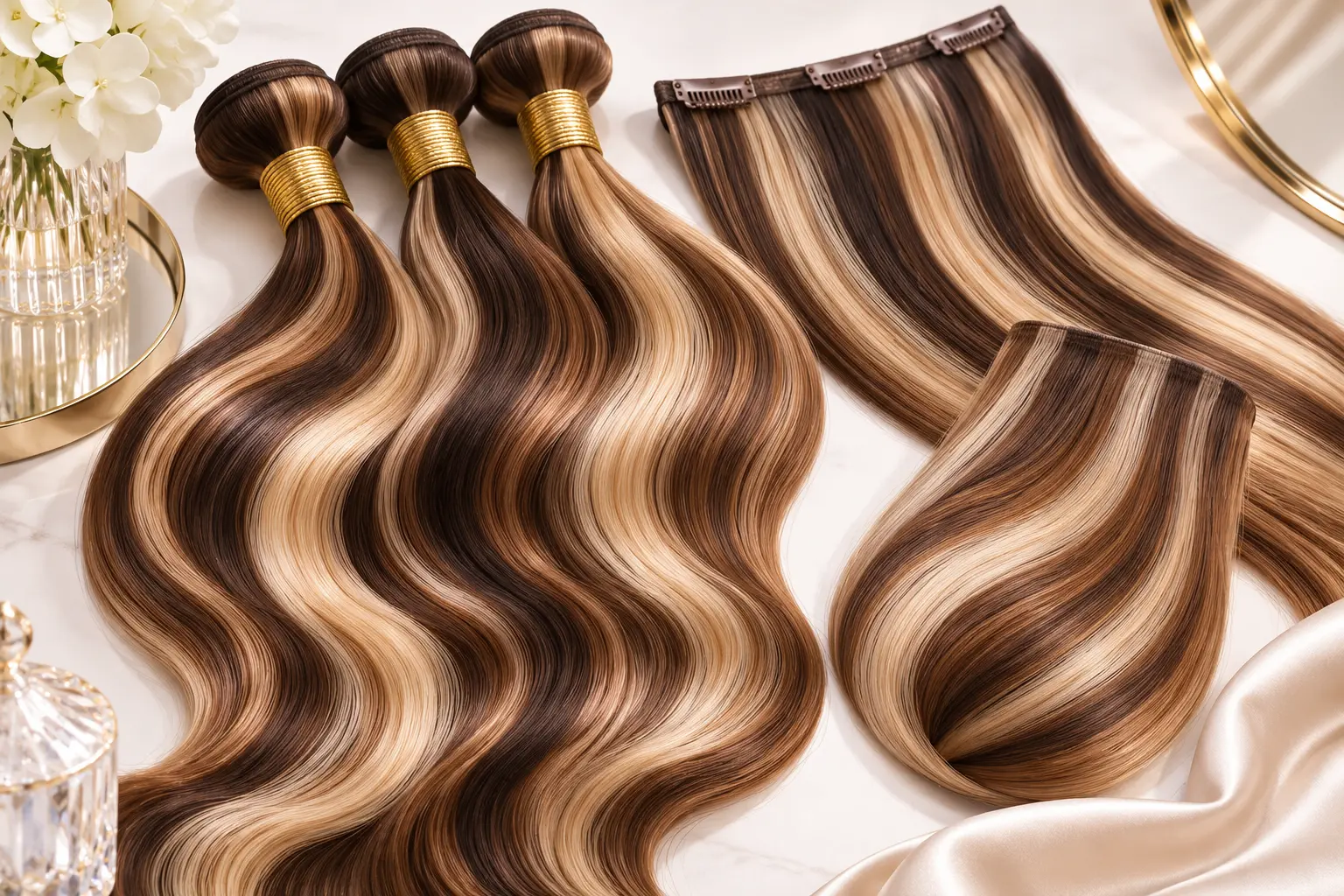
Mixed color is one of the most practical upgrades a buyer can make to a standard color lineup. It adds visual depth without the complexity of a gradient dye process.
How Mixed Color Is Produced
Mixed color is not a single dyeing process applied to one bundle. Instead, individual hair strands or sections are dyed separately to their target shades, then blended in a controlled ratio before the product is constructed — wefted, bonded, or clipped.
Common ratio examples:
- 60% dark + 40% light (a subtle, natural blend)
- 50% / 50% (high contrast, dramatic effect)
- Three-tone blends: dark base + mid-tone + highlight strand
The exact ratio determines the final visual effect. Buyers should request a physical sample or color swatch board before placing a bulk order, since the same shade combination can look very different depending on the mix ratio.
Why Mixed Color Performs Well Commercially
- More natural appearance: Real human hair is rarely one flat color. Mixed color mimics natural hair's tonal variation.
- Broader client appeal: Works well for clients who want subtle depth without a full color service.
- Lower complexity than gradient colors: Because each strand is dyed solid before blending, the production process is more controlled than ombre or balayage.
- Same MOQ as solid color: At 100g per color combination, mixed color is accessible for smaller catalogs.
Evaluating Mixed Color Quality
The main quality risk in mixed color is inconsistent blending ratios. If the production team does not control strand distribution carefully, some wefts may appear heavier in one shade than others — causing inconsistency across units in the same order.
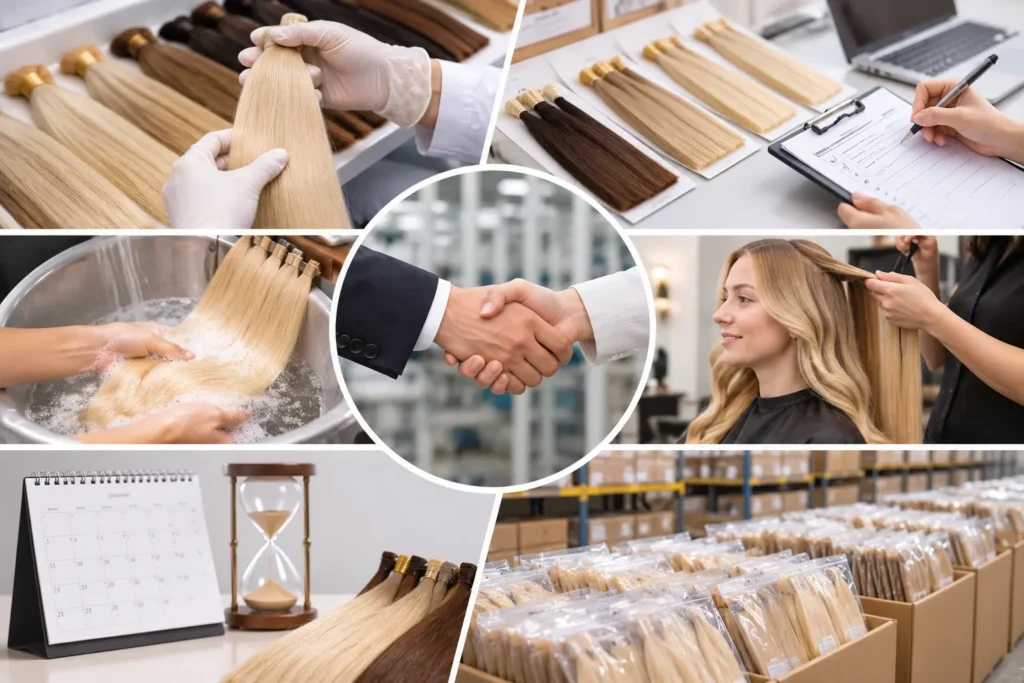
Request multiple units from the same batch during sampling. Hold them side by side under natural light. The color distribution should look consistent across all pieces.
What Is T-Color (Ombre) in Hair Extensions?
Gradient color effects have driven enormous demand in the hair extension market over the past decade. T-color and ombre products deliver that look — but they require significantly more production precision than solid or mixed color.
T-color (also called ombre) hair extensions feature a gradual color transition from root to tip. The darker shade at the root gradually lightens toward the ends. This effect requires a segmented dyeing process, where different sections of the hair are exposed to different dye formulas, temperatures, and processing times. Minimum order quantities at RENAI HAIR start at 500 grams per color for T-color and ombre products.
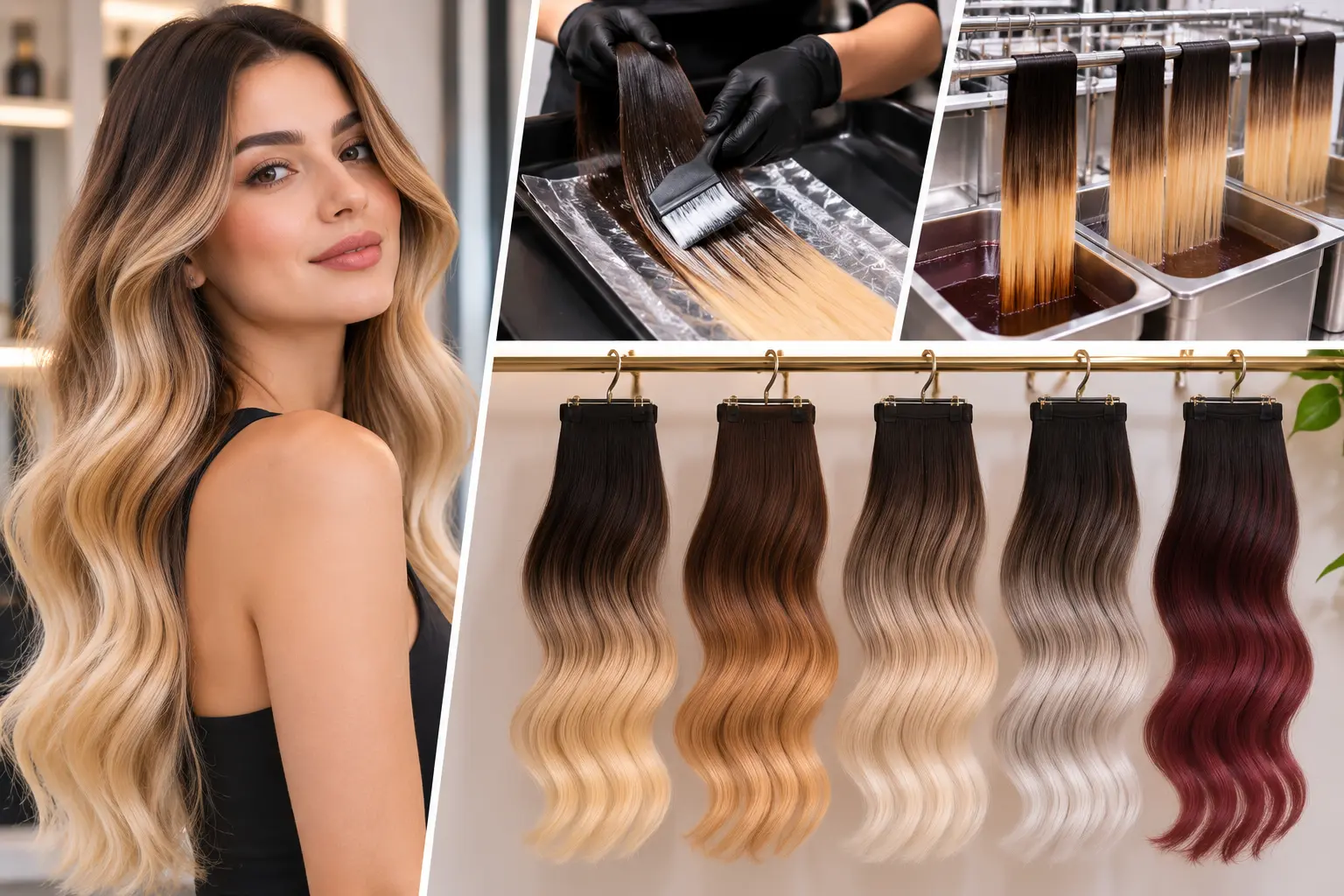
The jump from 100g to 500g MOQ reflects a real production difference. Understanding why helps buyers negotiate with suppliers and plan their inventory more effectively.
Why T-Color Requires Higher MOQs
Each color section in an ombre product — the dark root, the transition zone, and the lighter ends — goes through its own chemical process. The variables include:
- Different bleach or dye formulas for each zone
- Different processing temperatures to achieve clean color separation without harsh lines
- Different processing times to control how far the lighter shade develops
- Precise placement of where each zone begins and ends
Because these variables must be calibrated together, production runs for T-color and ombre require more setup time, more specialized labor, and more quality control checkpoints. Small batches are economically impractical and also harder to keep consistent. A higher MOQ ensures the factory can run a controlled, repeatable process.
Evaluating T-Color Quality
| Quality Factor | What Good Looks Like |
|---|---|
| Transition zone | Smooth gradient — no harsh line between colors |
| Color placement consistency | Same root-to-tip ratio across all units in the order |
| Root shade accuracy | Root color matches the specified shade ring reference |
| Tip shade accuracy | End color matches the specified blonde or light shade |
| Hair condition | Ends (the most processed section) remain soft and intact |
The transition zone is the most technically demanding part. A sharp, unblended line between the dark and light sections signals poor production control. The gradient should feel seamless when the hair moves naturally.
What Is Balayage Color in Hair Extensions?
Balayage is the most complex color type in hair extension production. It is also one of the fastest-growing segments in the premium extension market.
Balayage hair extensions simulate the hand-painted highlight technique used in professional salons. The color design typically features a deeper root, painted mid-strand highlights at varying intensities, and lighter, blended ends. Because each piece requires individually placed color application — with different formulas, temperatures, and timings for each zone — balayage carries the highest MOQ at RENAI HAIR: 500 grams per color.
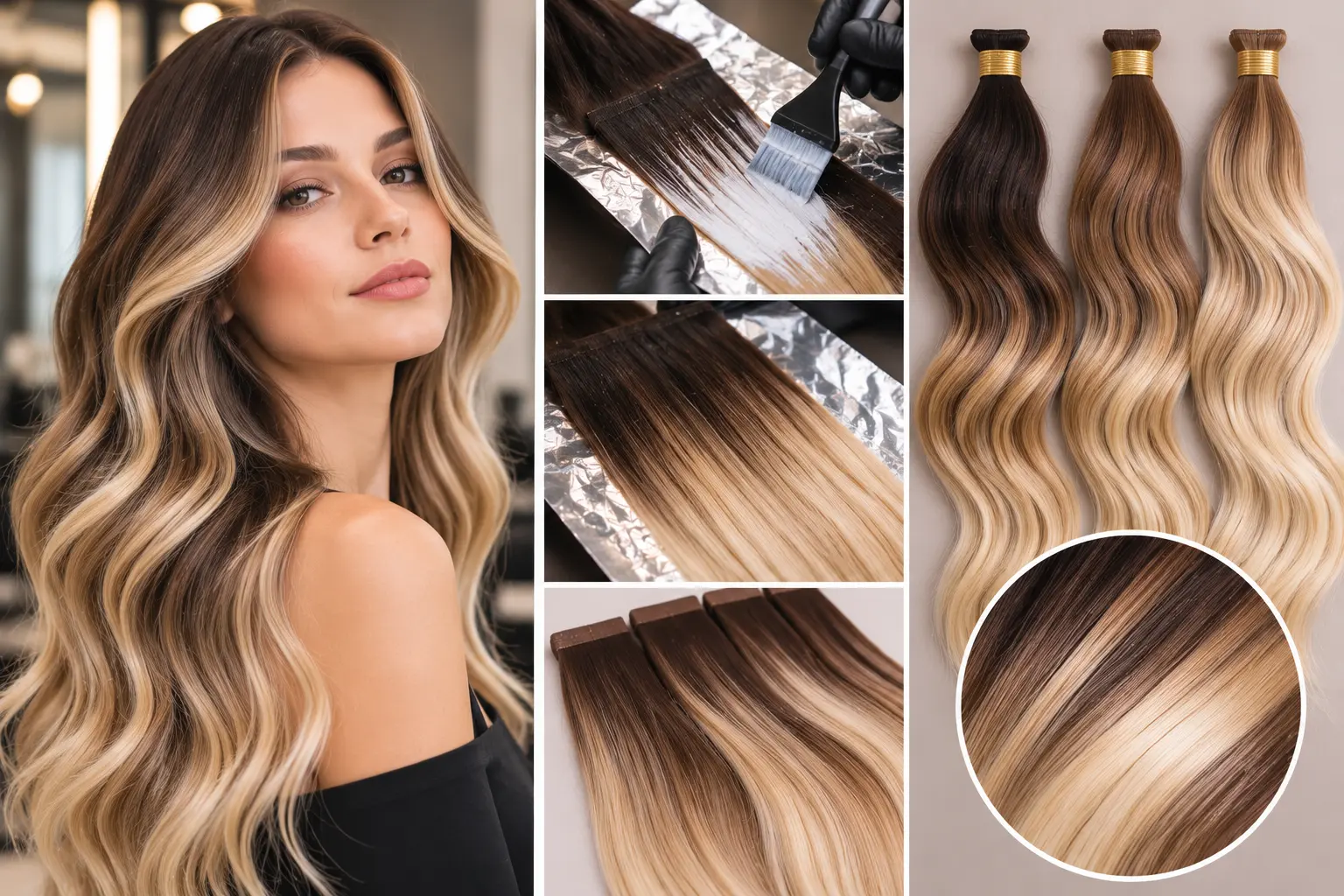
Balayage is not a single formula. It is a design philosophy applied to each individual piece. This is what makes it both the most visually stunning and the most technically demanding color type to produce at scale.
How Balayage Differs From T-Color
Both balayage and T-color involve color transitions. But there are important distinctions:
| Feature | T-Color / Ombre | Balayage |
|---|---|---|
| Color placement | Band-based, root to tip | Freehand, irregular, natural-looking |
| Highlight density | Uniform across the weft | Varied — heavier toward the face frame |
| Number of tones | Typically 2 (root + end) | 3 or more (root + mid-tones + tips) |
| Production method | Segmented dye bath | Individually applied brushwork |
| Complexity level | High | Very high |
| MOQ at RENAI HAIR | 500g per color | 500g per color |
What Makes a Good Balayage Product?
A well-produced balayage extension should look like it was colored by a skilled colorist, not produced on an assembly line. Key quality indicators include:
- Natural color fall: The lightest sections should not be too concentrated in one area.
- Smooth tonal blending: No harsh bands between the root, mid-tone, and tip colors.
- Soft ends: The tips are the most chemically processed. They should remain soft and manageable, not dry or brittle.
- Consistency across units: Each weft or bundle in the order should follow the same color design — same root depth, same highlight placement, same tip tone.
Commercial Applications for Balayage
Balayage extensions are most popular with:
- Luxury extension brands targeting high-end salon clients
- Hair stylists who want pre-colored wefts that match modern balayage haircuts
- Private label buyers building a premium product line to differentiate from commodity extensions
The 500g MOQ is a meaningful investment, which is why I recommend buyers request a sample set first and confirm the color design matches their brand's visual aesthetic before committing to a full run.
Frequently Asked Questions
What is the difference between T-color and balayage in hair extensions?
T-color (ombre) uses a band-based gradient from a dark root to a lighter end, with a relatively even transition. Balayage simulates a freehand painted effect with irregular, multi-tonal highlights. Balayage typically involves more color tones and a more complex application process, making it the more premium option.
Why do ombre and balayage colors have higher minimum order quantities?
Ombre and balayage require segmented dyeing processes with different formulas, temperatures, and timings for each color zone. This level of production complexity cannot be managed economically in small batches. Higher MOQs — typically 500g per color — ensure consistent, repeatable results and justify the additional labor and quality control involved.
Can I order a custom color combination for mixed (piano) color?
Yes. Mixed color products can be customized by shade combination and blending ratio. Buyers should provide a reference color ring or swatch and specify the desired ratio of each shade. I recommend requesting a physical sample before placing a bulk order to confirm the visual effect matches your expectations.
What is the MOQ for solid color hair extensions?
Solid color and mixed (piano) color hair extensions typically carry a minimum order of 100 grams per color. This applies across product types including wefts, tape-in hair, keratin bonds, and clip-in sets. Ombre and balayage colors start at 500 grams per color due to their more complex production processes.
How do I verify color consistency between production batches?
Request a retained color sample from your first approved order. Use this as a physical reference standard for all future orders. When new stock arrives, compare it directly against the reference sample under consistent lighting conditions. Working with a supplier that maintains documented color standards and rigorous outgoing quality inspection significantly reduces batch-to-batch variation.
Conclusion
Understanding the four main custom hair extension color types — solid, mixed, T-color, and balayage — helps buyers make informed sourcing decisions and build product lines that match their market. Solid and mixed colors offer accessible MOQs of 100g per color and strong commercial versatility. T-color and balayage deliver premium visual appeal but require 500g per color to support the more complex dyeing processes involved. At RENAI HAIR, we produce all four color types with strict quality controls at every stage of production. If you are evaluating custom hair extension colors for your brand or wholesale catalog, contact our team to request color ring samples, discuss MOQ options, or explore a custom color development program.
[^1]: "Controlled Silver Nanoparticle Formation in Hair Fibers Dyed with ...", https://pmc.ncbi.nlm.nih.gov/articles/PMC12388297/. Research in textile dyeing science has established that fiber position relative to dye bath circulation, temperature gradients, and dye concentration affects uptake uniformity, with longer fibers presenting greater risk of differential exposure across their length during batch processing. Evidence role: mechanism; source type: paper. Supports: Fiber position and length within a dye bath affect dye uptake uniformity in batch dyeing processes. Scope note: Most published dyeing uniformity research addresses synthetic textile fibers; direct studies on human hair extension batch dyeing are limited in the peer-reviewed literature.