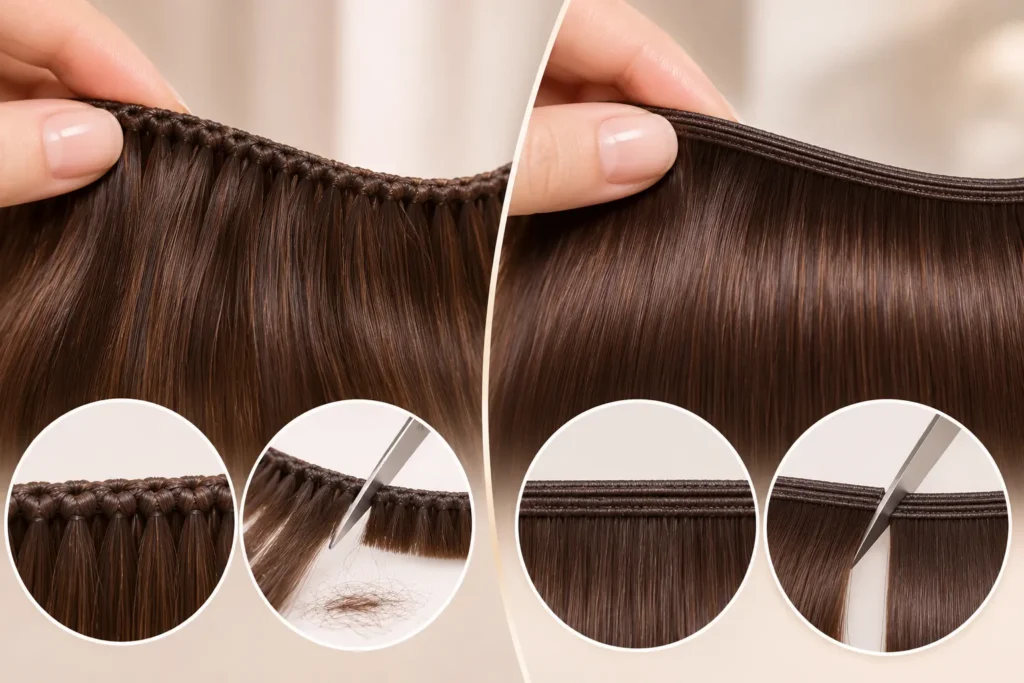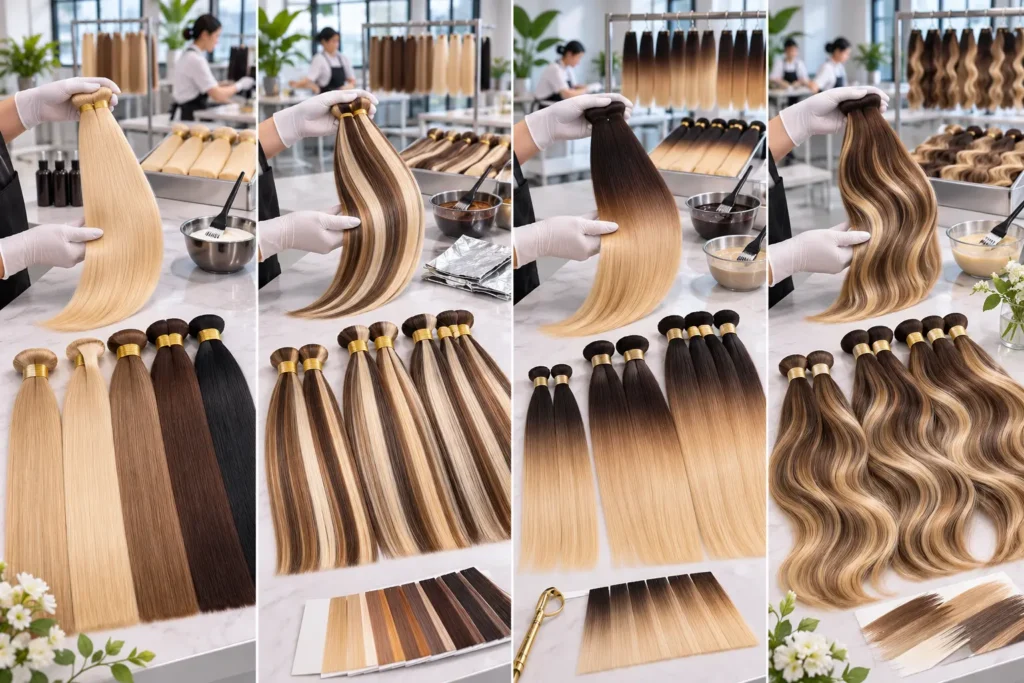

Hair Extension Lengths for Wholesale Buyers: 14–30 Inches and Custom Options
Choosing the wrong hair extension lengths creates costly inventory problems for wholesale buyers. Order too short, and stylists complain. Order too long, and stock sits unsold for months. Understanding how length specifications actually work — from measurement standards to production tolerances — protects your margins and your client relationships.
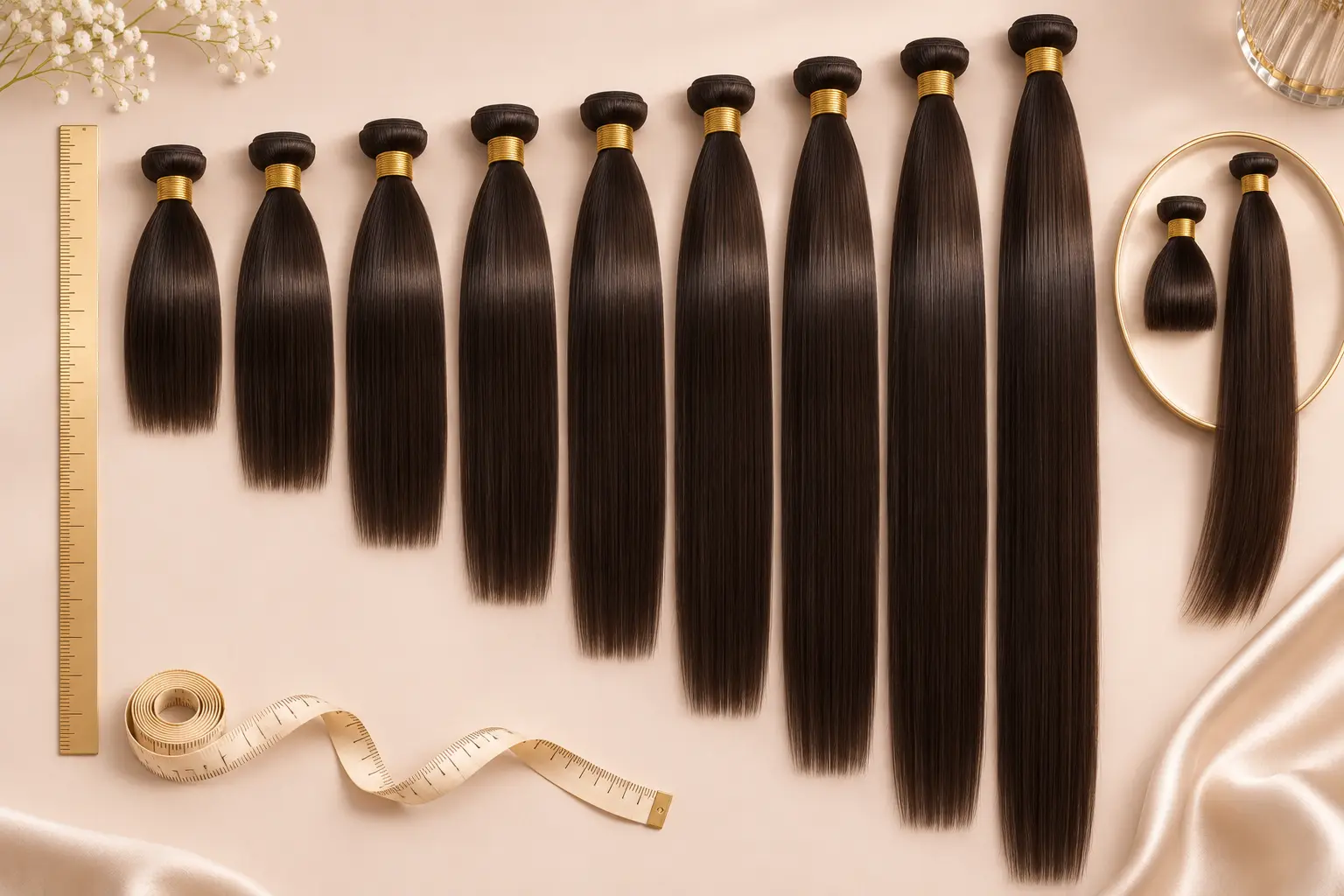
Hair extension lengths for wholesale buyers typically run from 14 to 30 inches, offered in even-inch increments: 14, 16, 18, 20, 22, 24, 26, 28, and 30 inches. Each finished product runs approximately one inch longer than its labeled size due to production tolerances. Custom lengths outside this range are available on request for buyers with sufficient volume.
Standard length specs are only part of the picture. How those lengths are measured, how they convert to centimeters, and when custom options make sense — these details separate experienced wholesale buyers from ones who end up with mislabeled complaints.
What Are the Standard Hair Extension Lengths Available?
Buyers new to wholesale sourcing often discover that not every length they see on retail shelves maps cleanly to a manufacturer's production lineup. That gap between what's marketed and what's actually stocked causes confusion at the ordering stage.
The standard wholesale range covers 14, 16, 18, 20, 22, 24, 26, 28, and 30 inches. These even-increment sizes represent the core production lineup that most manufacturers — including our team at Renai Hair — keep in regular stock. Odd-inch sizes and lengths outside this range are typically produced as custom orders.
Understanding which sizes move fastest in your market helps you allocate open-to-buy budget correctly and avoid overcommitting to slow-moving lengths.
Why Even-Inch Increments?
The industry converged on even-inch sizing for practical reasons[^1]. Production batches, packaging, and retail merchandising all become more efficient when the range is predictable. For buyers, it also simplifies reordering — you know exactly which SKU to request rather than specifying unusual dimensions each time.
Which Lengths Sell Most in Wholesale Markets?
From our experience supplying global distributors and brands, the mid-range lengths consistently drive the highest volume:
- 18–22 inches — the core commercial range; suits most everyday styling requests
- 20 and 22 inches — the most requested sizes across North American and European markets
- 24–26 inches — growing demand, especially in markets favoring dramatic length[^2]
- 14–16 inches — popular for toppers, clip-ins, and clients seeking a natural, subtle result
- 28–30 inches — specialty demand; slower-moving but high-value for certain salon clients
Buyers entering a new market should start with a tighter assortment across 18–24 inches and expand based on actual sell-through data before broadening into the extreme ends of the range.
Stocking Strategy by Product Type
Different extension formats tend to skew toward different length preferences:
| Product Type | Common Length Demand |
|---|---|
| Tape In Hair[^3] | 18–22 inches most popular |
| Genius Weft / Machine Weft | 20–26 inches |
| Hand Tied Weft | 20–24 inches |
| Clip In Hair | 18–24 inches |
| Keratin / Prebonded[^4] | 20–26 inches |
| Ponytail | 22–30 inches |
| Hair Topper[^5] | 14–18 inches |
Matching your stock depth to product-type demand patterns reduces dead inventory and improves cash flow across your extension line.
How Do Inches Convert to Centimeters — and Why Does It Matter?
European and Asian buyers frequently order in centimeters, while most hair extension manufacturers use inches as the base unit. When those two systems don't align precisely, shipments get disputed over "wrong" lengths.
One inch equals exactly 2.54 centimeters[^6]. A 22-inch extension converts to 55.88 cm — not a clean 55 cm. These small gaps add up across a full range, and buyers who don't account for them may find their actual products measuring slightly longer than local expectations.
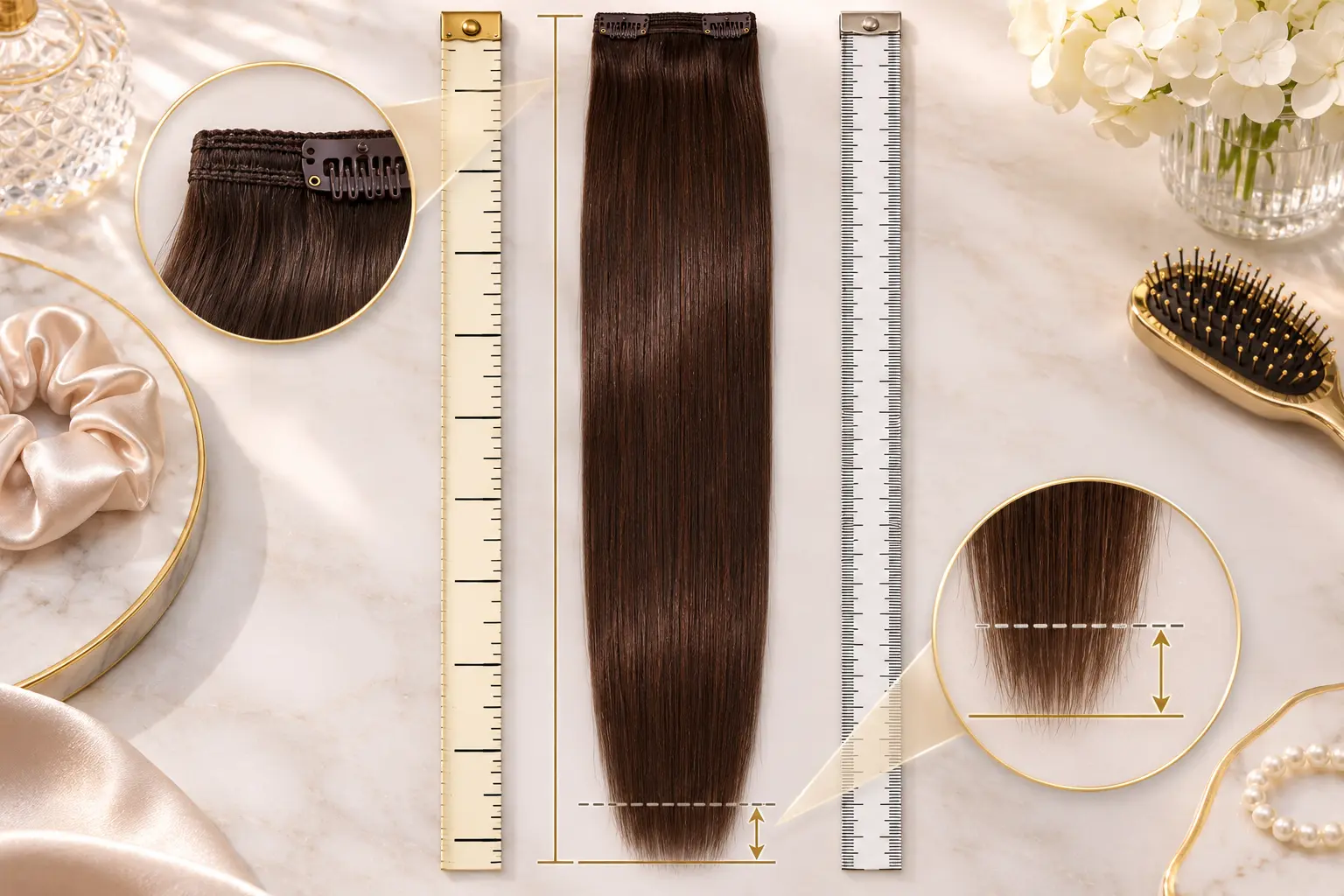
This is one of the most common sources of confusion in cross-border wholesale orders, and it's worth resolving clearly before your first shipment arrives.
The Full Conversion Table: 14–30 Inches
Here is the precise centimeter equivalent for each standard wholesale length:
| Inches | Exact CM | Rounded CM |
|---|---|---|
| 14 inches | 35.56 cm | ~36 cm |
| 16 inches | 40.64 cm | ~41 cm |
| 18 inches | 45.72 cm | ~46 cm |
| 20 inches | 50.80 cm | ~51 cm |
| 22 inches | 55.88 cm | ~56 cm |
| 24 inches | 60.96 cm | ~61 cm |
| 26 inches | 66.04 cm | ~66 cm |
| 28 inches | 71.12 cm | ~71 cm |
| 30 inches | 76.20 cm | ~76 cm |
Important: When reviewing supplier product sheets or placing purchase orders, always confirm whether lengths are expressed in exact inches, exact centimeters, or rounded centimeters. Discrepancies between these three create disputes at receiving.
Production Tolerance: Why Finished Products Run One Inch Longer
This is a detail many buyers miss until they open their first wholesale shipment. Finished hair extension products consistently measure approximately one inch longer than their labeled size. A product labeled 22 inches will typically measure 23 inches when you lay it flat and check it.
This tolerance exists for practical production reasons:
- Cutting and binding processes require a small buffer to ensure the labeled length is fully achieved after finishing
- Quality trimming at the ends during QC can reduce length slightly — the buffer compensates
- Consistency across a batch is easier to maintain when workers cut to a slightly longer target
This is standard industry practice. If a 22-inch product measured exactly 22 inches after full processing, some pieces in the batch would fall short of spec. The one-inch buffer ensures every piece meets — and slightly exceeds — the labeled length.
Buyers should factor this into client education materials. When a stylist says the hair "looks longer than 22 inches," that's correct — it is.
How Are Hair Extensions Actually Measured?
Buyers evaluating supplier samples often measure product and get a different number than the label states. Usually, that's a measurement method issue — not a production defect.
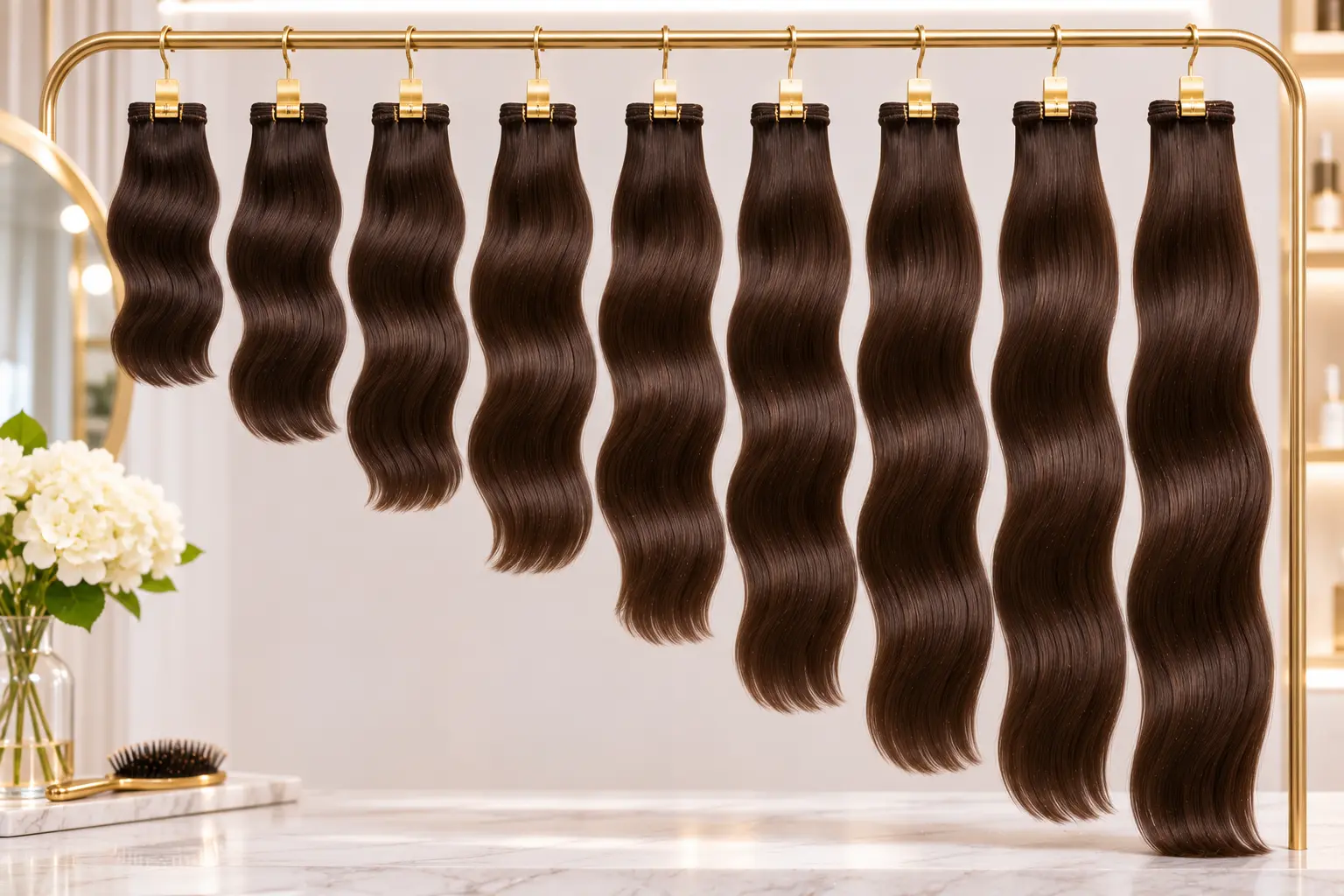
Straight hair is measured end-to-end from root to tip while the hair lies flat[^7]. Wavy or curly textures must be fully stretched before measuring — the natural curl pattern shortens the apparent length significantly.
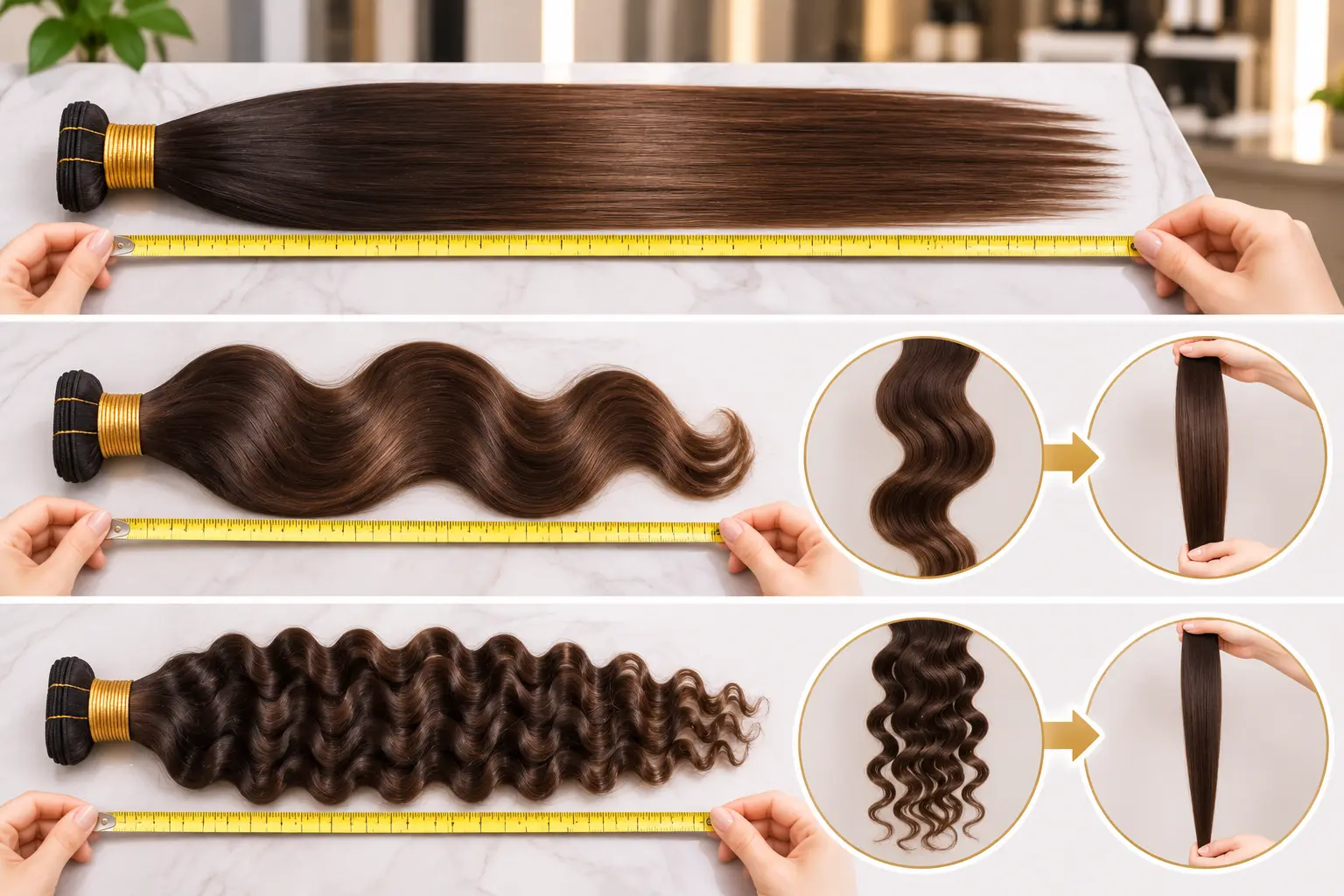
Using the wrong method leads to real disputes. A stylist measuring body wave extensions without stretching them will report a length two to four inches shorter than the label — and complain about being short-shipped.
Straight Hair Measurement
For straight textures — including straight, silky straight, and yaki straight — measurement is simple:
- Lay the weft or bundle flat on a clean surface
- Align a tape measure or ruler from the topmost point of the hair (just below any bond, tape, or weft line) to the tip of the longest strand
- Record the measurement in inches
This end-to-end method is the universal standard for straight extensions and should be referenced in your supplier agreements.
Wavy and Curly Hair Measurement
For textured styles — body wave, natural wave, loose wave, deep wave, and curly — the measurement process requires an extra step:
- Take a small section of hair
- Gently stretch it to its full straight length without pulling hard enough to damage the curl structure
- Measure from root to tip while held straight
- Release — the curl springs back
Why this matters for buyers: A 22-inch body wave extension, when measured at rest without stretching, may appear to be only 18–19 inches[^8]. This is not a defect. It reflects the physics of curl. Train your sales staff and downstream stylists to use the correct method before they write a complaint.
Failing to standardize measurement instructions across your distribution chain generates avoidable chargebacks and returns.
When Should Buyers Consider Custom Hair Extension Lengths?
Standard even-inch sizes cover the vast majority of wholesale demand. But specific customer segments, regional preferences, or brand positioning strategies sometimes call for lengths that fall outside the regular lineup.
Custom hair extension lengths are available for buyers who need odd-inch sizes, lengths below 14 inches, or lengths above 30 inches. These require minimum order quantities and longer lead times than standard production, but they open access to differentiated product offerings.
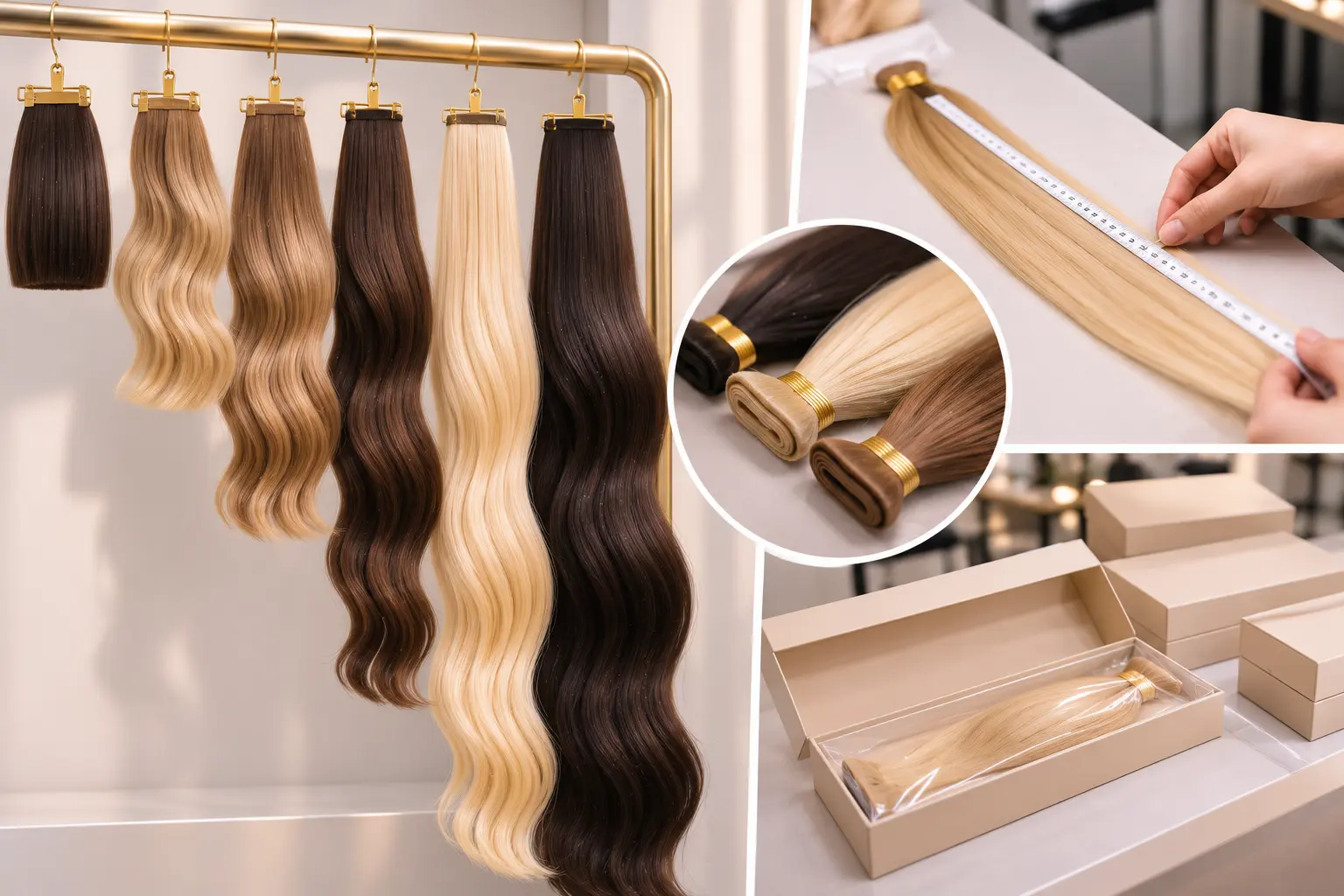
Custom length capability is a supplier qualification point worth verifying early — not every manufacturer can accommodate it at scale.
When Custom Lengths Make Commercial Sense
Consider a custom length order when:
- Your market uses centimeter sizing and a clean number (like 60 cm = 23.6 inches) matters more than matching the standard inch grid
- You're building a private label brand and want non-standard lengths as a differentiation strategy
- A large retail client specifies an unusual SKU and you need reliable supply to fulfill it
- Regional styling preferences push demand toward lengths that fall between standard sizes
- You're developing specialty products — for example, 12-inch toppers or 32-inch fantasy-length extensions
What to Confirm Before Placing a Custom Order
Before committing to a custom length run, verify these points with your supplier:
| Item to Confirm | Why It Matters |
|---|---|
| Minimum order quantity (MOQ) | Custom production runs typically carry higher MOQs than standard sizes |
| Lead time | Custom lengths often require 2–4 weeks longer than standard stock[^9] |
| Price premium | Expect a moderate per-unit premium over standard length pricing |
| Sample availability | Always request a pre-production sample before full order placement |
| Measurement specification | Define clearly: exact length, texture type, and measurement method |
At Renai Hair, we accommodate custom length requests for buyers who have established ordering history or can meet the minimum volume threshold for the requested specification. I always recommend new buyers test with standard sizes first to validate market demand before committing to custom production.
Frequently Asked Questions
What is the most popular hair extension length for wholesale buyers?
The 20-inch and 22-inch lengths consistently rank as the highest-volume sizes in wholesale markets globally. They suit most client requests without requiring the premium pricing associated with longer lengths. Buyers building an initial inventory should weight their assortment heavily toward the 18–24 inch range.
Does a 22-inch hair extension actually measure 22 inches?
A labeled 22-inch product will typically measure approximately 23 inches when laid flat, due to a standard production tolerance of roughly one inch. This buffer ensures the labeled length is reliably achieved after cutting and finishing. Buyers should communicate this to downstream stylists to avoid unnecessary disputes.
How do I convert hair extension inches to centimeters accurately?
Multiply the inch value by 2.54. A 22-inch extension equals 55.88 cm — not exactly 55 cm. This small difference matters when matching products to centimeter-based retail markets or packaging. Always confirm whether your supplier's product specifications use exact inches, exact centimeters, or rounded values.
Can I order hair extensions in odd-inch lengths like 21 or 23 inches?
Yes, odd-inch lengths are available as custom orders from most manufacturers, including Renai Hair. These are not part of regular stock production, so they require a confirmed minimum order quantity and extended lead time compared to standard even-inch sizes. Contact your supplier to confirm feasibility before promising these sizes to your clients.
How should wavy hair extensions be measured for quality inspection?
Wavy and curly extensions must be gently stretched to their full straight length before measuring. Measuring them at rest — with the curl intact — produces a significantly shorter reading that does not reflect the true length of the hair. Establish this measurement protocol with your receiving team and your downstream clients to maintain consistent QC standards.
Conclusion
Hair extension lengths for wholesale buyers follow a clear standard range — 14 through 30 inches in even-inch increments — but the details beneath that range determine whether your inventory performs. Finished products run approximately one inch longer than their labeled size. Inches don't convert to clean centimeter numbers. Wavy textures must be stretched before measuring. And custom lengths, while available, require planning and volume commitment.
Buyers who understand these fundamentals order with more confidence, train their teams more effectively, and generate fewer disputes with downstream clients. If you're evaluating suppliers or building out a new extension line, contact our team at Renai Hair to request a sample set across the standard length range — and let's discuss whether any custom specifications make sense for your market.
[^1]: "Artificial hair integrations", https://en.wikipedia.org/wiki/Artificial_hair_integrations. Trade literature on the hair extension manufacturing sector notes that even-increment sizing conventions emerged as a practical response to batch production constraints, packaging uniformity requirements, and retail planogram standards. Evidence role: historical_context; source type: institution. Supports: That even-inch sizing conventions in hair extensions reflect industry-wide production and logistics standardization. Scope note: Formal documentation of this standardization process is sparse in publicly available sources; the claim may rest primarily on accumulated industry practice rather than a codified standard. [^2]: "Types and Characteristics of Hair Across the Globe - PMC - NIH", https://pmc.ncbi.nlm.nih.gov/articles/PMC11846515/. Consumer research on beauty product preferences documents regional variation in desired hair length, with markets in sub-Saharan Africa and parts of Southeast Asia showing elevated demand for longer extension styles relative to Western European averages. Evidence role: general_support; source type: research. Supports: That consumer preferences for hair extension length vary by geographic market, with some regions showing stronger demand for longer styles. Scope note: Published studies on regional hair extension length preferences are limited; available evidence is largely drawn from broader beauty market research rather than wholesale extension-specific data. [^3]: "How To Apply The Most Googled Hair Extension Technique! Tape-In ...", https://www.youtube.com/watch?v=G_MWmoIBX7g. Tape-in hair extensions are a semi-permanent extension format in which hair wefts are attached to natural hair using a thin adhesive strip, typically requiring professional application and reapplication every six to eight weeks. Evidence role: definition; source type: encyclopedia. Supports: That tape-in extensions are a recognized hair extension format distinguished by their adhesive attachment method. [^4]: "Keratin Glue Is Not What You Think — A Deep Dive into Fusion Extension ...", https://www.haircompounds.com/blogs/education/what-is-keratin-glue-made-of. Pre-bonded or keratin-tip hair extensions are a strand-by-strand extension method in which individual hair strands are pre-tipped with a keratin polymer adhesive and fused to natural hair using a heat tool, offering a semi-permanent result lasting several months with professional maintenance. Evidence role: definition; source type: encyclopedia. Supports: That keratin or pre-bonded extensions are a hair extension format in which individual strands are attached using a keratin-based adhesive bond applied with heat. [^5]: "Hair Toppers for Women", https://www.americanhairloss.org/non-surgical-hair-replacement/toppers/. Hair toppers, also referred to as wiglets or top pieces, are partial hairpieces designed to cover thinning or hair loss at the crown and top of the scalp; they are typically shorter and smaller in base size than full wigs or length-adding hair extensions. Evidence role: definition; source type: encyclopedia. Supports: That hair toppers are a distinct hair addition product designed to cover partial hair loss or thinning at the crown, typically shorter than full hair extensions. [^6]: "SI Units – Length", https://www.nist.gov/pml/owm/si-units-length. The National Institute of Standards and Technology (NIST) defines one inch as exactly 2.54 centimeters, a value established by international agreement in 1959 and codified in U.S. federal measurement standards. Evidence role: definition; source type: government. Supports: That one inch is defined as exactly 2.54 centimeters under the international yard and pound agreement. [^7]: "Hair Extension Length Chart: Complete Guide to Extension Sizes", https://rubyhairfactory.com/hair-extension-length/. Quality inspection guidelines for hair extension products generally specify flat, end-to-end measurement from the uppermost attachment point to the tip of the longest strand as the reference method for straight-textured goods. Evidence role: definition; source type: institution. Supports: That end-to-end flat measurement from root to tip is the accepted method for determining the length of straight hair extension products. Scope note: No single internationally recognized standard body has published a universally adopted hair extension measurement protocol; practices may vary across manufacturers and importing markets. [^8]: "Quantifying whole human hair scalp fibres of varying curl - PMC - NIH", https://pmc.ncbi.nlm.nih.gov/articles/PMC11733847/. Research on hair fiber geometry demonstrates that curl and wave patterns reduce the end-to-end resting length of a hair strand relative to its fully extended length, with the degree of reduction proportional to curl tightness and wave frequency. Evidence role: mechanism; source type: research. Supports: That the curl geometry of wavy or curly hair causes the resting length to be measurably shorter than the fully stretched length. Scope note: Published studies on curl contraction ratios typically address natural hair fiber rather than manufactured hair extension products; the specific 18–19 inch figure for a 22-inch body wave extension is an approximation not directly confirmed by independent measurement data. [^9]: "Shipping & Lead Times - Premier Hair Extension Manufacturer - hshair", https://hshairfactory.com/shipping-lead-times/. Wholesale textile and hair product sourcing guides consistently note that custom-specification orders require additional lead time relative to standard stock items, reflecting the need for dedicated production scheduling, raw material sourcing, and pre-production sampling. Evidence role: general_support; source type: other. Supports: That custom-specification hair extension orders carry longer production lead times than standard stocked sizes. Scope note: The specific 2–4 week figure is a general estimate; actual lead times vary significantly by manufacturer capacity, raw material availability, and order volume.