
Genius Weft vs Hand-Tied Weft
Choosing the wrong weft type can cost your clients comfort, volume, and money. If you've ever watched a customer walk out with shedding extensions or a visible weft line, you know the frustration. Understanding the difference between Genius Weft and Hand-Tied Weft is the first step toward making smarter sourcing decisions.
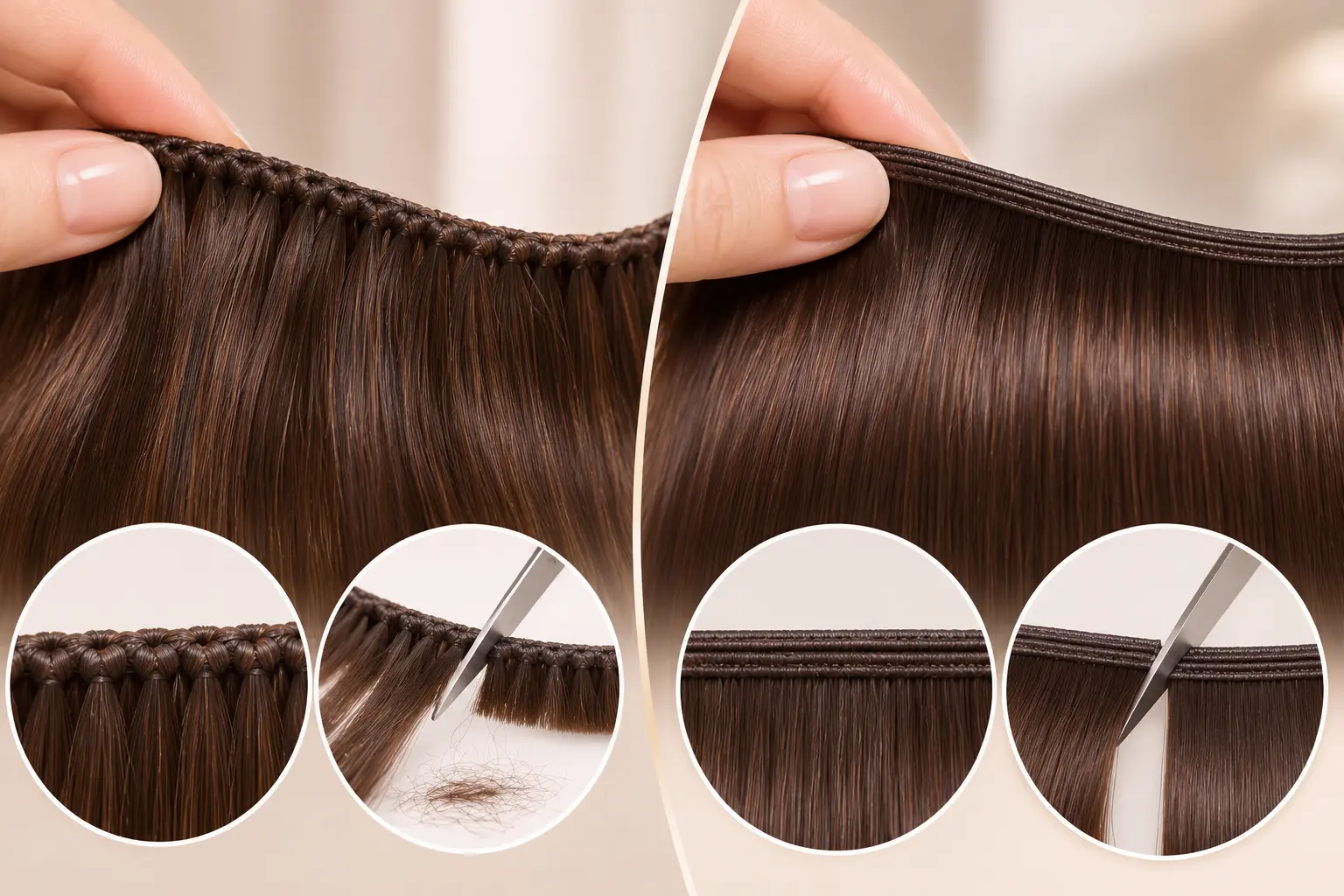
Genius Weft and Hand-Tied Weft are both premium hair extension formats, but they serve different needs. Hand-Tied Weft is crafted by hand, strand by strand, making it flat and natural-looking — but costly to produce and prone to shedding when cut.[^1] Genius Weft is a machine-assisted alternative engineered specifically to solve those two problems: lower production cost and cut-anywhere flexibility without shedding.[^2]
Both weft types have genuine strengths, and the right choice depends on your customers, your price point, and how the extensions will be installed. Let's break down each one carefully so you can evaluate them as a buyer or brand builder.
What Is Hand-Tied Weft — and Why Did It Dominate the Market?
For years, every serious hair extension brand stocked Hand-Tied Weft. It was the gold standard.[^3] But as demand scaled up, two persistent problems started hurting brands and salons alike: high labor costs and shedding after customization.
Hand-Tied Weft is a hair extension weft constructed entirely by hand. A skilled technician weaves individual strands onto a thread base one by one, creating an extremely thin, flat, and flexible weft.[^4] Because no machine stitching or adhesive is involved in the base, the weft sits exceptionally close to the scalp and blends naturally with the client's hair.
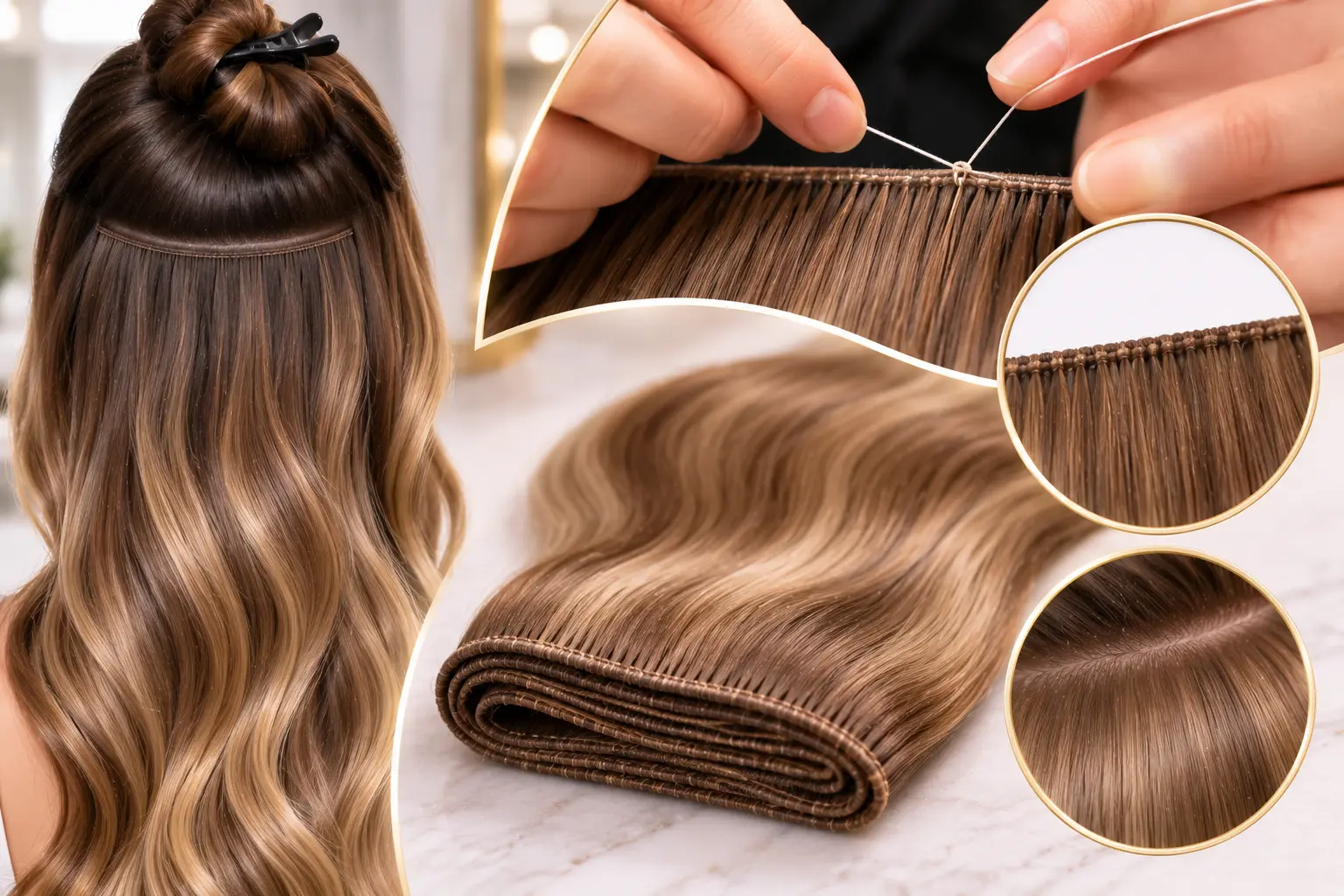
Why Salons and Stylists Loved It
Hand-Tied Weft became popular for good reasons:
- Ultra-thin base — lies flat against the scalp with minimal bulk
- Flexible and lightweight — moves naturally with the client's hair
- No machine stitching — reduces visible texture at the weft line
- Ideal for fine hair clients — low-profile installation hides easily
The installation method most associated with Hand-Tied Weft is the beaded row or sew-in technique.[^5] A stylist creates horizontal rows with micro-beads, then hand-sews the weft along each row. When done well, the result looks completely seamless.
The Two Problems That Created a Market Gap
Despite its popularity, Hand-Tied Weft has two structural disadvantages that matter enormously at the B2B level.
Problem 1: High Labor Cost
Every row of a Hand-Tied Weft is assembled manually. This process is time-consuming and requires skilled artisans. As a result, the manufacturing cost per bundle is significantly higher than machine-produced wefts.[^6] For brands building a mid-market product line or distributors working with tight margins, this cost pressure is real.
Problem 2: Shedding After Cutting
This is the more damaging problem in practice. Hand-Tied Weft can be cut to fit a client's head width — but cutting the weft severs the hand-tied threads holding the hair in place.[^7] Without a sealed edge, strands near the cut begin to shed. Stylists must seal cut edges with bonding glue or thread to prevent this[^8], which adds time and introduces inconsistency.
From my experience working with salon clients, the shedding complaint almost always traces back to improper cutting technique or wefts that weren't sealed after customization. It's a solvable problem — but it adds friction to every installation.
Problem 3: Top Short Hairs
Hand-Tied Weft can also contain short hairs at the top of the weft — a natural result of the hand-tying process.[^9] If these short hairs aren't managed carefully during installation, they can poke through the base row, reducing client comfort and overall polish.
| Feature | Hand-Tied Weft |
|---|---|
| Construction | 100% handmade |
| Base thickness | Very thin and flat |
| Flexibility | High |
| Production cost | Higher |
| Cut-safe? | No — requires sealing |
| Short hairs at top | Possible |
| Best for | Fine hair, seamless blends |
What Is Genius Weft — and How Does It Improve on Hand-Tied?
Genius Weft was developed specifically to address the two core weaknesses of Hand-Tied Weft: manufacturing cost and post-cut shedding. It's a newer format, and in my view, it represents one of the most practical innovations in the professional weft category in recent years.
Genius Weft uses a machine-assisted production process combined with a thin, specialized adhesive top layer.[^10] The weft is machine-made, which significantly reduces labor cost. The adhesive layer at the top of the weft seals the hair in place — meaning you can cut the weft anywhere along its length without triggering shedding.[^11]
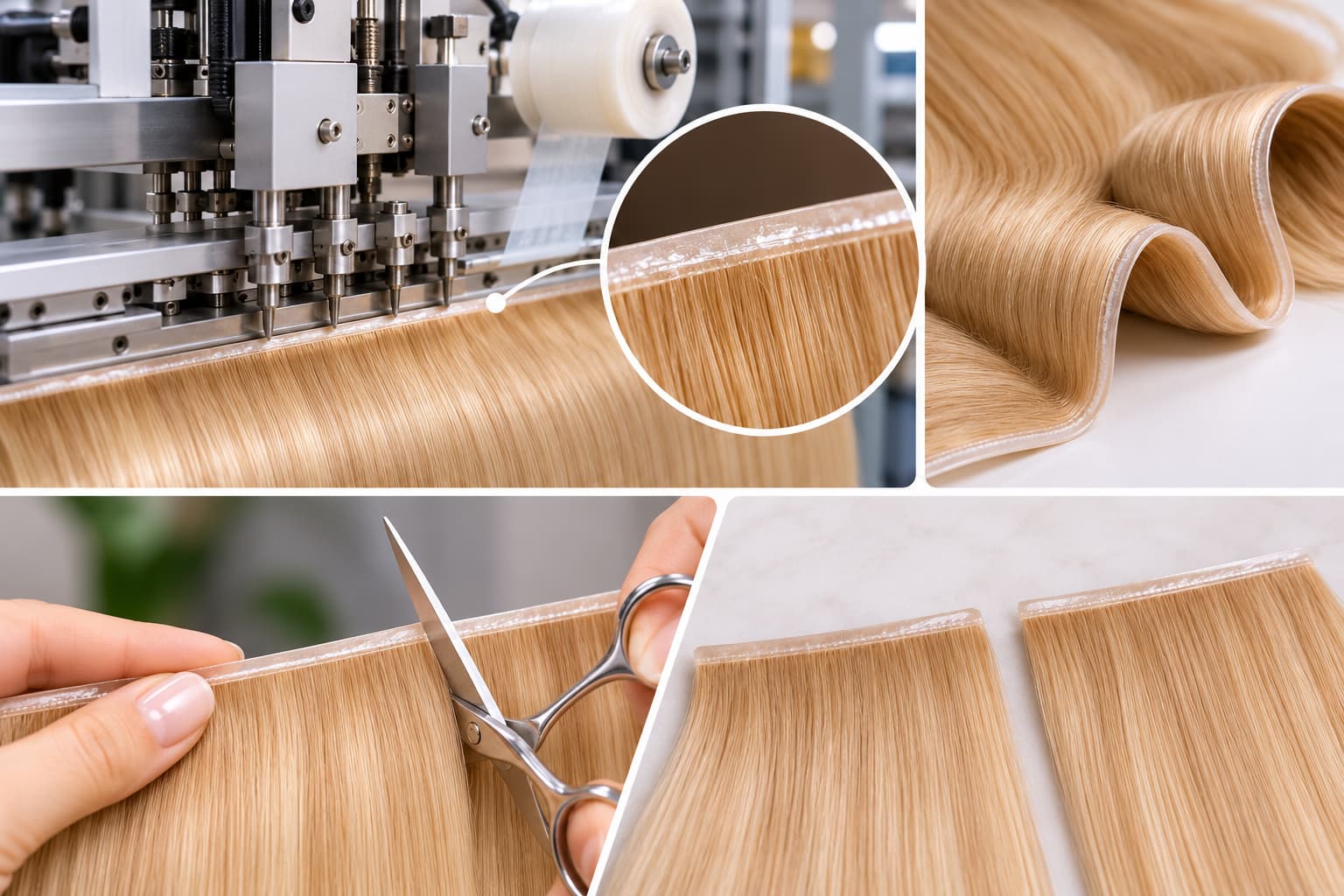
How Genius Weft Is Constructed
The production process involves two stages:
- Machine weft formation — Hair is machine-stitched into a weft base, which is faster and more consistent than hand-tying.
- Thin adhesive application — A fine, flexible adhesive layer is applied along the top of the weft. This layer locks every strand in place and creates a sealed edge regardless of where the weft is cut.
The result is a weft that behaves similarly to Hand-Tied Weft in terms of thinness and profile — but with meaningful structural advantages.
Key Advantages of Genius Weft
- Cut anywhere without shedding — The adhesive top layer seals strands in place. Stylists can customize the width freely.
- Lower production cost — Machine manufacturing reduces labor significantly, allowing for better margins at the brand and distributor level.
- Thinner and more invisible than many weft alternatives — Despite the adhesive layer, Genius Weft maintains a low profile that blends well.
- Reduced short hairs at the top — The design process specifically addresses the short hair issue common in Hand-Tied Weft, improving wearer comfort.
- Consistent quality — Machine production reduces variability compared to fully handmade wefts.[^12]
Who Benefits Most from Genius Weft?
From a procurement perspective, Genius Weft is especially well-suited for:
- Hair extension brands building scalable product lines who need reliable margins
- Distributors and wholesalers supplying salons that value installation ease
- Salons with high client volume where cutting and fitting wefts quickly matters
- Clients with medium to thick hair who want a flat, blended install
| Feature | Genius Weft |
|---|---|
| Construction | Machine-made + adhesive top layer |
| Base thickness | Very thin, comparable to Hand-Tied |
| Flexibility | High |
| Production cost | Lower than Hand-Tied |
| Cut-safe? | Yes — no shedding after cutting |
| Short hairs at top | Minimized by design |
| Best for | Scalable supply, versatile installs |
Genius Weft vs Hand-Tied Weft: Which Should You Source?
This is the question most buyers are really asking. Both wefts are legitimate professional products. Neither is universally "better." The right choice depends on your specific business model and client base.
The decision between Genius Weft and Hand-Tied Weft comes down to three factors: installation requirements, margin structure, and customization needs. Genius Weft wins on cost and cut-safety. Hand-Tied Weft wins on tradition and certain installation preferences among experienced stylists.
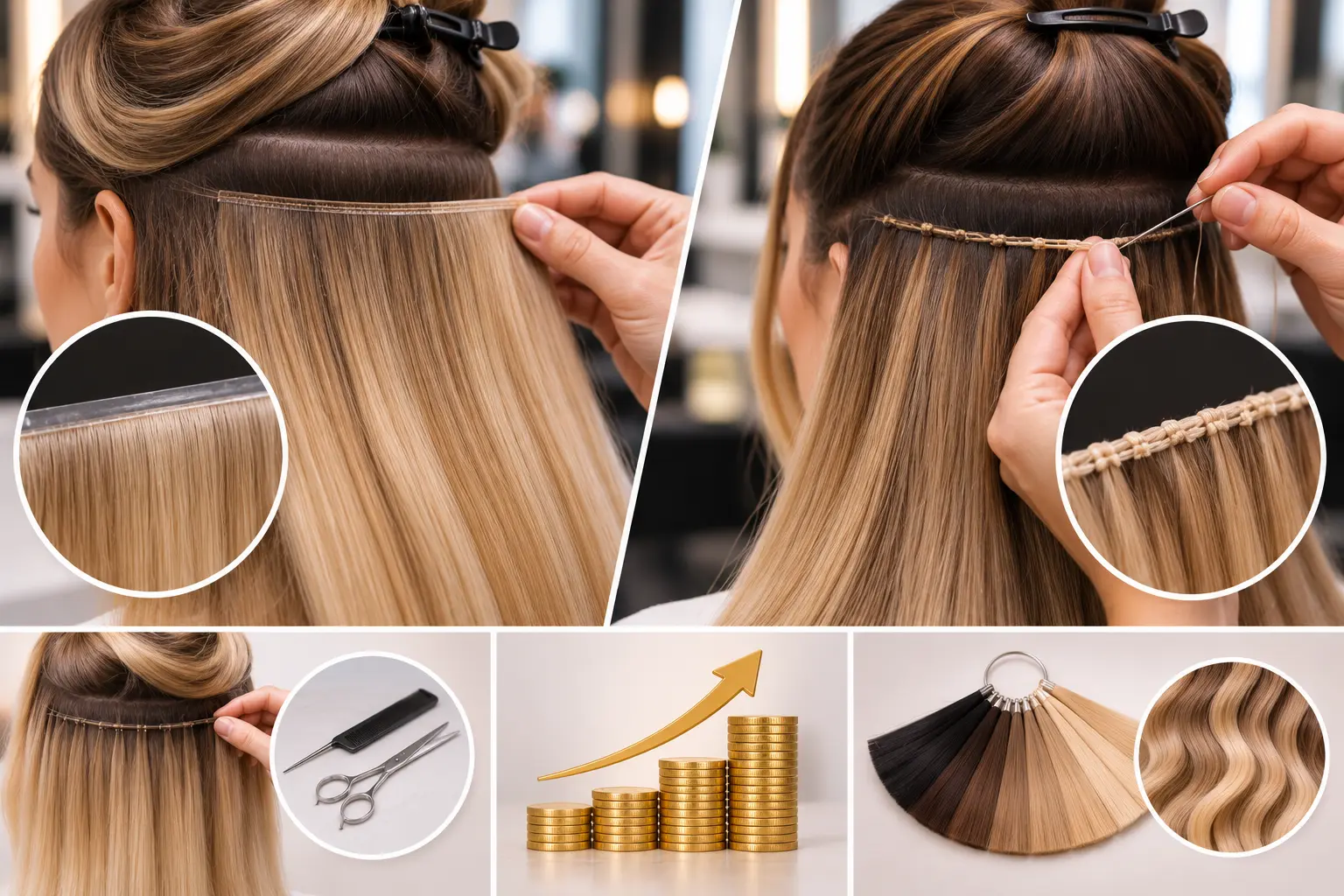
Head-to-Head Comparison
| Criteria | Genius Weft | Hand-Tied Weft |
|---|---|---|
| Manufacturing method | Machine + adhesive layer | 100% handmade |
| Production cost | Lower | Higher |
| Retail price point | Mid to premium | Premium |
| Cut flexibility | Cut anywhere safely | Requires sealing after cut |
| Thinness / invisibility | Very thin | Very thin |
| Shedding risk (post-cut) | Minimal | Moderate without sealing |
| Short hairs at top | Reduced | Possible |
| Wearer comfort | High | High (when installed correctly) |
| Ideal for | Scalable product lines, versatile salons | Boutique salons, fine hair specialists |
How I Think About This for B2B Buyers
If you're building or expanding a hair extension brand, Genius Weft offers a stronger value proposition for most SKUs in your product line. It's easier to standardize, more forgiving in salon conditions, and allows your stylists or end customers to cut freely without worrying about shedding or edge sealing.
If you serve high-end boutique salons where stylists have strong preferences and are trained in Hand-Tied Weft installation methods, keeping Hand-Tied Weft in your line makes sense. Some professional stylists have strong brand loyalty to this format, particularly for fine or color-treated hair clients.
A practical approach for many distributors and brands is to carry both — positioning Genius Weft as the core scalable SKU and Hand-Tied Weft as a premium specialty option.
A Note on Verification
As with any hair extension product, buyers should request samples before committing to bulk orders. Evaluate weft thinness, adhesive consistency, and shedding behavior after cutting. Ask suppliers about their quality control processes and request documentation of hair sourcing standards. For application-specific concerns — such as matching weft type to a particular installation method — consulting a qualified professional stylist or extension educator is always advisable.
Frequently Asked Questions
Can Genius Weft be installed the same way as Hand-Tied Weft?
Genius Weft and Hand-Tied Weft share similar installation methods, including beaded row and sew-in techniques. However, the slight difference in top construction means stylists may need a brief adjustment period. Most experienced extension stylists adapt quickly. Always recommend a test install before full client application.
Does the adhesive layer in Genius Weft make it stiff or uncomfortable?
No. The adhesive layer in Genius Weft is specifically engineered to be thin and flexible. When applied correctly during manufacturing, it does not create stiffness at the weft line. The result is a lightweight, comfortable wear experience comparable to Hand-Tied Weft.
Why does Hand-Tied Weft shed after cutting?
Hand-Tied Weft is constructed by hand-threading individual strands onto a base thread. When you cut the weft, you sever those threads, releasing the strands held near the cut edge. Without a sealed adhesive layer, those strands are no longer anchored and will shed. Genius Weft eliminates this issue through its adhesive top layer.
Is Genius Weft suitable for fine hair clients?
Yes. Genius Weft is designed to be thin and low-profile, making it a viable option for fine hair clients. That said, the best weft choice for fine hair depends on the specific installation technique and the client's hair density. A qualified stylist should assess each client individually.
How do I evaluate weft quality when sourcing from a manufacturer?
Request physical samples and perform a cut test — cut the weft at several points and check for shedding. Examine the weft top for adhesive consistency and check the overall thinness. Ask the manufacturer about their quality inspection process, raw hair sourcing standards, and whether they can provide product documentation for verification.
Conclusion
Both Genius Weft and Hand-Tied Weft are professional-grade hair extension formats with distinct strengths. Hand-Tied Weft delivers an ultra-flat, handcrafted weft that experienced stylists trust — but comes with higher production costs and shedding risk when cut. Genius Weft solves both problems through machine-assisted production and a thin adhesive top layer, offering cut-safe flexibility, lower cost, minimized short hairs at the top, and comparable thinness.
For most B2B buyers building scalable product lines, Genius Weft represents a compelling core offering. Hand-Tied Weft remains a valuable premium option for specialty markets. The right sourcing strategy often includes both.
If you're evaluating weft options for your brand or distribution business, I'd recommend requesting samples from your supplier and testing both formats under real salon conditions. At RENAI HAIR, we manufacture both Genius Weft and Hand-Tied Weft to professional quality standards and welcome inquiries from brands, wholesalers, and distributors looking for a reliable long-term supply partner.
[^1]: "What Are Weft Hair Extensions? Types and Differences Explained", https://bombayhair.com/blogs/hair/what-are-weft-hair-extensions-types-and-differences-explained?srsltid=AYCX9vI7Pbo7fv4hFv184tuhIRQLVP2s5dABvsYXcZ2BXd0vsiCEXpXb. A cosmetology training source on weft extensions describes hand-tied wefts as manually tied, low-profile extension bases and notes that cut ends generally require securing to prevent hair loss from the weft; this supports the construction and handling aspects of the claim, though it does not independently quantify production cost. Evidence role: general_support; source type: education. Supports: A cosmetology education or training source should support the basic construction and handling characteristics of hand-tied wefts, including their low-profile structure and need for care when cut.. Scope note: Contextual support; production-cost comparisons may require a separate manufacturing labor source. [^2]: "Genius Weft Extensions: Cut Anywhere Without Unraveling", https://superiorhairextensions.com/blogs/superior-hair/genius-weft-extensions-cut-anywhere-without-unraveling?srsltid=AYCX9vJ1vV-Rz97fpM05tUjZsrqRRfJ7gVpUlpsTE4_sUdoIdtMwz7B8. Technical documentation on sealed hair-extension wefts explains that bonding or encapsulating the weft head can secure fibers along the cut edge, providing mechanistic support for cut-safe behavior; the source would not by itself verify the performance of every product marketed as a Genius Weft. Evidence role: mechanism; source type: research. Supports: A technical or patent-style source should support the mechanism that a machine-made weft with a sealed or adhesive top can retain strands after cutting.. Scope note: Contextual mechanism support rather than direct proof for a particular supplier or batch. [^3]: "The History of Hair Extensions: From Ancient Times to Modern Trends", https://adoredhairextensions.com/the-history-of-hair-extensions-from-ancient-times-to-modern-trends/. An industry overview of professional hair-extension methods identifies hand-tied wefts as a commonly used premium salon format, supporting the article's historical context, although the phrase 'gold standard' remains an interpretive characterization rather than a measured ranking. Evidence role: historical_context; source type: institution. Supports: An industry or institutional overview should document the prominence of hand-tied wefts in professional extension services.. Scope note: Supports market prominence, not the absolute claim that every serious brand stocked it. [^4]: "Are Hand Tied Weft Extensions Worth the Investment?", https://queenofgoodhair.com/blogs/news/are-hand-tied-weft-extensions-worth-investment?srsltid=AYCX9vKNhoI-V41oqXYQ2ci_dKn-8QocbdWnwdf6o53Q9WA6vnysBOBj. Cosmetology education materials define hand-tied wefts as hair extensions in which hair is manually tied to a narrow base, a construction associated with a thin and flexible weft profile; this supports the definition but may not specify exact thickness values. Evidence role: definition; source type: education. Supports: A cosmetology textbook or training guide should define hand-tied wefts and describe their thread-base construction and low-profile form.. Scope note: Defines the format and typical characteristics, but does not quantify thinness. [^5]: "How to apply Sew-in beaded row hair extensions", https://www.youtube.com/watch?v=O5UV3lDw8ak. Professional extension-education materials describe hand-tied wefts as commonly applied by sewing the weft to a row supported by beads or a similar foundation, supporting the stated association between hand-tied wefts and beaded-row or sew-in installation. Evidence role: general_support; source type: education. Supports: A professional training source should confirm that beaded-row and sew-in approaches are standard installation methods for hand-tied wefts.. Scope note: Supports common practice, not exclusivity; other installation methods may also exist. [^6]: "Who Is the Next “China” in Labor-Intensive Manufacturing? So ...", https://sccei.fsi.stanford.edu/china-briefs/who-next-china-labor-intensive-manufacturing-so-far-china. Research on textile manufacturing economics shows that labor-intensive manual production generally increases unit labor costs compared with mechanized production, providing contextual support for the cost comparison between hand-tied and machine-made wefts. Evidence role: mechanism; source type: paper. Supports: A manufacturing economics or textile-production source should support the general principle that labor-intensive manual production raises unit cost relative to mechanized production.. Scope note: General manufacturing support; it does not provide a hair-extension-specific cost differential. [^7]: "The Real Reason Hair Extensions Shed and How to Stop It", https://www.yilitehair.com/blogs/news/the-real-reason-hair-extensions-shed?srsltid=AYCX9vLosb8VJ61OrOXAtvI_oVy_PbctHiXyN6_kO7lWb8vlgg1AXXqg. Extension-training guidance explains that hand-tied wefts should not be freely cut because cutting through the tied base can disrupt the threads securing the hair, which supports the article's mechanical explanation of post-cut shedding. Evidence role: mechanism; source type: education. Supports: A training or technical source should explain that cutting through the tied base can disrupt the securing threads of a hand-tied weft.. Scope note: Applies to typical hand-tied weft construction; performance may vary with manufacturer finishing and installer technique. [^8]: "Should You Seal Hair Wefts? How to Reduce Shedding Before a Sew-In", https://www.herhaircompany.com/blogs/her-hair-blog/should-you-seal-hair-wefts-how-to-reduce-shedding-before-a-sew-in?srsltid=AYCX9vLA97XdoaPmeeNl8Nej8TSsGV7HaOQWhkwm86dVx18ViOeAwFRb. Professional hair-extension training materials advise securing or sealing cut weft ends to limit shedding, supporting the procedural claim that cut hand-tied wefts require edge treatment. Evidence role: expert_consensus; source type: education. Supports: A professional extension education source should support the practice of sealing cut hand-tied weft edges to prevent shedding.. Scope note: Supports a common professional practice; exact products and methods may vary by training program and manufacturer. [^9]: "Hand-Tied Weft Hair Extensions Ann Arbor", https://avissasalon.com/hand-tied-weft-hair-extensions-ann-arbor/. Extension-education sources describe short return hairs near the weft base as a possible feature of tied weft construction, supporting the claim that top short hairs can occur in hand-tied wefts. Evidence role: mechanism; source type: education. Supports: A cosmetology or extension-training source should explain return hairs or short hairs created during weft construction.. Scope note: Supports possibility and mechanism, not prevalence across all products. [^10]: "Genius Weft Tutorial 2026 | Easy Application + Biggest Myths Busted!", https://www.youtube.com/watch?v=qBJkRTZqzAc. Technical descriptions of sealed machine-made hair wefts identify a machine-formed base combined with a bonded upper edge, supporting the construction description of Genius Weft as machine-assisted with an adhesive top layer. Evidence role: definition; source type: research. Supports: A technical description should define Genius Weft or sealed machine weft construction as using machine formation and an adhesive or sealed upper edge.. Scope note: May describe the construction category rather than every branded product sold under the Genius Weft name. [^11]: "United States Patent and Trademark Office", https://www.uspto.gov/. Technical literature on bonded or sealed weft constructions explains that an adhesive layer can encapsulate and retain fibers at the weft head, providing mechanistic support for reduced shedding after cutting. Evidence role: mechanism; source type: research. Supports: A patent, technical paper, or testing source should support the mechanism by which a bonded top layer anchors hair fibers after cutting.. Scope note: Mechanistic support only; actual shedding resistance should be verified by product-specific testing. [^12]: "Textile manufacturing", https://en.wikipedia.org/wiki/Textile_manufacturing. Manufacturing quality-control research indicates that mechanized production can reduce operator-dependent variation and improve repeatability compared with manual fabrication, providing contextual support for the claim about machine-made weft consistency. Evidence role: general_support; source type: paper. Supports: A production engineering source should support that mechanization or automation can reduce process variability compared with manual fabrication.. Scope note: General manufacturing evidence; it does not measure variability in Genius Weft versus hand-tied weft samples.