
Hair Extensions Prices – What You Need To Know About Pricing In The Hair Industry
Hair Extensions Prices can feel confusing when two suppliers quote very different numbers for products that look similar. That confusion becomes risky when a low quote leads to shedding, tangling, color failure, or customer complaints. I always suggest looking beyond the unit price and checking the raw hair, color, length, ratio, and construction method.
Hair Extensions Prices are mainly determined by raw human hair quality, color processing, length, fullness ratio, and extension type. Remy or virgin hair costs more than non-Remy hair, lighter colors cost more than dark colors, longer lengths rise sharply in price, and double-drawn or complex products require higher production costs.
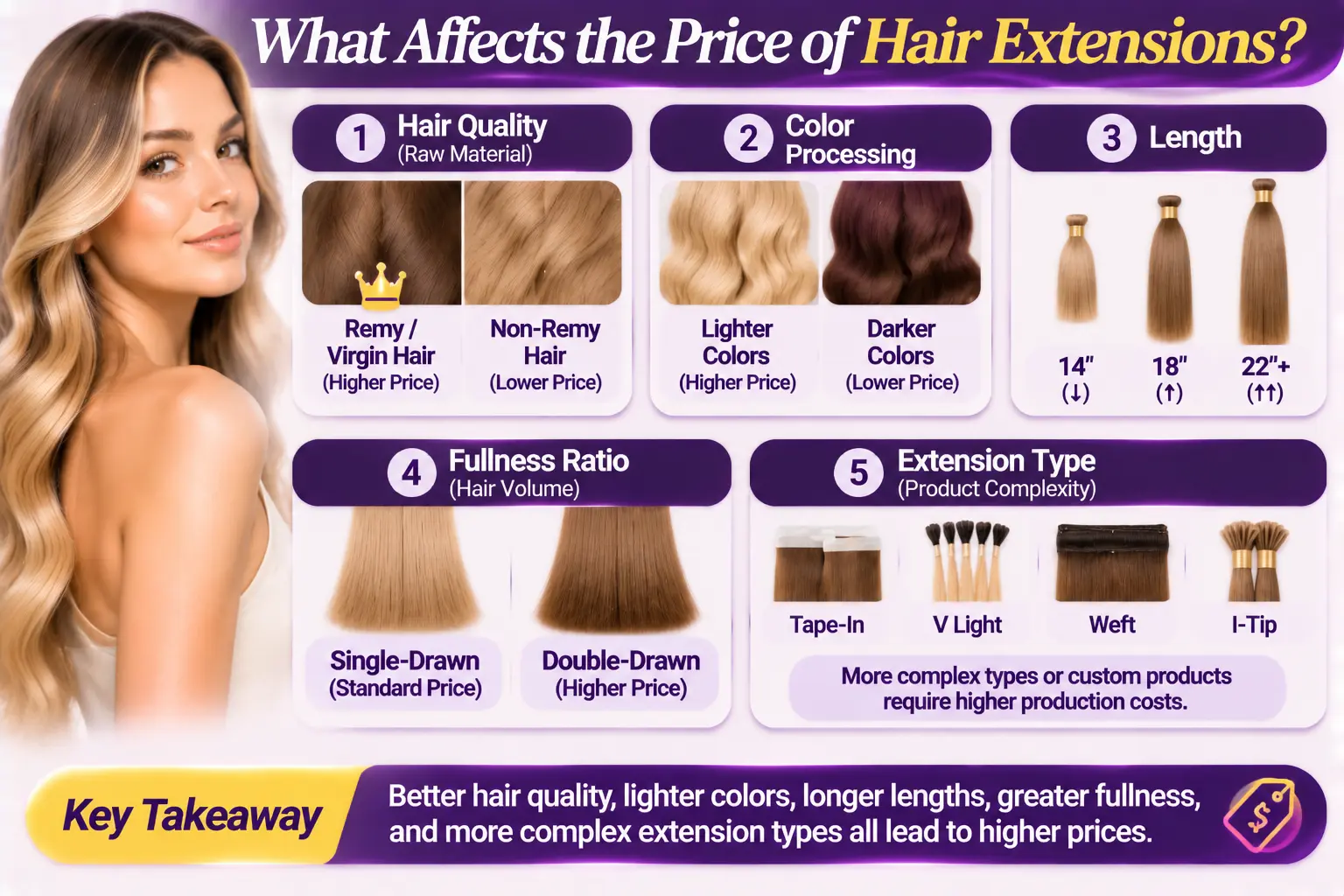
For B2B buyers, the best price is not always the lowest price. It is the price that matches the product grade, market positioning, salon expectations, and repeat-order quality standard. Below, I will break down the main cost drivers that I check when evaluating human hair extension pricing.
How Do Raw Materials Affect Hair Extensions Prices?
Raw hair is the first reason Hair Extensions Prices vary so much. Buyers often compare quotes by grams, but the real value starts before production begins. If the raw material is weak, mixed, or poorly aligned, the finished extension cannot become a premium product.
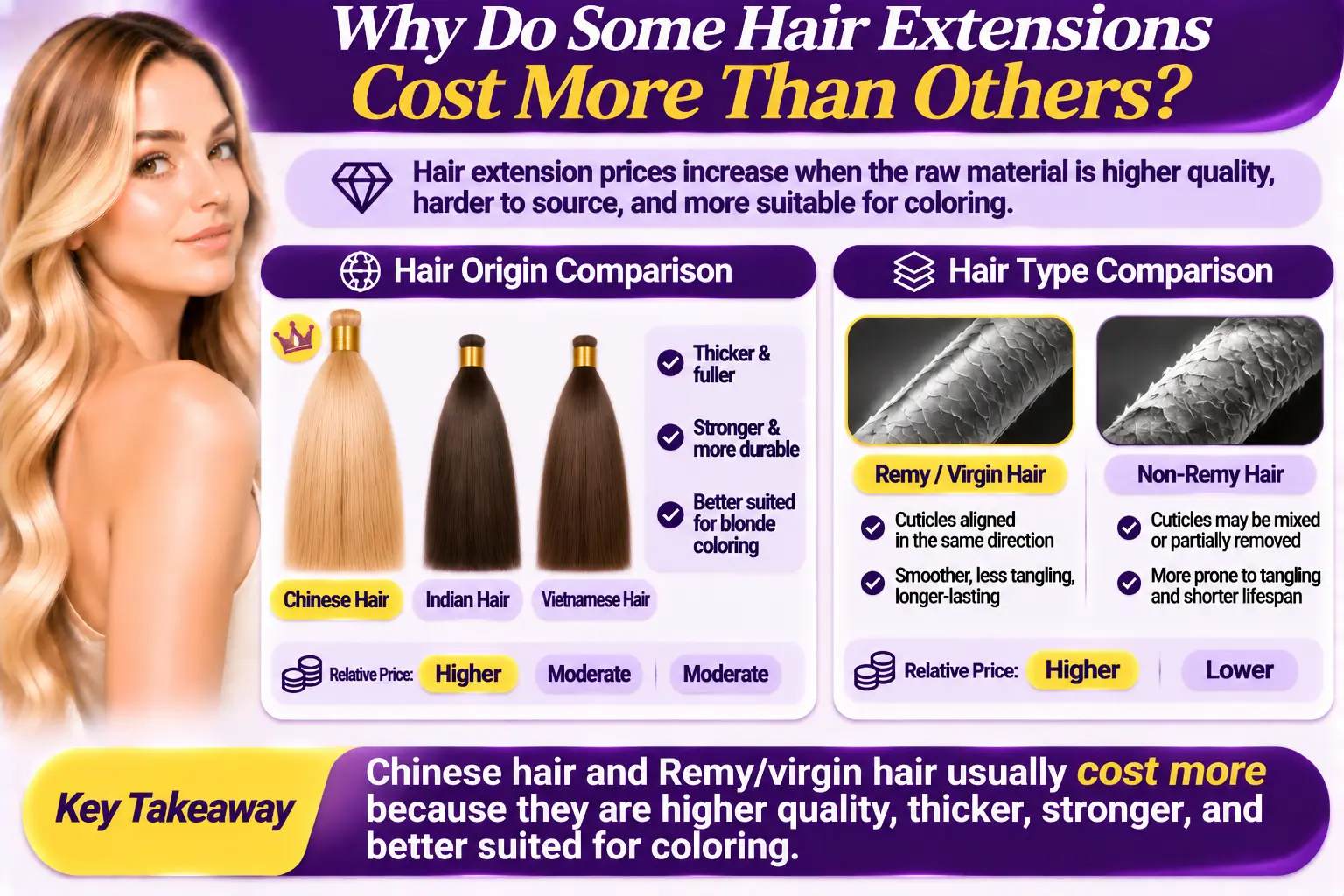
Hair Extensions Prices increase when the raw material is higher quality, harder to source, and more suitable for coloring. Chinese human hair usually costs more than Indian or Vietnamese hair because it is thicker, stronger, and better suited for blonde processing. Remy or virgin hair also costs more because the cuticles are better aligned.
Why raw hair source matters
In my experience working with human hair extensions, raw material is the foundation of every quote. A finished product may be called “human hair,” but that term alone does not tell a buyer enough. There are many kinds of natural human hair materials in the market, including:
- Chinese human hair
- Indian human hair
- Vietnamese human hair
- European hair
- Brazilian hair
- Mixed-origin human hair
Each source has different characteristics. Chinese hair is generally thicker and stronger.[^1] It can often handle bleaching better, especially when buyers need blonde shades.[^2] Vietnamese hair can be smooth and beautiful, but it is usually harder to lift to very light blonde shades. Indian hair may have a nice natural wave, but it can become fragile when heavily bleached.
I always tell buyers that the same “18-inch human hair weft” can have very different performance depending on the raw material behind it.
Remy hair vs non-Remy hair
Raw hair is also classified by cuticle direction and collection quality. This is where Remy hair, virgin hair, and non-Remy hair become important.
| Raw Hair Type | Cuticle Direction | Typical Cost | Common Buyer Concern |
|---|---|---|---|
| Non-Remy hair | Mixed or processed | Lower | More tangling risk |
| Remy hair | Mostly aligned | Higher | Supplier must prove consistency |
| Virgin hair | Less chemically processed | Highest | Limited supply and higher cost |
Remy hair is more expensive because the hair shafts are kept in the same direction. This helps reduce friction, matting, and tangling.[^3] Virgin hair is often described as hair that has not been chemically processed[^4], but buyers should verify this through supplier documentation, sample testing, and batch checks.
Why Chinese Remy hair can cost more
When I compare Remy Indian hair and Remy Chinese hair, the major difference is the source. However, price can still vary inside one category. For example, Chinese virgin hair may have different grades depending on:
- Follicle direction
- Natural color
- Texture
- Length
- Thickness
- Cleanliness of collection
- Suitability for bleaching
A reliable supplier should explain these details clearly. If a quote is much cheaper than the market average, I would ask whether the hair is truly Remy, whether it contains mixed lengths, and whether the cuticles remain intact.
For brands, wholesalers, and salons, raw material selection should match the target customer. A salon selling premium blonde extensions cannot use the same raw material as a budget black weft product. The procurement decision should start with application, not only price.
Why Does Hair Color Change Hair Extensions Prices?
Hair color strongly affects Hair Extensions Prices because lighter shades require more processing and create more material loss[^5]. Many buyers notice that blonde hair, balayage colors, and bright fashion shades cost more than natural black or dark brown. That difference is not random.
Light-colored human hair extensions cost more because bleaching and coloring reduce usable hair volume and increase production risk. In general, light-color production can create around 20% more hair material loss[^6] than dark-color production. Blonde shades are usually priced higher than black, brown, or dark natural colors.

The hidden cost of lifting color
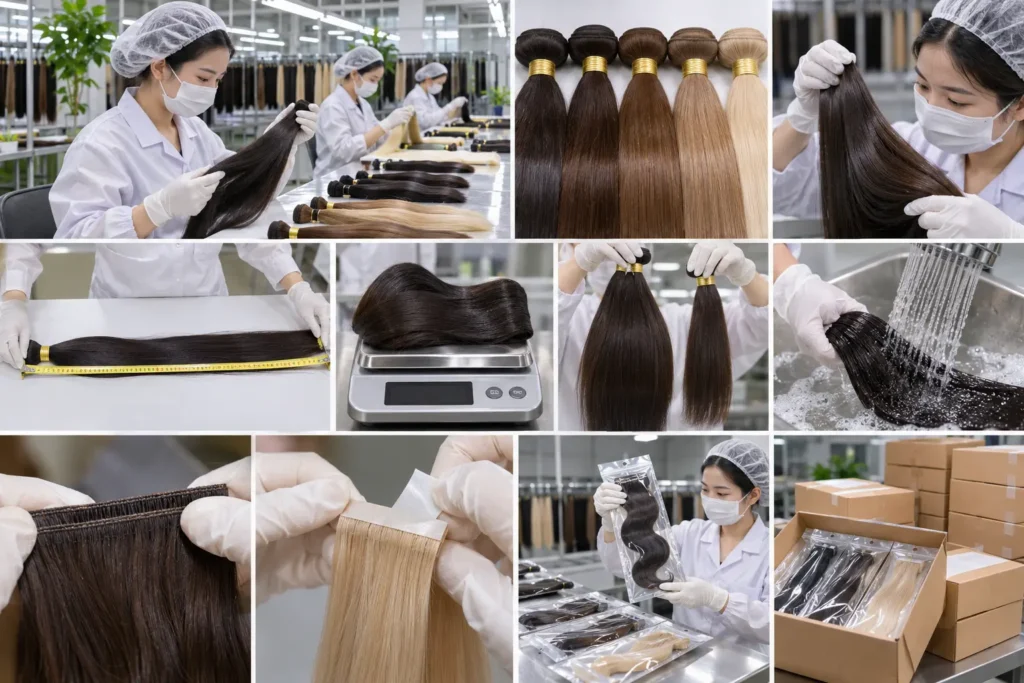
Color processing is one of the most important cost points in the hair industry. Natural dark hair must be lifted before it can become blonde[^7], ash, piano color, balayage, or highlighted hair. The lighter the final shade, the more difficult the production becomes.
When hair is bleached, several things can happen:
- Some strands become too weak and must be removed.
- Some hair does not lift evenly.
- Some batches cannot reach the required tone.
- Some hair breaks during processing.[^8]
- Extra conditioning and quality control are needed.
This is why a blonde weft is not simply a “different color” from a black weft. It is a more difficult product to produce.
Common color cost differences
| Color Category | Processing Difficulty | Material Loss | Typical Price Level |
|---|---|---|---|
| Natural black | Low | Low | Lower |
| Dark brown | Low to medium | Low | Lower to medium |
| Medium brown | Medium | Medium | Medium |
| Blonde | High | Higher | High |
| Platinum / light ash | Very high | Highest | Very high |
| Balayage / highlight | High | Higher | High |
I usually advise B2B buyers to compare color quotes by shade level, not only by product type. For example, a 20-inch Genius Weft in natural black and a 20-inch Genius Weft in #60 blonde are not equal from a production-cost view.
Why raw material and color must be evaluated together
Not every raw hair source can become every color. This is a key reason Hair Extensions Prices differ between suppliers. Some suppliers may quote low prices for blonde hair, but the product may break, feel dry, or have poor longevity after washing.
For example:
- Vietnamese hair may not always lift well to blonde.
- Indian hair may become fragile after heavy bleaching.
- Chinese hair is often stronger for light-color development.
- High-quality Remy hair can better support premium color work.
Color also affects delivery time. A standard dark color may be available faster. A custom blonde or multi-tone shade may require additional production checks. As a buyer, I would ask for:
- Color ring confirmation
- Lab dip or pre-production sample
- Washing and combing test
- Shade tolerance standard
- Batch-to-batch color control
A lower color price is only valuable if the finished hair still performs after installation, washing, styling, and salon use.
How Does Length Influence Hair Extensions Prices?
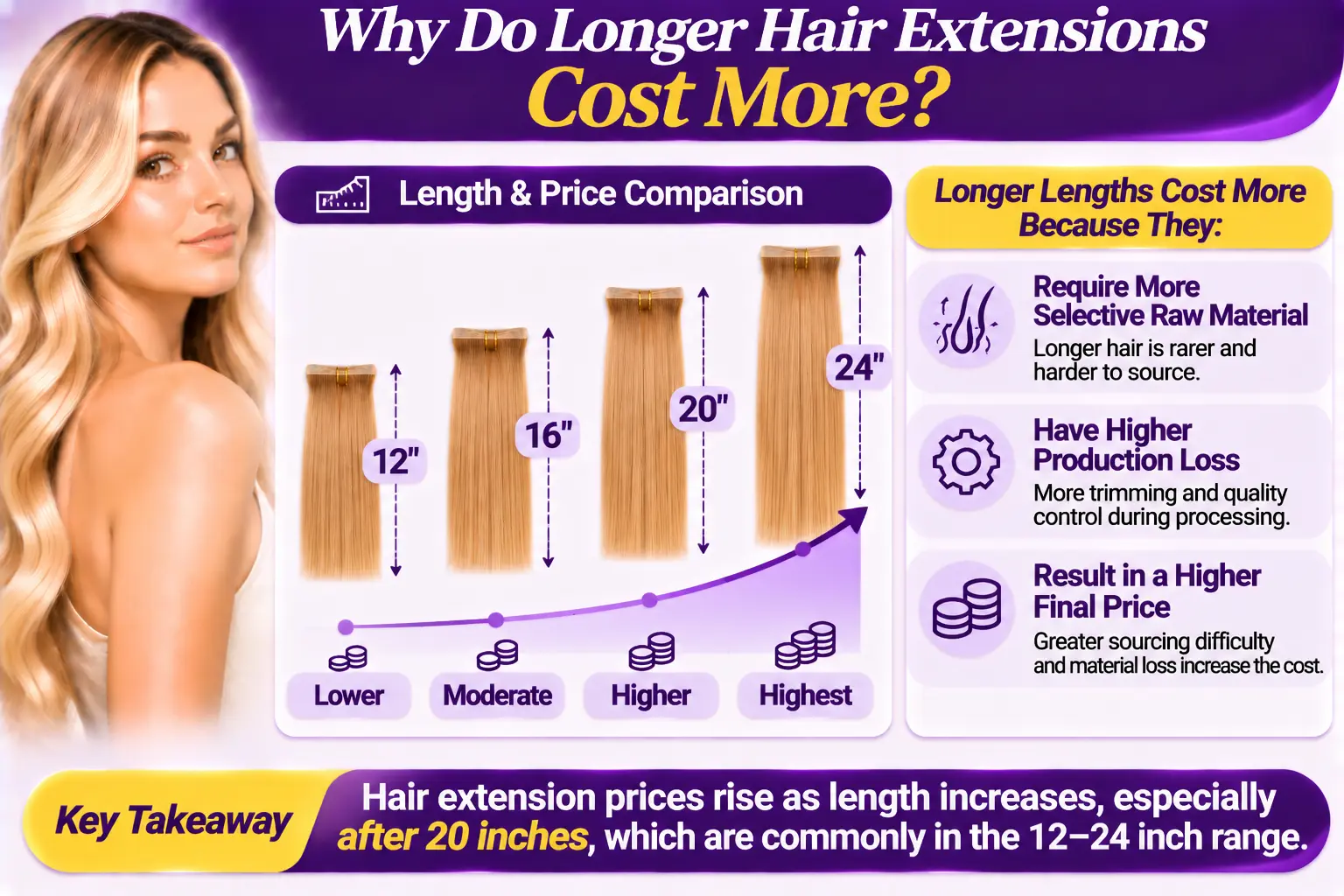
Length has a direct impact on Hair Extensions Prices because longer hair is rarer and harder to collect in consistent quality[^9]. A 24-inch human hair extension does not simply use twice the hair of a 12-inch product. It requires longer raw strands with fewer defects.
Hair Extensions Prices rise as length increases, especially after 20 inches.[^10] Most common human hair extensions range from 12 inches to 24 inches, but longer lengths require more selective raw material. The longer the hair, the higher the sourcing difficulty, production loss, and final price.
Why long hair costs more per gram
Many new buyers assume that price should increase evenly by length. In reality, the price curve becomes steeper as the length gets longer. A 12-inch bundle is easier to produce than a 22-inch bundle because more donors can provide shorter hair. Fewer donors can provide long, healthy, thick hair.
Long hair also has higher rejection risk. During sorting and production, workers remove short, broken, weak, or unsuitable strands. The longer the target length, the more selective the process becomes.
Here is a simplified view:
| Length Range | Supply Difficulty | Price Movement | Buyer Note |
|---|---|---|---|
| 12–14 inches | Easier | Lower | Good for entry-level lines |
| 16–18 inches | Medium | Moderate | Popular salon range |
| 20 inches | Higher | Noticeable increase | Strong demand |
| 22–24 inches | High | Sharp increase | Needs better raw material |
| 26 inches+ | Very high | Premium | Requires careful supplier verification |
True length and finished length
I recommend buyers confirm how the supplier measures hair length. For straight hair, measurement is more direct. For wavy or curly hair, the stretched length and natural fall length can differ.[^11] This can create misunderstanding if the buyer expects one standard and the supplier uses another.
Buyers should define:
- Measured straight or natural?
- Tolerance range, such as ±0.5 inch or ±1 inch
- Finished length after wefting or bonding
- Length distribution inside each pack
- Minimum acceptable short-hair percentage
Length and market positioning
Longer hair often sells at a premium in salons, boutiques, and online brands. However, the buyer must calculate margin carefully. If a brand sells 24-inch blonde double-drawn hair, the cost base is high because three expensive factors combine:
- Long length
- Light color
- Full ratio
That product can be profitable, but only if the target market accepts premium pricing. For wholesale buyers, I often suggest building a price ladder. For example, a brand can keep 16–20 inches as the main stock range and offer 22–24 inches as premium or pre-order options.
This approach reduces inventory pressure while still serving high-end customers.
What Is The Role Of Hair Ratio In Hair Extensions Prices?
Hair ratio affects Hair Extensions Prices because it controls how full the ends look. Two bundles can have the same weight and length but look very different if one has thin ends and the other has full ends. This is where single-drawn and double-drawn hair matter.
Higher hair ratio means fuller ends and higher cost. Single-drawn hair extensions contain more varied strand lengths, so the ends look thinner. Double-drawn hair extensions remove more short hairs and keep more long strands, so the ends look fuller. The production process is more complex, so the price is higher.

What hair ratio means
The ratio represents the degree of fullness from top to bottom. In simple terms, it tells buyers how much of the hair reaches the stated length.
For example, if a 20-inch bundle has many shorter strands mixed inside, the bottom will look thinner. If more strands reach 20 inches, the bottom will look thicker and more luxurious.
The two common categories are:
- Single-drawn hair extensions
- Double-drawn hair extensions
Some suppliers also use terms like “super double drawn” or “luxury ratio.” Buyers should ask for actual standards, because these terms are not always used consistently across factories.
Single drawn vs double drawn
| Feature | Single Drawn Hair | Double Drawn Hair |
|---|---|---|
| End fullness | Natural, thinner ends | Fuller, thicker ends |
| Production cost | Lower | Higher |
| Sorting process | Less intensive | More intensive |
| Best for | Natural look, budget lines | Premium salon and brand lines |
| Customer expectation | Soft natural taper | Full luxury finish |
Double-drawn hair costs more because workers need to sort and remove more short strands. This increases labor time and material waste.[^12] The factory may need more raw hair to produce the same finished weight.
Why weight alone can mislead buyers
A 100g pack is not always equal to another 100g pack. If one pack has many short hairs, it may weigh the same but look less full at the ends. This can cause customer dissatisfaction, especially in markets where clients expect thick, Instagram-ready results.
When I evaluate samples, I check:
- Top thickness
- Middle thickness
- End fullness
- Short-hair percentage
- Shedding after combing
- Tangle performance after washing
- Visual fullness after installation
For B2B buyers, the correct ratio depends on the brand position. A budget line may use single-drawn hair honestly and still satisfy customers. A premium salon line usually needs double-drawn hair or a defined high-ratio standard.
The key is transparency. I prefer clear specifications over vague terms. Buyers should request product photos, videos, and physical samples before confirming large orders.
Do Different Types Of Hair Extensions Change The Final Price?
Different extension types change the final price because each product uses different materials, labor, tools, and quality control steps. A weft, tape-in, clip-in, keratin bond, halo, or topper may use similar human hair, but the finished construction is not the same.
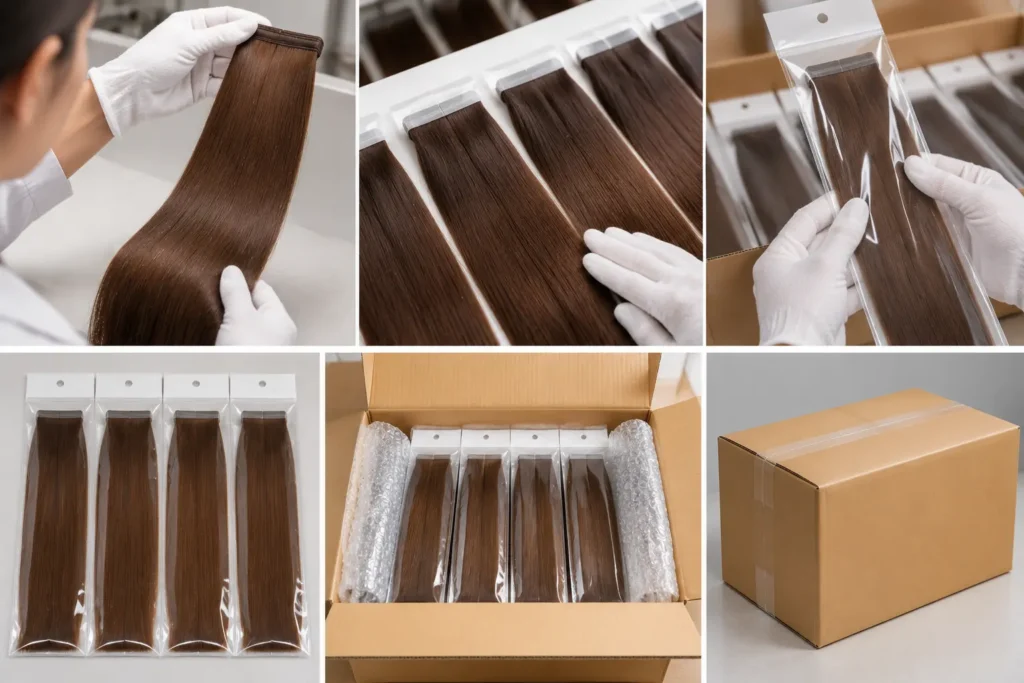
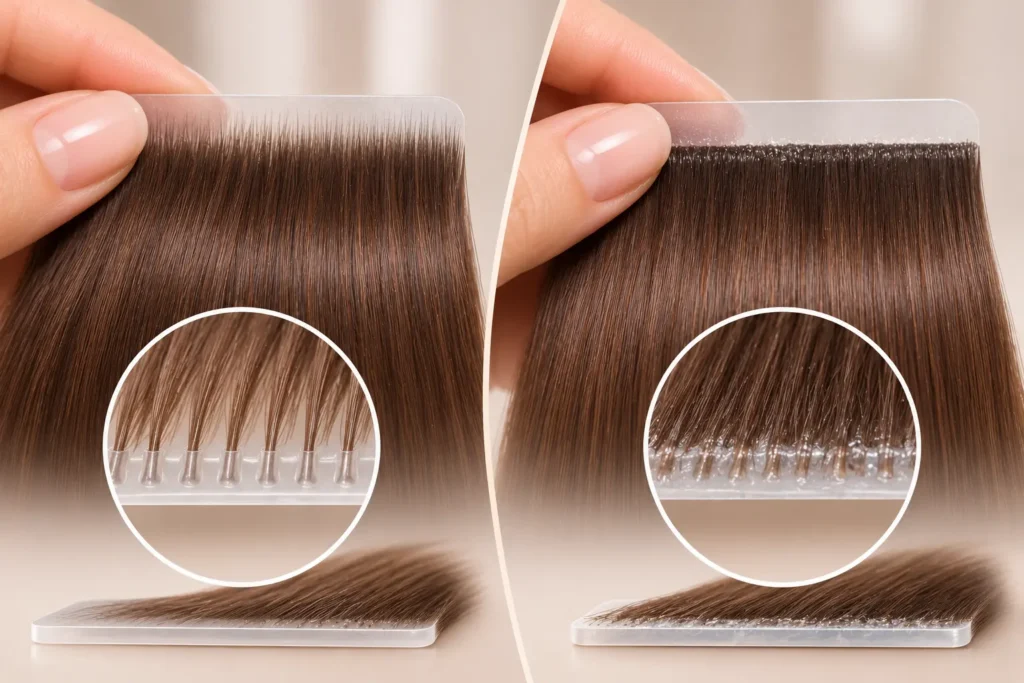
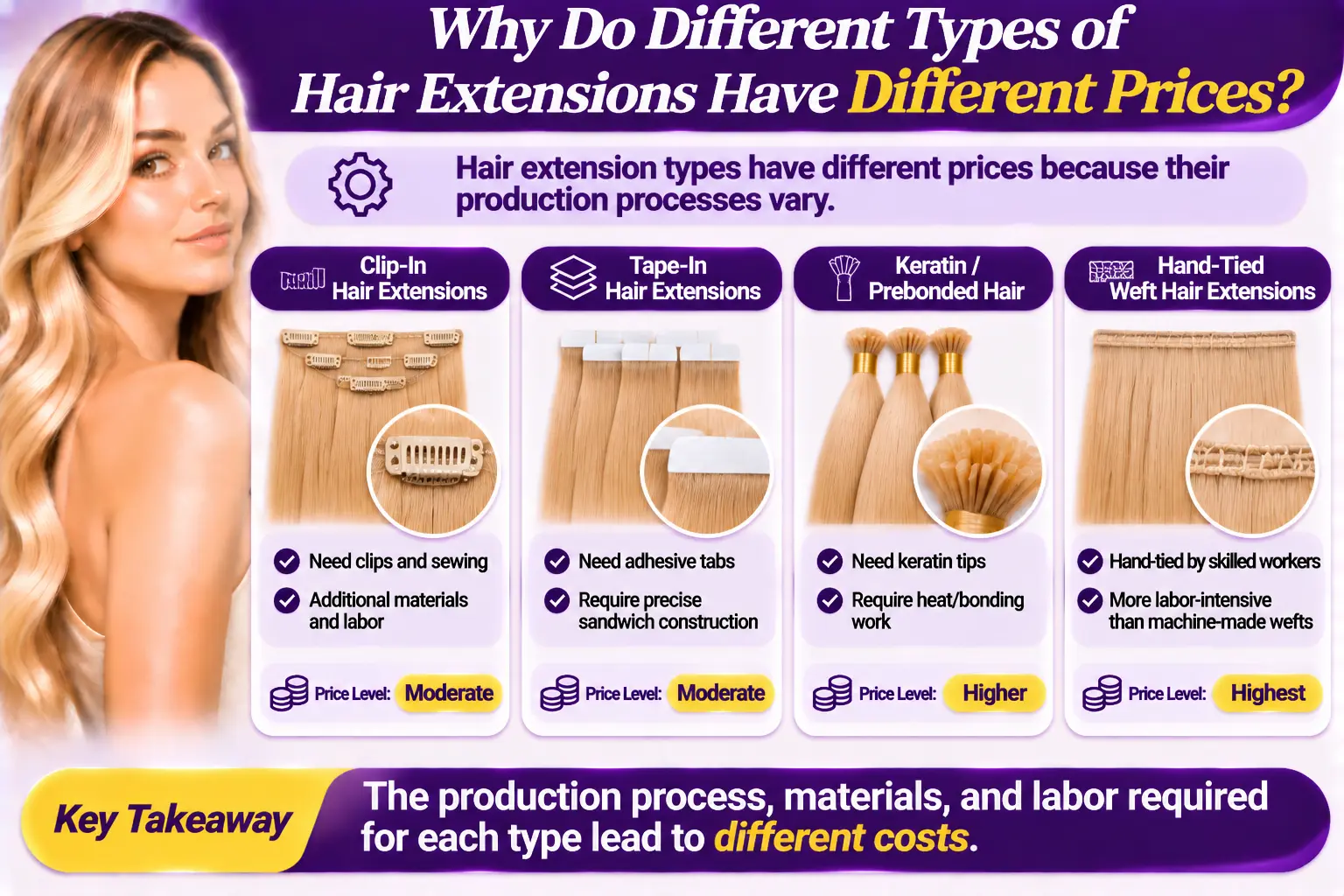
Human hair extension types have different prices because their production processes vary. Clip-ins need clips and sewing. Tape-ins need adhesive tabs and precise sandwich construction. Keratin or prebonded hair needs tips and bonding work. Hand-tied wefts require more labor than many machine-made products.
Main product types and cost drivers
At RENAI HAIR, our product range includes several human hair extension categories. I see buyers compare these categories often, but each one has different cost logic.
| Extension Type | Main Cost Drivers | Typical Buyer Use |
|---|---|---|
| Machine Weft | Hair quality, weft sewing, density | Wholesale, salons, sew-in installs |
| Hand Tied Weft | Skilled labor, thin weft construction | Premium salon service |
| Genius Weft / Flex Weft | Product design, flatness, comfort | Modern professional installs |
| Tape In Hair | Hair, tape quality, tab precision | Salon quick installation |
| Keratin / Prebonded Hair | Tip material, bonding, strand consistency | Strand-by-strand installs |
| Clip In Hair | Clips, sewing, set weight, packaging | Retail and salon resale |
| Halo Hair | Wire, band construction, blending | Easy temporary wear |
| Ponytail | Base construction, combs, Velcro | Fashion and retail use |
| Hair Topper | Base material, ventilation, density | Thinning-hair solutions |
Why labor changes the quote
Some products need more handwork. Hand-tied wefts, toppers, and customized pieces usually require more skilled labor than standard machine wefts. Tape-ins require clean tab cutting and adhesive control. Keratin tips require uniform bonding, because inconsistent tips can affect installation safety and durability.
A buyer should ask:
- What adhesive is used for tape-ins?
- What keratin or bonding material is used?
- How strong is the weft seam?
- Does the product shed after washing and brushing?
- Are clips rust-resistant and securely sewn?
- Is the packaging included in the quote?
Comparing prices fairly
To compare suppliers fairly, buyers should create a clear specification sheet. I recommend including:
- Hair origin and grade
- Remy or non-Remy status
- Length
- Color
- Weight per pack
- Ratio or fullness standard
- Product type
- Packaging requirements
- Private label requirements
- Quality control checklist
Without these details, two suppliers may quote “tape in hair extensions,” but one quote may include premium Remy hair, strong adhesive, full ends, and custom packaging, while another may include lower-grade hair and basic packing.
For brand owners, this difference affects reviews, returns, and long-term customer trust. The cheapest product can become expensive if it creates complaints. The right product should support the buyer’s sales channel, price point, and customer promise.
Frequently Asked Questions
Why are some human hair extensions so cheap?
Some hair extensions are cheap because they may use non-Remy hair, mixed hair, shorter internal lengths, lower fullness ratios, or darker colors that require less processing. I suggest checking samples, washing performance, cuticle direction claims, and supplier consistency before placing large wholesale orders.
Is Remy hair always worth the higher price?
Remy hair is often worth the higher price for brands, salons, and repeat customers because aligned cuticles can reduce tangling and improve wear quality. However, buyers should still verify the supplier’s Remy claim through samples, testing, and consistent batch inspection.
Why does blonde human hair cost more than black hair?
Blonde human hair costs more because dark raw hair must be bleached and toned. This process creates higher material loss, usually around 20% more than dark colors, and it increases breakage risk. Stronger raw hair and stricter quality control are needed.
What length of hair extensions is most cost-effective?
Lengths from 16 to 20 inches are often cost-effective because they balance customer demand, supply availability, and price. Hair over 20 inches becomes more expensive because long, healthy raw hair is harder to source and produces more sorting loss.
How can I compare hair extension supplier prices correctly?
I compare supplier prices by matching the full specification: hair origin, Remy status, color, length, weight, ratio, extension type, packaging, and QC standard. A fair comparison needs the same product details. Otherwise, the lower price may reflect lower quality or missing services.
Conclusion
Hair Extensions Prices depend on more than one factor. Raw material, Remy quality, color level, length, fullness ratio, and product type all shape the final quote. I always recommend that B2B buyers evaluate price together with samples, specifications, and supplier quality control. If you are building or expanding a human hair extension line, RENAI HAIR can help you compare product options and develop a stable supply plan for your market.
[^1]: "Asian Hair: A Review of Structures, Properties, and Distinctive ...", https://pmc.ncbi.nlm.nih.gov/articles/PMC7187942/. Comparative studies of human hair fibers report population-level variation in shaft diameter and mechanical properties, with East Asian hair often described as having larger average diameter; this supports the general material context for the claim, but it does not prove that every batch sold as Chinese hair is thicker or stronger. Evidence role: general_support; source type: paper. Supports: Comparative hair-fiber studies describing population-level differences in shaft diameter, morphology, and mechanical behavior.. Scope note: Population-level hair-fiber data contextualizes the claim but cannot verify the origin or quality of any specific supplier batch. [^2]: "Effects of excessive bleaching on hair: comparative analysis of ...", https://pmc.ncbi.nlm.nih.gov/articles/PMC11652465/. Experimental research on bleached human hair shows that oxidative lightening can reduce fiber strength and damage the cuticle and cortex; such findings explain why stronger or thicker raw fibers may better tolerate light-color processing, although they do not directly rank commercial Chinese hair against all other origins. Evidence role: mechanism; source type: paper. Supports: Research on how bleaching affects human hair fibers and how structural properties influence breakage or strength loss.. Scope note: The likely source would support the bleaching-damage mechanism, not the full commercial ranking by hair origin. [^3]: "What Is Remy Hair? A Professional Guide to Cuticle ...", https://www.verahairco.com/blogs/the-journal/the-science-behind-remy-hair-what-makes-it-the-gold-standard-for-extensions. Cosmetology references commonly define Remy hair as collected or processed so that hair fibers remain aligned in the same root-to-tip direction, a configuration that helps preserve cuticle orientation and reduce friction-related tangling; this supports the performance rationale but not a specific price premium. Evidence role: definition; source type: education. Supports: A cosmetology or hair-science source defining Remy hair by cuticle alignment and explaining its relevance to tangling.. Scope note: The source would define and explain Remy structure, while the price effect remains a market inference. [^4]: "Hair Analysis | Georgia Bureau of Investigation Division of ...", https://dofs-gbi.georgia.gov/hair-analysis. Educational hair-care and cosmetology sources generally use 'virgin hair' to mean hair that has not undergone chemical treatments such as coloring, bleaching, perming, or relaxing; this supports the definition but not the authenticity of any supplier's virgin-hair claim. Evidence role: definition; source type: education. Supports: A neutral definition of virgin hair as hair without prior chemical treatment such as coloring, perming, relaxing, or bleaching.. Scope note: A definition source cannot verify whether a commercial batch has truly avoided chemical treatment. [^5]: "The physical and chemical disruption of human hair after ...", https://pubmed.ncbi.nlm.nih.gov/30229956/. Studies of oxidative hair bleaching show that lightening treatments can damage cuticle and cortical structures, reduce mechanical strength, and increase fiber fragility; this supports the mechanism behind greater processing loss for lighter shades, although it does not quantify loss in extension factories. Evidence role: mechanism; source type: paper. Supports: Scientific evidence that oxidative lightening changes hair structure and can increase breakage, dryness, and rejection risk.. Scope note: The mechanism is supported by hair-fiber research, but production-loss rates vary by factory, raw material, and quality standard. [^6]: "The physical and chemical disruption of human hair after ...", https://pubmed.ncbi.nlm.nih.gov/30229956/. A production-yield study or documented quality-control dataset should be cited to support the estimate that light-color processing causes about 20% more material loss than dark-color processing; without such data, the figure should be treated as an approximate industry estimate rather than a verified universal rate. Evidence role: statistic; source type: research. Supports: Quantitative evidence comparing material loss or rejection rates for light-color versus dark-color human hair extension production.. Scope note: The 20% figure is likely to vary by raw hair source, bleaching level, factory process, and rejection standard. [^7]: "Effects of excessive bleaching on hair: comparative analysis of ...", https://pmc.ncbi.nlm.nih.gov/articles/PMC11652465/. Hair-color chemistry sources explain that bleaching lightens dark hair by oxidizing melanin pigments within the fiber, which provides the chemical basis for lifting dark hair before achieving blonde shades. Evidence role: mechanism; source type: education. Supports: The chemistry of hair lightening, including oxidation of melanin pigments before blonde coloring or toning.. [^8]: "Effects of excessive bleaching on hair: comparative analysis of ...", https://pmc.ncbi.nlm.nih.gov/articles/PMC11652465/. Experimental studies on chemically bleached hair report reduced tensile strength, cuticle damage, and increased fiber fragility, supporting the claim that some hair may break during processing. Evidence role: mechanism; source type: paper. Supports: Experimental findings that bleaching can weaken human hair fibers and increase breakage risk.. [^9]: "Evolution of long scalp hair in humans - PMC - NIH", https://pmc.ncbi.nlm.nih.gov/articles/PMC11918595/. Hair-growth research shows that terminal scalp-hair length is constrained by growth rate and anagen duration, while longer fibers have more time to accumulate weathering and breakage; this supports the biological context for long hair being harder to obtain in consistent quality, though it does not directly measure extension-market supply. Evidence role: mechanism; source type: paper. Supports: Research showing that scalp hair length depends on growth rate, anagen duration, and damage accumulated over time.. Scope note: The evidence explains biological scarcity and quality risk, not commercial sourcing volumes. [^10]: "Human hair extension Market Size, Trends, Growth | 2035", https://www.businessresearchinsights.com/market-reports/human-hair-extension-market-118223?srsltid=AYCX9vIMJw01SAlSTpk61EPw9-PSmChdfSG34Q6p2jJXDKj1xq9mwyGL. A market-pricing dataset or industry survey should be cited to show that human hair extension prices generally rise with length and that longer lengths command steeper premiums; such evidence would document a market pattern rather than establish a fixed global price rule. Evidence role: statistic; source type: research. Supports: Market or price-survey evidence showing that human hair extension prices increase as listed length increases, with higher increments for longer lengths.. Scope note: Prices vary by hair origin, grade, color, ratio, supplier region, and order volume. [^11]: "The what, why and how of curly hair: a review - PMC", https://pmc.ncbi.nlm.nih.gov/articles/PMC6894537/. Hair morphology research describes curliness as a function of fiber curvature and shape, which explains why wavy or curly hair can have a shorter apparent hanging length than its stretched length. Evidence role: mechanism; source type: paper. Supports: Research or educational material explaining that curvature and curl pattern reduce apparent length relative to stretched fiber length.. [^12]: "Double Drawn Human Hair : 5 Things to Know", https://miellee.com/blogs/hair-extensions-101/double-drawn-human-hair. Cosmetology and extension-manufacturing references describe double-drawn hair as hair sorted for greater length uniformity and fuller ends, commonly by removing shorter strands; this supports the labor-and-waste rationale for higher cost, though it does not quantify the exact price increase. Evidence role: mechanism; source type: education. Supports: A cosmetology or manufacturing source explaining that double-drawn hair has more uniform length because shorter strands are removed or sorted out.. Scope note: The source would support the production mechanism, not a universal markup.