
What Are Genius Wefts?
Genius Wefts can be confusing when every supplier uses the term a little differently. Buyers may assume the label guarantees a certain seam, cutting rule, or comfort level, but that can lead to poor sourcing decisions. The practical solution is to compare the exact construction, dimensions, fitting instructions, and sample evidence before ordering.
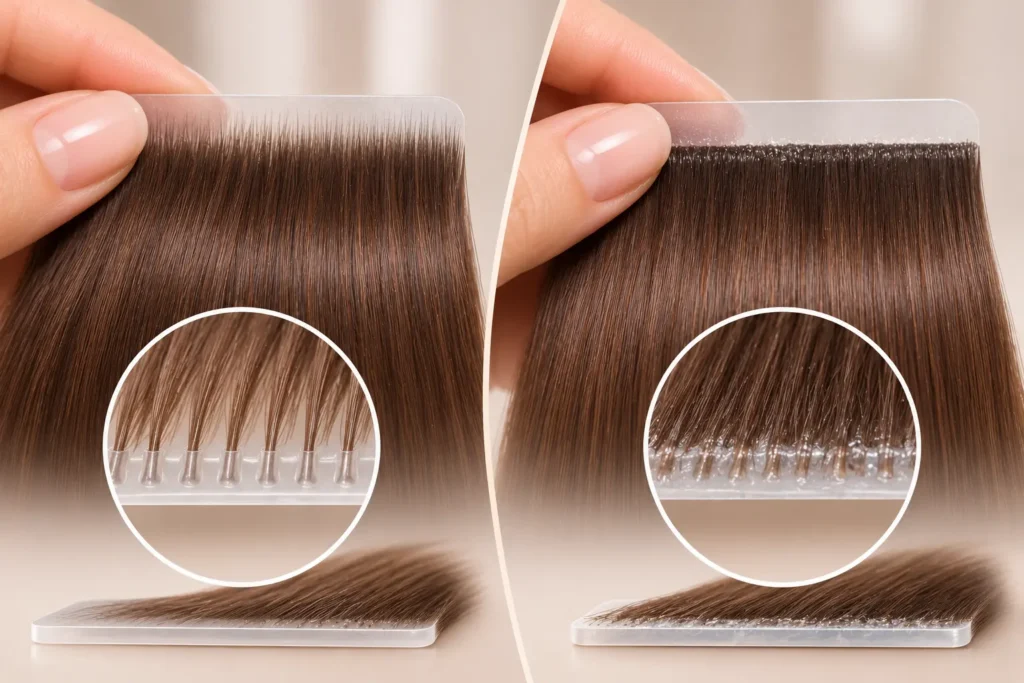
Genius Wefts are a type of hair-extension weft usually marketed for a fine, low-bulk seam. However, the term is not a universal technical specification[^1]. Each supplier may use different construction methods, materials, sizes, and cutting rules, so buyers should confirm the exact product details before purchase or installation.
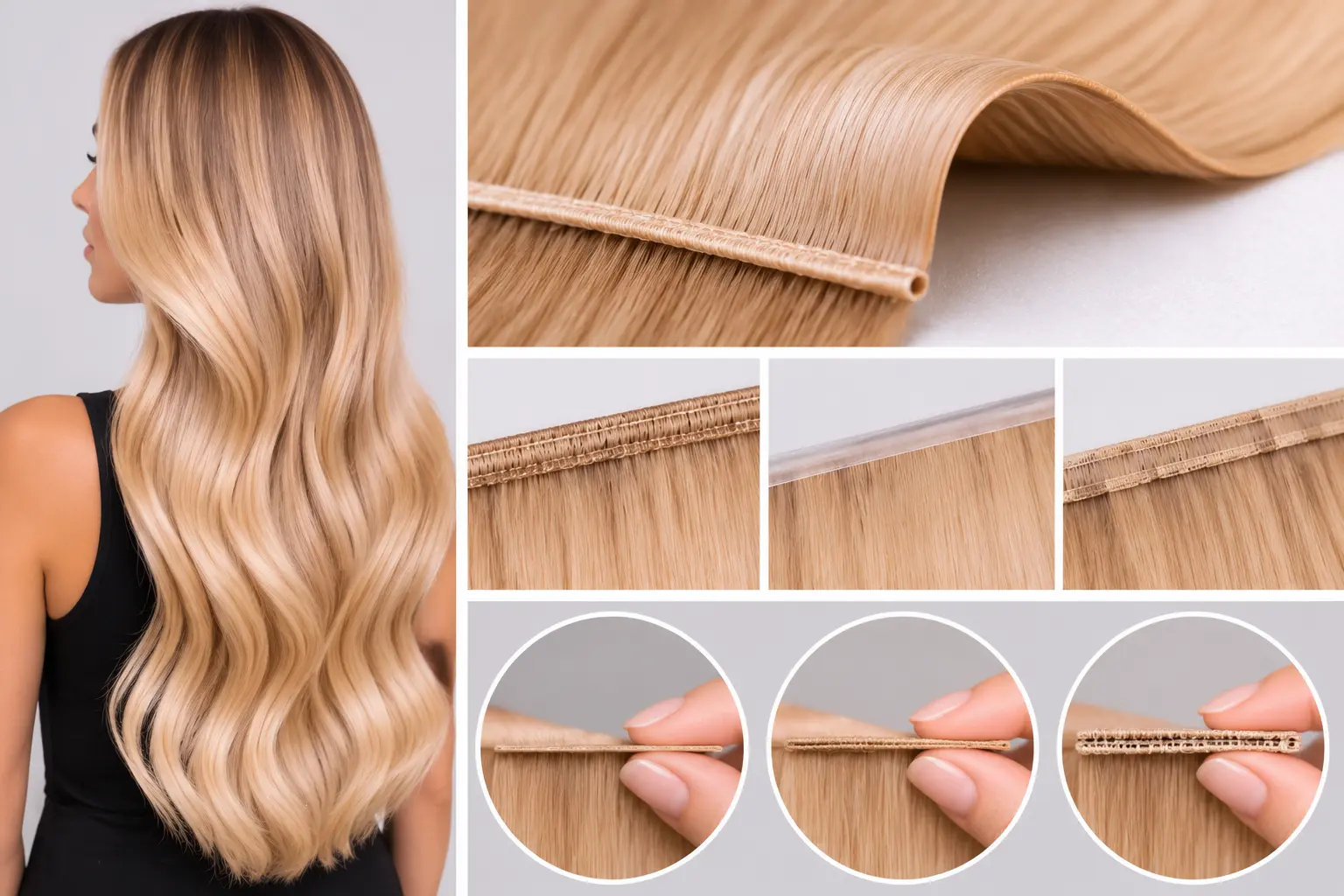
I often see buyers treat names like “Genius,” “hybrid,” “micro-thin,” and “hand-tied” as if they mean the same thing. They do not. In this guide, I break down how I evaluate Genius Wefts for B2B sourcing, salon use, and wholesale product planning.
What Is a Genius Weft?
Genius Wefts sound simple, but the market language can create problems. A buyer may expect one exact seam structure, while a supplier may use the name for a different style of thin weft. That mismatch can affect installation, packaging, returns, and customer satisfaction.
A Genius weft is a hair-extension weft with hair secured along a continuous seam, often promoted as fine, flexible, and low bulk. Some suppliers describe it as a hybrid between machine wefts and hand-tied wefts, but buyers should verify the real construction, dimensions, and fitting instructions for the exact model.
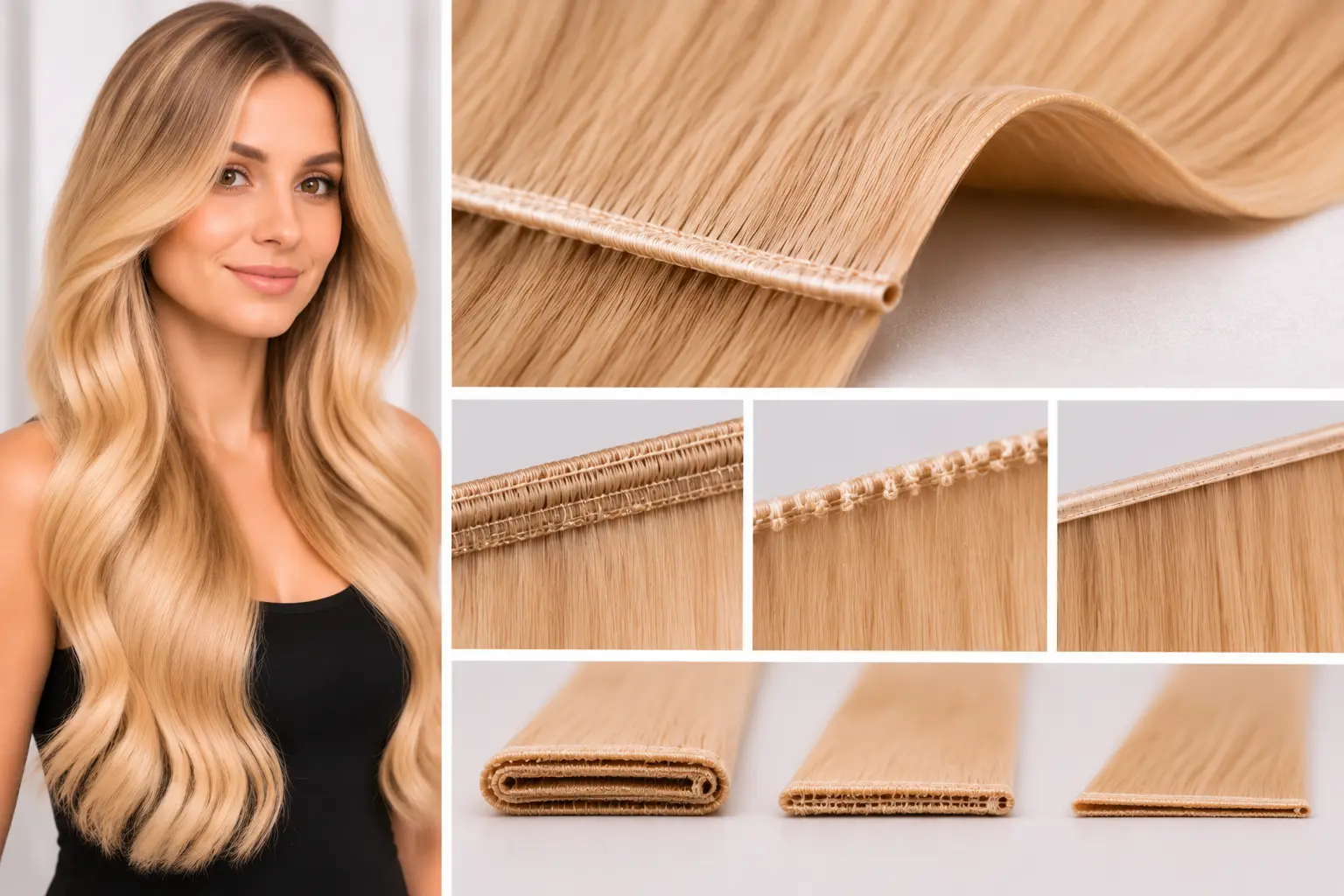
How I Understand the Term
In practical sourcing, I treat Genius Wefts as a commercial product category, not a fixed global standard. The word “Genius” usually points to a slimmer weft seam designed to sit flatter against the head. However, I never assume that two suppliers make it the same way.
A traditional machine weft is usually made with a stronger, thicker stitched seam. It can often be cut more easily, depending on the construction. A hand-tied weft is usually finer and lighter, but it often has stricter cutting limits because cutting may cause shedding or unraveling. A Genius weft is often positioned between these two styles, but the details depend on the supplier.
For Renai Hair’s commercial product information, buyers can visit the Genius Weft hair extensions page and review the exact product details with our sales team.
What the Name Does Not Prove
The name alone does not prove:
- The weft is always thinner than every hand-tied weft.
- The seam can be cut anywhere.
- The product has one fixed resin or thread structure.
- The product will suit every client’s scalp or hair density.
- The service life will be the same across all colors and lengths.
I prefer to ask for measurable information. A good supplier should be able to discuss the seam height, seam thickness, usable weft width, net weight, pieces per pack, and cutting instructions. A close-up photo with a scale is also more useful than a broad claim such as “invisible” or “ultra-thin.”
My sourcing rule is simple: I do not buy a label. I buy a confirmed specification.
For B2B buyers, this matters because your customers may compare products side by side. If your product page says “Genius Wefts,” but your packs differ in width, weight, or cutting behavior from a previous supplier, your salon clients will notice quickly.
How Should Buyers Compare Genius Wefts, Hand-Tied Wefts, and Machine Wefts?
Genius Wefts, hand-tied wefts, and machine wefts are often compared by marketing claims instead of measurable details. That creates risk for wholesalers and salons. A thin seam may help comfort, but it does not automatically prove strength, suitability, or long service life.[^2]
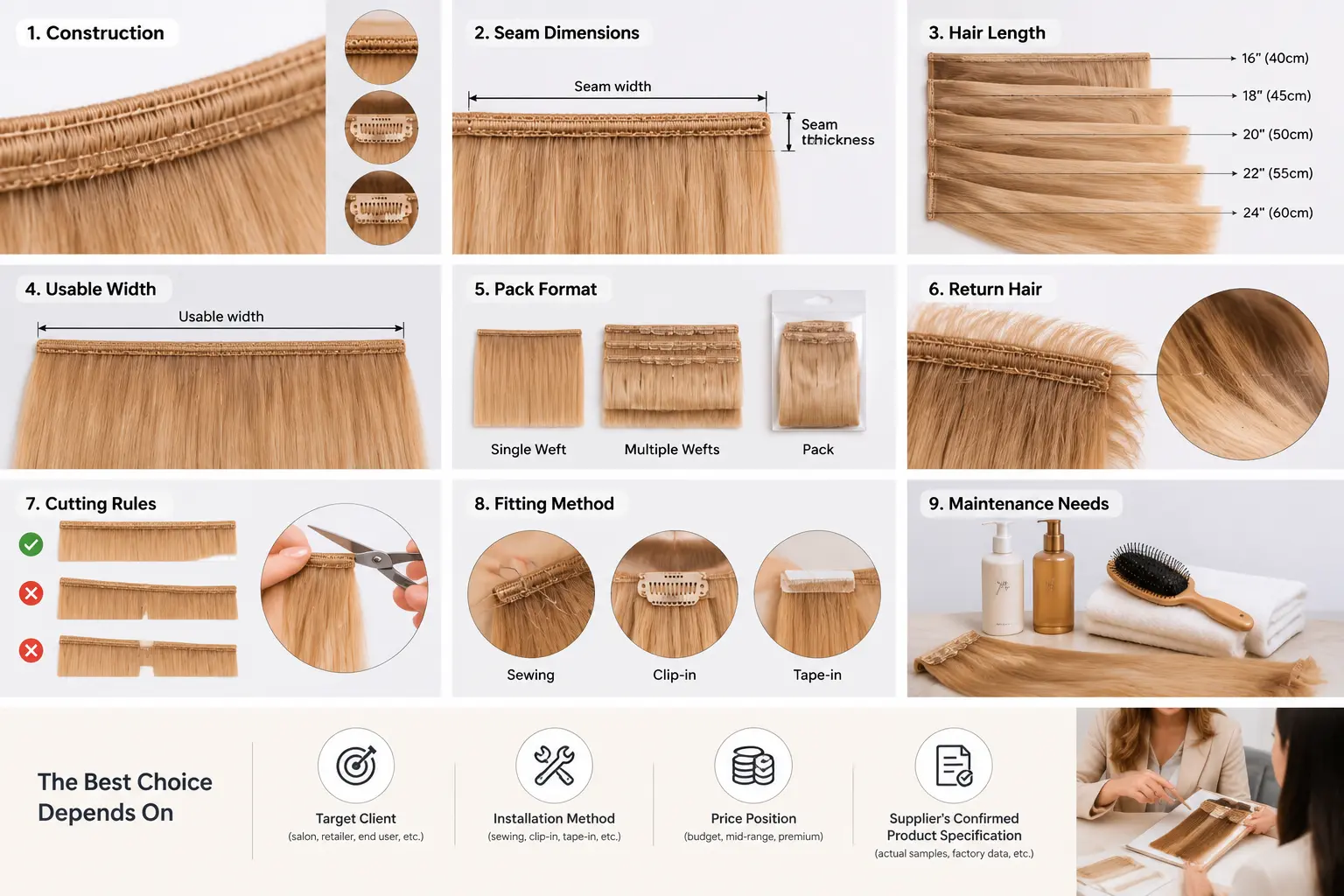
Buyers should compare wefts by construction, seam dimensions, hair length, usable width, pack format, return hair, cutting rules, fitting method, and maintenance needs. The best choice depends on the target client, installation method, price position, and the supplier’s confirmed product specification.
Key Details to Compare
The best comparison starts with facts. I usually create a simple sourcing sheet before I approve a weft supplier or add a new SKU to a product line.
| Detail to Compare | What to Check |
|---|---|
| Seam construction | How the seam is formed, which materials are used, and whether there are fitting or cutting restrictions. |
| Seam dimensions | Height and thickness measured consistently. A close-up photo with a scale is more useful than a claim like “invisible.” |
| Hair length and weft width | Hair length is different from the usable width of the weft. Confirm both before building price lists. |
| Pack format | Net weight, pieces per pack, and width per piece. Pack weight alone does not describe the layout. |
| Return hair | Whether short return hairs are present and how the seam should be positioned during fitting. |
| Fitting and maintenance | Approved attachment method, care instructions, and professional maintenance requirements. |
Comparison by Procurement Use
Different customers need different weft formats. A beauty supply distributor may want a durable, easy-to-explain product. A high-end salon may prefer a slimmer seam for premium installations. A hair extension brand may need a balanced product that supports attractive packaging and consistent reorder specifications.
| Weft Type | Common Strength | Common Limitation | Best Buyer Check |
|---|---|---|---|
| Genius Wefts | Fine seam, flexible positioning, premium market appeal | Not standardized across suppliers | Confirm cutting rules and seam dimensions |
| Hand-Tied Wefts | Very fine and lightweight appearance | Often limited cutting flexibility | Confirm piece width and installation restrictions |
| Machine Wefts | Strong seam and familiar structure | Can be bulkier than finer wefts | Confirm seam thickness and comfort expectations |
Why Pack Format Matters
I have seen buyers compare two 100g packs and assume they are equal. They are not always equal. One pack may contain longer weft pieces, while another may contain more shorter pieces. One may have a thicker seam, while another may distribute hair differently. Both may weigh 100g, but the installation experience can be very different.
For example, a buyer should confirm:
- Net hair weight per pack
- Number of weft pieces
- Width per piece
- Total usable width
- Hair length
- Color blend or single-color reference
- Root, balayage, ombre, or piano color processing
- Packaging style for wholesale or retail
Comfort and suitability depend on the selected product, placement, and the wearer’s circumstances. A thin seam alone does not establish that an extension is suitable for every client. Professional installers should evaluate the client’s natural hair density, scalp condition, lifestyle, and maintenance habits before fitting.[^3]
For B2B procurement, I also recommend checking whether the supplier can maintain the same pack layout across repeat orders. Consistency helps brands reduce complaints and helps salons plan installations more accurately.
Can Genius Wefts Be Cut?
Genius Wefts are often promoted as flexible, but cutting rules should never be assumed. Some suppliers allow cutting with product-specific limits. Other suppliers may use a construction that requires sealing, edge treatment, or minimum piece widths to reduce shedding risk.
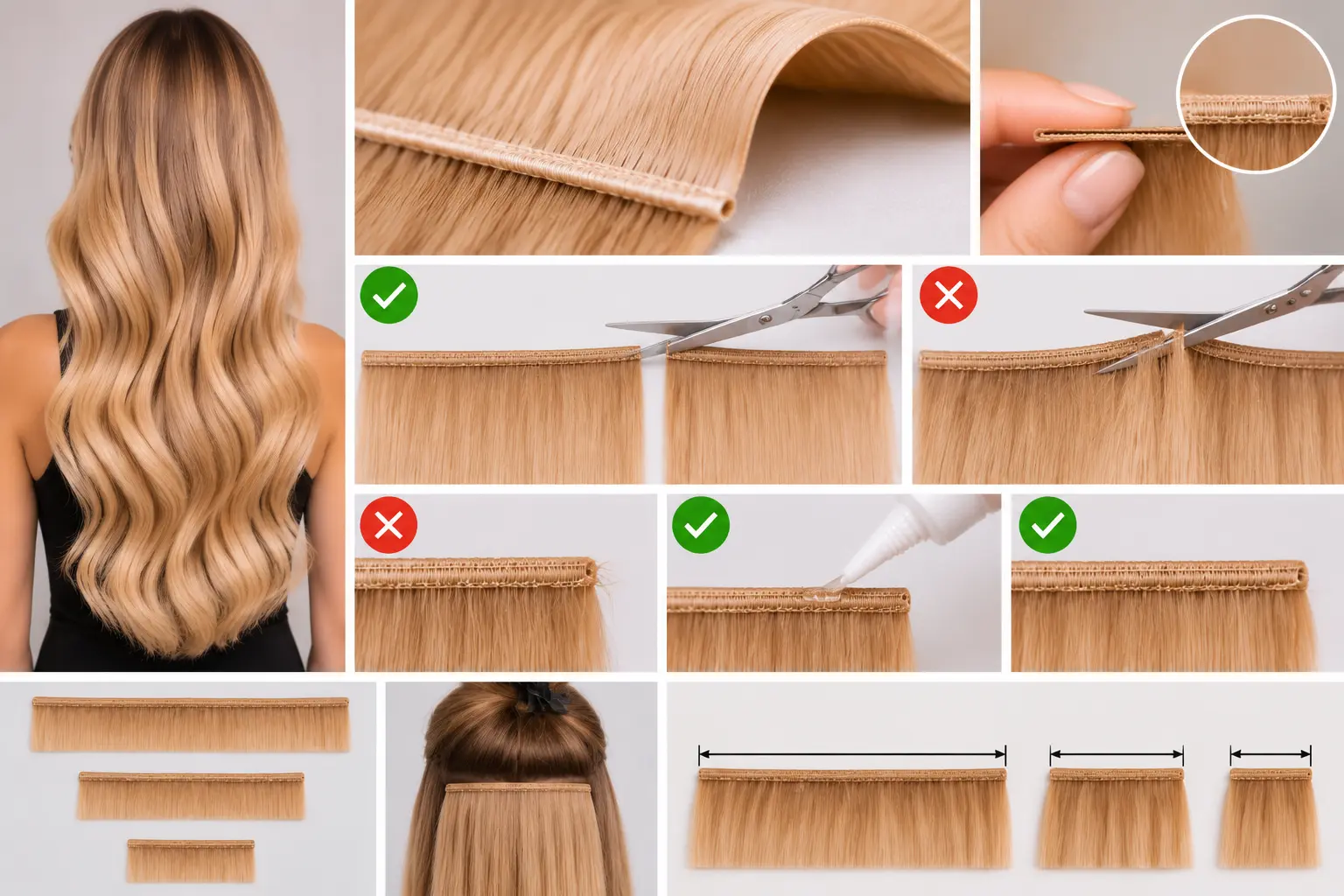
Some Genius Wefts can be cut, but only according to the instructions for the exact product model. Buyers should confirm permitted cutting positions, minimum piece width, sealing or edge-treatment requirements, and installation guidance before fitting. One supplier’s cutting rule should not be applied to another supplier’s product.
Why Cutting Rules Differ
Cutting behavior depends on how the seam is made. If the seam uses a certain stitching pattern, adhesive support, or reinforced edge, cutting may be easier. If the seam depends on continuous thread tension or a delicate tied structure, cutting may cause shedding or seam failure.[^4]
This is why I do not rely on general phrases like:
- “Cut anywhere”
- “No shedding”
- “Works like hand-tied”
- “Works like machine weft”
- “One weft fits all installations”
These phrases are not enough for professional procurement. A supplier should provide clear instructions for the exact model.
Questions to Ask Before Cutting
Before a salon or brand approves a Genius weft for sale, I recommend asking:
- Can this exact model be cut?
- Where can it be cut?
- Is there a minimum piece width?
- Does the cut edge need glue, stitching, or heat sealing?
- Will cutting affect the return policy or warranty terms?
- Which installation methods are approved?
- Are there photos or videos showing the correct cutting process?
For wholesale buyers, this information should be turned into simple customer-facing instructions. If stylists misunderstand the product, the brand may receive complaints that are really caused by incorrect handling.
Installer Responsibility
Professional fitting is important. A qualified extension professional should confirm the client’s natural hair condition, scalp sensitivity, intended placement, and maintenance schedule. The installer should also use the care instructions for the selected product and attachment method.
I always tell buyers to separate product quality from installation suitability. A weft can be well made, but still unsuitable for a client with fragile hair, scalp problems, or poor maintenance habits. That is not a failure of the weft type. It is a fitting decision.
For Renai Hair customers, I recommend confirming the orderable model and requesting the current product instructions before sampling. This is especially important when a buyer is building a private-label line and needs stable after-sales guidance for salon clients.
Are All Genius Wefts Made in the Same Way?
Genius Wefts are not made in one universal way. The same name can appear on products with different seam structures, hair grades, dimensions, and processing methods.[^5] That creates confusion when buyers compare samples from different factories or read competitor descriptions online.
No, all Genius Wefts are not made in the same way. The name does not guarantee one construction, resin formulation, production sequence, cutting rule, or performance level. Buyers should request model-specific specifications, sample evidence, and product instructions from each supplier before making sourcing decisions.
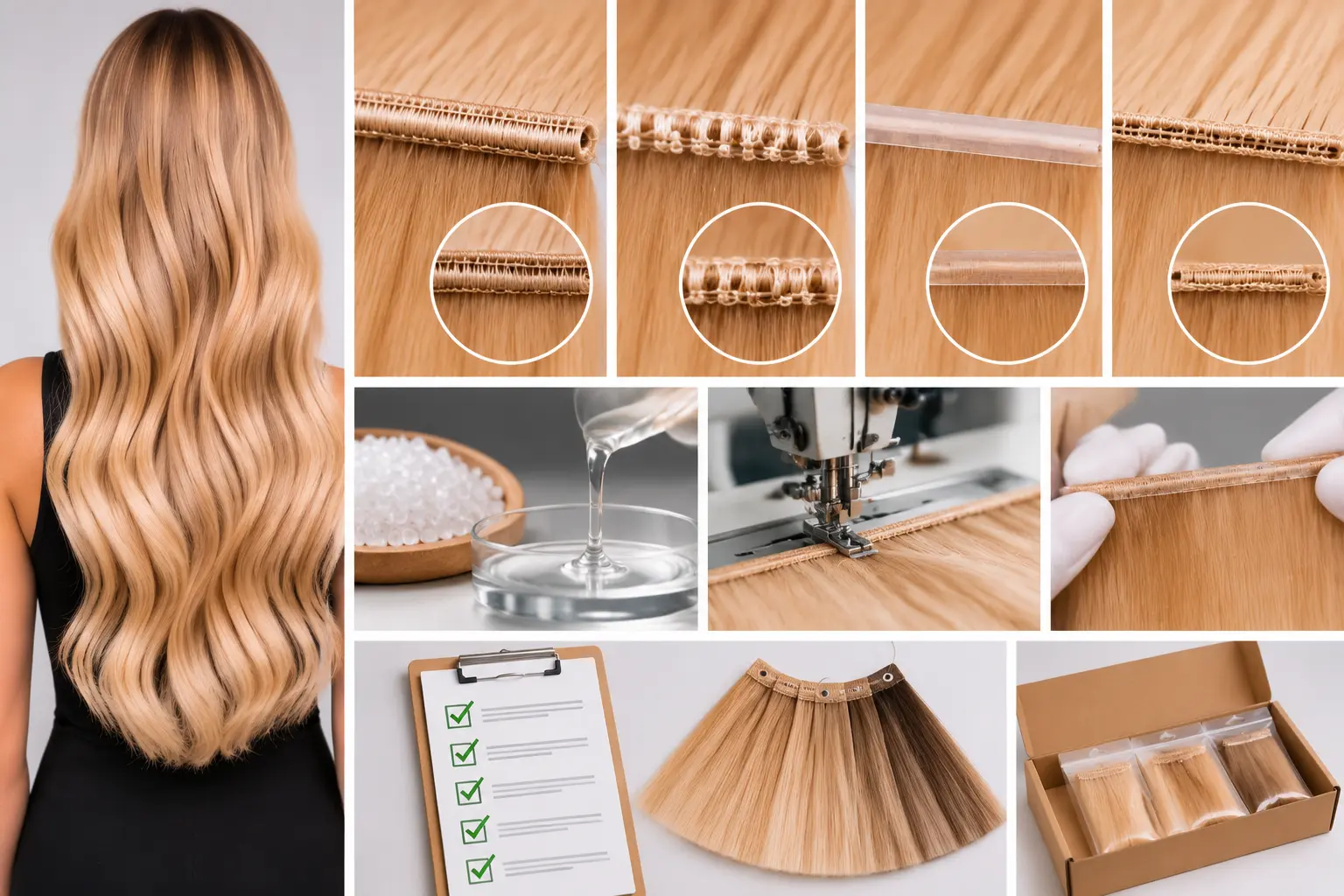
What Buyers Should Not Infer from the Name
A marketing name does not prove the production method. A version number does not prove the product is better. A generic factory story does not replace a specification. Buyers need documents, samples, and repeat-order consistency.
When I evaluate Genius Wefts, I look beyond the label and check these points:
- Hair material: 100% Human Hair, Remy Hair, or Cuticle Intact Hair, depending on the supplier’s claim.
- Hair direction: Whether cuticles are aligned and how the supplier verifies this.
- Color processing: Natural color, single process, bleach level, toner use, fashion colors, or mixed colors.
- Shedding performance: Testing method and realistic expectations.
- Tangling behavior: Especially after washing, coloring, or heat styling.
- Seam consistency: Thickness, flexibility, and edge quality across multiple pieces.
- Length accuracy: How the supplier measures hair length and handles tolerance.
- Weight tolerance: Whether the net weight is stable across packs.
- Packaging accuracy: Color labels, length labels, barcode needs, and private-label requirements.
Why Color Processing Matters
A blonde Genius weft and a dark natural-color Genius weft may not behave the same way. Light colors often require stronger processing. That can affect softness, moisture retention, and service life.[^6] This does not mean light colors are bad. It means buyers should set realistic expectations and verify the supplier’s processing quality.
For example, a B2B buyer may ask:
| Product Factor | Why It Matters |
|---|---|
| Bleached blonde shades | Higher processing may require more careful maintenance guidance. |
| Ombre and balayage colors | Color placement must stay consistent across repeat orders. |
| Piano colors | Blend ratio and strand distribution should match approved samples. |
| Rooted colors | Root length and transition softness should be specified. |
| Fashion colors | Colorfastness and aftercare instructions need extra attention.[^7] |
Evidence Buyers Can Request
A responsible supplier should be able to support product claims with practical evidence. This does not always mean a long technical report, but it should include enough detail for commercial evaluation.
Useful evidence includes:
- Product specification sheet
- Seam close-up photos with scale
- Pack layout photos
- Sample order records
- Color ring or color chart
- Hair care instructions
- Cutting and fitting guidance
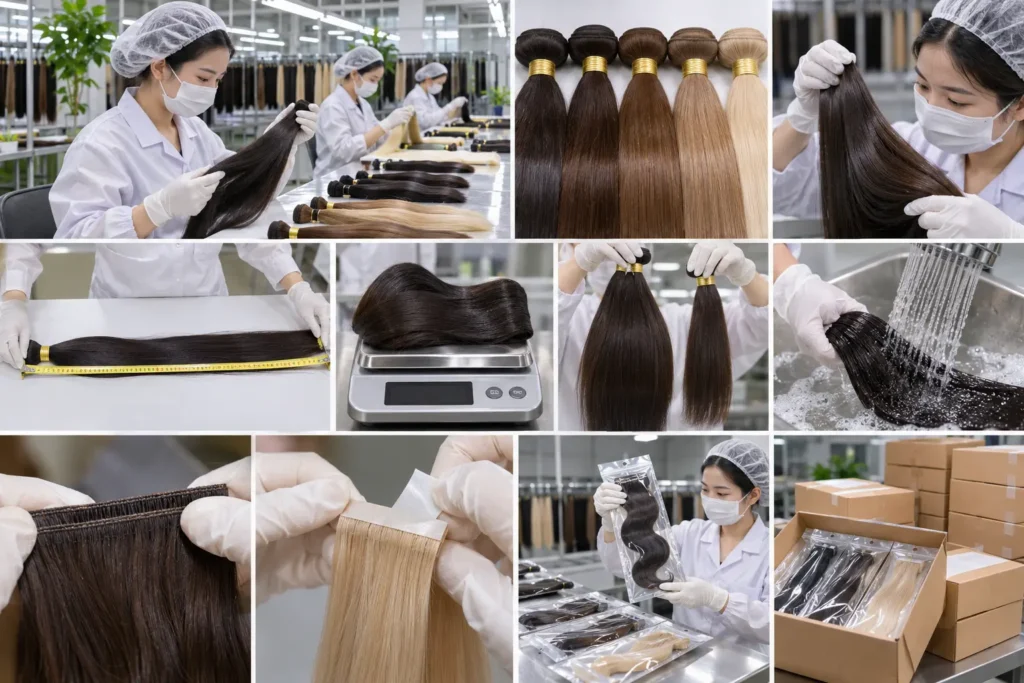
- Quality inspection process
- Packaging proof before bulk shipment
At Renai Hair, our business context is manufacturing and global supply of human hair extension products. Buyers should still verify the exact model, sample quality, and order terms before purchase. Certifications, claims, and product descriptions should be reviewed as procurement documents, not treated as assumptions.
What Should Buyers Confirm Before Choosing Genius Wefts?
Genius Wefts can be a strong product option for brands, wholesalers, and salons, but the selection process should be structured. Without clear confirmation, a buyer may approve a sample that does not match the final bulk order or does not fit the target market.
Before choosing Genius Wefts, buyers should confirm the orderable model, hair material, color processing, length, weft width, seam dimensions, net weight, pieces per pack, cutting rules, fitting instructions, care guidance, packaging requirements, and sample availability. These details reduce procurement risk and improve customer satisfaction.
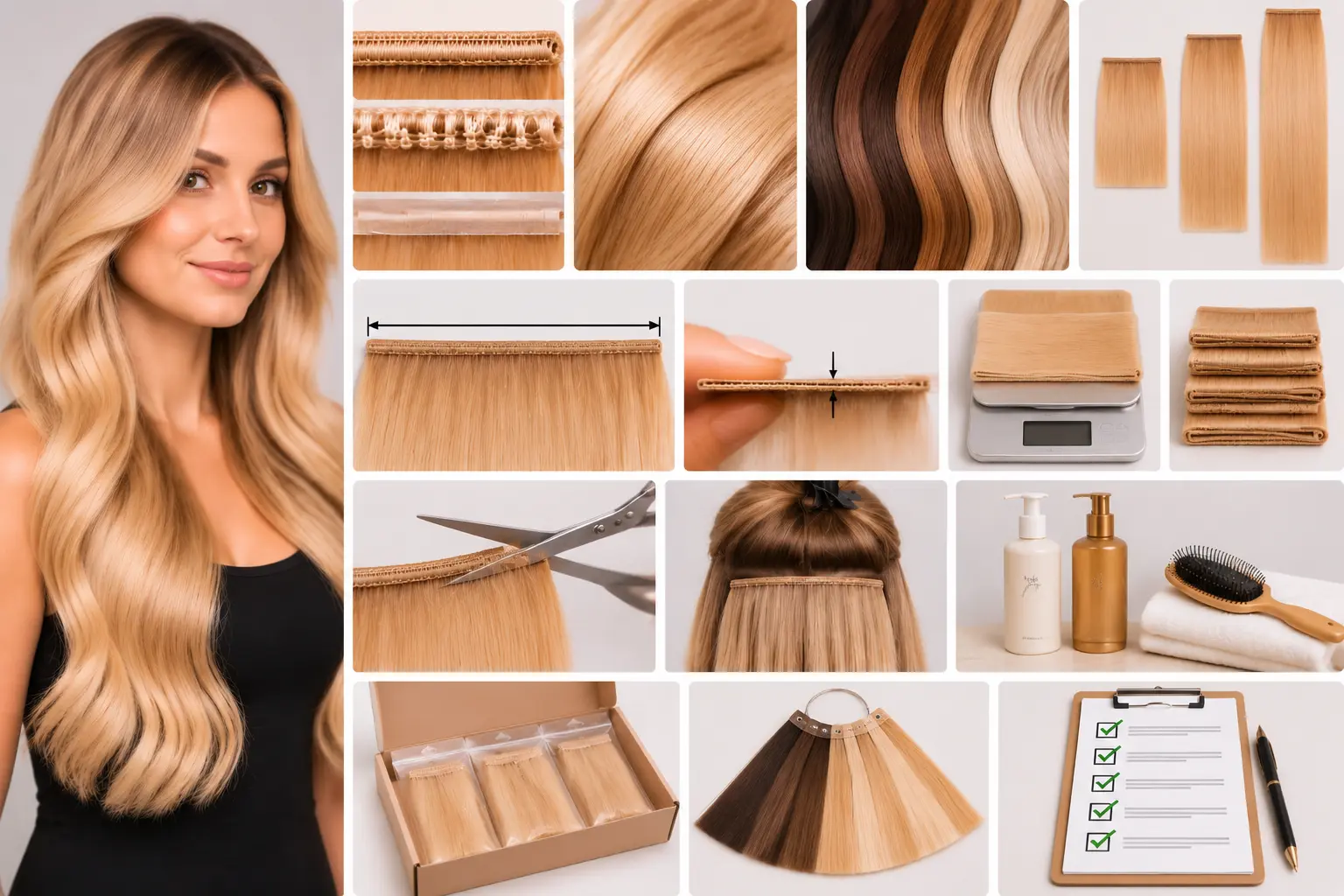
My Practical Buyer Checklist
I recommend using a checklist before placing a bulk order. This approach is simple, but it prevents many common sourcing problems.
Confirm these details:
- Orderable model name or code
- Hair material and grade claim
- Hair length
- Usable weft width
- Seam height and seam thickness
- Net weight per pack
- Pieces per pack
- Available colors and color references
- Color combinations, such as balayage, ombre, piano, or rooted
- Private-label packaging requirements
- Cutting instructions
- Fitting method
- Care and removal instructions
- Sample availability
- Bulk order lead time
- Quality inspection standard
- After-sales communication process
Sample Evaluation for B2B Buyers
A sample should answer specific sourcing questions. It should not only “look nice” in the package. When I review a sample, I check how it behaves before washing, after washing, and after light styling.[^8] I also compare the seam across different pieces in the same pack.
A basic sample check may include:
- Visual inspection under natural light
- Color match against a color ring
- Seam measurement with a ruler or caliper[^9]
- Gentle combing test
- Wash and air-dry check
- Heat styling check within recommended temperature
- Shedding observation during handling
- Tangling observation after drying
- Pack weight check
- Piece width measurement
For professional fitting, buyers should discuss the client’s hair and scalp condition, intended placement, and maintenance needs with a qualified extension professional. This is especially important for salon channels because the end result depends on both the product and the installation.
Supplier Selection Considerations
For long-term supply, product quality is only one part of the decision. A good supplier should also support communication, repeat-order stability, and packaging accuracy.
I would compare suppliers by:
| Supplier Factor | Why It Matters for Genius Wefts |
|---|---|
| Manufacturing experience[^10] | Helps maintain stable quality across batches. |
| R&D ability | Supports new colors, improved seams, and custom product development. |
| Quality control | Reduces shedding, color, weight, and packaging errors. |
| International trade experience | Supports smoother export documentation and shipment planning. |
| Sales and after-sales support | Helps buyers handle product questions from salons and distributors. |
Renai Hair focuses on 100% Human Hair, Remy Hair, and Cuticle Intact Hair products, including Genius Weft, Flex Weft, Machine Weft, Hand Tied Weft, Tape In Hair, Keratin/Prebonded Hair, Clip In Hair, Halo Hair, Ponytail, Hair Topper, and related tools. For wholesale evaluation, buyers can browse the hair weft category and compare the Genius model with other weft formats.
Where Can Buyers Compare Renai Hair’s Genius Wefts?
Genius Wefts should be compared in context, not in isolation. A buyer may need a premium thin-seam option, but another weft format may better match the salon’s installation habits, price range, or customer expectations. A full category review gives a clearer decision.
Buyers can compare Renai Hair’s Genius Wefts by reviewing the Genius Weft product information, browsing the wider hair weft category, requesting samples, and discussing model-specific details with the Renai Hair team. Buyers should confirm specifications, packaging, fitting guidance, and order terms before purchasing.
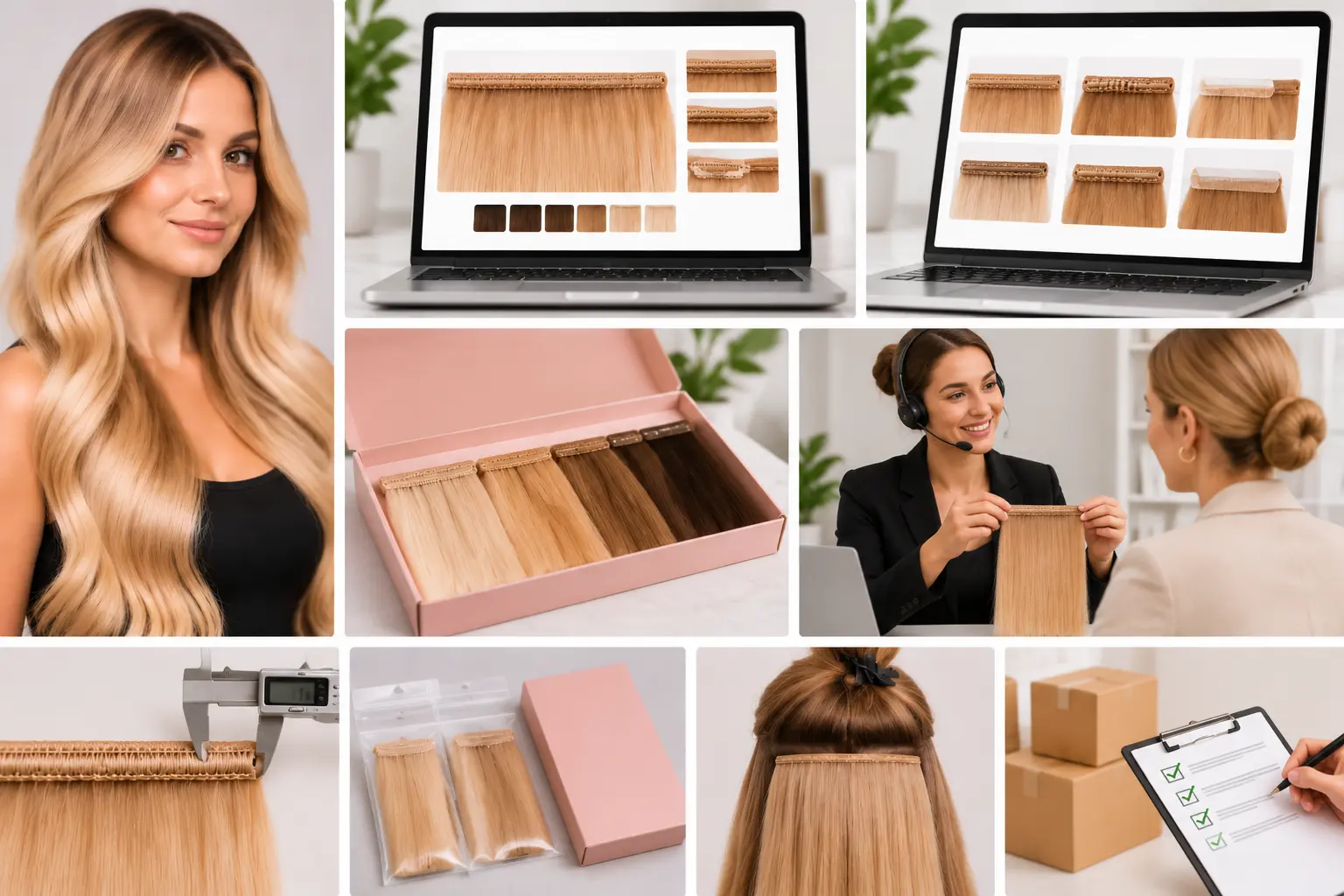
How I Would Use the Product Page
A product page is a starting point. It helps buyers understand the available model, general features, and commercial positioning. However, the final procurement decision should include direct confirmation with the supplier.
For Renai Hair’s commercial product information, visit the Genius Weft hair extensions page. If you are comparing multiple weft styles, browse the hair weft category as well. This helps you decide whether Genius Weft, Flex Weft, Machine Weft, or Hand Tied Weft better fits your target market.
What to Discuss with Renai Hair
Before a wholesale order, I would discuss:
- Target customer group
- Country or region of sale
- Preferred length range
- Color demand
- Pack weight and pack layout
- Private-label packaging
- Sample approval process
- Expected monthly or seasonal order volume
- Delivery schedule
- Inspection requirements
- After-sales questions from salons
This conversation matters because a salon-focused buyer may need different support than a beauty supply distributor. A brand owner may need stable packaging, product photography, and repeatable color references. A wholesaler may care most about stock planning, price tiers, and fast-moving colors.
Why Direct Confirmation Protects Buyers
Hair extension products involve natural material variation and processing differences.[^11] Even when the product name is the same, buyers should confirm the actual order specification. This protects both sides. The buyer gets clearer expectations, and the supplier can prepare the correct goods.
I suggest confirming final details in writing before payment or production. The confirmation should include model, length, color, quantity, pack format, packaging, shipment terms, and any special instructions. This is a basic procurement habit, but it prevents costly misunderstandings.
Frequently Asked Questions
Are Genius Wefts the same as hand-tied wefts?
No. Genius Wefts and hand-tied wefts may both be marketed as fine or low-bulk, but they are not automatically the same. Buyers should compare seam construction, cutting rules, width, weight, and installation instructions instead of treating the names as interchangeable specifications.
Are Genius Wefts better than machine wefts?
Genius Wefts are not always “better” than machine wefts. They may offer a slimmer seam and premium feel, while machine wefts may offer familiar handling and strong structure. The better choice depends on the client, installation method, budget, and confirmed product specification.
Can salons cut Genius Wefts during installation?
Some salons can cut certain Genius Wefts, but only if the supplier allows it for that exact model. The installer should confirm cutting position, minimum width, and edge treatment before fitting. A general “cut anywhere” claim should not replace product-specific instructions.
What should wholesale buyers ask before ordering Genius Wefts?
Wholesale buyers should ask for seam dimensions, hair length, usable weft width, net weight, pieces per pack, color references, cutting instructions, care guidance, packaging options, sample availability, and bulk order terms. These details help reduce disputes and improve repeat-order consistency.
Do Genius Wefts last longer than other wefts?
A weft type alone does not guarantee longer service life. Longevity depends on hair material, processing, seam quality, installation, care routine, and wearer habits. Buyers should request product evidence, test samples, and provide correct maintenance guidance to salon or retail customers.
Conclusion
Genius Wefts are best understood as a fine, low-bulk hair weft category, not as one universal specification. Buyers should confirm the exact construction, seam dimensions, pack format, cutting rules, fitting method, and care instructions before making procurement decisions. For B2B sourcing, samples and written specifications are essential. If you are evaluating Genius Wefts for wholesale, private label, or salon supply, contact Renai Hair to compare models, request samples, and confirm the right product plan for your market.
[^1]: "Genius Weft vs. Hand-Tied vs. Machine Weft", https://www.verahairco.com/blogs/the-journal/genius-weft-comparison. A standards or educational reference on hair-extension terminology supports the contextual point that commercial weft names are not necessarily formal technical specifications; this does not prove how any individual supplier constructs a product labeled “Genius Weft.” Evidence role: definition; source type: institution. Supports: A neutral standards or educational source should support that hair-extension weft terminology is descriptive and that “Genius Weft” is not a formally defined universal specification.. Scope note: Contextual support only, because absence of a universal standard is harder to prove than the existence of a defined standard. [^2]: "Effects of excessive bleaching on hair: comparative analysis of ...", https://pmc.ncbi.nlm.nih.gov/articles/PMC11652465/. Published research on hair damage and extension-related scalp risk supports that comfort and longevity depend on material condition, processing, attachment method, maintenance, and user factors, not on seam thickness alone. Evidence role: general_support; source type: paper. Supports: A dermatology or materials-science paper should support that hair-extension outcomes depend on construction, hair condition, installation tension, maintenance, and wearer factors rather than seam thickness alone.. Scope note: General support, because available research may address hair damage or extension risks broadly rather than Genius Wefts specifically. [^3]: "Traction alopecia: the root of the problem - PMC - NIH", https://pmc.ncbi.nlm.nih.gov/articles/PMC5896661/. Dermatology guidance on traction alopecia and hair-extension use supports pre-fitting assessment of hair density, scalp condition, styling habits, and maintenance ability to reduce avoidable hair and scalp stress. Evidence role: expert_consensus; source type: institution. Supports: The source should support that extension use can affect scalp and hair health and that assessment of hair condition, tension, and maintenance is appropriate before fitting.. [^4]: "How to prevent weave from unraveling when cutting", https://www.facebook.com/groups/151314337083952/posts/1265836622298379/. Textile-engineering literature on seam integrity supports the mechanism that cutting a stitched or bonded seam can interrupt structural continuity and increase fraying or failure risk; this provides contextual support for hair-extension wefts rather than product-specific proof. Evidence role: mechanism; source type: research. Supports: The source should explain that cutting stitched, bonded, or woven seam structures can interrupt load-bearing threads or adhesive areas and lead to fraying or failure.. Scope note: Contextual support, because textile seam mechanics are analogous to but not identical with every hair-extension weft design. [^5]: "Threading Your Way Through the Labeling Requirements ...", https://www.ftc.gov/business-guidance/resources/threading-your-way-through-labeling-requirements-under-textile-wool-acts. Consumer-product labeling guidance supports the general point that marketing names do not necessarily disclose complete material composition, construction, dimensions, or processing history; it does not verify differences among specific Genius Weft suppliers. Evidence role: general_support; source type: government. Supports: The source should support that product labels and marketing terms do not by themselves disclose all material, construction, or processing details.. Scope note: Contextual support, because government labeling guidance may not address the exact term “Genius Weft.” [^6]: "What is coral bleaching?", https://oceanservice.noaa.gov/facts/coral_bleach.html. Cosmetic-science studies of oxidative bleaching support that lightening processes can alter the hair cuticle and cortex, affecting moisture behavior, tactile feel, and fiber strength, which are relevant to extension service life. Evidence role: mechanism; source type: paper. Supports: A paper should show that bleaching or oxidative lightening damages hair fibers and can reduce moisture retention, surface smoothness, or mechanical strength.. [^7]: "Protection of oxidative hair color fading from shampoo ...", https://pubmed.ncbi.nlm.nih.gov/19450422/. Research and test-method literature on dyed fibers and hair-color fading supports the need to evaluate colorfastness and provide aftercare guidance for fashion-colored hair products; this is contextual rather than a test of a specific extension line. Evidence role: mechanism; source type: research. Supports: The source should support that dyed fibers can lose color through washing, friction, light exposure, or heat and that colorfastness testing is used to evaluate this behavior.. Scope note: Contextual support, because colorfastness varies by dye system, processing method, and aftercare routine. [^8]: "Hair Shaft Damage from Heat and Drying Time of Hair Dryer", https://pmc.ncbi.nlm.nih.gov/articles/PMC3229938/. Studies on hair weathering and thermal styling damage support evaluating hair products before and after washing and light styling, because these common exposures can alter fiber surface condition, tangling, and breakage behavior. Evidence role: mechanism; source type: paper. Supports: A paper should support that washing, combing, drying, and heat styling can affect hair fibers, making before-and-after sample checks meaningful.. [^9]: "Dimensional metrology", https://www.nist.gov/dimensional-metrology. Metrology guidance on dimensional inspection supports the use of rulers or calipers to verify physical dimensions against product specifications; it does not establish any particular acceptable seam thickness for hair extensions. Evidence role: general_support; source type: government. Supports: The source should support that calipers and rulers are standard tools for dimensional inspection and verification against specifications.. Scope note: Contextual support, because metrology sources support the measurement practice rather than hair-extension performance. [^10]: "Process Validation: General Principles and Practices", https://www.fda.gov/files/drugs/published/Process-Validation--General-Principles-and-Practices.pdf. Quality-management guidance, including process-control principles, supports the general claim that manufacturing capability and documented experience can improve batch-to-batch consistency; it does not prove that any named supplier achieves such consistency. Evidence role: general_support; source type: institution. Supports: The source should support that established process control, documented procedures, and manufacturing capability contribute to consistent batch quality.. Scope note: Contextual support, because quality-management principles do not verify a specific supplier’s performance. [^11]: "On Hair Care Physicochemistry: From Structure and ... - PMC", https://pmc.ncbi.nlm.nih.gov/articles/PMC9921463/. Hair-science literature documents natural variation in human hair fiber properties and shows that chemical processing can alter surface and mechanical characteristics, supporting the need to confirm actual extension specifications. Evidence role: general_support; source type: paper. Supports: A paper should support that human hair varies in physical properties and that processing such as bleaching, dyeing, and heat treatment can change fiber characteristics..